논문 해설
Reinforcement Learning and Control of a Lower Extremity Exoskeleton for Squat Assistance
스쿼트 보조를 위한 하지 외골격의 강화학습 및 제어
- 연구 문제 기존 외골격 제어는 큰 외란과 인간 상호작용 힘에 대해 강인성이 부족하며, 발바닥 CoP를 활용한 RL 기반 스쿼트 제어는 연구되지 않았습니다.
- 연구 방법 CoP 이력을 상태에 넣고 CoP 보상을 추가한 MLP 정책을 PPO로 학습하며, 동역학 무작위화와 무작위 외란을 적용합니다.
- 주요 결과 시뮬레이션에서 무외란, 무작위 외란, 인간 상호작용 조건의 스쿼트가 CoP 안정 영역 안에서 수행되었고, 분포 외 200개 환경에서도 발 추적 보상이 높게 유지되었다고 보고됩니다.
발목 자유도와 CoP 기반 균형 제어의 필요성
재활 외골격은 환자가 캔이나 목발 없이 스쿼트를 수행하려면 외란과 인간-외골격 상호작용 힘에도 흔들리지 않는 균형 제어가 필요합니다. 기존 궤적 추종 제어는 규칙적인 동작에는 적용하기 쉽지만 큰 외란에 대한 강인성이 충분하지 않다고 원문은 짚고 있습니다. 모델 기반 예측 제어와 운동량 기반 제어도 모델 부정확성이나 과제별 튜닝의 부담이 있습니다. 이 논문은 이러한 한계를 두고, 발바닥 힘 센서로 CoP를 직접 얻을 수 있는 외골격에서 강화학습 제어기가 스쿼트 균형을 유지할 수 있는지를 다룹니다. 외골격은 엉덩이·무릎 각 1 자유도와 발목 2 자유도를 갖고, 각 발에는 힘 센서 4개가 있습니다.
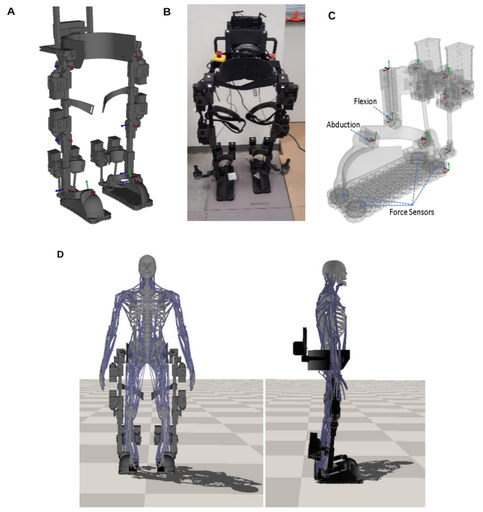
Figure 1 : The lower extremity exoskeleton and integrated human-exoskeleton model. (A) the physical prototype of the exoskeleton. (B) its multibody dynamics model. (C) the foot model with force sensors locations and the two independent ankle DoFs indicated. The joint axes of the model are displayed as well. (D) Integrated human and lower extremity exoskeleton model.
원문 · CC BY 4.0 · Luo, S., Androwis, G., Adamovich, S., Su, H., Zhou, X. · Reinforcement Learning and Control of a Lower Extremity Exoskeleton for Squat Assistance · 원문 그림 인용 · 원본 PDF 5쪽에서 그림 영역을 추출했습니다.모방 학습과 PPO 기반 정책 학습
제어 정책은 세 개의 완전연결층과 ReLU로 구성된 MLP이며, 은닉층 크기는 256, 256, 128입니다. 입력 상태에는 관절 위치와 속도의 이력, 행동 이력, 미래 여섯 시점의 목표 관절 자세와 CoP 이력이 포함됩니다. 정책은 관절 목표 위치를 출력하고, 이 값은 PD 제어를 거쳐 토크 명령으로 변환되며 토크 한계로 제한됩니다. 학습에는 PPO가 사용됩니다. PPO는 확률비 r_t(θ)와 클리핑된 대리 목적함수로 정책이 한 번에 크게 바뀌지 않도록 제한하며, 정책 경사 계열에 속합니다. 보상은 관절 자세, 속도, 끝점, 루트, 질량중심, CoP, 토크 항의 가중합으로 구성되며, CoP 보상은 발 중심의 7 cm × 11 cm 직사각형 안정 영역 안에 있을 때만 값을 갖습니다.
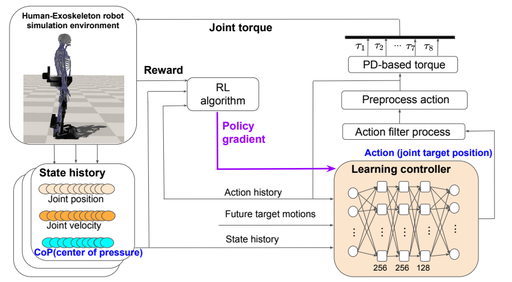
Figure 2 : The overall learning process of the integrated robust motion controller. We construct the learning controller as a Multi-Layer Perception (MLP) neural network that consists of three hidden layers. The neural network parameters are updated using the policy gradient method. The network produces joint target positions, which are translated into torque-level commands by PD (Proportional Derivative) control.
원문 · CC BY 4.0 · Luo, S., Androwis, G., Adamovich, S., Su, H., Zhou, X. · Reinforcement Learning and Control of a Lower Extremity Exoskeleton for Squat Assistance · 원문 그림 인용 · 원본 PDF 6쪽에서 그림 영역을 추출했습니다.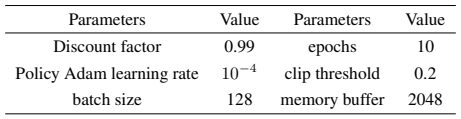
Table 1 : Hyper-parameters settings for training
원문 · CC BY 4.0 · Luo, S., Androwis, G., Adamovich, S., Su, H., Zhou, X. · Reinforcement Learning and Control of a Lower Extremity Exoskeleton for Squat Assistance · 원문 그림 인용 · 원본 PDF 9쪽에서 그림 영역을 추출했습니다.동역학 무작위화와 외란 학습
시뮬레이션과 실제 환경의 차이를 줄이기 위해 학습 중 각 에피소드마다 동역학 파라미터를 균일분포에서 샘플링하는 동역학 무작위화를 사용합니다. 원문은 이 방식이 sim-to-real 간극에 대한 강인성을 높이기 위한 것으로 설명합니다. 사례 2에서는 골반에 0에서 200N, 대퇴와 경골에 0에서 100N의 무작위 외란을 학습 중에 적용하며, 골반 외란의 방향은 수직 방향에서 0도에서 20도 이내로 제한됩니다. 정책은 외란이 없는 조건에서 학습된 것과 달리 이 외란을 포함하여 다시 학습되었습니다.
무외란, 외란, 인간 상호작용 조건의 검증
사례 1은 외란 없이 4초 참조 스쿼트를 모방하도록 학습한 정책을 평가하며, 이때 학습보다 넓은 범위의 동역학 파라미터로 일반화 능력을 확인합니다. 원문은 첫 스쿼트 주기에서 무릎 최대 토크가 약 13.5Nm라고 보고합니다. 사례 2는 학습 중 외란을 포함한 정책을 평가하며, 학습 외란의 75% 큰 외란에서도 발 CoP가 안정 영역 안에 있었다고 보고합니다. 사례 3은 인간 근골격 모델과 스트랩 스프링을 결합하여 수동 근육 반응만 가진 인간과의 상호작용을 평가합니다. 이 경우 가장 큰 피크 토크는 발목 배측·저측굴곡에서 68Nm로 보고됩니다.
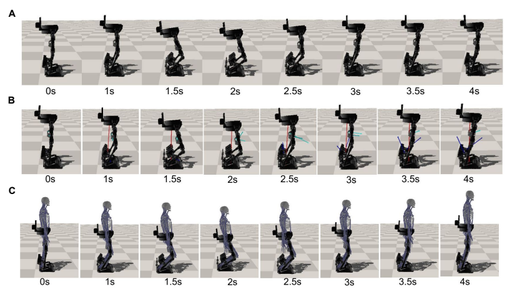
Figure 3 : Snapshots of the squatting motion of the exoskeleton. This RL-based controller enables the lower extremity exoskeleton to perform the squatting skill under a broad range of external perturbations. (A) performing the squatting skill without perturbation forces. (B) performing the squatting skill with large random perturbation forces. (Red, cyan and blue arrows show the random perturbation force applied on the hip, femur and tibia respectively.) (C) performing the squatting skill with human interaction.
원문 · CC BY 4.0 · Luo, S., Androwis, G., Adamovich, S., Su, H., Zhou, X. · Reinforcement Learning and Control of a Lower Extremity Exoskeleton for Squat Assistance · 원문 그림 인용 · 원본 PDF 10쪽에서 그림 영역을 추출했습니다.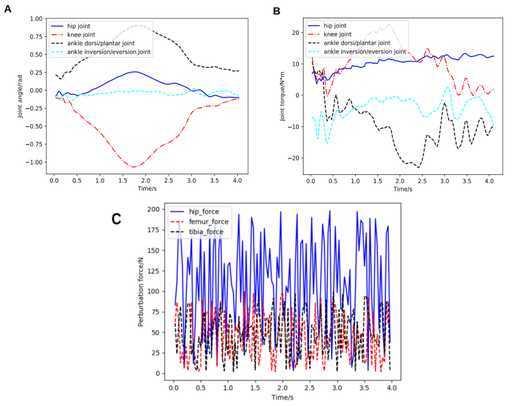
Figure 7 : Case2: joint behaviors under random perturbation forces in the first squatting cycle. (A) hip, knee, ankle dorsiflexion/plantarflexion, ankle inversion/eversion joint angles with respect to time in the first squatting cycle.(B) corresponding joint torques in the first squatting cycle. (C) magnitudes of the random perturbation forces applied on the three parts of the exoskeleton: hip, femur and tibia during testing.
원문 · CC BY 4.0 · Luo, S., Androwis, G., Adamovich, S., Su, H., Zhou, X. · Reinforcement Learning and Control of a Lower Extremity Exoskeleton for Squat Assistance · 원문 그림 인용 · 원본 PDF 12쪽에서 그림 영역을 추출했습니다.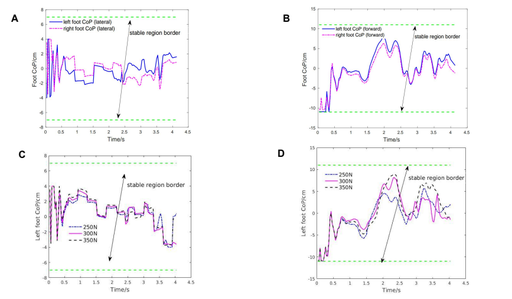
Figure 8 : Case2: foot CoP trajectories under random external perturbations in the first squatting cycle and robustness test on the foot CoP stability under 75% greater perturbation forces compared with the training setting. (A) left and right foot CoP trajectories (lateral direction). (B) left and right foot CoP trajectories (forward direction). (C) left foot CoP trajectory (lateral direction) under 75% greater perturbation forces compared with the training setting. (D) left foot CoP trajectory (forward direction) under greater perturbation forces compared with the training setting.
원문 · CC BY 4.0 · Luo, S., Androwis, G., Adamovich, S., Su, H., Zhou, X. · Reinforcement Learning and Control of a Lower Extremity Exoskeleton for Squat Assistance · 원문 그림 인용 · 원본 PDF 13쪽에서 그림 영역을 추출했습니다.분포 외 환경과 적용 범위
학습에 쓰지 않은 200개의 분포 외 시뮬레이션 환경에서 학습된 제어기를 평가했을 때 발 추적 보상은 높게 유지되었다고 원문은 보고합니다. 이 결과는 시뮬레이션 안에서 넓은 동역학 파라미터 범위를 대상으로 한 것입니다. 실제 하드웨어에서의 전이는 검증되지 않았으며, 논문은 sim-to-real 전이를 향후 과제로 제시합니다. 또한 인간 모델은 수동 근육 반응만 가지며, 능동 근육 수축을 가진 사용자는 평가하지 않았습니다.
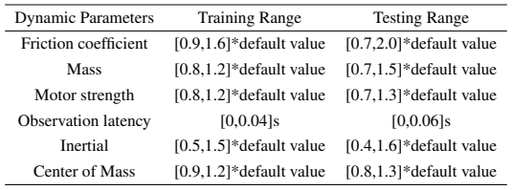
Table 2 : Dynamic parameters and their respective range of values used during training and testing. A larger range of values are used during testing to evaluate the generalization ability of control policies in dynamics uncertainties.
원문 · CC BY 4.0 · Luo, S., Androwis, G., Adamovich, S., Su, H., Zhou, X. · Reinforcement Learning and Control of a Lower Extremity Exoskeleton for Squat Assistance · 원문 그림 인용 · 원본 PDF 9쪽에서 그림 영역을 추출했습니다.논문 정보
- 저자
- Luo, S., Androwis, G., Adamovich, S., Su, H., Zhou, X.
- 학회·저널
- arXiv · 프리프린트
- 최초 공개일
- 2021년 5월 7일
- 등록일
- 2026년 11월 6일
- 수정일
- 2021년 5월 7일
- 버전
- v1
- arXiv
- 2105.03489
- 분류
- cs.RO
- 원문 이용 조건
- CC BY 4.0
- 제공 범위
- 논문 정보, 해설, 허용된 원문 그림
AI 해설은 논문 원문과 별개의 설명이며 오류가 있을 수 있습니다. 원문과 그림은 각 출처의 이용 조건과 따로 표시된 권리를 따릅니다.
초록
A significant challenge for the control of a robotic lower extremity rehabilitation exoskeleton is to ensure stability and robustness during programmed tasks or motions, which is crucial for the safety of the mobility-impaired user. Due to various levels of the user's disability, the human-exoskeleton interaction forces and external perturbations are unpredictable and could vary substantially and cause conventional motion controllers to behave unreliably or the robot to fall down. In this work, we propose a new, reinforcement learning-based, motion controller for a lower extremity rehabilitation exoskeleton, aiming to perform collaborative squatting exercises with efficiency, stability, and strong robustness. Unlike most existing rehabilitation exoskeletons, our exoskeleton has ankle actuation on both sagittal and front planes and is equipped with multiple foot force sensors to estimate center of pressure (CoP), an important indicator of system balance. This proposed motion controller takes advantage of the CoP information by incorporating it in the state input of the control policy network and adding it to the reward during the learning to maintain a well balanced system state during motions. In addition, we use dynamics randomization and adversary force perturbations including large human interaction forces during the training to further improve control robustness. To evaluate the effectiveness of the learning controller, we conduct numerical experiments with different settings to demonstrate its remarkable ability on controlling the exoskeleton to repetitively perform well balanced and robust squatting motions under strong perturbations and realistic human interaction forces.
원문 인용
Luo, S., Androwis, G., Adamovich, S., Su, H., Zhou, X. (2021). Reinforcement Learning and Control of a Lower Extremity Exoskeleton for Squat Assistance. arXiv:2105.03489v1. https://arxiv.org/abs/2105.03489v1
BibTeX
@misc{s2021reinforcement,
  title = {{Reinforcement Learning and Control of a Lower Extremity Exoskeleton for Squat Assistance}},
  author = {Luo, S. and Androwis, G. and Adamovich, S. and Su, H. and Zhou, X.},
  year = {2021},
  eprint = {2105.03489},
  archivePrefix = {arXiv},
  url = {https://arxiv.org/abs/2105.03489v1}
}