논문 해설
Applying machine learning to improve simulations of a chaotic dynamical system using empirical error correction
경험적 오차 보정을 이용해 카오스 동역학계의 시뮬레이션을 개선하는 머신러닝 적용
- 연구 문제 물리 기반 기후 모델의 오차를 머신러닝으로 줄이되, 물리 모델의 구조를 유지할 수 있는지 Lorenz '96 시스템에서 검증합니다.
- 연구 방법 물리 기반 기준 모델의 틴덴시에 신경망이 예측한 오차 보정을 더하는 방식으로, 전체 틴덴시를 신경망으로 대체하지 않습니다.
- 주요 결과 오차 보정 신경망은 단일 시간 단계 틴덴시 오차를 최대 42% 줄이고, 최적 수준에서 예측 ACC와 RMSE를 개선하며, 기후 KS 통계량을 최대 약 15% 개선합니다.
기존 기후 모델의 오차와 머신러닝 적용의 두 갈래
기후·날씨 예측 모델은 물리 법칙에 기반하지만 관측과 여전히 차이를 보입니다. 최근에는 머신러닝이 물리 모델 전체를 대체할 수 있다는 제안도 나왔으나, 이 연구는 물리 기반 모델을 유지한 채 머신러닝으로 모델의 오차를 시간 단계마다 보정하는 방식을 검토합니다. 전체 모델을 신경망으로 바꾸는 방식은 많은 학습 자료와 큰 구조가 필요하고 물리적 해석을 잃기 쉽다는 문제가 있습니다. 반면 오차 보정은 물리 모델의 기존 이해를 유지하면서 더 작은 알고리즘과 적은 학습 자료로 성능을 높일 수 있다고 논문은 제시합니다.
이 연구는 이러한 질문을 카오스 동역학계인 Lorenz '96 시스템에서 시험합니다. 질문은 오차 보정 신경망이 안정적인 모델을 만들면서 초기화된 예측 기술과 장기 기후 통계를 함께 개선할 수 있는지입니다.
오차 보정 신경망의 구조와 학습
기준 모델은 Lorenz '96 방정식에서 Y 변수를 명시적으로 계산하지 않고, 3차 다항식 U(X)로 그 영향을 매개화한 coarse-resolution 모델입니다. 이 기준 모델은 No-ANN 모델이라고 부르며, 시간 간격은 0.005 MTU로 설정됩니다.
오차 보정에서는 Truth 틴덴시와 No-ANN 틴덴시의 차이 ϵk = dXk/dt − dX*k/dt를 다층 퍼셉트론이 X 변수마다 따로 예측합니다. 예측 지점 주변 X 변수 다섯 개가 입력으로 쓰이고, 입력은 평균을 빼고 표준편차로 나누어 정규화됩니다. 실행 시에는 물리 모델의 틴덴시 M(x)에 학습된 보정 ϵ(x)를 더해 전체 틴덴시를 얻습니다. 학습에는 Adam 알고리즘을 쓴 확률적 경사 하강법이 사용되었고, truth 모델 데이터 1000 MTU가 학습 자료로 쓰였습니다. 활성화 함수는 은닉층에 정류 선형 단위, 출력층에 선형 함수를 사용했습니다.
이 구성은 보정기가 학습 중에 보는 차이만 맞추고, 기준 모델의 물리적 구조는 그대로 두는 방식입니다. 따라서 보정 신경망 자체가 전체 시스템을 새로 시뮬레이션하지는 않습니다.
틴덴시 예측 오차와 full-tendency 신경망 비교
먼저 단일 coarse 시간 단계의 틴덴시 예측 오차를 RMSE로 측정했습니다. 검증 데이터에서 오차 보정 신경망은 모든 구조에서 No-ANN 모델보다 오차를 줄였으며, 가장 큰 감소는 d3w64 구조에서 42%입니다. 구조가 커질수록 오차가 일반적으로 감소했고, 검증 RMSE는 학습 RMSE보다 3% 이상 높지 않아 뚜렷한 과적합은 확인되지 않았습니다.
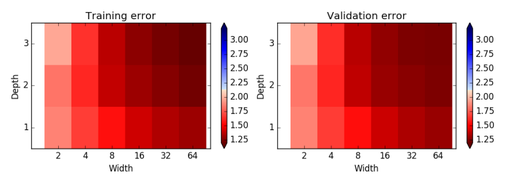
Figure 1 : The root mean square error of the tendency predictions over one coarse time step (0.005MTUs) of coarse-resolution models with error-correcting ANNs with different widths and depths evaluated on the training data (left) and validation data (right). Red indicates better performance relative to the No-ANN model and blue worse performance (with the value for the No-ANN model being the value at which the colour changes). The ANNs give robust outperformance of the No-ANN model.
원문 · CC BY 4.0 · Peter A. G. Watson · Applying machine learning to improve simulations of a chaotic dynamical system using empirical error correction · 원문 그림 인용 · 원본 PDF 16쪽에서 그림 영역을 추출했습니다.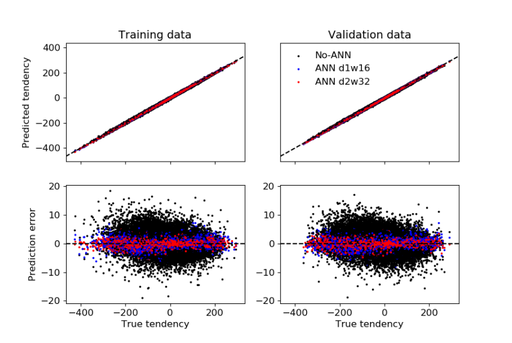
Figure 3 : The top panels show the tendencies predicted by several coarse-resolution models plotted against the true tendencies in the training dataset (top left) and validation dataset (top right). The models are the No-ANN model and the models with depth-1 width-16 and depth-2 width-32 error- correcting ANNs. The lower panels show the prediction errors plotted against the true tendencies. The dashed lines indicate the values for perfect predictions. The tendency predictions for the models using ANNs are mostly closer to the truth than the predictions from the No-ANN model, including for rare extreme values in the validation dataset, which is evidence that the ANNs have learnt to improve the representation of the dynamics.
원문 · CC BY 4.0 · Peter A. G. Watson · Applying machine learning to improve simulations of a chaotic dynamical system using empirical error correction · 원문 그림 인용 · 원본 PDF 17쪽에서 그림 영역을 추출했습니다.비교군으로 전체 틴덴시를 직접 예측하는 신경망도 학습했습니다. 이 경우 No-ANN보다 오차가 낮아지려면 폭 32 이상이거나 폭 16 이상이면서 깊이 2 이상인 큰 구조가 필요했습니다. 즉 같은 수준의 개선을 얻는 데 더 큰 구조와 더 많은 매개변수가 필요했습니다.
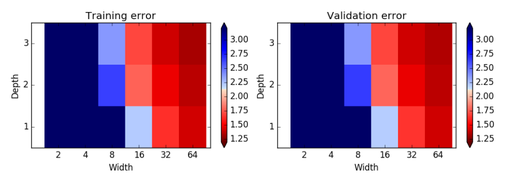
Figure 2 : RMSEs of tendency errors, as in figure 1, but for ANNs predicting the full X tendencies (section 2.1.2). Note that the colour scale is saturated for the smallest ANNs. More complex ANNs are required to outperform the No-ANN model than for models using error-correcting ANNs.
원문 · CC BY 4.0 · Peter A. G. Watson · Applying machine learning to improve simulations of a chaotic dynamical system using empirical error correction · 원문 그림 인용 · 원본 PDF 16쪽에서 그림 영역을 추출했습니다.이 결과는 오차 보정 방식이 작은 구조에서도 효과를 보인다는 점을 보여 주지만, 전체 틴덴시 방식의 최적 성능을 배제하지는 않습니다. 논문은 더 큰 구조의 전체 틴덴시 방식이 더 나은지 확인하지 않았다고 밝힙니다.
예측 기술과 기후 통계의 개선 범위
예측 기술은 1 MTU 선행 시간에서 ACC와 RMSE로 평가되었습니다. 오차 보정 모델은 폭 2·깊이 2 또는 3인 구조를 제외하고 No-ANN 모델보다 나은 결과를 보였습니다. 최적 수준에서 ACC는 약 0.46에서 0.49로, RMSE는 5.89에서 5.73으로 개선되었습니다. 같은 초기 조건에서 Truth 모델의 ACC는 0.52, RMSE는 5.59이므로 개선은 최대 가능 성능과의 차이 중 중간 정도를 메운 수준입니다.
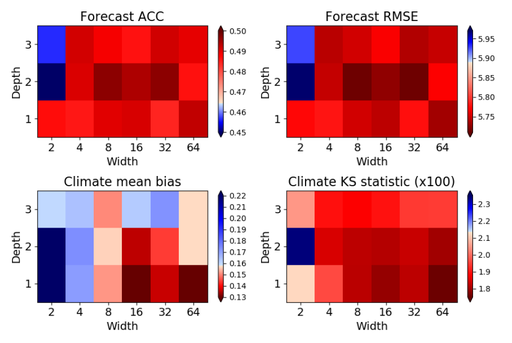
Figure 4 : Forecast skill and climate simulation diagnostics for models with error-correcting ANNs with different widths and depths, evaluated using the validation dataset as a reference: the forecast anomaly correlation coefficient (ACC; top left) and root mean square error (RMSE; top right), both at lead time 1MTU, and the climate time-mean bias (bottom left) and Kolmogorov-Smirnov (KS) statistic (bottom right) of the X variables. Red indicates better performance relative to the No-ANN model and blue worse performance. The models with ANNs generally have a better ACC, RMSE and KS statistic than the No-ANN model, but most differences in the mean bias were not found to be statistically significant (see text).
원문 · CC BY 4.0 · Peter A. G. Watson · Applying machine learning to improve simulations of a chaotic dynamical system using empirical error correction · 원문 그림 인용 · 원본 PDF 18쪽에서 그림 영역을 추출했습니다.기후 통계에서는 KS 통계량이 d2w2를 제외한 모든 구조에서 개선되었으며 최대 약 15%입니다. 평균 편향은 대부분의 구조에서 통계적으로 유의한 차이를 보이지 않았습니다. 따라서 이 결과는 평균의 개선보다는 분포 형태의 개선으로 해석됩니다. 단일 시간 단계 오차 감소가 장기 통계 개선보다 크다는 점에서, 짧은 시간 단계의 개선이 장기 시뮬레이션에 그대로 전달되지는 않는다는 한계가 확인됩니다.
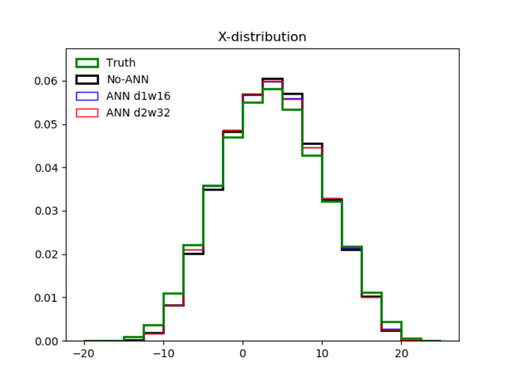
Figure 6 : Frequency distribution ofX values in long simulations in the validation dataset (”Truth”) and in several coarse-resolution models: the No-ANN model and those with error-correcting ANNs with depth-1 and width-16 and with depth-2 and width-32. The simulations by the models with ANNs have a smaller excess of frequencies of values near the centre of the distribution than the No-ANN model, but all have too low a frequency of extreme values.
원문 · CC BY 4.0 · Peter A. G. Watson · Applying machine learning to improve simulations of a chaotic dynamical system using empirical error correction · 원문 그림 인용 · 원본 PDF 20쪽에서 그림 영역을 추출했습니다.적용 범위와 남은 질문
이 결과는 Lorenz '96 시스템과 특정 설정에서 얻은 것입니다. 지구 시스템 모델의 구성 요소로 확장하려면 관측 주기가 길고 시간 간격이 짧은 문제, 여러 격자점 사이의 의존성, 안정성을 확보하는 다중 시간 단계 학습 같은 과제가 남아 있습니다. 논문은 시간 역전파 같은 방법이 이에 대응할 수 있다고 논의하지만, 이 연구에서 그 방법을 실제로 구현해 검증하지는 않았습니다.
또한 장기 통계의 개선이 단기 예측 개선보다 작았으므로, 장기 목표에 맞춘 학습이 필요하다는 점이 한계로 제시됩니다. 기후 변화에 대한 외삽 능력은 이 연구의 질문 밖이므로 검증되지 않았습니다.
논문 정보
- 저자
- Peter A. G. Watson
- 학회·저널
- arXiv · 프리프린트
- 최초 공개일
- 2019년 4월 24일
- 등록일
- 2026년 11월 6일
- 수정일
- 2019년 4월 24일
- 버전
- v1
- arXiv
- 1904.10904
- DOI
- 10.1029/2018ms001597
- 분류
- physics.ao-ph · cs.LG · nlin.CD · stat.ML
- 원문 이용 조건
- CC BY 4.0
- 제공 범위
- 논문 정보, 해설, 허용된 원문 그림
AI 해설은 논문 원문과 별개의 설명이며 오류가 있을 수 있습니다. 원문과 그림은 각 출처의 이용 조건과 따로 표시된 권리를 따릅니다.
초록
Dynamical weather and climate prediction models underpin many studies of the Earth system and hold the promise of being able to make robust projections of future climate change based on physical laws. However, simulations from these models still show many differences compared with observations. Machine learning has been applied to solve certain prediction problems with great success, and recently it's been proposed that this could replace the role of physically-derived dynamical weather and climate models to give better quality simulations. Here, instead, a framework using machine learning together with physically-derived models is tested, in which it is learnt how to correct the errors of the latter from timestep to timestep. This maintains the physical understanding built into the models, whilst allowing performance improvements, and also requires much simpler algorithms and less training data. This is tested in the context of simulating the chaotic Lorenz '96 system, and it is shown that the approach yields models that are stable and that give both improved skill in initialised predictions and better long-term climate statistics. Improvements in long-term statistics are smaller than for single time-step tendencies, however, indicating that it would be valuable to develop methods that target improvements on longer time scales. Future strategies for the development of this approach and possible applications to making progress on important scientific problems are discussed.
원문 인용
Peter A. G. Watson (2019). Applying machine learning to improve simulations of a chaotic dynamical system using empirical error correction. arXiv:1904.10904v1. https://doi.org/10.1029/2018ms001597
BibTeX
@article{watson2019applying,
  title = {{Applying machine learning to improve simulations of a chaotic dynamical system using empirical error correction}},
  author = {Peter A. G. Watson},
  year = {2019},
  eprint = {1904.10904},
  archivePrefix = {arXiv},
  doi = {10.1029/2018ms001597},
  url = {https://arxiv.org/abs/1904.10904v1}
}