논문 해설
Real-time 3D Single Object Tracking with Transformer
Transformer를 이용한 실시간 3D 단일 객체 추적
- 연구 문제 LiDAR 기반 3D 단일 객체 추적은 멀리 있거나 가려진 물체의 희소한 점군 때문에 특징이 모호해져 추적 성능이 떨어집니다.
- 연구 방법 PTT 모듈은 점 특징을 임베딩하고 KNN 기반 위치 인코딩과 벡터 self-attention으로 정제하며, 이를 P2B의 투표 단계와 제안 생성 단계에 삽입한 PTT-Net으로 구현됩니다.
- 주요 결과 KITTI Car에서 PTT-Net은 3D Success 67.8과 3D Precision 81.8을 보고하여 기준선 P2B보다 높은 성능을 보였고, NuScenes에서도 BAT보다 높은 결과를 보고합니다.
LiDAR 3D 단일 객체 추적의 희소성 문제
LiDAR 기반 3D 단일 객체 추적은 로봇과 자율주행에서 중요하지만, 멀리 있는 물체나 가려진 물체는 점군이 매우 희소하거나 일부만 관측됩니다. 이때 추출되는 특징이 모호해져 대상의 위치를 찾기 어려워집니다. 기존 Siamese 기반 방법들은 점의 기하 위치별 중요도를 충분히 구분하지 않으며, 희소한 점군에서 강건한 특징을 얻기 어렵다는 한계가 지적됩니다. 이 논문은 이러한 특징 모호성을 줄이기 위해 Transformer의 self-attention을 3D 점군 추적에 적용하는 것을 목표로 합니다.
PTT 모듈과 PTT-Net의 구성
PTT 모듈은 점의 좌표와 특징을 입력으로 받아 임베딩, KNN 기반 위치 인코딩, self-attention의 세 블록으로 정제된 특징을 만듭니다. 특징 임베딩은 선형 층으로 입력 차원을 M으로 바꾸고, 위치 인코딩은 각 점과 이웃점의 상대 좌표를 MLP로 인코딩합니다. self-attention에서는 질의 Q, 키 K, 값 V를 계산한 뒤 관계 함수로 Q−K의 벡터 어텐션을 사용하며, 출력은 입력 특징과 잔차 특징의 합으로 구성됩니다. PTT-Net은 기준선인 P2B의 투표 단계와 제안 생성 단계에 PTT 모듈을 각각 삽입하여 구성됩니다. 이 설계는 저자들이 점군에 더 적합하다고 판단한 벡터 어텐션을 선택한 것입니다.
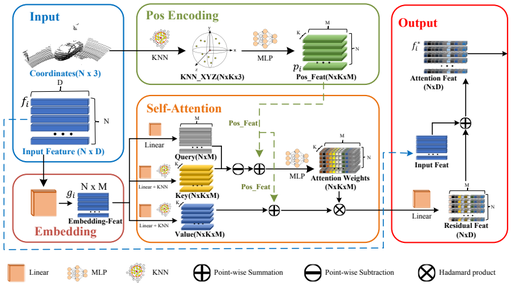
Fig. 2 . PTT module architecture. It consists of three blocks: feature embedding, position encoding, and self-attention. The whole input are the coordinates and their corresponding features. Feature embedding module maps input features into embedding space. In position encoding module, the k-nearest neighbor algorithm is used to obtain local position information, then the encoded position features will be learned by an MLP layer. The self-attention module learns refined attention features for input features based on local context. The output features of PTT module are the sum of input and residual features.
원문 · CC BY 4.0 · Jiayao Shan, Sifan Zhou, Yubo Cui, Zheng Fang · Real-time 3D Single Object Tracking with Transformer · 원문 그림 인용 · 원본 PDF 5쪽에서 그림 영역을 추출했습니다.샘플링 전략과 FPS 선택
점군 샘플링은 탐색 영역의 점 수를 네트워크 입력 크기에 맞추는 과정이지만, 방법에 따라 대상 정보 손실 정도가 다릅니다. 원문은 Random Sampling, Farthest Point Sampling, 특징 공간에서의 Feat-FPS를 비교하며, FPS가 기하 정보를 더 잘 보존하고 전경과 배경의 분포를 더 균형 있게 만든다고 설명합니다. 이에 따라 PTT-Net은 P2B가 사용하던 Random Sampling 대신 FPS를 채택합니다. 제거 실험에서 FPS의 3D Success는 67.8, Random Sampling은 60.4, Feat-FPS는 66.1로 보고됩니다.
KITTI와 NuScenes에서의 검증 결과
PTT-Net은 KITTI 추적 데이터셋의 Car 범주에서 3D Success 67.8과 3D Precision 81.8을 보고합니다. 이는 같은 표의 P2B 56.2와 72.8보다 높은 값이며, 원문은 기준선 대비 3D Success가 약 11% 향상되었다고 설명합니다. 이 결과는 첫 프레임 3D ground truth 박스로 초기화하고 KITTI Car 범주에서 측정한 결과입니다. NuScenes에서는 BAT의 설정을 따라 평가했으며, 원문에 따르면 PTT-Net이 BAT보다 모든 범주에서 높은 결과를 보입니다. 추적 속도는 단일 NVIDIA 1080Ti GPU에서 40FPS로 보고되며, 이는 본 실험 설정에서 얻은 측정값입니다.
삽입 위치에 대한 절제 결과
삽입 위치 절제 실험은 PTT 모듈을 투표 단계에만 넣은 경우, 제안 생성 단계에만 넣은 경우, 두 단계 모두에 넣은 경우를 비교합니다. 기준선 P2B는 3D Success 56.2와 3D Precision 72.8이며, 투표 단계만 넣으면 62.1과 76.9, 제안 생성 단계만 넣으면 65.7과 78.9가 보고됩니다. 두 단계 모두에 넣은 PTT-Net은 67.8과 81.8로 가장 높습니다. 이 결과는 두 단계의 PTT 삽입이 함께 성능 향상에 기여한다는 관찰로 읽어야 하며, 다른 설정에 대한 일반화는 원문에서 확인되지 않습니다.
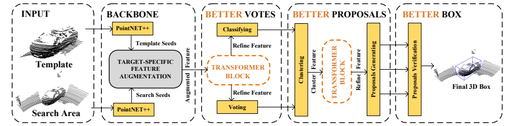
Fig. 3 . The pipeline of PTT-Net. In order to verify the effect of our PTT module, we embed two PTT modules into seeds voting and proposals generation stage of the deep hough voting framework.
원문 · CC BY 4.0 · Jiayao Shan, Sifan Zhou, Yubo Cui, Zheng Fang · Real-time 3D Single Object Tracking with Transformer · 원문 그림 인용 · 원본 PDF 6쪽에서 그림 영역을 추출했습니다.희소 점군에서의 한계
원문은 PTT-Net이 대부분의 장면에서 SC3D와 P2B보다 잘 작동하지만, 점이 극도로 희소할 때는 여전히 추적에 실패할 수 있다고 보고합니다. 실패 사례에서는 초기 검색 영역에 점이 거의 없어 유효한 대상 특징을 학습하기 어렵고, 그 결과 특징 모호성이 박스 추정 오류로 이어져 실패가 누적됩니다. KITTI에서도 프레임의 약 절반 가까이가 상대적으로 희소한 장면이라는 분석이 제시되어, 희소성이 여전히 추적 정확도의 병목임을 보여 줍니다.
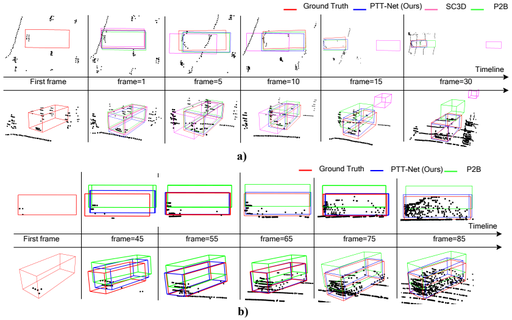
Fig. 10 . Advantageous cases of PTT-Net compared with SC3D and P2B (a-b). In (a) and (b), the number of point clouds in the first frame is less than 50. Our method can track the target accurately. However, in scenario (a), both P2B and SC3D failed to track. In scenario (b), even though P2B could track the target, it still has an inaccurate z-axis estimation for the target. Meanwhile, SC3D has failed to track. These results show the robustness of our method in sparse point cloud scenarios. Please see our experiment video for more details.
원문 · CC BY 4.0 · Jiayao Shan, Sifan Zhou, Yubo Cui, Zheng Fang · Real-time 3D Single Object Tracking with Transformer · 원문 그림 인용 · 원본 PDF 11쪽에서 그림 영역을 추출했습니다.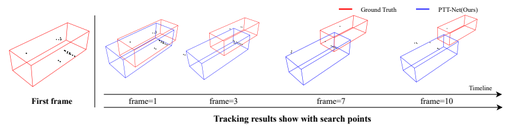
Fig. 11 . Failure cases. no points in the initial search area
원문 · CC BY 4.0 · Jiayao Shan, Sifan Zhou, Yubo Cui, Zheng Fang · Real-time 3D Single Object Tracking with Transformer · 원문 그림 인용 · 원본 PDF 11쪽에서 그림 영역을 추출했습니다.논문 정보
- 저자
- Jiayao Shan, Sifan Zhou, Yubo Cui, Zheng Fang
- 학회·저널
- arXiv · 프리프린트
- 최초 공개일
- 2022년 9월 2일
- 등록일
- 2026년 11월 6일
- 수정일
- 2022년 9월 2일
- 버전
- v1
- arXiv
- 2209.00860
- DOI
- 10.1109/tmm.2022.3146714
- 분류
- cs.CV
- 원문 이용 조건
- CC BY 4.0
- 제공 범위
- 논문 정보, 해설, 허용된 원문 그림
AI 해설은 논문 원문과 별개의 설명이며 오류가 있을 수 있습니다. 원문과 그림은 각 출처의 이용 조건과 따로 표시된 권리를 따릅니다.
초록
LiDAR-based 3D single object tracking is a challenging issue in robotics and autonomous driving. Currently, existing approaches usually suffer from the problem that objects at long distance often have very sparse or partially-occluded point clouds, which makes the features extracted by the model ambiguous. Ambiguous features will make it hard to locate the target object and finally lead to bad tracking results. To solve this problem, we utilize the powerful Transformer architecture and propose a Point-Track-Transformer (PTT) module for point cloud-based 3D single object tracking task. Specifically, PTT module generates fine-tuned attention features by computing attention weights, which guides the tracker focusing on the important features of the target and improves the tracking ability in complex scenarios. To evaluate our PTT module, we embed PTT into the dominant method and construct a novel 3D SOT tracker named PTT-Net. In PTT-Net, we embed PTT into the voting stage and proposal generation stage, respectively. PTT module in the voting stage could model the interactions among point patches, which learns context-dependent features. Meanwhile, PTT module in the proposal generation stage could capture the contextual information between object and background. We evaluate our PTT-Net on KITTI and NuScenes datasets. Experimental results demonstrate the effectiveness of PTT module and the superiority of PTT-Net, which surpasses the baseline by a noticeable margin, ~10% in the Car category. Meanwhile, our method also has a significant performance improvement in sparse scenarios. In general, the combination of transformer and tracking pipeline enables our PTT-Net to achieve state-of-the-art performance on both two datasets. Additionally, PTT-Net could run in real-time at 40FPS on NVIDIA 1080Ti GPU. Our code is open-sourced for the research community at https://github.com/shanjiayao/PTT.
원문 인용
Jiayao Shan, Sifan Zhou, Yubo Cui, Zheng Fang (2022). Real-time 3D Single Object Tracking with Transformer. arXiv:2209.00860v1. https://doi.org/10.1109/tmm.2022.3146714
BibTeX
@article{shan2022real,
  title = {{Real-time 3D Single Object Tracking with Transformer}},
  author = {Jiayao Shan and Sifan Zhou and Yubo Cui and Zheng Fang},
  year = {2022},
  eprint = {2209.00860},
  archivePrefix = {arXiv},
  doi = {10.1109/tmm.2022.3146714},
  url = {https://arxiv.org/abs/2209.00860v1}
}