논문 해설
Don't Match the Noise: Distribution Matching under Unknown Measurement Error with an Audit Sample
노이즈에 맞추지 마라: 감사 샘플을 활용한 미지의 측정 오차 아래의 분포 매칭
- 연구 문제 노이즈가 섞인 목표 표본으로 MMD를 계산하면 잠재 분포가 아니라 측정 과정에 맞춰지는 편향이 생깁니다.
- 연구 방법 감사 표본에서 관측되는 커널 차이항으로 qq와 pq 커널 합을 보정하는 MEC-MMD를 제안합니다.
- 주요 결과 단순 무작위 감사에서 오라클 MMD에 대해 비편향임을 증명했고, 밀도 추정 실험에서 여러 감사 크기에 대해 convMMD와 XDGMM과 비교했습니다.
측정 오차가 있는 목표 표본의 문제
많은 과학·머신러닝 파이프라인에서는 잠재 목표 값 Y를 직접 보지 못하고, 측정 오차가 섞인 대리 값 eY만 얻습니다. 이때 eY로 직접 계산한 MMD는 잠재 분포 q가 아니라 측정 과정의 산물에 맞춰지므로 편향됩니다. 이 논문은 대량의 노이즈 표본과 소규모 감사 표본이 함께 있는 상황에서, 노이즈 모델을 명시하지 않고도 잠재 대상 분포에 대한 MMD를 추정하는 문제를 다룹니다.
감사 표본으로 커널 합을 보정하는 방식
제안 방법 MEC-MMD는 오라클 경험적 MMD의 qq 커널 합과 pq 커널 합을 감사 표본으로 보정합니다. 감사 집합 L의 각 쌍에 대해 Γ_jj' = k(Y_j, Y_j') − k(eY_j, eY_j')와 Λ_ij = k(X_i, Y_j) − k(X_i, eY_j)를 계산할 수 있으므로, 노이즈 표본 기반 합에 감사 쌍의 보정항을 더합니다. 단순 무작위 감사에서 이 보정은 Horvitz–Thompson 형태로 쓰이며, 각 감사 단위와 쌍에 역포함 확률에 해당하는 가중치 N/m과 N(N−1)/{m(m−1)}을 곱합니다. 노이즈 모델이나 보정 함수를 따로 추정하지 않는 점이 핵심입니다.
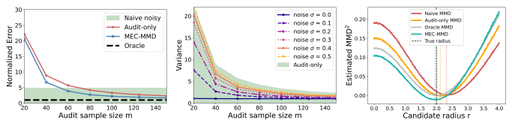
Figure 1 :Left Panel.Normalized error (MSE divided by the oracle’s) versus audit size. The naive estimator is low-variance but biased, the audit-only estimator is unbiased but high-variance, and MEC-MMD removes bias while reducing variance.Middle Panel.Effect of measurement noise on MMD estimation variance for several noise levels σ. The shaded region is the audit-only variance, independent of σ.Right Panel.MEC-MMD closely matches the oracle objective and correctly identifies the true parameter with lower bias and variance. See Supplementary Materials for details.
원문 · CC BY 4.0 · Arya Farahi, Ritwik Vashistha · Don't Match the Noise: Distribution Matching under Unknown Measurement Error with an Audit Sample · 원문 그림 인용 · 원본 PDF 6쪽에서 그림 영역을 추출했습니다.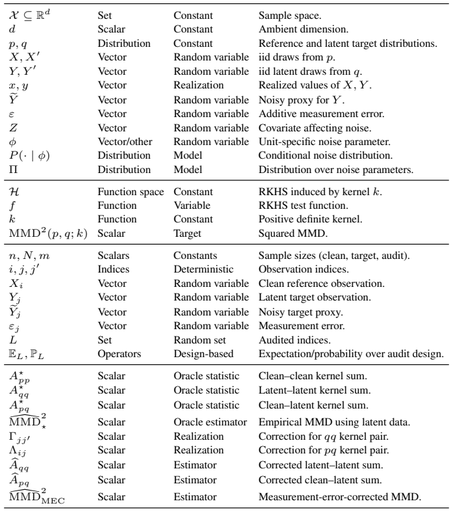
Table 6 : Summary of notation.
원문 · CC BY 4.0 · Arya Farahi, Ritwik Vashistha · Don't Match the Noise: Distribution Matching under Unknown Measurement Error with an Audit Sample · 원문 그림 인용 · 원본 PDF 19쪽에서 그림 영역을 추출했습니다.비편향성과 일관성 보장
정리 3.1은 단순 무작위 감사 조건에서 MEC 추정량의 기댓값이 오라클 경험적 MMD와 같다는 것을 보입니다. 정리 3.5는 감사 크기가 표본 크기에 비례하는 조건에서 MEC-MMD가 MMD²(p, q; k)에 확률 수렴하며, 오차가 O_P(N^{-1/2})로 주어진다고 말합니다. 분산은 감사 설계에 따른 1차 투영항과 퇴화된 2차 잔여항으로 나뉘어, 1차 항이 대부분을 설명합니다. 이 결과들은 커널이 유계이고 감사가 고정 크기 단순 무작위 표본이라는 가정 아래에서 성립합니다.

Table 8 : Numerical check of Theorems 3.1, 3.2 and 3.4; 40 populations, 3000 simple random audits
원문 · CC BY 4.0 · Arya Farahi, Ritwik Vashistha · Don't Match the Noise: Distribution Matching under Unknown Measurement Error with an Audit Sample · 원문 그림 인용 · 원본 PDF 29쪽에서 그림 영역을 추출했습니다.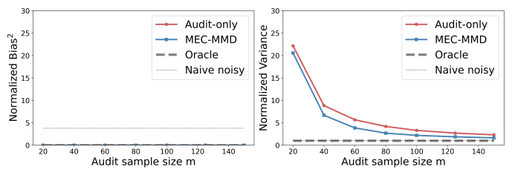
Figure 5 : Bias (left panel) and variance (right panel) for the Gaussian measurement-error experiment in Figure 1. The left panel reports empirical bias relative to MMD2(p, q;k), and the right panel reports empirical variance. The naïve noisy estimator has the smallest variance among practical methods because it uses all N observed target points, but it is biased because it ignores measurement error. The audit-only estimator is unbiased but has substantially larger variance since its effective target sample size is only m. MEC-MMD uses the noisy sample to retain efficiency and the audit sample to remove bias, yielding a markedly better bias–variance tradeoff: much lower variance than audit-only estimation and far smaller bias than the naive noisy estimator. The oracle variance serves as the lower benchmark corresponding to full access to the latent target sample.
원문 · CC BY 4.0 · Arya Farahi, Ritwik Vashistha · Don't Match the Noise: Distribution Matching under Unknown Measurement Error with an Audit Sample · 원문 그림 인용 · 원본 PDF 30쪽에서 그림 영역을 추출했습니다.밀도 추정과 차원 확장 실험
실험 4에서는 10성분 가우시안 혼합으로 만든 고양이 발바닥 모양 밀도를 N=2000, 감사 크기 m 변화 조건에서 추정했습니다. 평가는 ISE이며 convMMD와 XDGMM을 비교 기준으로 두었습니다. 실험 7에서는 나선형 리본을 d∈{3,7,11,15,20,30}으로 확장하고 감사 크기 m=400을 고정한 채 sliced Wasserstein distance에 √d를 곱한 값을 비교했습니다. 이 두 실험은 서로 다른 데이터·지표·조건을 사용하므로 결과를 하나의 평가로 합치지 않습니다.
작은 감사 표본과 비균일 감사의 한계
저자들은 감사 표본이 작으면 보정항이 분산을 키워 naive 추정량보다 MSE가 커질 수 있다고 봅니다. 감사가 무작위가 아닌 층화나 결과 의존 방식으로 이루어지면, 본문의 분산과 CLT 결과는 적용되지 않습니다. 비균일 감사에 대한 IPW 확장은 Appendix C와 E에서 다루지만, 역확률 가중치가 커지는 분산 문제와 포함 확률 추정은 향후 과제로 남겨 둡니다.

Table 2 : ISE under a non-uniform (stratified) audit with known inclusion probabilities (Gaussian noise, N = 2000; mean ± standard error over 10 seeds). MEC-MMD-IPW uses inverse-probability (Hájek) weights; bold marks the best non-oracle method.
원문 · CC BY 4.0 · Arya Farahi, Ritwik Vashistha · Don't Match the Noise: Distribution Matching under Unknown Measurement Error with an Audit Sample · 원문 그림 인용 · 원본 PDF 8쪽에서 그림 영역을 추출했습니다.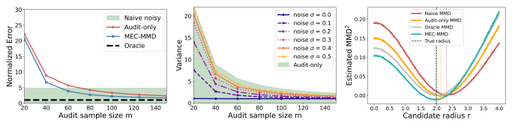
Figure 6 :Left Panel.Estimation error. The oracle estimator uses the full latent sample and yields a lower-variance bound. The naive estimator based on the full noisy sample has low variance but is biased for MMD2(p, q;k). The audit-only estimator removes this bias but has a much larger variance because it uses only m latent target points. MEC-MMD combines noisy samples with audit-based correction, thereby removing bias induced by noisy measurements while achieving substantially lower variance than audit-only estimation.Middle Panel.Measurement error effect on estimator variance. The horizontal axis shows the audit sample size m, and the vertical axis shows the variance of the estimator. Colored curves correspond to different noise levels σ∈ {0,0.1,0.2,0.3,0.4,0.5} . As measurement noise increases, the variance of the MEC-MMD estimator rises substantially, especially when the audit sample is small, because the correction must be estimated from a limited number of latent target points. For every noise level, increasing m reduces variance, reflecting the improved precision of the audit-based correction. When σ= 0 , the variance equals oracle variance and is flat in m, since no measurement-error correction is needed. The results illustrate that measurement noise primarily affects statistical efficiency rather than identifiability: larger noise inflates uncertainty, but this effect can be mitigated by increasing the audit sample size.Right Panel.Parameter estimation. The horizontal axis shows candidate radii, and the vertical axis shows the corresponding empirical MMD objective. Vertical lines indicate the minimizing radius for each estimator. The naive estimator (red) is biased because it compares candidate models to noisy observations. The audit-only estimator (orange) removes this bias but has higher variability due to the small audit sample. The proposed MEC-MMD estimator (teal) combines the full noisy dataset with audit-based corrections and closely matches the oracle estimator (gray), correctly identifying the true radius.
원문 · CC BY 4.0 · Arya Farahi, Ritwik Vashistha · Don't Match the Noise: Distribution Matching under Unknown Measurement Error with an Audit Sample · 원문 그림 인용 · 원본 PDF 32쪽에서 그림 영역을 추출했습니다.논문 정보
- 저자
- Arya Farahi, Ritwik Vashistha
- 학회·저널
- arXiv · 프리프린트
- 최초 공개일
- 2026년 11월 10일
- 등록일
- 2026년 11월 13일
- 수정일
- 2026년 11월 10일
- 버전
- v1
- arXiv
- 2611.14749
- 분류
- stat.ML · cs.LG · stat.ME
- 원문 이용 조건
- CC BY 4.0
- 제공 범위
- 논문 정보, 해설, 허용된 원문 그림
AI 해설은 논문 원문과 별개의 설명이며 오류가 있을 수 있습니다. 원문과 그림은 각 출처의 이용 조건과 따로 표시된 권리를 따릅니다.
초록
Real-world machine learning systems often operate on imperfect measurements: sensors are noisy, annotations are produced by non-experts, and scientific observations are often indirect. In these settings, classic distribution comparison tools such as maximum mean discrepancy (MMD) can be systematically biased, matching artifacts of the measurement process rather than the underlying mechanisms of interest. We study a practical regime in which noisy observations are abundant, but only a small audited subset contains ground-truth measurements. We propose measurement-error-corrected MMD (MEC-MMD), an audit-based estimator that debiases kernel evaluations without requiring a noise model. MEC-MMD is exactly unbiased for the oracle MMD under simple random auditing, admits an explicit variance decomposition, and is consistent for the population MMD, achieving the standard $O_p(N^{-1/2})$ rate when the audit size scales with the dataset. We demonstrate the utility of distributional matching with MEC-MMD loss for both parameter estimation and unsupervised applications, showing that MEC-MMD consistently outperforms MMD and alternative methods. These results provide a principled foundation for robust distribution comparison, simulation-based inference, and learning in noisy real-world machine learning pipelines.
원문 인용
Arya Farahi, Ritwik Vashistha (2026). Don't Match the Noise: Distribution Matching under Unknown Measurement Error with an Audit Sample. arXiv:2611.14749v1. https://arxiv.org/abs/2611.14749v1
BibTeX
@misc{farahi2026match,
  title = {{Don't Match the Noise: Distribution Matching under Unknown Measurement Error with an Audit Sample}},
  author = {Arya Farahi and Ritwik Vashistha},
  year = {2026},
  eprint = {2611.14749},
  archivePrefix = {arXiv},
  url = {https://arxiv.org/abs/2611.14749v1}
}