논문 해설
EO-Jev: Decision Model for Earth Observation
EO-Jev: 지구 관측을 위한 의사결정 모델
- 연구 문제 지구관측 작업에서 결정 모델이 선택지 확률을 한 번의 순전파로 제공할 수 있는지, 그리고 이 모델이 EO 과제에서 정확도와 보정 측면으로 전문가 모델과 비교해 어떤지를 확인하는 문제입니다.
- 연구 방법 d3-flash를 진단한 뒤 공개 EO 학습 분할에서 LoRA로 적응하고 일반 결정 데이터를 재생하여 EO-Jev를 만듭니다. 추론은 병합된 가중치로 한 번의 순전파로 수행됩니다.
- 주요 결과 EO-Jev는 30개 설정 중 26개에서 d3-flash보다 유의하게 향상되고, 28개 전문가 비교 설정 중 20개에서 같거나 더 높은 점수를 보입니다. 학습에 쓰지 않은 12개 설정에서는 평균 8.0점의 이득을 보입니다.
EO 작업을 한 번의 순전파로 푸는 결정 모델
지구관측(EO) 워크플로는 이미 알려진 결과 중 하나를 고르고, 그 답의 신뢰도를 추정하며, 많은 영상을 처리하는 일을 요구합니다. 생성형 시각-언어 모델은 이런 일을 수행할 수 있지만 답을 자기회귀적으로 생성하므로 계산 비용이 크고, 생성된 신뢰도 표현이 믿기 어렵다는 문제가 있습니다.
결정 모델은 텍스트를 생성하지 않습니다. 상태, 질문, 선택지가 주어지면 선택지들에 대한 확률 분포를 한 번의 순전파로 반환합니다. 이 확률은 임계값으로 자르거나 집계하고 감사할 수 있어 피해 분류나 경보 같은 EO 응용에 적합합니다. 다만 공개 결정 모델 리더보드에는 EO 영상이 포함되어 있지 않았고, 일반 결정 모델이 원격탐사 과제에서 정확도, 보정, 과제 간 전이를 얼마나 보이는지는 충분히 알려지지 않았습니다.
이 논문은 d3-flash를 진단하여 EO 과제 전반에서의 능력을 확인하고, 공개 EO 학습 분할로 적응한 EO-Jev가 전문 EO 모델 및 백본 모델과 비교해 어떤 차이를 보이는지 검토합니다.
d3-flash 구조와 EO-Jev 적응 방식
d3-flash는 Qwen3.5-9B를 기반으로 한 8.39B 파라미터 결정 모델입니다. 언어 모델링 헤드 대신 마지막 프롬프트 토큰에 255×4096 선형 readout을 적용하여 최대 255개의 답안 코드에 대한 분포를 산출합니다. 이 모델의 비전 타워는 동결되어 있고, 텍스트 타워는 전체가 미세조정되어 있습니다.
EO-Jev는 d3-flash의 readout을 255개 코드 구조 그대로 유지하면서, 비전 블록(낮은 학습률 적용), 비전 merger, 텍스트 타워에 저랭크 적응(LoRA) 어댑터를 추가합니다. 학습 목적은 목표 분포 q와 예측 분포 p 사이의 KL 항에 순서형 질문용 ranked probability score(RPS) 항을 더한 형태입니다. 원문에서 제시한 식은 \( L = KL(q \parallel p) + \lambda \, RPS(q, p) \) 이며, 순서형 질문이 아닌 경우에는 RPS 항이 쓰이지 않습니다. 학습은 20,000 단계 동안 진행되고, 각 학습 배치의 약 20%는 일반 결정 데이터로 채워집니다.
이때 일반 데이터의 목표 분포는 d3-flash 자신의 확률입니다.
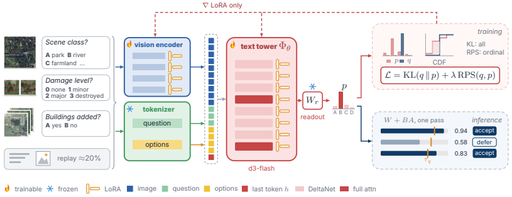
Figure 2 EO-Jev Architecture and Training.EO images (single images, pre/post pairs or time series) are paired with typed questions with predefined answers. General decision data is replayed in 20% of each batch. The vision encoder and text towerΦθ process the images and questions, respectively. A frozen readoutWr converts the final hidden state h into option probabilitiesp.Training:LoRA adapters in the vision encoder and text tower are optimized using KL divergence against target distributionsq, with an additional ranked probability score (RPS) on ordinal questions. Inference:merged adapters (W +BA) enable single-pass predictions at d3-flash cost. Answers are accepted when confidence exceeds a per-question thresholdτq and otherwise deferred to an analyst. Examples and probabilities are illustrative.
원문 · CC BY 4.0 · Mohamed Atef Abouelhadid, Diaa Addeen Abuhani, Muhammad Akhtar Munir, Fahad Shahbaz Khan, Salman Khan · EO-Jev: Decision Model for Earth Observation · 원문 그림 인용 · 원본 PDF 3쪽에서 그림 영역을 추출했습니다.학습이 끝나면 어댑터를 BF16 가중치에 병합하므로 EO-Jev는 d3-flash와 같은 구조와 추론 비용을 가집니다. 추론 시에는 질문별 임계값 τq를 넘는 신뢰도의 답은 수용되고, 나머지는 분석가에게 보류됩니다. 학습 데이터는 공개 학습 분할에서만 구성되며, 평가 영상과의 중복은 지각 해시로 제거됩니다.
학습 없는 d3-flash의 EO 전이
EO 특화 학습을 하지 않은 d3-flash는 30개 설정 중 7개에서만 최고 EO 전문가 모델과 같거나 더 나은 성능을 보입니다. 이 설정들은 다양한 영상에 걸친 넓은 추론을 요구하는 객관식 과제입니다. 예를 들어 LHRS-Bench 엄격 CircularEval에서 d3-flash는 77.5를 얻어 최고 전문가의 60.0을 넘고, CHOICE에서는 83.5 대 76.9입니다. UrBench 지리 위치 추정에서는 60.3 대 55.6입니다.
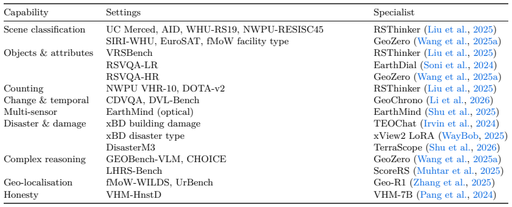
Table 2 Specialist reference models.The strongest open-weight EO specialist per setting in our common question format.
원문 · CC BY 4.0 · Mohamed Atef Abouelhadid, Diaa Addeen Abuhani, Muhammad Akhtar Munir, Fahad Shahbaz Khan, Salman Khan · EO-Jev: Decision Model for Earth Observation · 원문 그림 인용 · 원본 PDF 13쪽에서 그림 영역을 추출했습니다.반대로 전문가가 해당 벤치마크로 학습된 장면 분류와 시각 질의응답에서는 d3-flash가 뒤처집니다. AID에서 d3-flash는 78.1을, RSThinker는 98.5를 기록하고, NWPU-RESISC45에서는 73.3 대 97.0입니다. 저해상도 영상과 클래스 수가 많은 분류에서도 약합니다. 같은 답안 코드 방식의 Qwen3.5-9B 백본과 비교하면 d3-flash는 30개 설정 중 24개에서 더 낮은 기대 보정 오차를 보입니다. 이 결과는 결정 학습이 보정 측면에서 가장 뚜렷한 이득을 주었다는 관찰이며, 정확도 향상은 대체로 작았습니다.
EO 지도학습의 학습 내 효과와 보류 데이터셋 전이
EO-Jev는 30개 설정 중 26개에서 d3-flash보다 유의하게 향상됩니다. 학습 분할에 해당 데이터셋의 다른 영상이 쓰인 in-domain 설정은 18개이며, 평균 향상은 +23.8 퍼센트포인트이고 중앙값은 +24.6입니다. 예로 DisasterM3 단일 선택은 46.2에서 91.1로, EuroSAT은 57.3에서 96.1로 오릅니다. fMoW-WILDS 국가 분류 향상은 학습 영상이 2013년 이전이고 평가 영상이 2016년 이후이며, 평가 지점 근처의 학습 영상을 제거한 조건에서도 44.4에서 70.3으로 나타납니다.
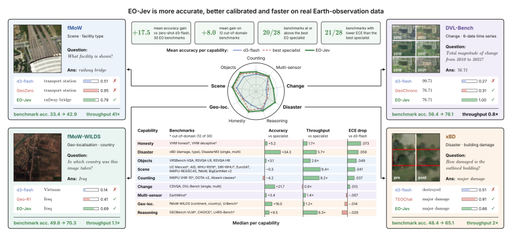
Figure 1 EO-Jev is more accurate, better calibrated and faster.Centre: mean accuracy per capability (30 benchmarks). Corners: real questions with each model’s answer and confidence; footers give benchmark accuracy (specialist→ EO-Jev) and throughput vs. the specialist. Bottom: per-capability medians of accuracy gain and throughput vs. the best specialist, and ECE drop vs. d3-flash; green = better, red = worse.
원문 · CC BY 4.0 · Mohamed Atef Abouelhadid, Diaa Addeen Abuhani, Muhammad Akhtar Munir, Fahad Shahbaz Khan, Salman Khan · EO-Jev: Decision Model for Earth Observation · 원문 그림 인용 · 원본 PDF 2쪽에서 그림 영역을 추출했습니다.데이터셋을 전혀 사용하지 않은 out-of-domain 설정은 12개이고, 그중 8개가 유의하게 향상됩니다. 12개 전체의 평균 향상은 +8.0점입니다. 장면 데이터셋 UC Merced는 +11.0, SIRI-WHU는 +7.7, WHU-RS19는 +6.2입니다. VHM 기만 질문의 올바른 기권은 학습에 VHM 데이터가 쓰이지 않았는데도 30.4에서 74.0으로 올라갑니다. 다른 데이터셋에서 부재 객체 질문을 학습한 것이 일반화된 결과로 해석됩니다.
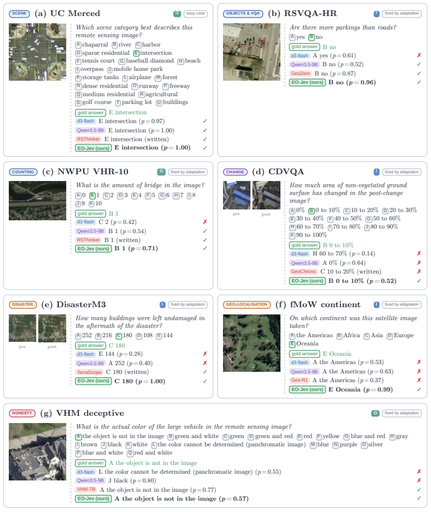
Figure 3 Qualitative examples across capability groups.Each panel shows the input image(s), the question and its options (gold option highlighted in green), and the top answer of each model with its probability, or “written” for specialists whose best mode is a generated answer. Badges: I = in-domain, O = out-of-domain for EO-Jev. In (b)–(g), d3-flash sometimes answers incorrectly with high confidence, defined as assigning a probability of at least 0.8 to the selected answer (e.g., predictingthe Americasfor an Oceanian site in (f)),the color cannot be determinedin (g)), while EO-Jev selects the correct option; in (d) and (f) the best specialist is wrong as well. This includes two out-of-domain settings, NWPU VHR-10 counting (c) and VHM deceptive questions (g), where no training image came from the benchmark’s dataset. Panel (a) is an out-of-domain scene that every model answers correctly, EO-Jev withp = 1.00. All images, questions and probabilities are taken unchanged from the evaluation runs.
원문 · CC BY 4.0 · Mohamed Atef Abouelhadid, Diaa Addeen Abuhani, Muhammad Akhtar Munir, Fahad Shahbaz Khan, Salman Khan · EO-Jev: Decision Model for Earth Observation · 원문 그림 인용 · 원본 PDF 7쪽에서 그림 영역을 추출했습니다.전문가 비교에서는 EO-Jev가 28개 설정 중 20개에서 최고 전문가와 같거나 더 높습니다. 나머지 설정에서 차이는 대부분 2점 미만이며, NWPU VHR-10 계수 설정만 −7.8로 큽니다. 이 비교에서 전문가 모델도 해당 벤치마크 분할로 학습된 경우가 많으므로, 많은 비교는 동등하게 지도된 두 모델의 비교입니다. 일반 Decision Index에서는 d3-flash의 93.7이 EO-Jev에서 91.9로 낮아집니다.
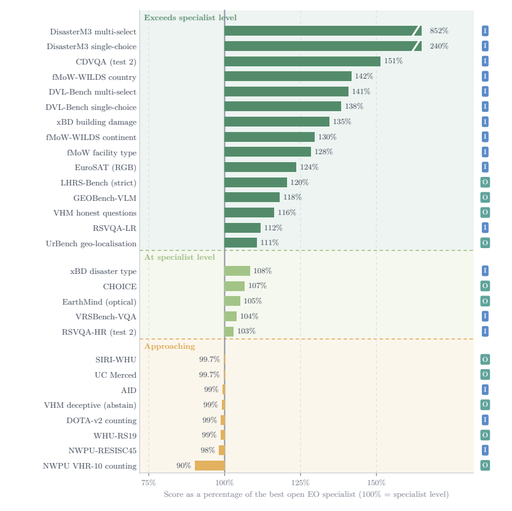
Figure 6 EO capability relative to specialist level.For each setting with a specialist reference, EO-Jev’s score as a percentage of the best open EO specialist’s. Settings are grouped into tiers: exceeds specialist level (above 110%), at specialist level (100–110%) and approaching (85–100%). No setting falls below 85%. Bars beyond 165% are clipped. Badges:I= in-domain,O= out-of-domain.
원문 · CC BY 4.0 · Mohamed Atef Abouelhadid, Diaa Addeen Abuhani, Muhammad Akhtar Munir, Fahad Shahbaz Khan, Salman Khan · EO-Jev: Decision Model for Earth Observation · 원문 그림 인용 · 원본 PDF 12쪽에서 그림 영역을 추출했습니다.보정과 추론 비용
보정은 최상위 답의 확률을 기준으로 15개의 동일 너비 구간을 사용하는 기대 보정 오차(ECE)로 측정됩니다. EO-Jev는 d3-flash보다 유의하게 낮은 ECE를 17개 EO 설정에서 보이고, 높은 ECE를 5개에서, 유의한 변화가 없는 설정을 8개에서 보입니다. 가장 큰 개선은 d3-flash가 부정확하면서 과신하던 설정에서 나타납니다. VHM 기만 질문의 ECE는 0.254에서 0.062로, xBD 피해 등급은 0.168에서 0.050으로 낮아집니다. 최고 전문가와의 비교에서는 28개 중 21개 설정에서 EO-Jev의 ECE가 낮습니다. 전문가는 생성 답안이 아니라 선택지 확률로 평가되었습니다.
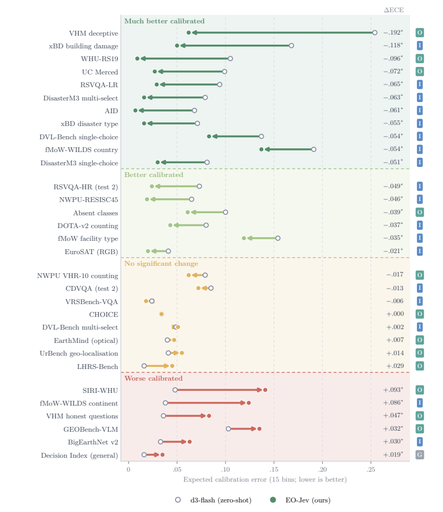
Figure 4 Calibration change from d3-flash to EO-Jev.Each arrow runs from d3-flash’s ECE (open circle) to EO-Jev’s (filled circle); lower is better. Rows are grouped by∆ECE=EO-Jev − d3-flash: much better calibrated (∆ECE ≤− 0.05), better calibrated, no significant change, and worse calibrated.∗: the paired 95% bootstrap interval (over images) excludes zero. Badges:I= in-domain,O= out-of-domain,G= general (non-EO) retention check. All EO rows in the bottom tier are over-confident; the Decision Index is slightly under-confident.
원문 · CC BY 4.0 · Mohamed Atef Abouelhadid, Diaa Addeen Abuhani, Muhammad Akhtar Munir, Fahad Shahbaz Khan, Salman Khan · EO-Jev: Decision Model for Earth Observation · 원문 그림 인용 · 원본 PDF 9쪽에서 그림 영역을 추출했습니다.보정이 악화된 설정에서는 평균 신뢰도가 정확도보다 높은 체계적 과신이 확인됩니다. 이 격차는 SIRI-WHU, GEOBench-VLM, fMoW-WILDS continent에서 12~14 퍼센트포인트입니다. 저자들은 이러한 과신이 무작위 변동보다는 체계적 현상이라고 보고, 개발 세트 기반의 과제별 temperature scaling이 많은 오차를 줄일 수 있다고 해석합니다. 이 해석은 본 연구에서 실제로 검증되지 않았습니다.
추론 비용은 같은 4×A100-80GB 노드, BF16 조건에서 같은 시드 기반 160개 질문 표본으로 측정되었습니다. 질문을 하나씩 호출할 때 최고 전문가 대비 중앙 지연시간 배율은 3.2배이고, 배치 처리 시 최고 피크 처리량 기준 배율은 6.4배입니다. 전문가가 더 빠른 행도 있습니다. 이 속도 차이는 더 작은 모델 때문이 아니라 생성 대신 결정을 읽어내는 구조에서 나온다고 설명됩니다.
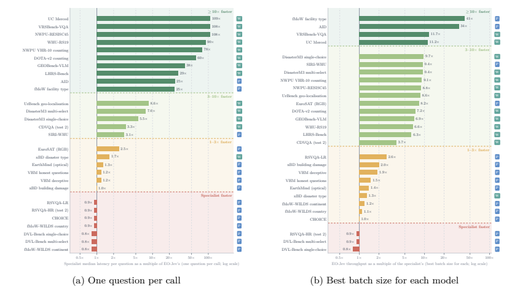
Figure 5 Inference cost against the specialists.(a) Specialist median latency per question as a multiple of EO-Jev’s, one question per call. (b) EO-Jev throughput as a multiple of the specialist’s, each at its best batch size. Bars are grouped by speed-up; red rows are those where the specialist is faster. Badges give the specialist’s best-accuracy mode (P: prompted, W: wrapped/generative). All models run on the same exclusive node (4×A100, BF16), on the same 160-question seeded sample per row, with image decoding inside the timed region. Medians: 3.2× in (a) and 6.4× in (b).
원문 · CC BY 4.0 · Mohamed Atef Abouelhadid, Diaa Addeen Abuhani, Muhammad Akhtar Munir, Fahad Shahbaz Khan, Salman Khan · EO-Jev: Decision Model for Earth Observation · 원문 그림 인용 · 원본 PDF 11쪽에서 그림 영역을 추출했습니다.남은 한계와 적용 범위
계수 과제는 적응 후에도 가장 뚜렷한 약점입니다. d3-flash는 DOTA-v2에서 계수 정확도 33.8, NWPU VHR-10에서 64.2를 보였습니다. EO-Jev는 NWPU VHR-10에서 72.0으로 올랐지만 RSThinker에 7.8점 뒤집니다. 변화 정량화도 어렵습니다. CDVQA에서 d3-flash는 468개 질문 중 401개에서 영상과 무관하게 건물을 답했습니다. 피해 등급 정확도 41.1은 무작위 기준인 25.0보다 조금 높은 수준입니다.
선택지 순서 일관성도 적응으로 일부 약해집니다. CHOICE는 −1.5, LHRS-Bench 엄격 정확도는 −5.2 낮아졌습니다. 이 두 결과는 학습 중 선택지 순열 증강이 없다는 조건과 연결해 해석해야 합니다. 기하 및 교차 시점 추론은 UrBench에서 60.3에서 61.5로 유의하게 변하지 않았고, 학습 데이터에는 교차 시점 감독이 없었습니다.
적용 범위도 제한됩니다. 평가는 주로 광학 항공·위성 영상이며 SAR 입력은 제외되었습니다. 결과는 여기서 사용한 30개 설정과 각 설정의 학습 분할 구성에 대한 것입니다. 일반 결정 능력의 1.8점 하락은 보존 점검으로 측정된 값입니다.
논문 정보
- 저자
- Mohamed Atef Abouelhadid, Diaa Addeen Abuhani, Muhammad Akhtar Munir, Fahad Shahbaz Khan, Salman Khan
- 학회·저널
- arXiv · 프리프린트
- 최초 공개일
- 2026년 11월 2일
- 등록일
- 2026년 11월 4일
- 수정일
- 2026년 11월 2일
- 버전
- v1
- arXiv
- 2611.03371
- 분류
- cs.CV
- 원문 이용 조건
- CC BY 4.0
- 제공 범위
- 논문 정보, 해설, 허용된 원문 그림
AI 해설은 논문 원문과 별개의 설명이며 오류가 있을 수 있습니다. 원문과 그림은 각 출처의 이용 조건과 따로 표시된 권리를 따릅니다.
초록
Earth observation (EO) workflows require selecting among known outcomes, estimating confidence, and processing large volumes of imagery. Generative vision-language models can address these tasks, but autoregressive decoding is computationally costly and their confidence estimates are unreliable. Decision models offer an alternative, returning probabilities over candidate answers in a single forward pass. However, their accuracy, calibration, and transfer across EO tasks remain insufficiently understood. We investigate these properties through a diagnostic study of d3-flash (8.4B parameters) across 30 settings from 23 public EO benchmarks. We find that compositional reasoning transfers well and calibration improves over its Qwen3.5-9B backbone on 24 settings, while counting, change quantification, damage grading, and absent-object recognition remain challenging. To address these limitations, we adapt d3-flash through low-rank fine-tuning on public EO training splits, producing EO-Jev. EO-Jev improves significantly over d3-flash on 26 of 30 settings and matches or exceeds specialist references on 20 of 28. It also achieves an average gain of 8.0 points across 12 held-out settings and lower expected calibration error than specialists on 21 of 28 settings. These improvements come at a modest cost of 1.8 points in general decision performance. Our results demonstrate the potential of adapting general decision models into competitive EO generalists while highlighting persistent challenges in quantitative perception, option-order consistency, and calibration under distribution shift.
원문 인용
Mohamed Atef Abouelhadid, Diaa Addeen Abuhani, Muhammad Akhtar Munir, Fahad Shahbaz Khan, Salman Khan (2026). EO-Jev: Decision Model for Earth Observation. arXiv:2611.03371v1. https://arxiv.org/abs/2611.03371v1
BibTeX
@misc{abouelhadid2026decision,
  title = {{EO-Jev: Decision Model for Earth Observation}},
  author = {Mohamed Atef Abouelhadid and Diaa Addeen Abuhani and Muhammad Akhtar Munir and Fahad Shahbaz Khan and Salman Khan},
  year = {2026},
  eprint = {2611.03371},
  archivePrefix = {arXiv},
  url = {https://arxiv.org/abs/2611.03371v1}
}