논문 해설
Posterior Inference with Diffusion Models for High-dimensional Black-box Optimization
고차원 블랙박스 최적화를 위한 확산 모델 기반 사후 추론
- 연구 문제 고차원 블랙박스 최적화에서 BO는 차원의 저주로 확장성이 떨어지고, 생성 모델 기반 방법은 표현력과 불확실성 추정의 한계를 가집니다.
- 연구 방법 DiBO는 확산 모델 사전분포와 프록시 앙상블의 UCB 보상을 곱한 사후분포에서 후보를 샘플링하고, RTB로 미세조정한 샘플러와 local search, filtering으로 후보를 고릅니다.
- 주요 결과 합성 함수와 실세계 과제에서 DiBO는 보고된 기준선들보다 우수했으며, 재가중 학습을 제거하면 성능이 떨어졌습니다.
고차원 블랙박스 최적화의 어려움
블랙박스 함수 최적화는 신약 설계나 하이퍼파라미터 탐색처럼 평가 비용이 큰 여러 과학·공학 문제에서 핵심적인 역할을 합니다. 베이지안 최적화(BO)는 적은 평가로 좋은 설계를 찾는 강력한 방법이지만, 차원이 커지면 차원의 저주로 성능이 떨어지고 수천 번 이상의 평가로 확장하기 어렵습니다. 생성 모델을 이용한 최적화는 이런 한계를 우회하는 방법으로 주목받았지만, 고차원에서는 모델의 표현력이 제한되고 불확실성 추정이 어려워 BO에 미치지 못하는 경우가 많았습니다. 이 논문은 후보 선택을 획득 함수의 최대화 문제가 아니라 사후분포에서의 샘플링 문제로 바꾸어 이 두 가지 문제를 함께 다룹니다.
사후분포 샘플링으로 후보를 고르는 DiBO
DiBO는 확산 모델을 데이터 분포의 사전분포로 쓰고, 프록시 앙상블이 주는 UCB 점수를 보상으로 결합한 사후분포 p_post(x) ∝ p_θ(x)·exp(β·r_φ(x))에서 후보를 뽑습니다. 여기서 r_φ(x)=μ_φ(x)+γ·σ_φ(x)는 프록시의 평균과 표준편차로 계산한 UCB 점수이며, β는 보상 항과 사전분포 사이의 균형을 조절합니다. 사후분포의 정규화 상수는 알 수 없으므로, 확산 모델을 relative trajectory balance(RTB) 손실로 미세조정하여 사후분포의 amortized sampler p_ψ를 얻습니다. 이 과정에서 온폴리시 궤적과 버퍼에서 가져온 오프폴리시 궤적을 함께 사용합니다.
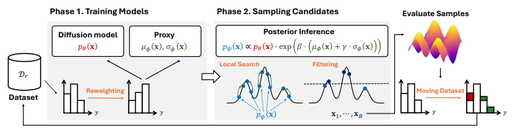
Figure 2 . Overview of our method. Phase 1: Train diffusion models and ensemble of proxies. Phase 2: Sampling candidates from the posterior distribution and post-processing via local search and filtering. Then, we evaluate samples, update the dataset, and repeat the process until we find an optimal design.
원문 · CC BY 4.0 · Yun, Taeyoung, Om, Kiyoung, Lee, Jaewoo, Yun, Sujin, Park, Jinkyoo · Posterior Inference with Diffusion Models for High-dimensional Black-box Optimization · 원문 그림 인용 · 원본 PDF 3쪽에서 그림 영역을 추출했습니다.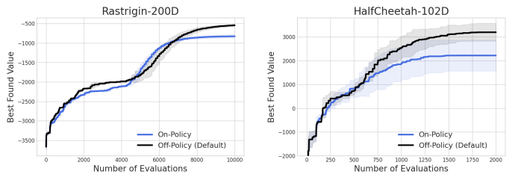
Figure 8 . Performance of DiBO in Rastrigin-200D and HalfCheetah-102D with and without off-policy training. Experiments are conducted with four random seeds. Mean and one standard deviation are reported.
원문 · CC BY 4.0 · Yun, Taeyoung, Om, Kiyoung, Lee, Jaewoo, Yun, Sujin, Park, Jinkyoo · Posterior Inference with Diffusion Models for High-dimensional Black-box Optimization · 원문 그림 인용 · 원본 PDF 18쪽에서 그림 영역을 추출했습니다.샘플링된 후보는 바로 평가되지 않습니다. local search는 확률 흐름 ODE로 계산한 주변 로그우도의 그래디언트를 이용해 후보를 고밀도 모드 쪽으로 이동시키고, filtering은 비정규화 목표 밀도 p_θ(x)·exp(β·r_φ(x))가 높은 상위 B개를 고릅니다. 평가된 후보는 데이터셋에 더해지며, 버퍼 크기 L을 넘으면 함수값이 낮은 샘플을 제거하여 고득점 영역에 집중하게 합니다.
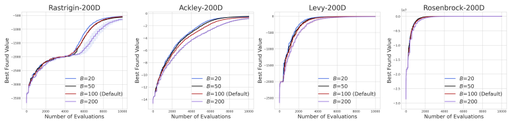
Figure 10 . Performance of DiBO in synthetic functions by varying B. Experiments are conducted with four random seeds. Mean and one standard deviation are reported.
원문 · CC BY 4.0 · Yun, Taeyoung, Om, Kiyoung, Lee, Jaewoo, Yun, Sujin, Park, Jinkyoo · Posterior Inference with Diffusion Models for High-dimensional Black-box Optimization · 원문 그림 인용 · 원본 PDF 19쪽에서 그림 영역을 추출했습니다.합성 함수와 실세계 과제에서의 비교
합성 함수 실험에서는 Rastrigin, Ackley, Levy, Rosenbrock 함수를 200차원과 400차원에서 평가했고, 초기 데이터셋 크기 200, 배치 크기 100, 최대 평가 한도 10,000으로 설정했습니다. 결과는 네 개의 랜덤 시드 평균과 표준편차 1개로 보고되었습니다. 저자들은 DiBO가 TuRBO, LA-MCTS, CMA-BO 같은 BO 계열과 CbAS, MINs, DDOM, Diff-BBO 같은 생성 모델 기반 방법보다 우수하다고 보고합니다. 특히 국소 최적점이 많은 Rastrigin과 Ackley에서 격차가 크다고 합니다.
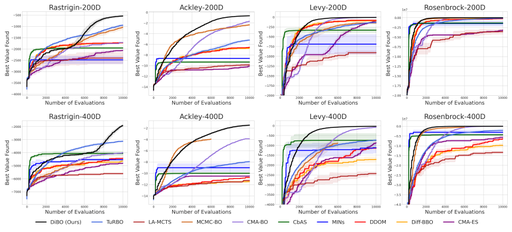
Figure 3 . Comparison between our method against baselines in synthetic tasks. Experiments are conducted with four random seeds, and the mean and one standard deviation are reported.
원문 · CC BY 4.0 · Yun, Taeyoung, Om, Kiyoung, Lee, Jaewoo, Yun, Sujin, Park, Jinkyoo · Posterior Inference with Diffusion Models for High-dimensional Black-box Optimization · 원문 그림 인용 · 원본 PDF 5쪽에서 그림 영역을 추출했습니다.실세계 과제는 HalfCheetah-102D, RoverPlanning-100D, DNA-180D이며, 초기 데이터셋 100, 배치 크기 50, 최대 평가 한도 2,000으로 실행되었고 열 개의 랜덤 시드를 사용했습니다. 이 실험의 조건은 합성 함수 실험과 달라서 두 결과를 하나의 공통 설정으로 합치면 안 됩니다. MCMC-BO는 D=400 과제에서 메모리 제약으로 6,000 평가 시점의 점수가 보고되었습니다.
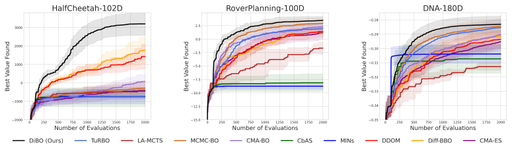
Figure 4 . Comparison between our method against baselines in real-world tasks. Experiments are conducted with ten random seeds, and the mean and one standard deviation are reported.
원문 · CC BY 4.0 · Yun, Taeyoung, Om, Kiyoung, Lee, Jaewoo, Yun, Sujin, Park, Jinkyoo · Posterior Inference with Diffusion Models for High-dimensional Black-box Optimization · 원문 그림 인용 · 원본 PDF 6쪽에서 그림 영역을 추출했습니다.재가중 학습 제거 실험
절제 실험은 Rastrigin-200D와 HalfCheetah-102D 과제에서 수행되었습니다. 재가중 학습을 제거하면 DiBO의 성능이 뚜렷하게 떨어진다고 저자들은 보고합니다. 이는 높은 점수의 데이터에 집중하는 학습이 최적화 속도를 높인다는 해석으로 이어집니다. 같은 절에서 저자들은 학습 에폭을 단순히 늘리는 것이 성능 향상으로 이어지지 않는다고 밝힙니다.
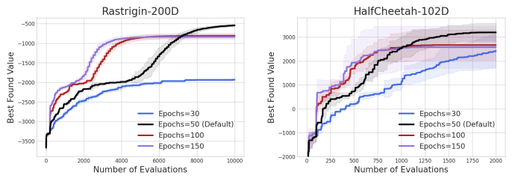
Figure 6 . Performance of DiBO in Rastrigin-200D and HalfCheetah-102D by varying training epochs. Experi- ments are conducted with four random seeds. Mean and one standard deviation are reported.
원문 · CC BY 4.0 · Yun, Taeyoung, Om, Kiyoung, Lee, Jaewoo, Yun, Sujin, Park, Jinkyoo · Posterior Inference with Diffusion Models for High-dimensional Black-box Optimization · 원문 그림 인용 · 원본 PDF 17쪽에서 그림 영역을 추출했습니다.한계와 향후 과제
저자들이 밝힌 주요 한계는 매 라운드마다 확산 모델을 업데이트된 데이터셋으로 다시 학습해야 한다는 점입니다. 저자들은 계산 복잡도가 기존 기준선보다 낮다고 분석하지만, 이전 라운드의 학습된 모델을 효율적으로 재사용하는 방법은 향후 과제로 남겨 둡니다. 따라서 계산 비용의 이점은 본 실험의 구현과 측정 조건 안에서 읽어야 합니다.
논문 정보
- 저자
- Yun, Taeyoung, Om, Kiyoung, Lee, Jaewoo, Yun, Sujin, Park, Jinkyoo
- 학회·저널
- arXiv · 프리프린트
- 최초 공개일
- 2025년 2월 24일
- 등록일
- 2026년 10월 29일
- 수정일
- 2025년 7월 3일
- 버전
- v2
- arXiv
- 2502.16824
- 원문 이용 조건
- CC BY 4.0
- 제공 범위
- 논문 정보, 해설, 허용된 원문 그림
AI 해설은 논문 원문과 별개의 설명이며 오류가 있을 수 있습니다. 원문과 그림은 각 출처의 이용 조건과 따로 표시된 권리를 따릅니다.
초록
Optimizing high-dimensional and complex black-box functions is crucial in numerous scientific applications. While Bayesian optimization (BO) is a powerful method for sample-efficient optimization, it struggles with the curse of dimensionality and scaling to thousands of evaluations. Recently, leveraging generative models to solve black-box optimization problems has emerged as a promising framework. However, those methods often underperform compared to BO methods due to limited expressivity and difficulty of uncertainty estimation in high-dimensional spaces. To overcome these issues, we introduce \textbf{DiBO}, a novel framework for solving high-dimensional black-box optimization problems. Our method iterates two stages. First, we train a diffusion model to capture the data distribution and deep ensembles to predict function values with uncertainty quantification. Second, we cast the candidate selection as a posterior inference problem to balance exploration and exploitation in high-dimensional spaces. Concretely, we fine-tune diffusion models to amortize posterior inference. Extensive experiments demonstrate that our method outperforms state-of-the-art baselines across synthetic and real-world tasks. Our code is publicly available \href{https://github.com/umkiyoung/DiBO}{here}.
원문 인용
Yun, Taeyoung, Om, Kiyoung, Lee, Jaewoo, Yun, Sujin, Park, Jinkyoo (2025). Posterior Inference with Diffusion Models for High-dimensional Black-box Optimization. arXiv:2502.16824v2. https://arxiv.org/abs/2502.16824v2
BibTeX
@misc{taeyoung2025posterior,
  title = {{Posterior Inference with Diffusion Models for High-dimensional Black-box Optimization}},
  author = {Yun, Taeyoung and Om, Kiyoung and Lee, Jaewoo and Yun, Sujin and Park, Jinkyoo},
  year = {2025},
  eprint = {2502.16824},
  archivePrefix = {arXiv},
  url = {https://arxiv.org/abs/2502.16824v2}
}