논문 해설
VideoMemBench: How Well Do MLLMs Remember in Video Conversations?
VideoMemBench: 다중모달 LLM은 비디오 대화를 얼마나 잘 기억하는가?
- 연구 문제 기존 비디오 QA는 질문들이 독립적이라 여러 턴에 걸친 대화 기억을 측정하지 못합니다.
- 연구 방법 하나의 비디오에 긴 다중 턴 대화를 짝지은 VideoMemBench를 구축하고, Episodic 및 Answer 의존성을 계획, 생성, 검사, 전문가 검토로 만듭니다.
- 주요 결과 최고 모델 Claude Opus 5의 Overall은 45.7%이며 사람 기준선은 86.1%입니다. Answer 의존 턴은 TurnAcc보다 낮은 정확도를 보입니다.
문제 설정: 대화 기억을 측정하지 못하는 기존 비디오 QA
기존 비디오 질의응답 벤치마크는 질문들이 서로 독립적이고 각 질문이 영상만으로 답할 수 있도록 구성되어 있습니다. 따라서 여러 턴에 걸쳐 앞선 대화에서 확립된 내용을 다시 꺼내 써야 하는 능력은 측정되지 않습니다. 이 논문은 이 능력을 in-context video memory라고 부르며, 모델이 본 장면을 기억하는 능력과 자신이 말한 답을 기억하는 능력을 구분해 평가하려고 합니다.
이를 위해 저자들은 하나의 비디오에 긴 다중 턴 대화를 짝지은 VideoMemBench를 구축했습니다. 각 턴은 Episodic Dependency 또는 Answer Dependency로 앞선 턴과 연결되며, 의존 턴은 부모 턴 없이는 답할 수 없어야 하고 질문이 부모 턴의 내용을 그대로 다시 진술하지 않아야 합니다.
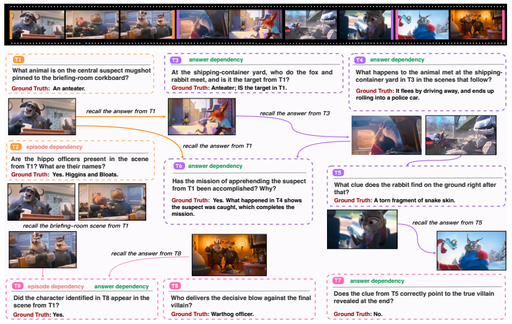
Figure 1 Example of VideoMemBench with cross-turn dependencies:Independent turns (e.g., T1, T8) establish visually grounded facts; dependent turns refer back to earlier turns through expressions such as “the scene fromT1” or “the target from T1”, without restating earlier content. AnEpisodic Dependency(e.g., T2) requires recallingwhat the model has seen: the model must recover which sceneT1 described before answering the question. AnAnswer Dependency (e.g.,T 3,T 4) requires recallingwhat the model has said: each builds on the answer produced at an earlier turn.
원문 · CC BY 4.0 · Zhengdong Hu, Chao Wang, Kaituo Feng, Huanjin Yao, Mingfei Lu, Hehe Fan, Yi Yang · VideoMemBench: How Well Do MLLMs Remember in Video Conversations? · 원문 그림 인용 · 원본 PDF 2쪽에서 그림 영역을 추출했습니다.데이터 구축: 계획, 생성, 검사, 전문가 검토의 연결
구축 절차는 계획자, 생성자, 판정자의 세 LLM 역할과 인간 검토를 결합합니다. 계획자는 질문을 쓰기 전에 비디오 개요, 대화 지침, 턴 간 의존성 그래프와 턴별 의도를 만듭니다. 이렇게 먼저 구조를 정하는 이유는 의존성이 우연한 참조가 아니라 실제로 필요한 구조가 되도록 하기 위해서입니다.
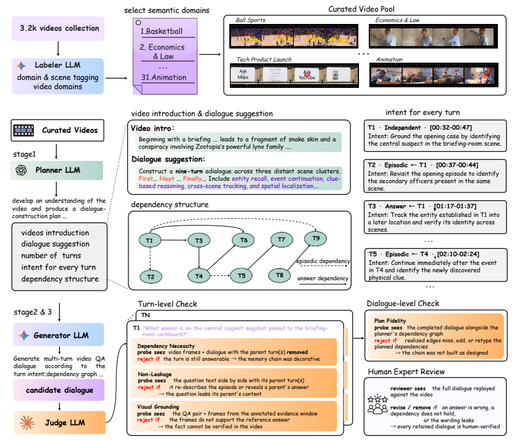
Figure 2 The VideoMemBench construction pipeline.Starting from a curated video pool, a planner specifies turn intents and a typed dependency graph. A generator constructs the dialogue turn by turn, while a judger checks necessity, non-leakage, and visual grounding, returning failed turns for regeneration. Completed dialogues are checked against the plan and reviewed by human experts.
원문 · CC BY 4.0 · Zhengdong Hu, Chao Wang, Kaituo Feng, Huanjin Yao, Mingfei Lu, Hehe Fan, Yi Yang · VideoMemBench: How Well Do MLLMs Remember in Video Conversations? · 원문 그림 인용 · 원본 PDF 5쪽에서 그림 영역을 추출했습니다.생성자는 계획에 따라 턴을 하나씩 작성하며, 부모 턴은 지시 표현으로만 참조하고 각 답은 프레임 근거에 고정합니다. 판정자는 의존 필요성, 비누설, 시각적 근거를 턴 단위로 검사하고 실패한 턴을 피드백과 함께 재생성합니다. 완성된 대화는 계획 그래프와 대조된 뒤 여덟 명의 전문가가 검토합니다.
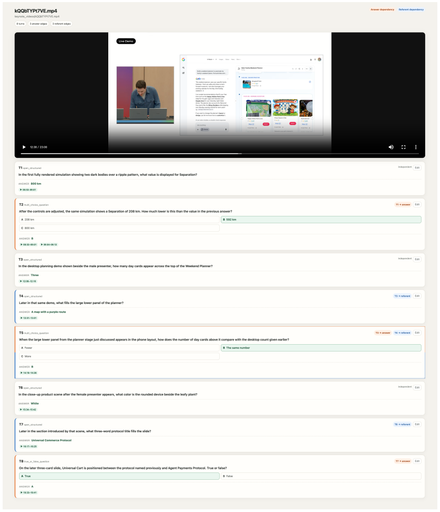
Figure 5 The expert review interface.For each dialogue, the expert replays the video in the top panel, where the evidence window of the current turn is marked on the timeline, and reads the dialogue turn by turn, where the parent turns and the type of each dependency are highlighted. The expert answers the current question before the reference answer is revealed, then marks the turn ascorrect,answer wrong,dependency not required,wording leaks a parent, or duplicate, and edits the question, the options, or the answer in place. A dialogue is retained only after every turn has been marked correct or revised, and the interface records each decision together with the time spent on the turn. Referent here means episodic dependency. Please zoom in to see the details.
원문 · CC BY 4.0 · Zhengdong Hu, Chao Wang, Kaituo Feng, Huanjin Yao, Mingfei Lu, Hehe Fan, Yi Yang · VideoMemBench: How Well Do MLLMs Remember in Video Conversations? · 원문 그림 인용 · 원본 PDF 21쪽에서 그림 영역을 추출했습니다.최종 데이터는 326개 비디오와 2,476개 턴으로 이루어지며, 그중 1,387개 턴이 의존 턴입니다. 의존성은 Episodic 1,200개와 Answer 594개, 합계 1,794개입니다. 여러 부모를 가진 턴은 348개입니다.
평가 프로토콜과 세 가지 지표
모델은 전체 비디오에서 균등 샘플링된 128개 프레임과 시간 정보를 함께 받습니다. 질문은 대화 순서대로 제시되며, 이전 질문과 모델이 실제로 낸 응답이 대화 이력에 남습니다. 이 설정을 self-rollout 프로토콜이라고 부릅니다.
지표는 세 가지입니다. TurnAcc는 모든 턴을 부모 턴의 정답 여부와 무관하게 채점합니다. EpiDepAcc는 Episodic 의존이 하나 이상인 턴을 부모의 정답과 독립적으로 채점하며, 이는 모델이 본 내용을 얼마나 되살리는지를 봅니다. AnsDepAcc는 Answer 의존이 하나 이상인 턴에 대해 chain crediting을 적용합니다. 즉 해당 턴과 Answer 방향으로 거슬러 올라간 조상 턴들의 응답이 모두 정답이어야 점수를 받으며, Episodic 간선은 이 순회에서 제외됩니다. Overall은 세 지표의 산술 평균이며 모델 순위를 매기는 데 쓰입니다.
주요 결과: 최고 모델과 사람 기준선의 차이
25개 모델을 평가한 결과, 폐쇄형 모델 중 Claude Opus 5가 Overall 45.7%로 가장 높았습니다. 이 모델의 TurnAcc는 52.3%, EpiDepAcc는 49.1%, AnsDepAcc는 35.7%입니다. 사람 주석자의 Overall은 86.1%이므로 격차가 큽니다.
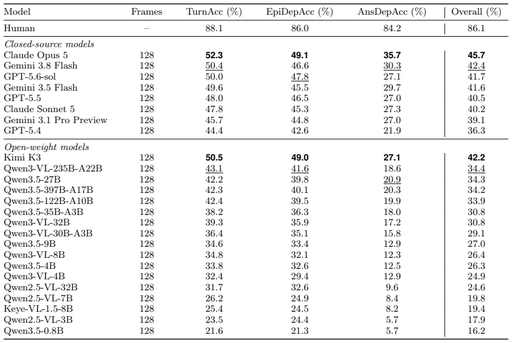
Table 2 Main results on VideoMemBench.Models are evaluated under the self-rollout protocol. TurnAcc: accuracy over all turns, scored individually. EpiDepAcc: accuracy on turns with at least one Episodic dependency. AnsDepAcc: accuracy on turns with at least one Answer dependency under chain crediting. Overall: the arithmetic mean of the three metrics. The best and second-best results in each metric within each model group areboldandunderlined, respectively.
원문 · CC BY 4.0 · Zhengdong Hu, Chao Wang, Kaituo Feng, Huanjin Yao, Mingfei Lu, Hehe Fan, Yi Yang · VideoMemBench: How Well Do MLLMs Remember in Video Conversations? · 원문 그림 인용 · 원본 PDF 8쪽에서 그림 영역을 추출했습니다.개방형 가중치 모델 중에서는 Kimi K3가 Overall 42.2%로 가장 높았으며, TurnAcc 50.5%, EpiDepAcc 49.0%, AnsDepAcc 27.1%를 기록했습니다. 이 결과는 128 프레임 self-rollout 조건에서 얻은 것입니다.
폐쇄형 모델들에서 AnsDepAcc는 TurnAcc보다 16.6~22.9 퍼센트포인트 낮게 나타났습니다. 사람 주석자의 같은 차이는 3.9 퍼센트포인트입니다. 저자들은 이 차이가 현재 턴의 오류와 상위 Answer 의존 실패의 누적을 함께 반영한다고 해석합니다.
Answer 이력 분석: oracle 응답과 self-rollout의 차이
Answer 의존 턴의 어려움이 앞선 자기 응답의 오류에서 오는지 확인하기 위해, 저자들은 이전 모델 응답을 정답 답변으로 바꾼 oracle 이력을 사용했습니다. Qwen3-VL-8B는 self-rollout에서 12.3%였던 Answer 의존 턴 정확도가 oracle 이력에서 32.4%로, Qwen3-VL-32B는 17.2%에서 37.3%로, Gemini 3.5 Flash는 29.7%에서 47.2%로 올랐습니다.
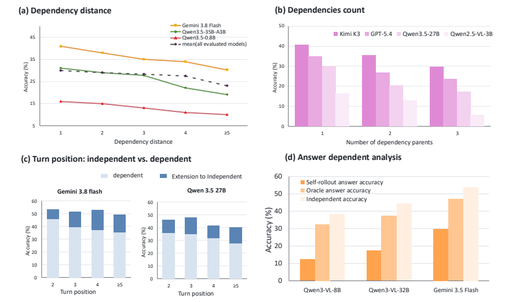
Figure 4 Analysis of factors affecting in-context video memory.(a) Accuracy on dependent turns by dependency distance, measured from the current turn to its earliest parent; the dashed line shows the mean across all evaluated models. (b) Accuracy on dependent turns by the number of parents. (c) Independent- and dependent-turn accuracy by dialogue position for two models: the light segment shows dependent-turn accuracy, the full bar height shows independent-turn accuracy, and the dark segment represents their difference. (d) Accuracy on answer-dependent turns under self-rollout and oracle histories. Oracle histories replace previous model responses with ground-truth answers.
원문 · CC BY 4.0 · Zhengdong Hu, Chao Wang, Kaituo Feng, Huanjin Yao, Mingfei Lu, Hehe Fan, Yi Yang · VideoMemBench: How Well Do MLLMs Remember in Video Conversations? · 원문 그림 인용 · 원본 PDF 9쪽에서 그림 영역을 추출했습니다.이 결과는 앞선 응답의 오류가 후속 Answer 의존 질문의 중요한 어려움임을 보여줍니다. 다만 oracle 정확도도 독립 턴 정확도보다 낮아, 정답 이력만으로는 안정적인 in-context video memory가 충분하지 않다는 것이 저자들의 해석입니다.
해석의 한계와 지표 범위
AnsDepAcc는 chain crediting 때문에 현재 턴의 오류와 상위 조상 턴의 실패를 함께 반영합니다. 따라서 낮은 AnsDepAcc 점수를 현재 턴만의 기억 실패로 읽을 수 없습니다. 이 점수는 해당 채점 규칙 안에서 해석해야 합니다.
또한 Overall은 세 지표를 평균한 순위 도구이며, 서로 겹치는 평가 부분집합의 평균입니다. 별도의 질문 집합에서 얻은 정확도가 아닙니다. 프레임 수 제거 실험은 16, 32, 64 프레임에서 13개 개방형 모델만 평가했으므로, 모든 모델과 프레임 설정으로 일반화하지 않습니다.
논문 정보
- 저자
- Zhengdong Hu, Chao Wang, Kaituo Feng, Huanjin Yao, Mingfei Lu, Hehe Fan, Yi Yang
- 학회·저널
- arXiv · 프리프린트
- 최초 공개일
- 2026년 10월 29일
- 등록일
- 2026년 11월 1일
- 수정일
- 2026년 10월 29일
- 버전
- v1
- arXiv
- 2610.40131
- 분류
- cs.CV
- 원문 이용 조건
- CC BY 4.0
- 제공 범위
- 논문 정보, 해설, 허용된 원문 그림
AI 해설은 논문 원문과 별개의 설명이며 오류가 있을 수 있습니다. 원문과 그림은 각 출처의 이용 조건과 따로 표시된 권리를 따릅니다.
초록
Multimodal large language models (MLLMs) can now process hour-long videos, making extended multi-turn dialogue over a single video a natural mode of use. Sustaining such a dialogue requires more than answering each question in isolation: the model must retrieve and reuse information established earlier in the conversation, both what it has seen and what it has said, an ability we term in-context video memory. Existing video QA benchmarks leave this ability unmeasured: their questions are mutually independent, never reference one another, and each is answerable from the video alone, so nothing ever requires carrying information across turns. We introduce VideoMemBench, in which each sample pairs a single video with a long multi-turn dialogue, whose turns are connected by typed cross-turn dependencies: an Episodic Dependency refers back to a visual episode described in an earlier turn, probing memory of what the model has seen, while an Answer Dependency builds on the model's own earlier answer, probing memory of what the model has said. Every dependency is verified considering two properties: 1) necessity, meaning the question cannot be answered without its earlier turns, and 2) non-leakage, meaning the question does not restate the information from its earlier turns. To enforce these properties, we design a construction pipeline with three LLM roles: a planner, a generator, and a judger, with each dialogue reviewed by human experts. VideoMemBench comprises 326 videos with 2,476 turns, of which 1,387 depend on earlier turns, including multi-parent dependencies and long-range call-back. Among over 20 evaluated open- and closed-source MLLMs, Claude Opus 5 performs the best with an overall score of only 45.7\%, highlighting the challenge of in-context video memory. Our dataset and evaluation are released.
원문 인용
Zhengdong Hu, Chao Wang, Kaituo Feng, Huanjin Yao, Mingfei Lu, Hehe Fan, Yi Yang (2026). VideoMemBench: How Well Do MLLMs Remember in Video Conversations?. arXiv:2610.40131v1. https://arxiv.org/abs/2610.40131v1
BibTeX
@misc{hu2026videomembench,
  title = {{VideoMemBench: How Well Do MLLMs Remember in Video Conversations?}},
  author = {Zhengdong Hu and Chao Wang and Kaituo Feng and Huanjin Yao and Mingfei Lu and Hehe Fan and Yi Yang},
  year = {2026},
  eprint = {2610.40131},
  archivePrefix = {arXiv},
  url = {https://arxiv.org/abs/2610.40131v1}
}