논문 해설
HumanLight: Incentivizing Ridesharing via Human-centric Deep Reinforcement Learning in Traffic Signal Control
HumanLight: 교통 신호 제어에서 인간 중심 심층 강화학습을 통한 승차 공유 유도
- 연구 문제 차량 단위 신호제어는 HOV 탑승자의 통행시간 보상을 충분히 반영하지 못하며, HumanLight는 사람 단위 교차로 처리량을 최적화하는 분산형 강화학습 신호제어를 제안합니다.
- 연구 방법 HumanLight는 FRAP 기반 Deep Q-learning에 사람 단위 교차로 압력 보상과 활성 차량 집합을 결합합니다.
- 주요 결과 4x4 격자의 높은 HOV 채택 시나리오에서 평균 사람 지연이 MPLight with FRAP + Pressure의 59.78초에서 HumanLight의 25.70초로 낮아졌다고 보고됩니다.
승객 단위 신호제어가 필요한 이유
도심 교통에서 단독 승차 차량은 여전히 가장 많이 선택되는 이동 수단이며, 이는 교통 혼잡과 대기오염으로 이어집니다. 카풀과 마이크로트랜짓 같은 HOV 이동 수단을 늘리려면 합승자가 합승에 따른 통행시간 손실을 보상받아야 합니다. 그러나 기존 적응형 신호제어와 강화학습 기반 신호제어는 대부분 차량 단위의 이동을 최적화하므로 탑승 인원이 다른 차량을 구별하지 않습니다. HumanLight는 이 한계를 줄이기 위해 교차로에서 처리되는 사람의 수를 최적화 대상으로 삼는 분산형 적응 신호제어 알고리즘입니다.
사람 교차로 압력과 활성 차량
HumanLight는 FRAP를 기반 모델로 채택하고, 보상 함수에 사람 단위 교차로 압력을 넣습니다. 사람 교차로 압력은 차량 수 함수 대신 사람 수 함수를 쓰며 보상은 이 값의 음수로 정의됩니다. 활성 차량은 행동 간격 동안 교차로에 도달할 수 있는 차량으로, 차량의 거리와 속도, 최대 속도와 가속도로 정해지는 범위 L로 판단합니다. 이 집합에 속한 차량의 승객 수만 상태와 보상 계산에 포함되므로, 교차로 근처의 사람 분포를 더 정확히 반영하도록 설계되어 있습니다.
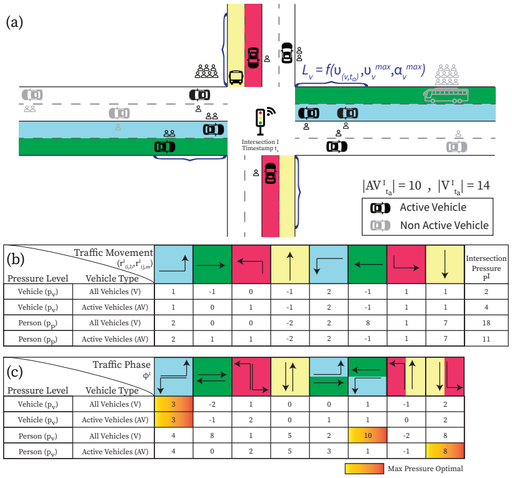
Figure 1 : (a) Standard four-way intersection with 8 incoming lanes. (b) Traffic movement illustration and pressure calculation. (c) Traffic phase illustration and pressure aggregation.The MaxPressure optimal phase is highlighted. We emphasize two keys points: i) Accounting for people movement returns a different optimal phase than the traditional vehicle-level pressure maximization strategy. ii) The introduction of active vehicles has no impact in the vehicle-level approach (same phase is returned as optimal) but radically affects the person-level approach (the returned phases are not only different but share no common movements).
원문 · CC BY 4.0 · Dimitris M. Vlachogiannis, Hua Wei, Scott Moura, Jane Macfarlane · HumanLight: Incentivizing Ridesharing via Human-centric Deep Reinforcement Learning in Traffic Signal Control · 원문 그림 인용 · 원본 PDF 6쪽에서 그림 영역을 추출했습니다.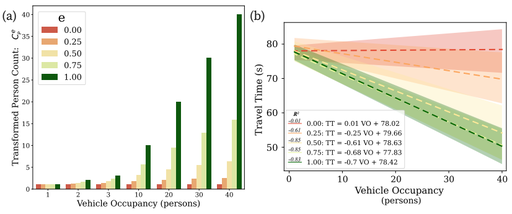
Figure 10 : (a) Five modified encodings of the person count function for the different vehicle types. (b) Linear least-squares regression fitted on means of travel times for all vehicle types.
원문 · CC BY 4.0 · Dimitris M. Vlachogiannis, Hua Wei, Scott Moura, Jane Macfarlane · HumanLight: Incentivizing Ridesharing via Human-centric Deep Reinforcement Learning in Traffic Signal Control · 원문 그림 인용 · 원본 PDF 19쪽에서 그림 영역을 추출했습니다.HOV 채택 시나리오별 비교
4x4 격자 실험에서 HumanLight는 HOV 채택이 높은 시나리오에서 MPLight with FRAP + Pressure와 비교되었습니다. 이 비교에서 평균 사람 지연은 HumanLight 25.70초, MPLight with FRAP + Pressure 59.78초로 보고되었습니다. 저자들은 높은 HOV 채택 시나리오에서 사람 지연과 대기열의 개선이 SOTA 대비 55%를 넘는다고 보고합니다. 이 결과는 교통 수요를 시나리오별로 고정하고 HOV 채택 비율을 바꾼 설정에서 얻어졌으며, SOV 약 15%가 마이크로트랜짓과 대중교통으로 이동하는 가정이 포함됩니다.
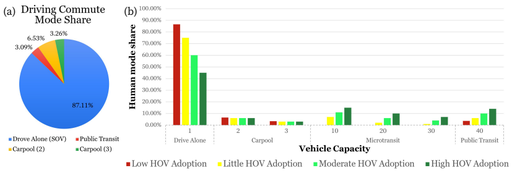
Figure 2 : (a) Adjusted driving commute mode share statistics drawn from the Bureau of Transportation Statistics for the year 2021. (b) Vehicle occupancy profiles for the HOV adoption scenarios (low, light, medium and high). Across each of the four scenarios, 15% of the single occupancy vehicle individuals shift to microtransit vehicles and public transit. Carpool ridership has been preserved at the same levels.
원문 · CC BY 4.0 · Dimitris M. Vlachogiannis, Hua Wei, Scott Moura, Jane Macfarlane · HumanLight: Incentivizing Ridesharing via Human-centric Deep Reinforcement Learning in Traffic Signal Control · 원문 그림 인용 · 원본 PDF 9쪽에서 그림 영역을 추출했습니다.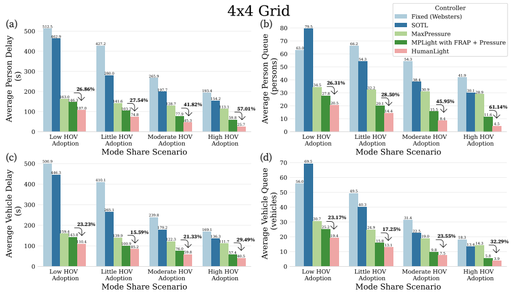
Figure 5 : Performance evaluation of HumanLight versus the SOTA vehicle-level optimization controllers in the 4x4 grid setting: the person-level benefits (a&b) of HumanLight increase as more people shift towards HOV alternatives. Thanks to the consideration of active vehicles, vehicle-level metrics (c&d) also improve. The corresponding results for the single intersection and corridor experiments are provided in Tables A1, A2 and A3.
원문 · CC BY 4.0 · Dimitris M. Vlachogiannis, Hua Wei, Scott Moura, Jane Macfarlane · HumanLight: Incentivizing Ridesharing via Human-centric Deep Reinforcement Learning in Traffic Signal Control · 원문 그림 인용 · 원본 PDF 14쪽에서 그림 영역을 추출했습니다.적용 범위와 해석의 한계
이 결과는 단일 교차로, 1x6 회랑, 4x4 격자 등 원문이 설정한 네트워크와 CityFlow 시뮬레이션 조건에서 얻어졌습니다. 평가 지표는 평균 사람 지연과 사람 대기열 중심이며, 실제 도시 규모 네트워크나 배출가스 영향은 원문에서 이어지는 향후 과제로 제시됩니다. 따라서 높은 HOV 채택 시나리오의 개선 폭을 모든 도시 교통에 그대로 일반화해서는 안 됩니다.
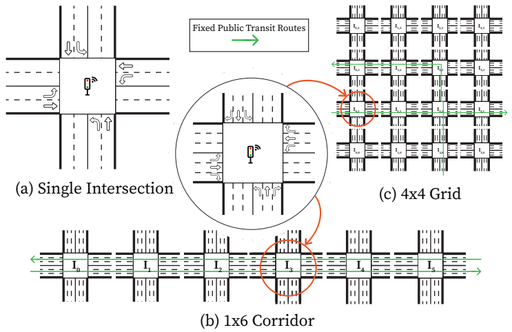
Figure 3 : Road Network Configurations: (a) Isolated four-way intersection where each road segment has one through and one left turning lane, (b) Six intersection corridor and (c) 4X4 grid of intersections with three lanes per road segment (one through, one left turning, and one right turning). Fixed public transit routelines are illustrated in green.
원문 · CC BY 4.0 · Dimitris M. Vlachogiannis, Hua Wei, Scott Moura, Jane Macfarlane · HumanLight: Incentivizing Ridesharing via Human-centric Deep Reinforcement Learning in Traffic Signal Control · 원문 그림 인용 · 원본 PDF 10쪽에서 그림 영역을 추출했습니다.논문 정보
- 저자
- Dimitris M. Vlachogiannis, Hua Wei, Scott Moura, Jane Macfarlane
- 학회·저널
- arXiv · 프리프린트
- 최초 공개일
- 2023년 4월 5일
- 등록일
- 2026년 11월 6일
- 수정일
- 2023년 4월 5일
- 버전
- v1
- arXiv
- 2304.03697
- 분류
- cs.LG · cs.AI · eess.SY
- 원문 이용 조건
- CC BY 4.0
- 제공 범위
- 논문 정보, 해설, 허용된 원문 그림
AI 해설은 논문 원문과 별개의 설명이며 오류가 있을 수 있습니다. 원문과 그림은 각 출처의 이용 조건과 따로 표시된 권리를 따릅니다.
초록
Single occupancy vehicles are the most attractive transportation alternative for many commuters, leading to increased traffic congestion and air pollution. Advancements in information technologies create opportunities for smart solutions that incentivize ridesharing and mode shift to higher occupancy vehicles (HOVs) to achieve the car lighter vision of cities. In this study, we present HumanLight, a novel decentralized adaptive traffic signal control algorithm designed to optimize people throughput at intersections. Our proposed controller is founded on reinforcement learning with the reward function embedding the transportation-inspired concept of pressure at the person-level. By rewarding HOV commuters with travel time savings for their efforts to merge into a single ride, HumanLight achieves equitable allocation of green times. Apart from adopting FRAP, a state-of-the-art (SOTA) base model, HumanLight introduces the concept of active vehicles, loosely defined as vehicles in proximity to the intersection within the action interval window. The proposed algorithm showcases significant headroom and scalability in different network configurations considering multimodal vehicle splits at various scenarios of HOV adoption. Improvements in person delays and queues range from 15% to over 55% compared to vehicle-level SOTA controllers. We quantify the impact of incorporating active vehicles in the formulation of our RL model for different network structures. HumanLight also enables regulation of the aggressiveness of the HOV prioritization. The impact of parameter setting on the generated phase profile is investigated as a key component of acyclic signal controllers affecting pedestrian waiting times. HumanLight's scalable, decentralized design can reshape the resolution of traffic management to be more human-centric and empower policies that incentivize ridesharing and public transit systems.
원문 인용
Dimitris M. Vlachogiannis, Hua Wei, Scott Moura, Jane Macfarlane (2023). HumanLight: Incentivizing Ridesharing via Human-centric Deep Reinforcement Learning in Traffic Signal Control. arXiv:2304.03697v1. https://arxiv.org/abs/2304.03697v1
BibTeX
@misc{vlachogiannis2023humanlight,
  title = {{HumanLight: Incentivizing Ridesharing via Human-centric Deep Reinforcement Learning in Traffic Signal Control}},
  author = {Dimitris M. Vlachogiannis and Hua Wei and Scott Moura and Jane Macfarlane},
  year = {2023},
  eprint = {2304.03697},
  archivePrefix = {arXiv},
  url = {https://arxiv.org/abs/2304.03697v1}
}