논문 해설
MessyNav: Zero-Shot Navigation via Manipulation in Messy Environments
MessyNav: 어수선한 환경에서의 조작을 통한 제로샷 내비게이션
- 연구 문제 실제 환경에서 일상 객체로 막힌 통로를 로봇이 학습 없이 판단하고 조작해 통과하는 문제를 다룹니다.
- 연구 방법 VLM 기반 affordance 추론을 작업 계획 앞에 명시적으로 두고, 그 라벨을 바탕으로 move to, swipe, pick up 행동을 계획합니다.
- 주요 결과 affordance 분류 정확도는 85.7%, 실로봇 성공률은 15회 중 10회로 기준선보다 높았고, 대규모 오프라인 평가에서도 7.0 퍼센트포인트 높았습니다.
열린 환경에서의 상호작용 내비게이션 문제
실제 환경에서는 복도나 방의 통로가 의자, 상자, 장난감 같은 일상 객체로 막히는 경우가 많습니다. 기존 내비게이션 스택은 모든 장애물을 움직일 수 없는 기하학적 경계로 취급하므로, 가벼운 물건을 밀어내야 하는 상황에서도 경로를 찾지 못합니다. 반대로 상호작용 내비게이션 연구는 시뮬레이션 기반 학습이나 미리 정의된 범주별 affordance에 의존해 새로운 객체와 맥락에 일반화하기 어렵습니다.
이 논문은 이 문제를 열린 세계의 상호작용 내비게이션으로 정식화합니다. 로봇은 새로운 객체, 다양한 환경, 달라지는 맥락에서 학습 없이 장애물을 밀거나 집을지, 아니면 피할지를 판단해야 합니다. 예를 들어 바퀴 달린 의자는 밀 수 있지만 '깨지기 쉬움' 표시가 붙은 상자는 피해야 합니다. 같은 카트라도 유리 제품을 싣고 있으면 피해야 한다는 점에서, 이 판단은 기하 정보만으로 결정되지 않습니다.
명시적 affordance 추론과 작업 계획의 분리
MessyNav의 핵심 설계는 무엇을 상호작용할지와 어떻게 상호작용할지를 분리하는 것입니다. 먼저 Affordance Reasoner가 RGB 이미지와 작업 설명을 바탕으로 각 객체에 interactive 또는 non-interactive 라벨과 safe, fragile, immovable 속성을 붙입니다. 이 추론은 두 단계로 진행됩니다. 첫째, 프롬프트에 포함된 로봇의 구성과 그리퍼 하중 한도, 조작 기술을 기준으로 로봇이 물리적으로 움직일 수 있는지 판단합니다. 둘째, 움직일 수 있는 객체에 대해 손상 가능성, 객체의 취약성과 가치, 배치가 의도적인지 여부를 바탕으로 상호작용 안전성을 판단합니다.
두 단계를 모두 통과한 객체만 interactive로 라벨링됩니다.
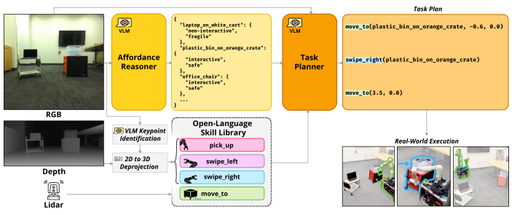
Figure 2 :MessyNav: A framework for zero-shot open-world interactive navigation. MessyNavconsists of anAffordance Reasonerthat infers object interactability from an RGB image using a VLM to evaluate both robot-centric physical feasibility and object-centric interaction safety. For example, it will label a cart with a laptop as non-interactive while labeling a wheeled crate with a bin as interactive. Given the object affordance labels, aTask Plannerthen sequences manipulation and navigation actions from an open-language skill library containing a simple set of motion primi- tives (pick up,swipe left,swipe right) and a LiDAR-based navigation stack (move to) that we find can tackle a wide range of interactive navigation scenarios. Finally, the generated plan is executed by grounding object references in 3D coordinates using VLM keypoint identification, semantic segmentation, and depth-based deprojection.
원문 · CC BY 4.0 · Kenneth Llontop, Cherie Ho, Dylan Zhou, Anuva Banwasi, Priya Sundaresan, Carlota Parés-Morlans, Jeannette Bohg · MessyNav: Zero-Shot Navigation via Manipulation in Messy Environments · 원문 그림 인용 · 원본 PDF 4쪽에서 그림 영역을 추출했습니다.이후 Task Planner는 affordance 라벨, 현재 장면 이미지, 사용 가능한 motion primitive 목록을 입력받아 move to, swipe left, swipe right, pick up으로 구성된 고수준 계획을 생성합니다. 실행 단계에서는 VLM의 포인팅과 세그먼테이션으로 객체를 찾고 깊이 정보를 이용해 3D 좌표로 바꿉니다. 이 설계에서 affordance 판단은 계획 단계의 암묵적 추론이 아니라 독립된 명시적 단계가 됩니다.
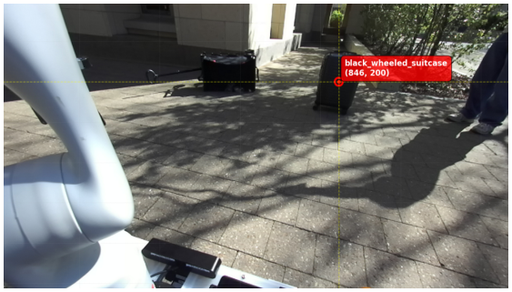
Figure 7 :Example Open-Vocabulary Keypoint Detection.We usegemini-2.5-pro[36] to detect keypoints of objects specified by the task planner through language queries.
원문 · CC BY 4.0 · Kenneth Llontop, Cherie Ho, Dylan Zhou, Anuva Banwasi, Priya Sundaresan, Carlota Parés-Morlans, Jeannette Bohg · MessyNav: Zero-Shot Navigation via Manipulation in Messy Environments · 원문 그림 인용 · 원본 PDF 17쪽에서 그림 영역을 추출했습니다.Affordance 분류 평가와 기준선 비교
affordance 추론만 따로 평가하기 위해 저자들은 객체 217개를 포함한 이미지 100장을 직접 주석했습니다. 이 평가 세트는 학습이나 fine-tuning에 쓰지 않습니다. 측정 지표는 객체별 interactive 또는 non-interactive 분류 정확도입니다.
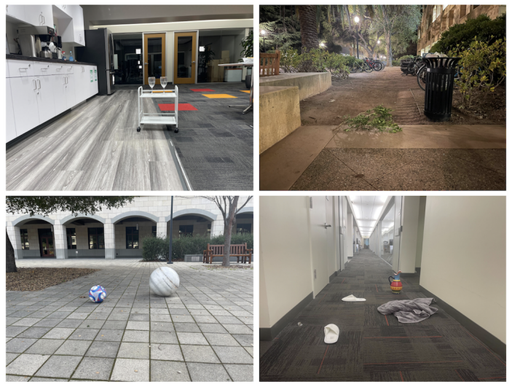
Figure 8 :Sample Images from the Affordance Reasoning Evaluation Set.To evaluate open- world interactive navigation, we collect images spanning three types of diversity: objects, environ- ments, and contextual variations.
원문 · CC BY 4.0 · Kenneth Llontop, Cherie Ho, Dylan Zhou, Anuva Banwasi, Priya Sundaresan, Carlota Parés-Morlans, Jeannette Bohg · MessyNav: Zero-Shot Navigation via Manipulation in Messy Environments · 원문 그림 인용 · 원본 PDF 18쪽에서 그림 영역을 추출했습니다.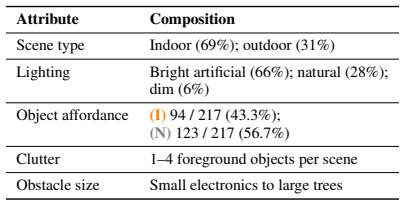
Table 5 :Composition of the Affordance Reasoning Benchmark.Our benchmark spans diverse environments, lighting, clutter, and obstacle sizes.
원문 · CC BY 4.0 · Kenneth Llontop, Cherie Ho, Dylan Zhou, Anuva Banwasi, Priya Sundaresan, Carlota Parés-Morlans, Jeannette Bohg · MessyNav: Zero-Shot Navigation via Manipulation in Messy Environments · 원문 그림 인용 · 원본 PDF 19쪽에서 그림 영역을 추출했습니다.결과에서 MessyNav는 85.7%의 정확도를 보였습니다. 높이 기준만 쓰는 height-only 기준선은 59.9%였고, 미리 정의된 범주 목록을 쓰는 closed-set 기준선은 24.4%였습니다. 범주 정답을 사용한 closed-set-oracle은 66.4%였습니다. 저자들은 이 차이를 같은 범주라도 맥락에 따라 affordance가 달라지는 경우가 많기 때문으로 해석합니다. 다만 이 수치는 해당 평가 세트와 사용한 VLM 설정에서의 결과이며, 다른 데이터셋이나 다른 로봇에 그대로 적용되는 값은 아닙니다.
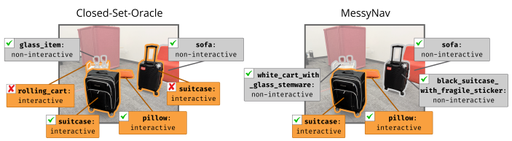
Figure 3 :MessyNavreasons about context, not just object category.In this cluttered scene, closed-set-oracleassigns affordances by category alone, misclassifying the rolling cart as interactive (ignoring the glassware it carries) and the suitcase as interactive (ignoring its fragile sticker). In contrast,MessyNavreasons at the instance level. It treats the cart and the glass stemware as a single fragile unit and reads the sticker on the suitcase as a contextual cue, cor- rectly labeling both as non-interactive.
원문 · CC BY 4.0 · Kenneth Llontop, Cherie Ho, Dylan Zhou, Anuva Banwasi, Priya Sundaresan, Carlota Parés-Morlans, Jeannette Bohg · MessyNav: Zero-Shot Navigation via Manipulation in Messy Environments · 원문 그림 인용 · 원본 PDF 6쪽에서 그림 영역을 추출했습니다.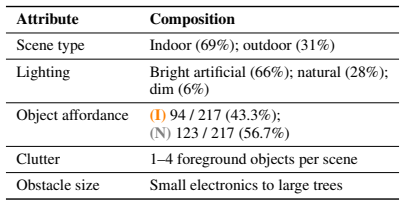
Table 6 :Example Context Variations in Affordance Reasoning Evaluation Set.The same object type is marked asinteractive (I)ornon-interactive (N)depending on context.
원문 · CC BY 4.0 · Kenneth Llontop, Cherie Ho, Dylan Zhou, Anuva Banwasi, Priya Sundaresan, Carlota Parés-Morlans, Jeannette Bohg · MessyNav: Zero-Shot Navigation via Manipulation in Messy Environments · 원문 그림 인용 · 원본 PDF 19쪽에서 그림 영역을 추출했습니다.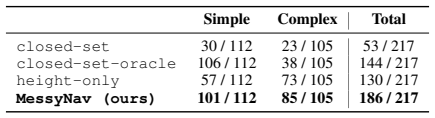
Table 7 :Affordance Reasoning Comparison. Number of objects with correctly classified inter- activity.Simplecases contain objects in their default state, whileComplexcases involve context- dependent configurations (e.g., cart with fragile items, table with vase, suitcase with caution tape).
원문 · CC BY 4.0 · Kenneth Llontop, Cherie Ho, Dylan Zhou, Anuva Banwasi, Priya Sundaresan, Carlota Parés-Morlans, Jeannette Bohg · MessyNav: Zero-Shot Navigation via Manipulation in Messy Environments · 원문 그림 인용 · 원본 PDF 21쪽에서 그림 영역을 추출했습니다.실로봇 상호작용 내비게이션 결과
실로봇 평가는 TidyBot++ 플랫폼에서 침실과 회의실 두 환경의 15개 장면을 대상으로 네 방법을 비교합니다. 전체 시도는 60회입니다. 성공은 목표에 도달하면서 안전하지 않은 상호작용이 없었던 경우로 정의됩니다. MessyNav는 15회 중 10회, 즉 67%의 성공률을 보였습니다. height-only는 13%, vlm-planner-only는 40%, closed-set-planner는 27%였습니다.
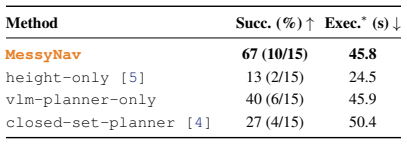
Table 2 :Real-World Interactive Navigation Results. MessyNavachieves the highest success rate across 15 real-world scenes. Success requires reaching the goal without any unsafe interactions. ∗Execution time (ex- cluding VLM queries) averaged across successful trials.
원문 · CC BY 4.0 · Kenneth Llontop, Cherie Ho, Dylan Zhou, Anuva Banwasi, Priya Sundaresan, Carlota Parés-Morlans, Jeannette Bohg · MessyNav: Zero-Shot Navigation via Manipulation in Messy Environments · 원문 그림 인용 · 원본 PDF 6쪽에서 그림 영역을 추출했습니다.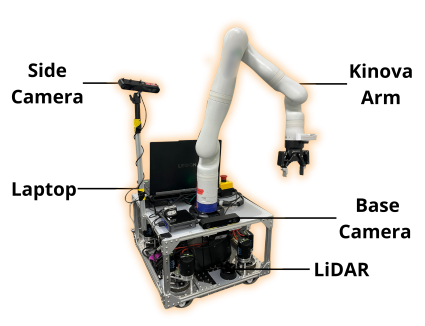
Figure 6 :Hardware:We deploy on the TidyBot++ holonomic mobile manipulator [18] with two cameras and a LiDAR for perception. An onboard laptop runs the autonomy stack.
원문 · CC BY 4.0 · Kenneth Llontop, Cherie Ho, Dylan Zhou, Anuva Banwasi, Priya Sundaresan, Carlota Parés-Morlans, Jeannette Bohg · MessyNav: Zero-Shot Navigation via Manipulation in Messy Environments · 원문 그림 인용 · 원본 PDF 14쪽에서 그림 영역을 추출했습니다.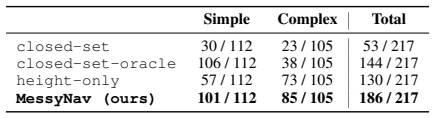
Table 8 :Real-World Navigation Scenarios.To evaluate open-world interactive navigation, we test in a bedroom and conference room environments while deliberately varying objects, contexts, and required interactions across trials. The scenes also contain furniture (e.g., couch, bed, drawers, meeting tables) as fixed non-interactive obstacles. Additional objects are listed and marked asin- teractive (I)ornon-interactive (N). Environment Additional Objects in Scenario Interaction Needed
원문 · CC BY 4.0 · Kenneth Llontop, Cherie Ho, Dylan Zhou, Anuva Banwasi, Priya Sundaresan, Carlota Parés-Morlans, Jeannette Bohg · MessyNav: Zero-Shot Navigation via Manipulation in Messy Environments · 원문 그림 인용 · 원본 PDF 21쪽에서 그림 영역을 추출했습니다.두 개의 절제 실험은 명시적 affordance 단계의 효과를 분리합니다. vlm-planner-only는 affordance 단계를 제거하고 VLM 계획기만 사용합니다. 이 설정은 시각적으로 명확한 상황에서는 성공하지만, 상자 위의 주의 테이프처럼 맥락이 중요한 경우에는 실패했습니다. closed-set-planner는 affordance 단계를 범주 기반 정답 기준선으로 바꾼 설정입니다. 이 설정은 vlm-planner-only보다 낮은 성공률을 보여, 부정확한 사전 affordance 추정이 사전 정보가 없는 경우보다 나쁠 수 있음을 보여 줍니다. 실행 시간은 성공한 시도에서 VLM 질의를 제외하고 평균한 값입니다.
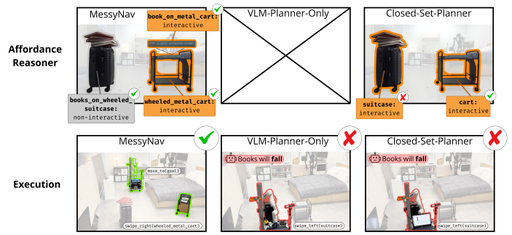
Figure 4 :Explicit affordance reasoning improves context-dependent task planning.In this scene, a suitcase supporting a stack of books is inherently unstable, while the black cart holding a single book can be safely cleared.[Left]MessyNavreasons about affordances before plan- ning, correctly labeling the suitcase as non-interactive and the cart as interactive, and swiping the cart aside to clear the path.[Middle]vlm-planner-onlyplans directly from the image with- out an explicit affordance stage and incorrectly decides to swipe the unstable suitcase.[Right] closed-set-plannerassigns fixed category-level affordances that misclassify the suitcase as interactive, leading to an unsafe plan.
원문 · CC BY 4.0 · Kenneth Llontop, Cherie Ho, Dylan Zhou, Anuva Banwasi, Priya Sundaresan, Carlota Parés-Morlans, Jeannette Bohg · MessyNav: Zero-Shot Navigation via Manipulation in Messy Environments · 원문 그림 인용 · 원본 PDF 7쪽에서 그림 영역을 추출했습니다.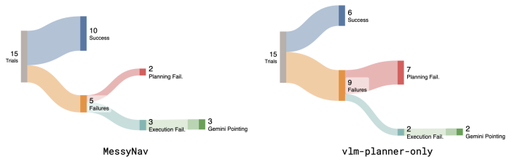
Figure 9 :MessyNav’s failure breakdown compared to the strongest baseline.Sankey diagrams of trial outcomes forMessyNav(left) andvlm-planner-only(right) over 15 real-world tri- als.MessyNavsucceeds on 10/15 trials versus 6/15 forvlm-planner-only. While most of vlm-planner-only’s failures are planning failures in whichvlm-planner-onlydecides to interact with non-interactive objects (7 of 9),MessyNavreduces these to 2, showcasing the impor- tance of explicit affordance reasoning.
원문 · CC BY 4.0 · Kenneth Llontop, Cherie Ho, Dylan Zhou, Anuva Banwasi, Priya Sundaresan, Carlota Parés-Morlans, Jeannette Bohg · MessyNav: Zero-Shot Navigation via Manipulation in Messy Environments · 원문 그림 인용 · 원본 PDF 23쪽에서 그림 영역을 추출했습니다.대규모 오프라인 계획 평가와 한계
대규모 오프라인 평가는 실로봇 실행 오류를 제외하고 고수준 계획 품질만 측정합니다. 55개 장면과 5개 환경에서 장면당 15회 반복했으며, 각 방법은 총 825회의 평가를 받았습니다. 사람 평가자는 계획이 비대화형 객체와 상호작용하지 않고 목표에 도달하면 성공으로 판정했습니다. MessyNav는 62.4%, vlm-planner-only는 55.4%로 7.0 퍼센트포인트 높았습니다. 15회 실행 단위의 쌍체 t-검정 결과는 통계적으로 유의했고, 차이의 95% 신뢰구간은 +3.8에서 +10.2 퍼센트포인트입니다. 이 결과는 실로봇 평가의 차이보다 작지만, 실행 오류를 가정한 계획 품질의 차이로 읽어야 합니다.
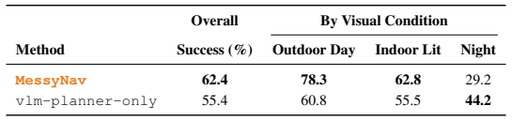
Table 3 :Scaled-Up Offline Planning Results.We evaluate high-level planning performance across 55 real-world scenes in 5 environments, with 15 repeated trials per scene, assuming perfect low-level execution.MessyNavoutperforms the strongest baseline from the real-world evaluation overall and under well-lit conditions, while nighttime remains challenging for both methods.
원문 · CC BY 4.0 · Kenneth Llontop, Cherie Ho, Dylan Zhou, Anuva Banwasi, Priya Sundaresan, Carlota Parés-Morlans, Jeannette Bohg · MessyNav: Zero-Shot Navigation via Manipulation in Messy Environments · 원문 그림 인용 · 원본 PDF 9쪽에서 그림 영역을 추출했습니다.야간 조건에서는 두 방법 모두 성능이 낮았고 MessyNav가 기준선보다 낮았습니다. 저자들은 시야가 줄어들어 affordance 추론에 필요한 세부 시각 단서가 줄어든 것으로 해석합니다. 또한 조작 primitive가 개방형 루프로 실행되며 로봇의 지속 메모리가 없다는 점이 장기 계획과 복구의 제약으로 제시됩니다.
논문 정보
- 저자
- Kenneth Llontop, Cherie Ho, Dylan Zhou, Anuva Banwasi, Priya Sundaresan, Carlota Parés-Morlans, Jeannette Bohg
- 학회·저널
- arXiv · 프리프린트
- 최초 공개일
- 2026년 11월 5일
- 등록일
- 2026년 11월 6일
- 수정일
- 2026년 11월 5일
- 버전
- v1
- arXiv
- 2611.07417
- 분류
- cs.RO · cs.CV
- 원문 이용 조건
- CC BY 4.0
- 제공 범위
- 논문 정보, 해설, 허용된 원문 그림
AI 해설은 논문 원문과 별개의 설명이며 오류가 있을 수 있습니다. 원문과 그림은 각 출처의 이용 조건과 따로 표시된 권리를 따릅니다.
초록
Real-world environments are messy, with paths often blocked by everyday objects like chairs and toys, requiring robots to perform interactive navigation by manipulating obstacles to clear a path. Existing methods rely on extensive simulation-based learning or per-scene instructions specifying which objects to avoid or manipulate. They struggle to generalize across novel objects, diverse environments, and varied contexts such as a cart of fragile glassware that should be avoided while an empty one can be pushed. We formalize this problem as open-world interactive navigation and present MessyNav, a zero-shot framework based on vision-language models (VLMs). At its core, MessyNav performs explicit VLM-based affordance reasoning before task planning to decide whether to swipe, pick up, or avoid an object and produce a high-level plan. Evaluated on a mobile manipulator across real-world indoor and outdoor environments, MessyNav improves success rate by 27 percentage points (pp) over the strongest baseline in real-robot trials and achieves statistically significant gains in a larger-scale offline evaluation, without task-specific training.
원문 인용
Kenneth Llontop, Cherie Ho, Dylan Zhou, Anuva Banwasi, Priya Sundaresan, Carlota Parés-Morlans, Jeannette Bohg (2026). MessyNav: Zero-Shot Navigation via Manipulation in Messy Environments. arXiv:2611.07417v1. https://arxiv.org/abs/2611.07417v1
BibTeX
@misc{llontop2026messynav,
  title = {{MessyNav: Zero-Shot Navigation via Manipulation in Messy Environments}},
  author = {Kenneth Llontop and Cherie Ho and Dylan Zhou and Anuva Banwasi and Priya Sundaresan and Carlota Parés-Morlans and Jeannette Bohg},
  year = {2026},
  eprint = {2611.07417},
  archivePrefix = {arXiv},
  url = {https://arxiv.org/abs/2611.07417v1}
}