논문 해설
Interpretable Cyber-Physical Attack Detection in Smart Grids: A Leakage-Controlled Multi-Testbed Evaluation of Fusion, Robustness, and Observability Limits
스마트 그리드에서 해석 가능한 사이버-물리 공격 탐지: 융합, 견고성, 관측 가능성 한계에 대한 누출 통제 다중 테스트베드 평가
- 연구 문제 셔플 교차검증 같은 평가 방식은 사이버-물리 공격 탐지기의 성능을 낙관적으로 보이게 할 수 있습니다.
- 연구 방법 해석 가능한 Random Forest 융합 탐지기를 여러 평가 프로토콜과 물리 실현 가능 공격으로 검증합니다.
연구 문제와 평가의 함정
스마트그리드의 사이버-물리 공격 탐지기는 보통 깨끗하고 시간적으로 섞인 데이터에서만 검증되어 성능이 낙관적으로 나타날 수 있습니다. 이 논문은 해석 가능한 Random Forest 기반 융합 탐지기를 중심으로, 평가 프로토콜이 바뀔 때 성능 추정이 어떻게 달라지는지 먼저 확인합니다. 데이터셋 1에서 셔플 5-fold 교차검증은 인접한 시간 창이 학습과 시험에 함께 들어가는 누수를 만들며, 시간 블록 교차검증과 롤링 오리진 평가는 이 누수와 분포 변화를 점차 강하게 제거합니다. 저자들은 셔플 교차검증에서 융합 탐지기의 macro-F1이 0.96±0.01이었고, 롤링 오리진 평가에서는 0.88±0.06이었다고 보고합니다.
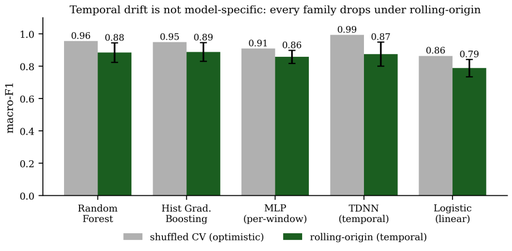
Figure 4 : The temporal drop is not model-specific: five model families, including a temporal time-delay neural network, all fall from shuffled CV to rolling-origin evaluation. The TDNN is the most inflated by shuffling and the most penalized by honest evaluation.
원문 · CC BY 4.0 · Muhammad Ridwanul Hoquea, Sarah Sharif, Reza Saeed Kandezy, Yaser Banad · Interpretable Cyber-Physical Attack Detection in Smart Grids: A Leakage-Controlled Multi-Testbed Evaluation of Fusion, Robustness, and Observability Limits · 원문 그림 인용 · 원본 PDF 9쪽에서 그림 영역을 추출했습니다.융합 특징과 Random Forest 탐지기
데이터셋 1의 물리 스트림과 사이버 스트림은 0.5초 창에서 내부 조인되어 1,529개의 융합 창을 만듭니다. 저자들은 이를 특징 수준의 초기 융합으로 설명하며, 두 영역 사이의 상호작용은 트리 분할을 통해 학습되고 별도의 잠재 결합 표현은 학습되지 않는다고 밝힙니다. 불균형 보정을 위해 클래스 가중치는 전체 학습 창 수와 클래스별 창 수로 정해집니다.
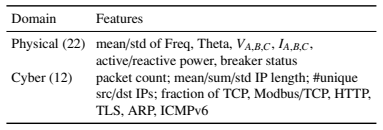
Table 1 : Engineered per-window features, dataset 1 (∆ =0.5 s).
원문 · CC BY 4.0 · Muhammad Ridwanul Hoquea, Sarah Sharif, Reza Saeed Kandezy, Yaser Banad · Interpretable Cyber-Physical Attack Detection in Smart Grids: A Leakage-Controlled Multi-Testbed Evaluation of Fusion, Robustness, and Observability Limits · 원문 그림 인용 · 원본 PDF 3쪽에서 그림 영역을 추출했습니다.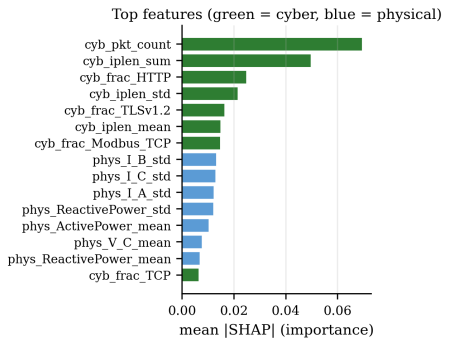
Figure 1 : SHAP importances: both cyber (green) and physical (blue) features matter.
원문 · CC BY 4.0 · Muhammad Ridwanul Hoquea, Sarah Sharif, Reza Saeed Kandezy, Yaser Banad · Interpretable Cyber-Physical Attack Detection in Smart Grids: A Leakage-Controlled Multi-Testbed Evaluation of Fusion, Robustness, and Observability Limits · 원문 그림 인용 · 원본 PDF 5쪽에서 그림 영역을 추출했습니다.특징 공간 공격과 물리 실현 가능 공격
데이터셋 1에는 토폴로지가 없으므로 이 실험의 특징 공간 공격은 실현 가능한 그리드 조작이 아니라 탐지기 입력에 대한 스트레스 한계로 해석됩니다. 조합 공격은 사이버 특징까지 직접 편집하기 때문에 실제 공격자가 간접적으로만 영향을 줄 수 있는 대상입니다. 반면 IEEE 14-Bus 실험에서는 공격 상태 변화가 전력 흐름 모델로 다시 계산되며, 진화 전략 회피 공격은 깨끗한 탐지기의 macro-F1 0.97을 0.33으로 낮춥니다. 제한된 관측성 조건에서는 FDI 클래스 recall이 0.26까지 떨어지며, 이 설정의 깨끗한 탐지기 macro-F1은 0.89입니다. 실현 가능한 학습 데이터로 적대적 학습을 수행하면 recall은 0.53으로 회복되지만 완전히 닫히지는 않습니다.
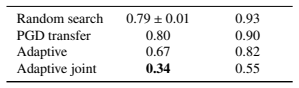
Table 3 : Dataset-1 robustness (macro-F1,ε=0.10). Clean=0.96. These are feature-spaceworst cases (attacker edits detector inputs directly; no grid feasi- bility enforced), so they bound rather than represent realizable attacks.
원문 · CC BY 4.0 · Muhammad Ridwanul Hoquea, Sarah Sharif, Reza Saeed Kandezy, Yaser Banad · Interpretable Cyber-Physical Attack Detection in Smart Grids: A Leakage-Controlled Multi-Testbed Evaluation of Fusion, Robustness, and Observability Limits · 원문 그림 인용 · 원본 PDF 10쪽에서 그림 영역을 추출했습니다.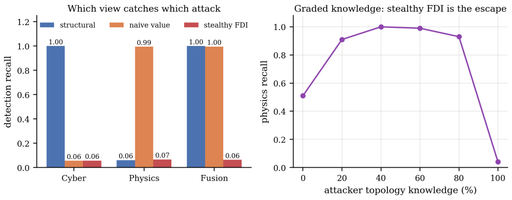
Figure 9 : Left: which view catches which attack (recall pooled over the 20 seeds of Table 5): cyber sees structural, physics sees naive value manipulation, fusion sees both, and stealthy FDI defeats all three. Right: as the attacker’s topology knowledge grows, a partial-knowledge value attack is in fact themostdetectable (large, inconsistent residual); only at full knowledge doesa=Hcbecome consistent and the residual collapse to the noise floor, driving physics recall to the false-positive rate.
원문 · CC BY 4.0 · Muhammad Ridwanul Hoquea, Sarah Sharif, Reza Saeed Kandezy, Yaser Banad · Interpretable Cyber-Physical Attack Detection in Smart Grids: A Leakage-Controlled Multi-Testbed Evaluation of Fusion, Robustness, and Observability Limits · 원문 그림 인용 · 원본 PDF 11쪽에서 그림 영역을 추출했습니다.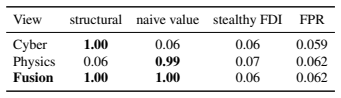
Table 5 : IEEE 14-Bus detection recall per attack class at a calibrated 5% benign false-positive rate, averaged over 20 independent seeds with Wilson 95% confi- dence intervals on the pooled test windows (∼9,100 benign windows). LS resid- uals: benign 3.9×10⁻³, naive-value 6.8×10⁻², stealthy-FDI 3.9×10⁻³. Pooled over seeds the calibrated benign FPR settles at 0.059–0.062; the 0.08 seen on any single split is finite-sample calibration noise, not a systematic bias. All non-bold recalls have 95% CIs within±0.02; bold cells are≥0.99 with CI up- per bound 1.00.
원문 · CC BY 4.0 · Muhammad Ridwanul Hoquea, Sarah Sharif, Reza Saeed Kandezy, Yaser Banad · Interpretable Cyber-Physical Attack Detection in Smart Grids: A Leakage-Controlled Multi-Testbed Evaluation of Fusion, Robustness, and Observability Limits · 원문 그림 인용 · 원본 PDF 11쪽에서 그림 영역을 추출했습니다.실제 IEC-104 트래픽과 의미적 조작의 경계
실제 IEC-104 HMI 트래픽에서는 120초 창의 사이버 특징만으로 구조적 공격을 탐지합니다. 보고 블록 공격의 recall은 0.98이고 재생 공격은 0.87입니다. 반면 MITM, 위장, 값 변경 같은 의미적 값 조작 공격의 recall은 0.35, 0.32, 0.11로 낮습니다. 이 결과는 헤더 중심 특징으로 측정한 경계이며, 조작된 값이 페이로드에 있으므로 네트워크 헤더만 읽는 탐지기는 그 값을 복원할 수 없다는 저자들의 해석과 함께 읽어야 합니다.
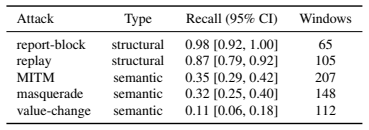
Table 4 : Dataset-3 per-attack detection recall on real IEC-104 HMI traffic, with Wilson 95% confidence intervals over the attack windows of each class (5-fold out-of-fold; benign windowsn=6470, FPR 0.024). The structural and semantic classes separate with non-overlapping intervals.
원문 · CC BY 4.0 · Muhammad Ridwanul Hoquea, Sarah Sharif, Reza Saeed Kandezy, Yaser Banad · Interpretable Cyber-Physical Attack Detection in Smart Grids: A Leakage-Controlled Multi-Testbed Evaluation of Fusion, Robustness, and Observability Limits · 원문 그림 인용 · 원본 PDF 10쪽에서 그림 영역을 추출했습니다.AC 상태 추정에서 시간 검정과 매니폴드 검정
IEEE 14-Bus와 118-Bus의 AC WLS 상태 추정에서 Jacobian과 일치하는 은닉 FDI는 잔차 기반 불량 데이터 검정을 통과하며, 두 카이제곱 분포가 구분되지 않습니다. 시간 기반 검정은 계단형 변화는 잘 잡지만, 편향이 느리게 주입되면 추세 필터가 이를 흡수하여 탐지율이 떨어집니다. 매니폴드 검정은 벤ign 추정 상태에서 PCA로 낮은 차원의 부분공간을 학습하고 그 바깥 잔차를 감시하므로, 램프 속도보다 누적 편향에 따라 반응합니다. 저자들은 118-Bus의 감소 원인을 아직 측정된 편향 예산으로 설명하지 못했다고 밝힙니다.
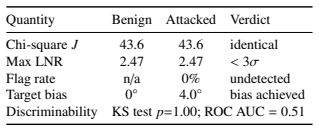
Table 6 : AC WLS state estimation: a Jacobian-consistent stealthy FDI is statis- tically invisible to snapshot bad-data detection. The 4 ◦ target bias is achieved with zero bad-data flags.
원문 · CC BY 4.0 · Muhammad Ridwanul Hoquea, Sarah Sharif, Reza Saeed Kandezy, Yaser Banad · Interpretable Cyber-Physical Attack Detection in Smart Grids: A Leakage-Controlled Multi-Testbed Evaluation of Fusion, Robustness, and Observability Limits · 원문 그림 인용 · 원본 PDF 11쪽에서 그림 영역을 추출했습니다.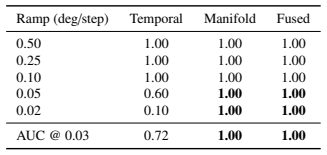
Table 7 : Detection probability vs. stealthy-FDI ramp rate at a common 5% false-alarm rate (IEEE 14-Bus AC testbed). Slow ramps escape the temporal test; they do not escape the rate-invariant manifold test or fusion. Each cell is 50 trials; an entry of 1.00 means zero misses in 50, i.e. P(detect)≥0.94 at 95% confidence (rule of three). The benign manifold is fitted onestimatedstates and its dimensionK=6 is selected by cross-validation on benign data only. Thresh- olds are calibrated on 600 benign streams; the false-alarm rates measured on 400 held-out benign streams are 4.5%/5.3%/5.0% (temporal/manifold/fused).
원문 · CC BY 4.0 · Muhammad Ridwanul Hoquea, Sarah Sharif, Reza Saeed Kandezy, Yaser Banad · Interpretable Cyber-Physical Attack Detection in Smart Grids: A Leakage-Controlled Multi-Testbed Evaluation of Fusion, Robustness, and Observability Limits · 원문 그림 인용 · 원본 PDF 12쪽에서 그림 영역을 추출했습니다.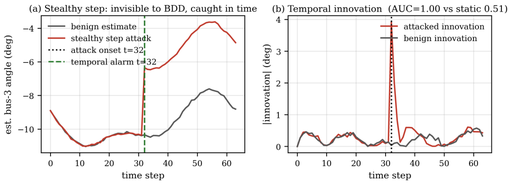
Figure 11 : Real-time AC estimation. A persistent stealthy step att=32 shifts the estimated bus-3 angle (left) with the chi-square residual unchanged; the temporal innovation (right) spikes at onset, giving AUC 1.00 vs. 0.51 for the static test.
원문 · CC BY 4.0 · Muhammad Ridwanul Hoquea, Sarah Sharif, Reza Saeed Kandezy, Yaser Banad · Interpretable Cyber-Physical Attack Detection in Smart Grids: A Leakage-Controlled Multi-Testbed Evaluation of Fusion, Robustness, and Observability Limits · 원문 그림 인용 · 원본 PDF 13쪽에서 그림 영역을 추출했습니다.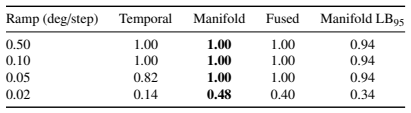
Table 8 : Full end-to-end IEEE 118-Bus detection probability with every test calibrated to a common 5% false-alarm target (50 trials per ramp rate). The achieved benign false-alarm rates are 0.067/0.011/0.056 for temporal/mani- fold/fused, so the manifold test operates more conservatively than the other two. The lower bound is the one-sided 95% binomial bound on the manifold detector.
원문 · CC BY 4.0 · Muhammad Ridwanul Hoquea, Sarah Sharif, Reza Saeed Kandezy, Yaser Banad · Interpretable Cyber-Physical Attack Detection in Smart Grids: A Leakage-Controlled Multi-Testbed Evaluation of Fusion, Robustness, and Observability Limits · 원문 그림 인용 · 원본 PDF 13쪽에서 그림 영역을 추출했습니다.적용 범위와 한계
데이터셋 1은 토폴로지를 노출하지 않으며, 사이버와 물리 계층은 단일한 실제 시스템에서 함께 융합되지 않았습니다. 물리 공격은 시뮬레이션된 IEEE 테스트베드에서 평가되었고, IEC-104 연구는 사이버 전용입니다. 매니폴드 검정은 선형 PCA와 합성 부하 모델을 사용하므로, 실제 부하 궤적이나 비선형 매니폴드, 완전 적응형 다중 버스 공격자에 대해서는 검증되지 않았습니다. 데이터셋 1의 클래스는 각각 별도의 캡처이므로 클래스 라벨이 캡처 세션과 교란되어 있어 탐지 수치는 공격 분리 가능성의 상한으로 읽어야 합니다.
논문 정보
- 저자
- Muhammad Ridwanul Hoquea, Sarah Sharif, Reza Saeed Kandezy, Yaser Banad
- 학회·저널
- arXiv · 프리프린트
- 최초 공개일
- 2026년 11월 7일
- 등록일
- 2026년 11월 10일
- 수정일
- 2026년 11월 7일
- 버전
- v1
- arXiv
- 2611.10950
- 분류
- cs.LG · cs.AI · cs.CR
- 원문 이용 조건
- CC BY 4.0
- 제공 범위
- 논문 정보, 해설, 허용된 원문 그림
AI 해설은 논문 원문과 별개의 설명이며 오류가 있을 수 있습니다. 원문과 그림은 각 출처의 이용 조건과 따로 표시된 권리를 따릅니다.
초록
Cyber-physical smart-grid detectors are typically treated as black boxes and validated exclusively on clean, temporally shuffled datasets, which risk overly optimistic performance claims. This work presents a multi-testbed evaluation study built around an interpretable, time-windowed fusion Random Forest, adopting the pessimistic result whenever evaluation protocols disagree. (i) On a public paired cyber-physical dataset, shuffled cross-validation is optimistic: macro-F1 falls from 0.96 to 0.88 +/- 0.06 under rolling-origin temporal evaluation. A topology-free graph convolutional network (GCN) serving as a control confirms that this lightweight model is competitive on these splits. (ii) The adaptive and adaptive-joint feature-space attacks, which are infeasible as realistic grid manipulations, degrade macro-F1 to 0.67 and 0.34, respectively. Adversarial training and randomized smoothing partially restore performance, and a physics-constrained evolution-strategy evasion on the IEEE 14-Bus testbed shows the same vulnerability pattern. (iii) On real IEC-104 traffic, the cyber view reliably catches structural attacks (recall of 0.87 to 0.98) but largely fails on semantic value manipulation (recall of 0.11 to 0.35). An observability taxonomy on the IEEE 14-Bus system reveals that stealthy false data injection defeats all three observation views. (iv) On a full AC weighted least-squares state-estimation testbed, a forecasting-aided temporal test is evaded by slow ramps precisely where a rate-invariant physics-manifold test sustains detection at a common 5% false-alarm target. A full end-to-end evaluation on IEEE 118-Bus confirms the ordering but bounds its strength: the manifold test detects every trial down to 0.05 degree/step and 0.48 at 0.02 degree/step, against 0.14 for the temporal test. All code and benchmarks are released.
원문 인용
Muhammad Ridwanul Hoquea, Sarah Sharif, Reza Saeed Kandezy, Yaser Banad (2026). Interpretable Cyber-Physical Attack Detection in Smart Grids: A Leakage-Controlled Multi-Testbed Evaluation of Fusion, Robustness, and Observability Limits. arXiv:2611.10950v1. https://arxiv.org/abs/2611.10950v1
BibTeX
@misc{hoquea2026interpretable,
  title = {{Interpretable Cyber-Physical Attack Detection in Smart Grids: A Leakage-Controlled Multi-Testbed Evaluation of Fusion, Robustness, and Observability Limits}},
  author = {Muhammad Ridwanul Hoquea and Sarah Sharif and Reza Saeed Kandezy and Yaser Banad},
  year = {2026},
  eprint = {2611.10950},
  archivePrefix = {arXiv},
  url = {https://arxiv.org/abs/2611.10950v1}
}