논문 해설
C3-DINO: Joint Contrastive and Non-contrastive Self-Supervised Learning for Speaker Verification
C3-DINO: 화자 검증을 위한 대조 및 비대조 결합 자기지도 학습
- 연구 문제 대조 학습 기반 자기지도 화자 임베딩은 false negative 쌍 때문에 class-collision 문제를 겪습니다.
- 연구 방법 C3-MoCo로 false negative를 줄인 뒤 그 모델을 DINO 목표로 미세조정합니다.
- 주요 결과 C3-DINO는 VoxCeleb1에서 CDS 기준 EER 2.5%를 기록했다고 보고됩니다.
대조 학습의 false negative 문제
대조 학습 기반 자기지도 화자 임베딩은 한 배치나 큐 안에서 앵커와 같은 화자인 샘플을 음성 쌍으로 잘못 취급할 수 있습니다. 원문은 이를 class-collision 문제라고 부르며, 이 현상이 CSSL 기반 화자 검증 시스템의 성능을 제한하는 주요 문제라고 설명합니다. 이 연구는 먼저 false negative 쌍이 SV 성능에 미치는 영향을 분석하고, 이를 줄이는 방법과 음의 샘플을 쓰지 않는 DINO 목표를 결합하는 방향을 다룹니다.
C3-MoCo의 false negative 필터링과 재가중
C3-MoCo는 MoCo 기반 베이스라인에 세 단계를 더합니다. 먼저 앵커-양성 유사도가 0.4를 넘고 앵커-음성 유사도가 앵커-양성 유사도의 0.8배를 넘는 항을 false negative로 보고 필터링 기준을 둡니다. 이어서 필터링이 어려운 샘플을 버릴 수 있다는 점을 보완하기 위해 참 음성 집합과 false negative 집합의 평균 MoCo 손실을 ω1 = 0.8, ω2 = 0.2로 재가중합니다. 마지막으로 프로토타입 기반 ProtoNCE 손실을 α = 0.2의 가중치로 더해 공동 학습합니다.
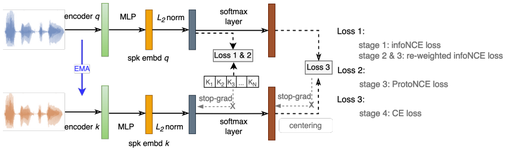
Fig. 2 : A multi-stage training framework. For the C3-MoCo training, the first stage is trained the infoNCE loss, then replace the InfoNCE loss with the re-weighted InfoNCE loss for the second stage, and jointly train with the ProtoNCE loss for stage 3. For C3-DINO training, the best way is using the pretrained C3-MoCo model as the initial, and apply the DINO loss.
원문 · CC BY 4.0 · Chunlei Zhang, Dong Yu · C3-DINO: Joint Contrastive and Non-contrastive Self-Supervised Learning for Speaker Verification · 원문 그림 인용 · 원본 PDF 6쪽에서 그림 영역을 추출했습니다.C3-DINO의 MoCo 초기화 DINO 미세조정
C3-DINO는 C3-MoCo 모델을 초기값으로 두고 단일 DINO 손실로 인코더를 미세조정하는 방식으로 설계됩니다. 원문은 MoCo 손실과 DINO 손실을 한 목적함수로 묶는 멀티태스크 방식도 함께 비교합니다. 이 방식은 두 손실의 수렴 수준 차이 때문에 MoCo 초기화 DINO보다 나은 결과를 내지 못했다고 보고됩니다. 따라서 이 논문이 제안하는 주된 결합 방식은 pre-training 후 DINO로 미세조정하는 방식입니다.
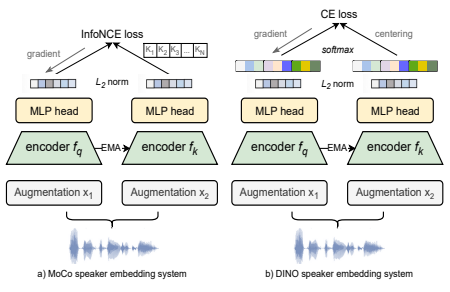
Fig. 1 : The baseline MoCo and DINO training diagrams.
원문 · CC BY 4.0 · Chunlei Zhang, Dong Yu · C3-DINO: Joint Contrastive and Non-contrastive Self-Supervised Learning for Speaker Verification · 원문 그림 인용 · 원본 PDF 3쪽에서 그림 영역을 추출했습니다.VoxCeleb1 평가 결과와 비교 범위
Table IV는 ECAPA-TDNN 모델을 기준으로 VoxCeleb1 테스트 세트와 VoxSRC21 Dev 결과를 함께 보고합니다. 재가중 InfoNCE 단계는 VoxCeleb1 EER 6.9%, ProtoNCE를 더한 C3-MoCo 단계는 6.4%입니다. C3-DINO2는 C3-MoCo로 초기화한 시스템에서 CDS 기준 EER 2.5%를 기록하며, 이는 이 논문에서 제시한 자기지도 방식의 최저값입니다. 이 결과는 ECAPA-TDNN과 VoxCeleb1 평가 조건에서 얻은 값입니다.
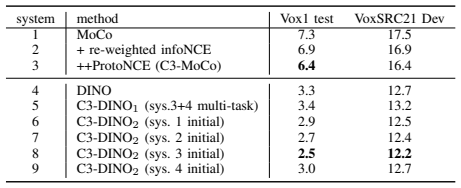
원문 그림 TABLE IV: Progressive results with the proposed techniques (EER in% ), reported with the best ECAPA-TDNN model.
원문 · CC BY 4.0 · Chunlei Zhang, Dong Yu · C3-DINO: Joint Contrastive and Non-contrastive Self-Supervised Learning for Speaker Verification · 원문 그림 인용 · 원본 PDF 8쪽에서 그림 영역을 추출했습니다.적용 범위와 한계
Table II의 false negative 비율 분석은 VoxCeleb1과 VoxCeleb2의 MoCo 설정, TDNN 인코더와 배치 크기 4096에서 보고되었습니다. 이 결과를 다른 인코더, 데이터, 설정으로 일반화하여 제시하지 않습니다. 또한 DINO 결과의 정확도 향상은 ECAPA-TDNN과 VoxCeleb1 평가 조건을 기준으로 해석해야 합니다.

원문 그림 TABLE II: Performance analysis (EER, in %) w.r.t. different pfn (in %) in the supervision signal controlled contrastive learning systems.
원문 · CC BY 4.0 · Chunlei Zhang, Dong Yu · C3-DINO: Joint Contrastive and Non-contrastive Self-Supervised Learning for Speaker Verification · 원문 그림 인용 · 원본 PDF 5쪽에서 그림 영역을 추출했습니다.논문 정보
- 저자
- Chunlei Zhang, Dong Yu
- 학회·저널
- arXiv · 프리프린트
- 최초 공개일
- 2022년 8월 15일
- 등록일
- 2026년 11월 6일
- 수정일
- 2022년 8월 15일
- 버전
- v1
- arXiv
- 2208.07446
- DOI
- 10.1109/jstsp.2022.3198315
- 분류
- eess.AS · cs.SD
- 원문 이용 조건
- CC BY 4.0
- 제공 범위
- 논문 정보, 해설, 허용된 원문 그림
AI 해설은 논문 원문과 별개의 설명이며 오류가 있을 수 있습니다. 원문과 그림은 각 출처의 이용 조건과 따로 표시된 권리를 따릅니다.
초록
Self-supervised learning (SSL) has drawn an increased attention in the field of speech processing. Recent studies have demonstrated that contrastive learning is able to learn discriminative speaker embeddings in a self-supervised manner. However, base contrastive self-supervised learning (CSSL) assumes that the pairs generated from a view of anchor instance and any view of other instances are all negative, which introduces many false negative pairs in constructing the loss function. The problem is referred as $class$-$collision$, which remains as one major issue that impedes the CSSL based speaker verification (SV) systems from achieving better performances. In the meanwhile, studies reveal that negative sample free SSL frameworks perform well in learning speaker or image representations. In this study, we investigate SSL techniques that lead to an improved SV performance. We first analyse the impact of false negative pairs in the CSSL systems. Then, a multi-stage Class-Collision Correction (C3) method is proposed, which leads to the state-of-the-art CSSL based speaker embedding system. On the basis of the pretrained CSSL model, we further propose to employ a negative sample free SSL objective (i.e., DINO) to fine-tune the speaker embedding network. The resulting speaker embedding system (C3-DINO) achieves 2.5% EER with a simple Cosine Distance Scoring method on Voxceleb1 test set, which outperforms the previous SOTA SSL system (4.86%) by a significant +45% relative improvement. With speaker clustering and pseudo labeling on Voxceleb2 training set, a LDA/CDS back-end applying on the C3-DINO speaker embeddings is able to further push the EER to 2.2%. Comprehensive experimental investigations of the Voxceleb benchmarks and our internal dataset demonstrate the effectiveness of our proposed methods, and the performance gap between the SSL SV and the supervised counterpart narrows further.
원문 인용
Chunlei Zhang, Dong Yu (2022). C3-DINO: Joint Contrastive and Non-contrastive Self-Supervised Learning for Speaker Verification. arXiv:2208.07446v1. https://doi.org/10.1109/jstsp.2022.3198315
BibTeX
@article{zhang2022dino,
  title = {{C3-DINO: Joint Contrastive and Non-contrastive Self-Supervised Learning for Speaker Verification}},
  author = {Chunlei Zhang and Dong Yu},
  year = {2022},
  eprint = {2208.07446},
  archivePrefix = {arXiv},
  doi = {10.1109/jstsp.2022.3198315},
  url = {https://arxiv.org/abs/2208.07446v1}
}