논문 해설
LLM-Powered Socially Assistive Robot-Delivered Cognitive Behavioral Therapy Exercises: an Exploratory Study with University Students
LLM 기반 사회적 보조 로봇이 전달하는 인지행동치료 연습: 대학생을 대상으로 한 탐색적 연구
- 연구 문제 CBT 가정 과제는 치료 효과를 좌우하지만, 워크시트는 정적이어서 치료사와 같은 후속 질문을 제공하지 못합니다.
- 연구 방법 38명의 대학생을 로봇, 챗봇, 워크시트 조건에 배정하고 1~8일 필수 과제와 9~15일 선택 과제를 수행하게 했습니다. 챗봇과 로봇은 GPT-3.5 기반 제로샷 프롬프트를 사용했습니다.
- 주요 결과 OQ-45 점수는 전체 기간에 유의하게 감소했고, 워크시트와 로봇 조건에서 유의한 감소가 있었습니다. 세션 전후 불안은 로봇 조건에서 8일 중 5일, 챗봇 조건에서 2일 유의하게 감소했습니다. 혼합효과 모형에서는 로봇과 챗봇이 워크시트보다 사후 불안을 낮췄습니다.
CBT 과제 실천의 문제와 연구 질문
CBT는 불안과 우울을 다루는 데 널리 쓰이는 치료법이지만, 전문 치료사에게 접근하기 어려운 사람에게는 비용과 시간이 큰 장벽이 됩니다. 이 때문에 치료 효과는 상당 부분 가정에서 수행하는 CBT 과제의 실천에 달려 있습니다. 그런데 워크시트 형태의 과제는 정적인 질문만 제시하므로, 치료사와의 대화처럼 후속 질문을 던지지 못한다는 한계가 있습니다. 이 연구는 이러한 한계를 LLM 기반 대화로 보완할 수 있는지를 탐색합니다. 연구는 CBT 과제를 LLM이 안내하는 저비용 사회적 지원 로봇 Blossom, 같은 LLM을 쓴 텍스트 챗봇, 전통적 워크시트의 세 방식으로 전달하고, 즉각적 불안 변화, 단기 치료 결과, 과제 채택률, 사용 경험을 비교합니다.
대상은 38명의 대학생이며, 사회적 지원 로봇의 전달 방식이 기존 워크시트나 텍스트 챗봇과 다른 결과를 만드는지를 묻는 것이 핵심입니다.
LLM 기반 과제 전달과 세션 구조
세 조건은 같은 CBT 과제를 서로 다른 방식으로 전달합니다. 과제는 온라인 CBT 워크시트에서 Cognitive Restructuring과 Coping Strategies 두 가지를 골라 구성했습니다. 챗봇과 로봇 조건은 GPT-3.5를 사용했으며, 프롬프트는 예시 대화 없이 과제 설명과 역할만 주는 제로샷 방식으로 확정되었습니다. 저자들은 few-shot 예시가 모델이 예시 문장을 그대로 반복하게 만들고, 토큰 한도를 차지한다는 이유로 이 방식을 택했다고 설명합니다. 모더레이터는 별도의 GPT-3.5 프롬프트로, LLM 응답이 화면에 나오기 전에 부적절한 응답인지 검토합니다. 로봇 조건에서는 Blossom이 LLM 응답을 음성으로 말하고, 관찰 상태에서는 머리가 천천히 오르내리며 호흡하는 동작을 보입니다.
참가자는 세 조건 모두에서 응답을 타이핑하므로 입력 방식은 같습니다. 각 세션은 사전 불안 척도, 과제 수행, 사후 불안 척도로 이루어집니다. 1일차부터 8일차까지는 과제가 의무였고 9일차부터 15일차까지는 선택이었습니다.
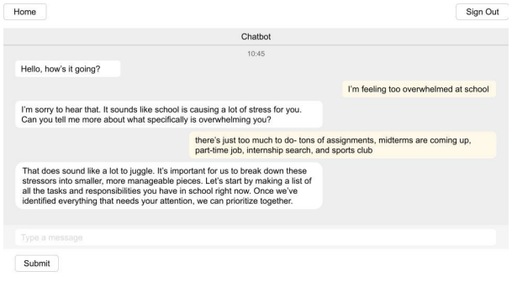
Fig. 1 .Web application interface.The user interface for the CBT homework interaction. The interface was identical in the robot and chatbot conditions.
원문 · CC BY 4.0 · Mina Kian, Mingyu Zong, Katrin Fischer, Abhyuday Singh, Anna-Maria Velentza, Amy O'Connell, Lydia Ignatova, Pau Sang, Shriya Upadhyay, Anika Gupta, Misha Faruki, Wallace Browning, Sébastien M. R. Arnold, Meng Chen, Bhaskhar Krishnamachari, Maja Matarić · LLM-Powered Socially Assistive Robot-Delivered Cognitive Behavioral Therapy Exercises: an Exploratory Study with University Students · 원문 그림 인용 · 원본 PDF 7쪽에서 그림 영역을 추출했습니다.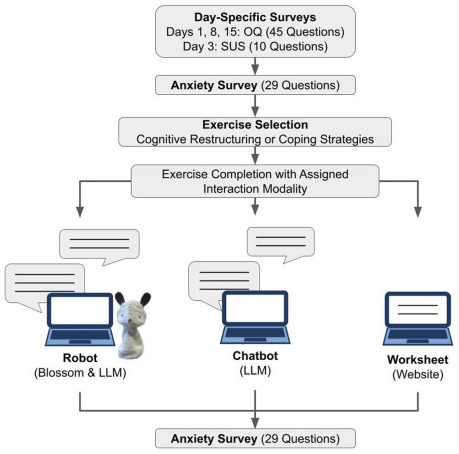
Fig. 2 .Interaction structure.Flow chart showing the sequence of surveys and CBT exercise for all three conditions.
원문 · CC BY 4.0 · Mina Kian, Mingyu Zong, Katrin Fischer, Abhyuday Singh, Anna-Maria Velentza, Amy O'Connell, Lydia Ignatova, Pau Sang, Shriya Upadhyay, Anika Gupta, Misha Faruki, Wallace Browning, Sébastien M. R. Arnold, Meng Chen, Bhaskhar Krishnamachari, Maja Matarić · LLM-Powered Socially Assistive Robot-Delivered Cognitive Behavioral Therapy Exercises: an Exploratory Study with University Students · 원문 그림 인용 · 원본 PDF 7쪽에서 그림 영역을 추출했습니다.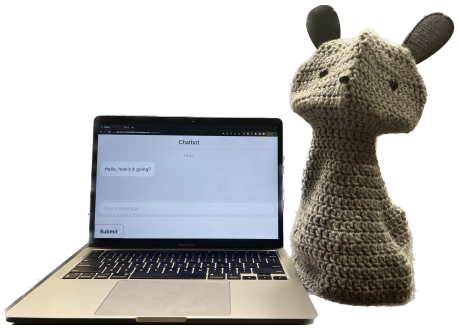
Fig. 3 .SAR design.Blossom robot and laptop interface used in the robot condition in the study.
원문 · CC BY 4.0 · Mina Kian, Mingyu Zong, Katrin Fischer, Abhyuday Singh, Anna-Maria Velentza, Amy O'Connell, Lydia Ignatova, Pau Sang, Shriya Upadhyay, Anika Gupta, Misha Faruki, Wallace Browning, Sébastien M. R. Arnold, Meng Chen, Bhaskhar Krishnamachari, Maja Matarić · LLM-Powered Socially Assistive Robot-Delivered Cognitive Behavioral Therapy Exercises: an Exploratory Study with University Students · 원문 그림 인용 · 원본 PDF 8쪽에서 그림 영역을 추출했습니다.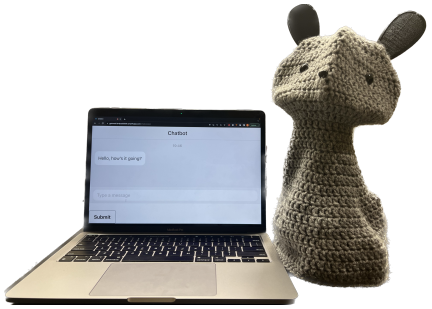
Fig. 7 . Blossom Robot Design
원문 · CC BY 4.0 · Mina Kian, Mingyu Zong, Katrin Fischer, Abhyuday Singh, Anna-Maria Velentza, Amy O'Connell, Lydia Ignatova, Pau Sang, Shriya Upadhyay, Anika Gupta, Misha Faruki, Wallace Browning, Sébastien M. R. Arnold, Meng Chen, Bhaskhar Krishnamachari, Maja Matarić · LLM-Powered Socially Assistive Robot-Delivered Cognitive Behavioral Therapy Exercises: an Exploratory Study with University Students · 원문 그림 인용 · 원본 PDF 32쪽에서 그림 영역을 추출했습니다.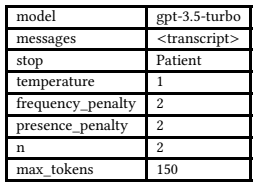
Table 5 . Parameters for OpenAI’s completion API
원문 · CC BY 4.0 · Mina Kian, Mingyu Zong, Katrin Fischer, Abhyuday Singh, Anna-Maria Velentza, Amy O'Connell, Lydia Ignatova, Pau Sang, Shriya Upadhyay, Anika Gupta, Misha Faruki, Wallace Browning, Sébastien M. R. Arnold, Meng Chen, Bhaskhar Krishnamachari, Maja Matarić · LLM-Powered Socially Assistive Robot-Delivered Cognitive Behavioral Therapy Exercises: an Exploratory Study with University Students · 원문 그림 인용 · 원본 PDF 32쪽에서 그림 영역을 추출했습니다.치료 결과와 세션 전후 불안의 비교
주간 치료 결과는 Outcomes Questionnaire-45 점수를 1일차와 15일차 사이에서 비교했습니다. 전체 참가자의 점수는 유의하게 감소했습니다(t(36)=3.122, p=0.004). 조건별로는 워크시트 조건이 가장 큰 감소를 보였고(t(10)=4.046, p=0.002), 로봇 조건도 유의한 감소를 보였습니다(t(13)=2.253, p=0.042). 챗봇 조건은 유의한 감소가 없었습니다. 세션 전후 불안은 조건마다 일별 대응 검정을 하고 Benjamini-Hochberg 절차로 보정했습니다. 로봇 조건은 필수 기간 8일 중 5일에서 유의한 감소를 보였고, 챗봇은 1일과 7일에서, 워크시트는 어느 날에도 유의하지 않았습니다.
혼합효과 모형에서는 워크시트를 기준으로 로봇 조건(b=-6.26, p=.001)과 챗봇 조건(b=-6.74, p=.002)의 사후 불안이 낮았습니다. 세션 전 불안과 조건의 상호작용도 있었습니다. 이 결과는 본 연구의 표본과 설정에서 얻은 것이며, 단기 세션 불안 감소를 장기 치료 효과로 바로 확대할 수 없습니다.
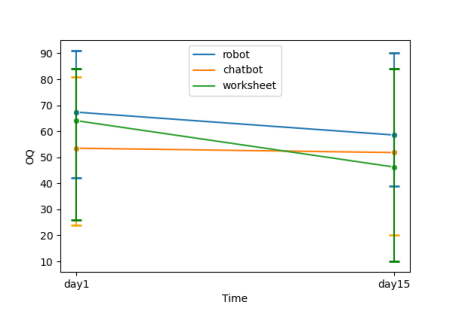
Fig. 4 .Marginal means of OQ scores from the first to last day of the study.There was a significant decrease in the OQ scores for the participants in the robot and worksheet conditions, but not in the chatbot condition.
원문 · CC BY 4.0 · Mina Kian, Mingyu Zong, Katrin Fischer, Abhyuday Singh, Anna-Maria Velentza, Amy O'Connell, Lydia Ignatova, Pau Sang, Shriya Upadhyay, Anika Gupta, Misha Faruki, Wallace Browning, Sébastien M. R. Arnold, Meng Chen, Bhaskhar Krishnamachari, Maja Matarić · LLM-Powered Socially Assistive Robot-Delivered Cognitive Behavioral Therapy Exercises: an Exploratory Study with University Students · 원문 그림 인용 · 원본 PDF 13쪽에서 그림 영역을 추출했습니다.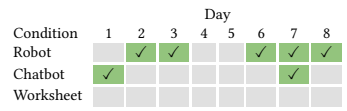
Table 2 .Pre- to post-session anxiety score improvements by modality.For each study condition, the days where the change from pre- to post-session anxiety scores significantly improved are shown in green.
원문 · CC BY 4.0 · Mina Kian, Mingyu Zong, Katrin Fischer, Abhyuday Singh, Anna-Maria Velentza, Amy O'Connell, Lydia Ignatova, Pau Sang, Shriya Upadhyay, Anika Gupta, Misha Faruki, Wallace Browning, Sébastien M. R. Arnold, Meng Chen, Bhaskhar Krishnamachari, Maja Matarić · LLM-Powered Socially Assistive Robot-Delivered Cognitive Behavioral Therapy Exercises: an Exploratory Study with University Students · 원문 그림 인용 · 원본 PDF 13쪽에서 그림 영역을 추출했습니다.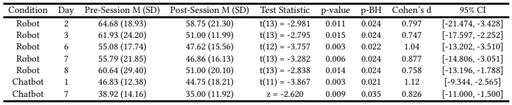
Table 3 .Pre- to post-session anxiety improvements.Only days with significant reductions in anxiety ( 𝑝<. 05) are shown. The corrected p values after the Benjamini-Hochberg procedure are given in column p-BH. The results for Chatbot Day 7 were computed using Wilcoxon signed-rank test because the assumption of homogeneity of variance was violated.
원문 · CC BY 4.0 · Mina Kian, Mingyu Zong, Katrin Fischer, Abhyuday Singh, Anna-Maria Velentza, Amy O'Connell, Lydia Ignatova, Pau Sang, Shriya Upadhyay, Anika Gupta, Misha Faruki, Wallace Browning, Sébastien M. R. Arnold, Meng Chen, Bhaskhar Krishnamachari, Maja Matarić · LLM-Powered Socially Assistive Robot-Delivered Cognitive Behavioral Therapy Exercises: an Exploratory Study with University Students · 원문 그림 인용 · 원본 PDF 14쪽에서 그림 영역을 추출했습니다.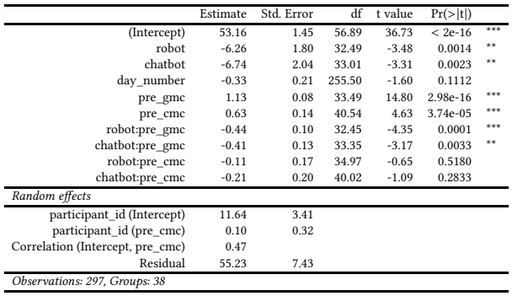
Table 4 .Linear Mixed-Effects Model Results Predicting Post-Session Anxiety.The worksheet condition was taken as the base model. 297 observations nested within 38 participants. pre_gmc = rand-mean centered pre-session anxiety; pre_cmc = cluster-mean centered pre-session anxiety. Significance codes: *** 0.001 ** 0.01 * 0.05 . 0.1 ’ ’ 1
원문 · CC BY 4.0 · Mina Kian, Mingyu Zong, Katrin Fischer, Abhyuday Singh, Anna-Maria Velentza, Amy O'Connell, Lydia Ignatova, Pau Sang, Shriya Upadhyay, Anika Gupta, Misha Faruki, Wallace Browning, Sébastien M. R. Arnold, Meng Chen, Bhaskhar Krishnamachari, Maja Matarić · LLM-Powered Socially Assistive Robot-Delivered Cognitive Behavioral Therapy Exercises: an Exploratory Study with University Students · 원문 그림 인용 · 원본 PDF 15쪽에서 그림 영역을 추출했습니다.채택률, 사용성, 한계
사용성은 세 조건 사이에 유의한 차이가 없었습니다(H(2)=0.992, p=0.381). 두 번째 주의 선택적 채택률도 조건 사이에 유의한 차이가 없었습니다(H(2)=4.2, p=0.1). 다만 로봇 조건에서는 로봇에 대한 부정적 태도 점수 NARS와 채택률 사이에 유의한 음의 회귀 관계가 보고되었습니다. 이 분석은 저자가 밝힌 회귀 결과이며, 원인 관계로 해석하기는 어렵습니다. 한계는 분명합니다. 조건당 참가자는 12명에서 14명이었고, CBT 과제는 두 가지로 제한되었으며, 치료사 지도는 포함되지 않았습니다. 연구 기간은 15일이었고, 음성 챗봇 같은 통제 조건이 없어 로봇의 신체성과 음성 출력의 효과를 분리하지 못했습니다.
검정력 분석에서 일별 효과의 검정력은 38.7%로 낮았습니다. 따라서 이 연구는 탐색적 결과로 읽어야 하며, 확정적인 임상 효과를 주장하는 근거로 쓰기에는 부족합니다.
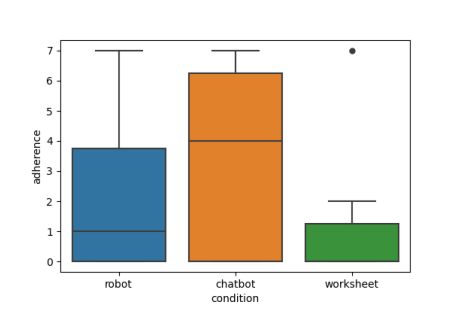
Fig. 5 .Adherence means.The distribution of adherence, measured by the number of days participants completed the exercises during the optional week (Days 9-15 of the study), for each condition.
원문 · CC BY 4.0 · Mina Kian, Mingyu Zong, Katrin Fischer, Abhyuday Singh, Anna-Maria Velentza, Amy O'Connell, Lydia Ignatova, Pau Sang, Shriya Upadhyay, Anika Gupta, Misha Faruki, Wallace Browning, Sébastien M. R. Arnold, Meng Chen, Bhaskhar Krishnamachari, Maja Matarić · LLM-Powered Socially Assistive Robot-Delivered Cognitive Behavioral Therapy Exercises: an Exploratory Study with University Students · 원문 그림 인용 · 원본 PDF 16쪽에서 그림 영역을 추출했습니다.논문 정보
- 저자
- Mina Kian, Mingyu Zong, Katrin Fischer, Abhyuday Singh, Anna-Maria Velentza, Amy O'Connell, Lydia Ignatova, Pau Sang, Shriya Upadhyay, Anika Gupta, Misha Faruki, Wallace Browning, Sébastien M. R. Arnold, Meng Chen, Bhaskhar Krishnamachari, Maja Matarić
- 학회·저널
- arXiv · 프리프린트
- 최초 공개일
- 2024년 2월 27일
- 등록일
- 2026년 11월 6일
- 수정일
- 2026년 9월 23일
- 버전
- v2
- arXiv
- 2402.17937
- DOI
- 10.3389/frobt.2026.1802622
- 분류
- cs.RO
- 원문 이용 조건
- CC BY 4.0
- 제공 범위
- 논문 정보, 해설, 허용된 원문 그림
AI 해설은 논문 원문과 별개의 설명이며 오류가 있을 수 있습니다. 원문과 그림은 각 출처의 이용 조건과 따로 표시된 권리를 따릅니다.
초록
Mental health is a significant healthcare challenge, and cognitive behavioral therapy (CBT) is a widely used therapeutic method for treating anxiety and depression. However, traditional CBT often requires access to trained clinicians and can be cost-prohibitive or logistically difficult for many individuals. To address these barriers, we developed a low-cost socially assistive robot (SAR) that uses a large language model (LLM) to guide the user through interactive at-home CBT exercises. In this exploratory study, 38 university students completed CBT exercises across a 15-day period using one of three modalities: with a robot (using an LLM for dialogue), a chatbot (using the same LLM for dialogue), or traditional CBT worksheets. We measured weekly therapeutic outcomes, changes in pre-/post-session anxiety measures, and adherence to completing CBT exercises. Our findings indicate that self-reported general psychological distress significantly decreased over the study period in the robot and worksheet conditions but not in the chatbot condition. Additionally, the SAR enabled significant single-session improvements on more days than the other two conditions combined. Mixed-effects modeling further suggested that the robot and chatbot conditions better reduced post-session anxiety for those with elevated levels of anxiety. Our findings suggest that SAR-guided, LLM-powered CBT may be an effective method for supporting therapeutic progress and decreasing user anxiety immediately after completing the CBT exercise. The findings underscore the potential for combining AI-driven personalization with socially assistive robotics to create accessible, scalable, and engaging mental health interventions.
원문 인용
Mina Kian, Mingyu Zong, Katrin Fischer, Abhyuday Singh, Anna-Maria Velentza, Amy O'Connell, Lydia Ignatova, Pau Sang, Shriya Upadhyay, Anika Gupta, Misha Faruki, Wallace Browning, Sébastien M. R. Arnold, Meng Chen, Bhaskhar Krishnamachari, Maja Matarić (2024). LLM-Powered Socially Assistive Robot-Delivered Cognitive Behavioral Therapy Exercises: an Exploratory Study with University Students. arXiv:2402.17937v2. https://doi.org/10.3389/frobt.2026.1802622
BibTeX
@article{kian2024powered,
  title = {{LLM-Powered Socially Assistive Robot-Delivered Cognitive Behavioral Therapy Exercises: an Exploratory Study with University Students}},
  author = {Mina Kian and Mingyu Zong and Katrin Fischer and Abhyuday Singh and Anna-Maria Velentza and Amy O'Connell and Lydia Ignatova and Pau Sang and Shriya Upadhyay and Anika Gupta and Misha Faruki and Wallace Browning and Sébastien M. R. Arnold and Meng Chen and Bhaskhar Krishnamachari and Maja Matarić},
  year = {2024},
  eprint = {2402.17937},
  archivePrefix = {arXiv},
  doi = {10.3389/frobt.2026.1802622},
  url = {https://arxiv.org/abs/2402.17937v2}
}