논문 해설
Code-Grounded Agentic Explanations for Static Analysis Vulnerability Findings
정적 분석 취약점 탐지 결과를 위한 코드 기반 에이전트형 설명
- 연구 문제 SAST 경고는 규칙 기반이라 감사 가능하지만 개발자가 이해하지 못하면 무시되기 쉽습니다.
- 연구 방법 SAFE는 SAST의 탐지를 유지하고 SAFE Agent가 규칙 정의와 프로젝트 코드를 도구로 조회해 설명만 생성합니다.
- 주요 결과 판정 정확도와 소요 시간 차이는 유의하지 않았습니다.
SAST 경고가 외면받는 이유
정적 애플리케이션 보안 테스트(SAST) 도구는 취약점을 개발 초기에 찾아내고, 그 판정이 규칙 기반이라 감사 가능합니다. 그러나 개발자는 경고를 해석하지 못하면 쉽게 무시합니다. 원문은 SAST 도구가 제공하는 설명이 너무 간결한 규칙 식별자와 일반적인 메시지에 머물러 있어 기본적인 사용성 기준을 충족하지 못한다고 지적합니다. 대규모 언어 모델(LLM)은 이 설명 공백을 메울 수 있지만, 모델이 탐지까지 맡기면 정적 분석이 가진 감사 가능성이 사라집니다. 이 논문은 탐지는 분석기에 남기고 모델은 설명만 담당하게 하는 방향을 택합니다.
탐지는 분석기에, 설명은 에이전트에
SAFE는 Static Analysis Results Interchange Format(SARIF) 2.1.0 형식의 결과를 읽는 IntelliJ IDEA 플러그인이며, 설명을 생성하는 백엔드로 SAFE Agent를 둡니다. 에이전트의 오케스트레이터는 선택된 발견 항목에서 만든 프롬프트를 언어 모델에 전달하고, 모델이 발행한 도구 호출을 프로젝트 대상으로 실행하여 결과를 다시 모델에 돌려줍니다. 모델은 규칙 정의 조회와 코드 읽기 도구를 사용해 분석기가 실제로 검사한 조건과 데이터 흐름의 양 끝을 확인한 뒤에야 설명을 씁니다. 에이전트는 코드를 수정하거나 새로운 판정을 내리지 못하도록 제한되어 있습니다.
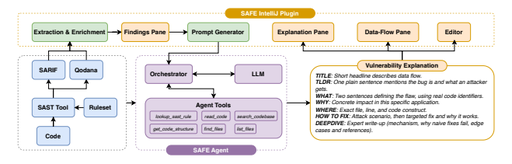
Fig. 1 : Architecture of the SAFE approach. A SAST tool applies its ruleset to the code and reports findings as SARIF or through Qodana. The SAFE plugin extracts and enriches them, lists them in its findings pane, and builds a prompt for the selected finding. In the SAFE Agent, an orchestrator relays that prompt to the language model and executes the tool calls the model issues against the project. The resulting struc- tured explanation is rendered in the explanation pane, the data-flow pane, and the editor.
원문 · CC BY 4.0 · Oshando Johnson, Ranjith Krishnamurthy, Rohith Kumar Shanmuganathan, Goran Piskachev, Eric Bodden · Code-Grounded Agentic Explanations for Static Analysis Vulnerability Findings · 원문 그림 인용 · 원본 PDF 9쪽에서 그림 영역을 추출했습니다.교차 실험의 설계와 비교 조건
평가는 SAFE-Blue라는 첫 버전과 SAFE-Red라는 재설계 버전을 같은 참여자가 두 번 사용하는 within-subjects 교차 실험으로 수행되었습니다. 두 빌드는 계층형 표시와 에이전트 백엔드, 워크플로 통합 등 여러 요소가 동시에 달라서 결과는 재설계 전체의 차이로만 읽어야 합니다. 발견 항목은 Fraunhofer IEM의 비공개 Java 웹 애플리케이션 Health-Doc-Exchange를 Semgrep으로 스캔해 얻었으며, 다섯 가지 취약점 계열과 참 양성·거짓 양성의 혼합으로 구성되었습니다.
판정 정확도와 수정 방식 품질
판정 정확도는 SAFE-Blue에서 0.46, SAFE-Red에서 0.53이었으며, 참여자별 Wilcoxon 부호순위 검정에서 차이는 유의하지 않았습니다(p=.59). 미확정 판정은 오답으로 계산되었습니다. 누적 연결 모델에서 SAFE-Red의 우세 오즈비는 2.6이었고 95% 신뢰구간은 0.93에서 7.09였으며, p=.069로 유의수준에 근접했습니다. 이 수정 방식 비교는 두 빌드의 결과로서 보고된 것이며 확정적 우세로 읽지 않습니다.
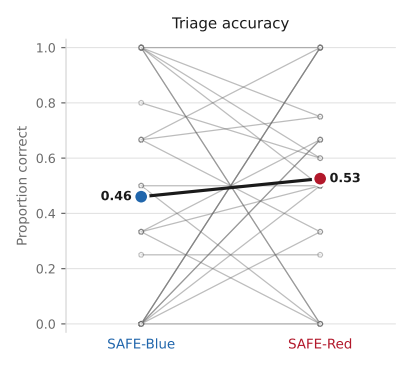
Fig. 3 : Per-participant triage accuracy for the two conditions (N= 24). Each thin line joins one participant’s two blocks, and the heavy line joins the condition means. An unsure verdict counts as incorrect.
원문 · CC BY 4.0 · Oshando Johnson, Ranjith Krishnamurthy, Rohith Kumar Shanmuganathan, Goran Piskachev, Eric Bodden · Code-Grounded Agentic Explanations for Static Analysis Vulnerability Findings · 원문 그림 인용 · 원본 PDF 19쪽에서 그림 영역을 추출했습니다.사용성 향상과 변하지 않은 신뢰
지각된 사용성은 System Usability Scale에서 SAFE-Blue 77.3, SAFE-Red 85.0으로 보고되었고 p=.011로 유의했습니다. 설명 품질 항목 가운데 다음 단계의 실행 가능성(actionability)이 가장 큰 +0.67 차이를 보였습니다. 그러나 Holm 보정 후 개별 항목은 유의하지 않았으며, 평가 결과의 신뢰 항목은 +0.04로 사실상 변하지 않았습니다. 인터뷰에서 참여자들은 근거 추적이 판정을 더 믿게 하기보다 위치 파악과 이해를 돕는다고 설명했습니다. 이는 근거 연결이 확신보다 이해에 기여했을 가능성을 보여주는 저자들의 해석입니다.
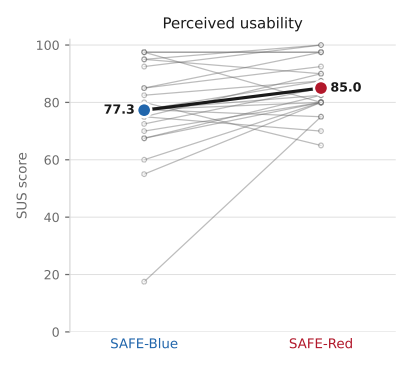
Fig. 5 : Per-participant System Usability Scale scores for the two conditions (N= 24). Each thin line joins one participant’s two blocks, and the heavy line joins the condition means.
원문 · CC BY 4.0 · Oshando Johnson, Ranjith Krishnamurthy, Rohith Kumar Shanmuganathan, Goran Piskachev, Eric Bodden · Code-Grounded Agentic Explanations for Static Analysis Vulnerability Findings · 원문 그림 인용 · 원본 PDF 22쪽에서 그림 영역을 추출했습니다.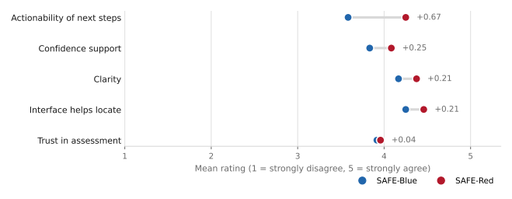
Fig. 6 : Mean ratings on the five post-task perception items, ordered by the size of the gap between conditions.
원문 · CC BY 4.0 · Oshando Johnson, Ranjith Krishnamurthy, Rohith Kumar Shanmuganathan, Goran Piskachev, Eric Bodden · Code-Grounded Agentic Explanations for Static Analysis Vulnerability Findings · 원문 그림 인용 · 원본 PDF 22쪽에서 그림 영역을 추출했습니다.소요 시간 결과와 실험의 한계
발견 항목당 소요 시간은 참여자별 중앙값 기준으로 SAFE-Blue 5.1분, SAFE-Red 4.7분이었고 p=.21로 유의하지 않았습니다. 블록당 15분 제한 때문에 대부분 참여자는 두세 개의 발견 항목만 판정했습니다. 따라서 정확도와 시간의 null 결과는 효과가 없다는 증거가 아니라 측정 여건이 제한적이었다는 뜻으로 읽어야 합니다. 또한 설명은 세션 전에 미리 생성되어 캐시에 저장되었으므로 생성 지연은 측정에 포함되지 않았습니다.
논문 정보
- 저자
- Oshando Johnson, Ranjith Krishnamurthy, Rohith Kumar Shanmuganathan, Goran Piskachev, Eric Bodden
- 학회·저널
- arXiv · 프리프린트
- 최초 공개일
- 2026년 11월 9일
- 등록일
- 2026년 11월 11일
- 수정일
- 2026년 11월 9일
- 버전
- v1
- arXiv
- 2611.13041
- 분류
- cs.SE · cs.AI · cs.HC
- 원문 이용 조건
- CC BY 4.0
- 제공 범위
- 논문 정보, 해설, 허용된 원문 그림
AI 해설은 논문 원문과 별개의 설명이며 오류가 있을 수 있습니다. 원문과 그림은 각 출처의 이용 조건과 따로 표시된 권리를 따릅니다.
초록
Static application security testing (SAST) tools surface vulnerabilities early and their verdicts are rule-based and auditable. Yet developers routinely dismiss findings they cannot interpret. Large language models can supply the missing explanation, but designs that also hand the model the detection give up the auditability that makes static analysis defensible. We keep detection with the analyser and give the model only the explaining. A preliminary user study with 20 participants and a workshop with 19 practitioners yielded five requirements. Guided by these we redesigned SAFE, an open-source IntelliJ IDEA plugin that explains findings from any analyser reporting in the Static Analysis Results Interchange Format. It tiers explanations by demand, ties them to the reported data flow, and replaces the single-prompt backend with an agent that must consult the repository and the rule that fired before answering. A within-subjects crossover experiment with 24 participants compared the redesign against its predecessor. Perceived usability rose from 77.3 to 85.0 on the System Usability Scale. Actionability gained most among the explanation-quality items, the aspect both earlier studies flagged as weakest, and the odds of a correct remediation were 2.6 times higher. Triage accuracy and time per finding were indistinguishable, which we read as uninformative rather than as equivalence. Trust was the one measure that did not move, and the closing interviews indicate that grounding made findings easier to understand rather than easier to believe. Participants also drew a boundary no requirement anticipated, wanting the tool to find and explain while they judge and apply.
원문 인용
Oshando Johnson, Ranjith Krishnamurthy, Rohith Kumar Shanmuganathan, Goran Piskachev, Eric Bodden (2026). Code-Grounded Agentic Explanations for Static Analysis Vulnerability Findings. arXiv:2611.13041v1. https://arxiv.org/abs/2611.13041v1
BibTeX
@misc{johnson2026code,
  title = {{Code-Grounded Agentic Explanations for Static Analysis Vulnerability Findings}},
  author = {Oshando Johnson and Ranjith Krishnamurthy and Rohith Kumar Shanmuganathan and Goran Piskachev and Eric Bodden},
  year = {2026},
  eprint = {2611.13041},
  archivePrefix = {arXiv},
  url = {https://arxiv.org/abs/2611.13041v1}
}