논문 해설
METER: a mobile vision transformer architecture for monocular depth estimation
METER: 단안 깊이 추정을 위한 모바일 비전 트랜스포머 아키텍처
- 연구 문제 임베디드 장치의 제한된 메모리와 저전력 환경에서 깊은 ViT 기반 단안 깊이 추정 모델은 실행하기 어렵습니다.
- 연구 방법 METER는 MobileViT 인코더의 계산 비용이 큰 블록을 METER 블록으로 바꾸고, 완전 합성곱 디코더와 균형 손실, 쉬프팅 증강을 함께 사용합니다.
- 주요 결과 METER는 두 벤치마크에서 비교된 경량 방법보다 우수한 결과를 보고하며, Jetson TX1에서 METER S, XS, XXS는 16.3, 18.3, 25.8 fps를 보고합니다.
문제 설정: 임베디드 장치에서 ViT 기반 깊이 추정의 어려움
단안 깊이 추정(MDE)은 단일 RGB 영상 프레임에서 픽셀별 밀집 깊이 맵을 예측하는 과제입니다. 능동형 깊이 센서는 비투명 물체나 조명 조건에서 깊이 맵이 비어 있거나 깊이 범위가 제한되고, 저전력 임베디드 장치에 통합하기 어렵습니다. 반면 최신 MDE 모델은 깊은 비전 트랜스포머(ViT) 구조에 의존하여 메모리와 저전력 CPU/GPU가 제한된 장치에서 빠르게 추론하기 어렵습니다. 이 논문은 이 간극을 메우기 위해 ViT의 전역 처리 능력을 유지하면서 계산량을 줄인 경량 구조를 다룹니다.
METER 구조: MobileViT 인코더의 계산 블록 교체
METER는 MobileViT를 수정한 인코더와 완전 합성곱 디코더로 구성된 경량 인코더-디코더 모델입니다. 인코더에서는 MobileViT 블록 중 합성곱과 트랜스포머가 연쇄된 계산 비용이 큰 블록을 METER 블록으로 교체합니다. METER 블록은 3×3 합성곱과 점별 합성곱으로 이루어진 합성곱 블록 두 개, 하나의 트랜스포머 블록, 그리고 1×1 합성곱을 사용하며, 트랜스포머 어텐션은 펼친 입력 패치에 적용된 뒤 다시 접는 연산으로 특징 맵에 반영됩니다. 또한 METER 블록에 들어온 입력을 트랜스포머 출력과 연결하여 1×1 합성곱 층에 전달합니다. 인코더 마지막 출력 채널 C6은 절반으로 줄이고, 활성화 함수는 SiLU 대신 ReLU를 사용합니다.
세 구성 S, XS, XXS는 채널 수를 달리하며 학습 파라미터는 각각 3.29M, 1.45M, 0.71M입니다.
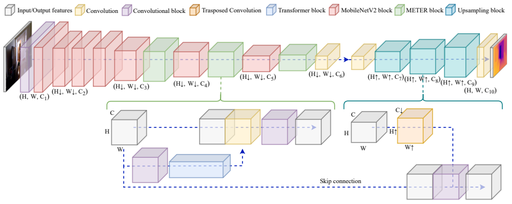
Fig. 2 : Overview of METER encoder-decoder network structure. The processing flow, i.e. the sequence of operations and the skip-connection, is represented with a blue dashed arrow. The (H, W, C) format refers to the input-output spatial dimensions, while the ↑ and ↓ refers to the feature resolution upsampling and downsampling.
원문 · CC BY 4.0 · L. Papa, P. Russo, I. Amerini · METER: a mobile vision transformer architecture for monocular depth estimation · 원문 그림 인용 · 원본 PDF 4쪽에서 그림 영역을 추출했습니다.디코더와 skip-connection: 해상도 복원 방식
METER 디코더는 완전 합성곱 구조로, 세 개의 연쇄된 업샘플링 블록과 시작과 끝에 놓인 두 개의 합성곱 층으로 구성됩니다. 각 업샘플링 블록에서는 전치 합성곱 층이 공간 해상도를 두 배로 키우고, 합성곱 블록이 특징을 추출합니다. 인코더와 디코더를 잇는 skip-connection은 인코더 특징 맵의 영상 세부 정보를 디코더로 전달하여 깊이 맵의 세부 구조 복원을 돕습니다.
균형 손실 함수: 깊이 항과 고주파 항의 결합
균형 손실 함수(BLF)는 Ldepth, Lgrad, Lnorm, LSSIM의 가중 합으로 정의됩니다. 식은 L = Ldepth + λ1Lgrad + λ2Lnorm + λ3LSSIM이며, λ1, λ2, λ3는 스케일 계수입니다. Ldepth는 픽셀별 절대 차이의 평균인 L1 손실이고, Lgrad는 오차 절대값의 공간 기울기를 Sobel 방식으로 계산하여 경계의 오차를 벌합니다. Lnorm은 정답과 예측의 표면 법선 벡터 사이 코사인 유사도를 이용하고, LSSIM은 1에서 평균 SSIM을 뺀 값입니다. 저자들은 λ1을 0.5로 두고 λ2, λ3는 단위에 따라 {1, 10, 100} 중에서 골랐다고 설명합니다.
이 설정은 METER 학습에 적용된 값이며 다른 모델에 공통으로 적용된 고정값은 아닙니다.
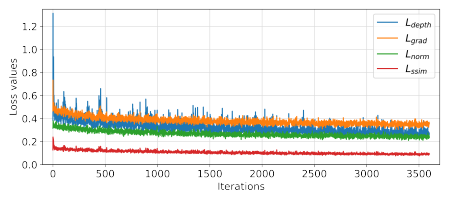
Fig. 6 : Plot of the individual loss components composing the balanced loss function in the first ten epochs, i.e. almost 3600 iterations.
원문 · CC BY 4.0 · L. Papa, P. Russo, I. Amerini · METER: a mobile vision transformer architecture for monocular depth estimation · 원문 그림 인용 · 원본 PDF 9쪽에서 그림 영역을 추출했습니다.쉬프팅 데이터 증강: 색상과 깊이 범위의 동시 변환
쉬프팅 전략은 기본 증강인 수직 뒤집기, 좌우 반전, 무작위 자르기, 채널 교환과 함께 사용됩니다. C shift는 RGB 입력에 감마-밝기 변환과 색상 스케일 변환을 적용하며, D shift는 정답 깊이 맵 전체에 무작위 양수 또는 음수 값을 더합니다. D shift의 범위는 실내 데이터셋에서 ±10 센티미터, 실외 데이터셋에서 ±10 데시미터로 설정됩니다. 이 두 변환은 입력 영상과 정답 깊이 맵에 동시에 적용되며, 각 무작위 변환은 확률 0.5로 적용됩니다.
데이터셋과 평가 조건
평가는 실내 데이터셋 NYU Depth v2와 실외 데이터셋 KITTI에서 수행됩니다. NYU Depth v2는 입력을 256×192로 축소해 학습하고, KITTI는 Eigen 분할에서 636×192 입력 해상도로 학습합니다. 지표는 RMSE, REL, δ1이며 δ1은 임계값 1.25를 쓰는 정확도 지표입니다. 추론 속도는 Jetson TX1과 Jetson Nano에서 단일 영상 기준 fps를 테스트셋 평균으로 측정합니다.
경량 방법과의 비교 결과
두 벤치마크의 비교에서 METER는 비교된 경량 방법들보다 우수하다고 보고됩니다. SPEED와 비교하면 METER S는 NYU Depth v2에서 RMSE 17%, REL 15%, δ1 6% 향상되었고, KITTI에서는 RMSE 11%, REL 30%, δ1 7% 향상되었습니다. METER XS는 NYU Depth v2에서 RMSE 9%, REL 10%, δ1 5%, KITTI에서 RMSE 10%, REL 29%, δ1 7% 향상되었습니다. METER XXS는 0.7M 파라미터와 0.186G MAC으로 경쟁력 있는 결과를 보입니다. 추론 속도는 Jetson TX1에서 SPEED 30.9 fps, FastDepth 18.8 fps와 비교하여 METER S 16.3 fps, XS 18.3 fps, XXS 25.8 fps로 보고됩니다.
이 속도 결과는 TX1에서 측정된 값이며, 다른 하드웨어의 인용 점수와 같은 조건으로 묶이지 않습니다.
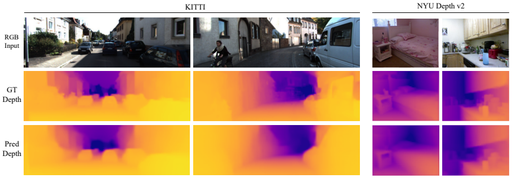
Fig. 1 : METER depth map predictions (third-row) over the KITTI and NYU Depth v2 datasets. GT depth maps are resized to match METER output resolution. The depth maps are converted in RGB format with a perceptually uniform colormap (Plasma-reversed) extracted from the ground truth (second-row), for a better view.
원문 · CC BY 4.0 · L. Papa, P. Russo, I. Amerini · METER: a mobile vision transformer architecture for monocular depth estimation · 원문 그림 인용 · 원본 PDF 2쪽에서 그림 영역을 추출했습니다.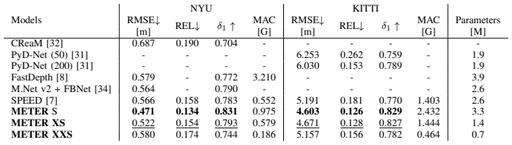
원문 그림 TABLE II: Comparison with state of the art lightweight methods on the two benchmark datasets. The best scores are in bold and second best are underlined; the - represents a value which is not reported in the original paper.
원문 · CC BY 4.0 · L. Papa, P. Russo, I. Amerini · METER: a mobile vision transformer architecture for monocular depth estimation · 원문 그림 인용 · 원본 PDF 7쪽에서 그림 영역을 추출했습니다.인코더와 디코더 절제 실험
인코더 비교에서 디코더를 METER 디코더로 고정하고 MobileViT 인코더와 METER 인코더를 비교합니다. ReLU와 SiLU를 각각 적용한 결과에서 METER 인코더는 모든 구성에서 더 나은 깊이 추정 성능을 보고합니다. 원문은 MobileViT 대비 평균적으로 실내 RMSE 10%, REL 14%, δ1 6% 개선과 실외 RMSE 2%, REL 7%, δ1 2% 개선을 보고합니다. 또한 MAC 연산은 S, XS, XXS에서 각각 20%, 29%, 60% 줄었다고 보고합니다. 디코더 비교에서는 METER S 인코더를 고정하고 NNConv5, NNDSConv5, MDSPP와 비교하며, METER 디코더는 NNConv5 및 MDSPP 대비 NYU RMSE를 각각 16%와 19% 낮춥니다.
이 디코더 결과는 해당 실험의 인코더 설정에서 얻은 것입니다.
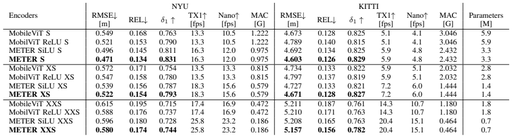
원문 그림 TABLE III: Comparison between the MobileViT [9] and METER encoders over different activation functions (ReLU, SiLU) keeping METER decoder fixed. The fps are measured on the two benchmark hardwares, the NVIDIA Jetson TX1 and the NVIDIA Jetson Nano. In bold the best results for each configuration in terms of RMSE, REL and δ1.
원문 · CC BY 4.0 · L. Papa, P. Russo, I. Amerini · METER: a mobile vision transformer architecture for monocular depth estimation · 원문 그림 인용 · 원본 PDF 8쪽에서 그림 영역을 추출했습니다.손실 함수와 데이터 증강의 절제 결과
손실 절제는 METER S를 기준으로 Ldepth 단독, Ldepth와 LSSIM, Ldepth와 Lgrad 및 Lnorm, 그리고 전체 BLF를 비교합니다. BLF는 Ldepth 단독 대비 두 시나리오 전체에서 정량적 기여가 25%이며, 기존 손실 식 [38]과 비교해서는 13%의 기여가 있다고 보고됩니다. 데이터 증강 절제에서는 기본 증강, 기본 증강과 C shift, 기본 증강과 D shift, 그리고 C shift와 D shift를 함께 쓴 전체 전략을 비교합니다. 전체 쉬프팅 전략은 기본 증강 대비 두 시나리오 전체에서 4% 향상되며, C shift만 또는 D shift만 추가한 경우에는 개선이 없거나 약간 나빠집니다.
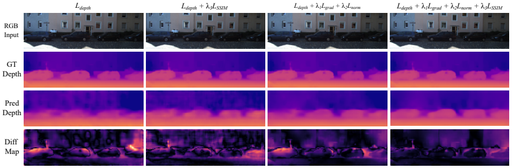
Fig. 5 : Qualitative comparison of a predicted frame taking into account different loss components. For a better visualization, we apply to the depth images and to the difference maps uniform colormaps with the same depth range. Precisely, in the ground truth (GT) and predicted depth maps (Pred) a lower color intensity corresponds to further distances, while in the difference map (Diff = |GT − Pred|) a lower color intensity corresponds to a smaller error.
원문 · CC BY 4.0 · L. Papa, P. Russo, I. Amerini · METER: a mobile vision transformer architecture for monocular depth estimation · 원문 그림 인용 · 원본 PDF 9쪽에서 그림 영역을 추출했습니다.
원문 그림 TABLE V: The effect of each balanced loss function components on the METER S over the considered metrics. The best scores are in bold.
원문 · CC BY 4.0 · L. Papa, P. Russo, I. Amerini · METER: a mobile vision transformer architecture for monocular depth estimation · 원문 그림 인용 · 원본 PDF 9쪽에서 그림 영역을 추출했습니다.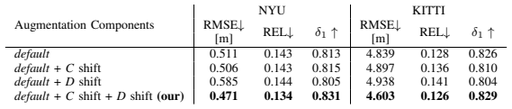
원문 그림 TABLE VI: Comparison between different augmentation strategies. The default policy comprises the flip, random crop and channel swap while the others represent the different components of the shifting strategy described in Section III-C. The reference model is METER S. The best scores are in bold.
원문 · CC BY 4.0 · L. Papa, P. Russo, I. Amerini · METER: a mobile vision transformer architecture for monocular depth estimation · 원문 그림 인용 · 원본 PDF 10쪽에서 그림 영역을 추출했습니다.구성 간 트레이드오프와 실제 장면 한계
세 구성은 학습 파라미터를 줄이는 대신 최종 추정 오차가 약간 증가합니다. KITTI에서는 XXS가 추론 속도 측면에서 가장 빠르지만 정확도는 S보다 낮습니다. 실제 장면 예시에서 METER의 예측은 낮은 작업 해상도 때문에 기준 깊이보다 덜 선명하며, 강한 광원 아래의 영역에서는 정답 깊이 오차를 알 수 없습니다. 이 예시는 한 장면에 대한 정성적 관찰이므로 일반적인 실환경 성능으로 확대하지 않습니다.
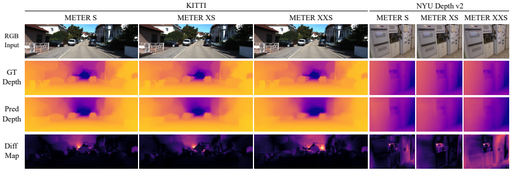
Fig. 4 : A graphical comparison among METER (S, XS, XXS) configurations. For a better visualization, we apply to depth images and difference maps uniform colormaps with the same depth range. Precisely, in the ground truth (GT) and predicted depth maps (Pred) a lower color intensity corresponds to further distances, while in the difference map (Diff = |GT − Pred|) a lower color intensity corresponds to a smaller error.
원문 · CC BY 4.0 · L. Papa, P. Russo, I. Amerini · METER: a mobile vision transformer architecture for monocular depth estimation · 원문 그림 인용 · 원본 PDF 7쪽에서 그림 영역을 추출했습니다.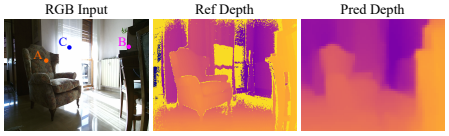
Fig. 7 : METER application in a real-case scenario. Missing depth measurements of reference (Ref) depth are shown as yellow pixels. A uniform colormap, with the same depth range, has been applied to the depth maps. Points A (armchair), B (box), and C (curtain) on the RGB frame indicates object used for quantitative comparison.
원문 · CC BY 4.0 · L. Papa, P. Russo, I. Amerini · METER: a mobile vision transformer architecture for monocular depth estimation · 원문 그림 인용 · 원본 PDF 10쪽에서 그림 영역을 추출했습니다.논문 정보
- 저자
- L. Papa, P. Russo, I. Amerini
- 학회·저널
- arXiv · 프리프린트
- 최초 공개일
- 2024년 3월 13일
- 등록일
- 2026년 11월 6일
- 수정일
- 2024년 3월 13일
- 버전
- v1
- arXiv
- 2403.08368
- DOI
- 10.1109/tcsvt.2023.3260310
- 분류
- cs.CV
- 원문 이용 조건
- CC BY 4.0
- 제공 범위
- 논문 정보, 해설, 허용된 원문 그림
AI 해설은 논문 원문과 별개의 설명이며 오류가 있을 수 있습니다. 원문과 그림은 각 출처의 이용 조건과 따로 표시된 권리를 따릅니다.
초록
Depth estimation is a fundamental knowledge for autonomous systems that need to assess their own state and perceive the surrounding environment. Deep learning algorithms for depth estimation have gained significant interest in recent years, owing to the potential benefits of this methodology in overcoming the limitations of active depth sensing systems. Moreover, due to the low cost and size of monocular cameras, researchers have focused their attention on monocular depth estimation (MDE), which consists in estimating a dense depth map from a single RGB video frame. State of the art MDE models typically rely on vision transformers (ViT) architectures that are highly deep and complex, making them unsuitable for fast inference on devices with hardware constraints. Purposely, in this paper, we address the problem of exploiting ViT in MDE on embedded devices. Those systems are usually characterized by limited memory capabilities and low-power CPU/GPU. We propose METER, a novel lightweight vision transformer architecture capable of achieving state of the art estimations and low latency inference performances on the considered embedded hardwares: NVIDIA Jetson TX1 and NVIDIA Jetson Nano. We provide a solution consisting of three alternative configurations of METER, a novel loss function to balance pixel estimation and reconstruction of image details, and a new data augmentation strategy to improve the overall final predictions. The proposed method outperforms previous lightweight works over the two benchmark datasets: the indoor NYU Depth v2 and the outdoor KITTI.
원문 인용
L. Papa, P. Russo, I. Amerini (2024). METER: a mobile vision transformer architecture for monocular depth estimation. arXiv:2403.08368v1. https://doi.org/10.1109/tcsvt.2023.3260310
BibTeX
@article{papa2024meter,
  title = {{METER: a mobile vision transformer architecture for monocular depth estimation}},
  author = {L. Papa and P. Russo and I. Amerini},
  year = {2024},
  eprint = {2403.08368},
  archivePrefix = {arXiv},
  doi = {10.1109/tcsvt.2023.3260310},
  url = {https://arxiv.org/abs/2403.08368v1}
}