논문 해설
Radiance Fields from Photons
광자로부터의 래디언스 필드
- 연구 문제 기존 신경 복사장(NeRF)은 카메라가 기록한 픽셀 값을 그대로 학습합니다.
- 연구 방법 단일 광자 카메라의 이진 프레임으로 광자 검출 확률을 신경 복사장으로 학습하고, 고밀도 카메라 포즈는 푸리에 영역 평활화 정규화로 안정화합니다.
- 주요 결과 시뮬레이션 Lego truck 뷰 외삽에서 QRF는 평균 PSNR 19.74를 기록해 Conventional의 12.58보다 높았습니다. 가우시안 스플래팅 장면에서 TS는 PSNR 16.93으로 Conventional과 Deblur Gaussians보다 높았으나 SSIM과 LPIPS에서는 Conventional보다 낮았습니다.
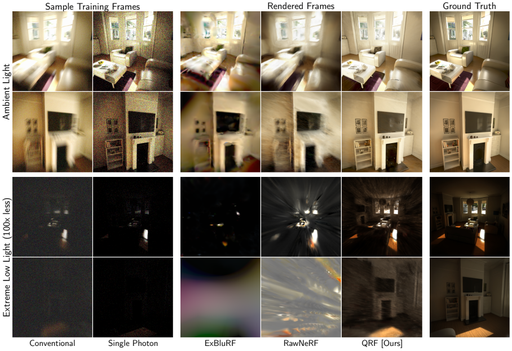
Fig. 2 .Reconstruction under challenging scenario:We simulate a high-speed ( ∼72km/h) drone fly-through of an indoor scene which has16stops of dynamic range. We train a conventional motion-aware NeRF with tonemapped images [26], one with raw linear intensity conventional images like in [40], and a QRF with simulated binary frames from this scene. In ambient light, the ExBluRF and RawNeRF reconstructions suffer from various artifacts, while the QRF model captures the full dynamic range of the scene with no noticeable blur. In the extreme case of lowering the light levels by100×, the QRF reconstruction remains recognizable, while baselines fail.
원문 · CC BY 4.0 · Sacha Jungerman, Aryan Garg, Mohit Gupta · Radiance Fields from Photons · 원문 그림 인용 · 원본 PDF 4쪽에서 그림 영역을 추출했습니다.픽셀 단위 NeRF의 한계와 광자 단위 표현의 동기
기존 신경 복사장(NeRF)은 카메라가 기록한 픽셀 값을 그대로 학습합니다. 이 때문에 저조도의 센서 노이즈, 고동적범위에서의 포화, 빠른 움직임에 따른 모션 블러가 픽셀 값에 포함된 채 장면 표현에 굳어집니다. 논문은 이런 문제를 개별 후처리로 고치기보다, 측정의 최소 단위를 광자로 바꾸면 원천에서 줄일 수 있다고 제안합니다.
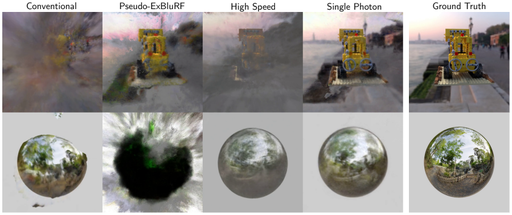
Fig. 6 .Robustness to Motion Blur:(Column 1) Traditional NeRF reconstructions suffer considerably when the data it has been trained on contains motion blur. (Column 2) Some methods, such as [26], address this by incorporating the formation of image blur into the forward rendering model. (Column 3) A high-speed camera running at 1000 fps can be used to capture more views with less motion blur, however, the colors look washed out due to the read noise being baked into the learned radiance field. (Column 4) We show that, despite much noisier individual frames, training using binary data obtained from a single photon camera achieves visually superior reconstructions. For corresponding quantitative results, see Tab. 2.
원문 · CC BY 4.0 · Sacha Jungerman, Aryan Garg, Mohit Gupta · Radiance Fields from Photons · 원문 그림 인용 · 원본 PDF 10쪽에서 그림 영역을 추출했습니다.이 연구가 다루는 카메라는 개별 광자를 검출해 세는 단일 광자 카메라(SPC)이며, 각 노출 동안 한 개 이상의 광자가 검출되었는지를 0 또는 1로 기록하는 이진 프레임을 만듭니다. 논문은 이 이진 프레임 시퀀스로 광자 검출 확률을 학습하는 Quanta Radiance Fields(QRF)를 제안합니다. 핵심 질문은 이 설정이 저조도와 고동적범위, 빠른 움직임에서 재구성 품질과 뷰 외삽 성능을 실제로 개선하는지, 그리고 노이즈가 큰 이진 프레임에서 카메라 포즈를 안정적으로 최적화할 수 있는지입니다.
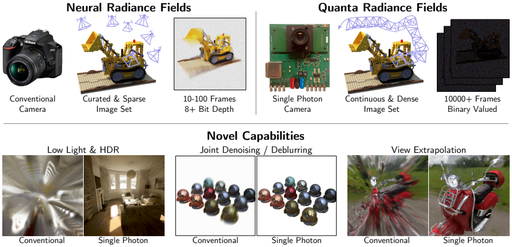
Fig. 1 .Single Photon Radiance Fields:We introduce Quanta Radiance Fields (QRFs), neural radiance fields trained at the granularity of photons, using single photon cameras. QRFs significantly mitigate common challenges of conventional NeRFs and enable fast and continuous capture of the scene. They faithfully reconstruct scenes in extremely low-light and high dynamic range settings, effectively denoise and deblur training data without resorting to specialized techniques, and generalize better, producing novel view synthesis for a greater diversity of poses.
원문 · CC BY 4.0 · Sacha Jungerman, Aryan Garg, Mohit Gupta · Radiance Fields from Photons · 원문 그림 인용 · 원본 PDF 1쪽에서 그림 영역을 추출했습니다.이진 프레임의 형성 모델과 광자 검출 확률 학습
SPAD 픽셀은 노출 시간 τ 동안 광자 수 k가 포아송 분포를 따른다고 모델링되며, 측정값 B는 k가 0이면 0, 1 이상이면 1인 이진 값입니다. 이때 P(B=0)=e^{-φτ}, P(B=1)=1−e^{-φτ}로 주어집니다. 여기서 φ는 입사 플럭스입니다. 이 모델은 독출 잡음과 완전 우물 용량이 없고, 노출 시간이 짧다는 점에서 기존 CMOS 모델(식 2)과 다릅니다.
QRF는 방사장을 직접 예측하지 않고, 공간과 시점에 따라 달라지는 광자 검출 확률 P̂를 신경망으로 학습합니다. 학습 손실은 렌더링된 P̂와 관측된 이진 값 B 사이의 제곱 오차 L_quanta=||P̂−B||²₂입니다. 이 손실은 이진 측정 자체에 대해 정의되지만, 렌더링된 확률은 연속값이므로 최적화가 미분 가능합니다. 학습 후에는 식 6, 즉 φ̂=−(1/τ)ln(1−P̂)로 플럭스를 추정할 수 있습니다. 논문은 이것이 정적 장면의 최대우도 추정과 유사하다고 설명하지만, 이를 모든 장면에 대한 일반 성질로 확장하지는 않습니다.
푸리에 영역 평활화로 고밀도 포즈를 최적화하는 방법
이진 프레임은 수십만 장이 될 수 있어 카메라 포즈도 수십만 개를 함께 최적화해야 합니다. 논문은 인접한 프레임의 포즈가 비슷해야 한다는 사실을 이용해, 포즈 궤적이 부드럽다는 사전 지식을 정규화로 넣습니다. 포즈는 평행이동 3차원과 6차원 회전 표현을 합친 9차원 벡터로 인코딩되며, 이 텐서를 첫 번째 차원에 대해 1D 푸리에 변환하고 저역 통과 필터를 적용한 뒤 역변환하여 평활화된 궤적 P̄를 얻습니다.
학습 손실은 L_total=L_quanta+λΣ_j||P_j−P̄_j||²입니다. 여기서 λ는 정규화 강도를 조절합니다. 평활화된 궤적과의 차이를 줄이므로 고주파 잡음 성분이 포즈에 과도하게 반영되는 것을 억제합니다. 논문은 이 평활화가 SPC의 높은 샘플링 속도에서 유효하다고 설명하며, 같은 정규화가 기존 카메라에서는 나이키스트 주파수 때문에 거의 사라진다고 밝힙니다. 실험에서는 이상적인 저역 통과 필터를 사용했으며 기본 차단 주파수는 500Hz, λ는 0.1로 보고됩니다.
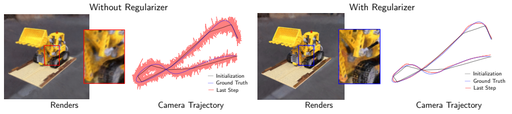
Fig. 4 .Camera Pose Optimization:The trajectory of the camera is co-optimized with the radiance field. Due to the large number of camera poses to optimize and the noisy binary measurements, a strong smoothing regularizer on the poses is needed. Without it, poses settle in noisy local minima, which affects the final reconstruction quality.
원문 · CC BY 4.0 · Sacha Jungerman, Aryan Garg, Mohit Gupta · Radiance Fields from Photons · 원문 그림 인용 · 원본 PDF 9쪽에서 그림 영역을 추출했습니다.Lego truck 뷰 외삽 실험
논문은 시뮬레이션된 Lego truck 장면에서 50fps와 200fps의 기존 카메라, 그리고 80kHz 단일 광자 카메라를 비교합니다. 세 설정 모두 총 촬영 시간과 카메라 궤적을 고정합니다. 훈련 포즈는 원 궤적에서 샘플링되고, 검증 궤적은 훈련 궤적에서 출발해 원호를 따라 점점 멀어집니다. 기준 각도는 12°로 제시되며, 이는 훈련 뷰 사이의 중간 위치에 해당합니다.
결과에 따르면 기존 카메라로 학습한 NeRF는 몇 도의 작은 포즈 변화에서도 재구성 품질이 빠르게 떨어지고 이후 완전히 실패합니다. 전체 시뮬레이션 장면 평균에서는 QRF가 PSNR 19.74, SSIM 0.752, LPIPS 0.094를 기록했고, Conventional은 PSNR 12.58, SSIM 0.622, LPIPS 0.165였습니다. 이 수치는 이 시뮬레이션 설정에서 얻은 결과이며, 다른 장면이나 실제 촬영으로 일반화된다고 보기는 어렵습니다.
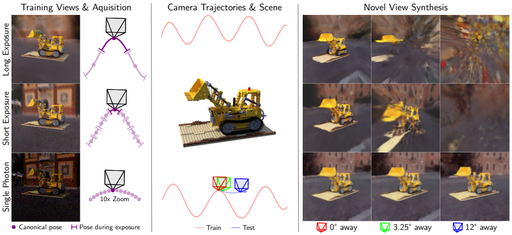
Fig. 3 .View Diversity and Extrapolation:Radiance fields trained using single photon data perform better view extrapolation (novel views that are significantly different than the training poses) and degrade more gracefully than ones trained with conventional frames, given the same total capture time. The training viewpoints in both cases span the same trajectory, that is, both datasets have the same pose diversity, however, the denser sampling provided by the single photon camera better constrains the scene’s geometry leading to significantly improved reconstructions and better generalization.
원문 · CC BY 4.0 · Sacha Jungerman, Aryan Garg, Mohit Gupta · Radiance Fields from Photons · 원문 그림 인용 · 원본 PDF 6쪽에서 그림 영역을 추출했습니다.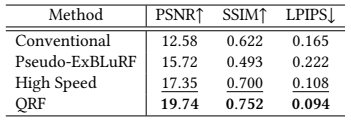
Table 2 .View Extrapolation:quantitative evaluation of novel view syn- thesis averaged over all simulated scenes.
원문 · CC BY 4.0 · Sacha Jungerman, Aryan Garg, Mohit Gupta · Radiance Fields from Photons · 원문 그림 인용 · 원본 PDF 8쪽에서 그림 영역을 추출했습니다.가우시안 스플래팅에서의 시간적 평활화 실험
명시적 3D 가우시안 스플래팅에서는 이진 프레임을 직접 학습하면 가우시안이 수렴하지 않고 과도하게 가지치기되는 문제가 보고됩니다. 논문은 이를 해결하기 위해 초기 단계에서 k개 인접 프레임을 평균내어 저역 통과 효과를 주고, 이후 평활화 강도를 단계적으로 줄이는 Scheduled Temporal Smoothing(TS)을 제안합니다.
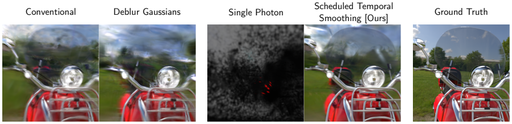
Fig. 10 .Qualitative results from explicit reconstruction:Traditional 3D Gaussian Splatting [ 22] (3DGS) reconstructions suffers with motion-blur data. Deblur Gaussians [24] addresses this by modeling per-Gaussian motion offsets using an MLP in the vanilla 3DGS training process. Using purely single photon data does not allow the individual gaussians to converge due to the view-dependent dynamic noise, leading to premature pruning and a failed reconstruction. However, we show that temporally smoothing single photon frames allows superior explicit 3D reconstruction. The metrics for the scene are provided in Tab. 4.
원문 · CC BY 4.0 · Sacha Jungerman, Aryan Garg, Mohit Gupta · Radiance Fields from Photons · 원문 그림 인용 · 원본 PDF 13쪽에서 그림 영역을 추출했습니다.이 장면의 평균 지표에서 Conventional은 PSNR 15.15, SSIM 0.692, LPIPS 0.216이고, Deblur Gaussians는 PSNR 15.14, SSIM 0.592, LPIPS 0.281입니다. TS는 PSNR 16.93, SSIM 0.663, LPIPS 0.237입니다. 이 결과는 PSNR에서는 우위를 보이지만 SSIM과 LPIPS 모두에서 Conventional보다 좋지 않으므로, 전체적인 품질 우위를 단정할 수 없습니다. 또한 이 결과는 하나의 장면에 대한 평균이므로 여러 장면의 결과로 확장하지 않습니다.
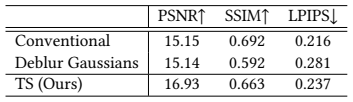
Table 4 .Average metrics over scene shown in Fig.10.
원문 · CC BY 4.0 · Sacha Jungerman, Aryan Garg, Mohit Gupta · Radiance Fields from Photons · 원문 그림 인용 · 원본 PDF 12쪽에서 그림 영역을 추출했습니다.초기 포즈 의존성과 실험 범위의 한계
논문은 QRF가 카메라 포즈를 학습 중에 미세 조정하더라도 좋은 초기 추정을 여전히 필요로 한다고 명시합니다. 이 한계는 극저조도와 야외 QRF에서 주요 제약으로 제시됩니다. 실제 SwissSPAD2 촬영에서는 해상도가 낮아 COLMAP으로 얻은 초기 포즈가 정밀하지 않고, 움직임이 빠르거나 빛이 약하면 COLMAP이 수렴하지 않을 수 있습니다.
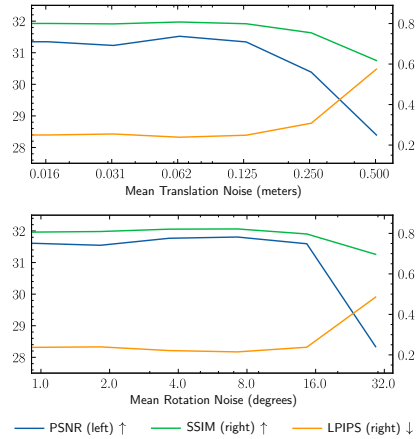
Fig. 5 .Robustness of Pose Regularizer:Using the same scene as in Fig. 4, we show the final reconstruction quality as a function of the amount of noise added to the pose initialization. Reconstruction quality stays nearly constant, rivaling that of using ground truth poses, up until it rapidly col- lapses when initialized with around0.25m and16°of mean translational or rotational noise. For comparison, the base of the truck is about2.3m× 1.3m and the camera’s diagonal field-of-view is39.6°.
원문 · CC BY 4.0 · Sacha Jungerman, Aryan Garg, Mohit Gupta · Radiance Fields from Photons · 원문 그림 인용 · 원본 PDF 9쪽에서 그림 영역을 추출했습니다.또한 실제 하드웨어 결과는 색 필터 배열이 없어 그레이스케일로 보고되며, 대부분의 정량 평가는 시뮬레이션 또는 보간된 NeRF 데이터셋에서 이루어졌습니다. 따라서 시뮬레이션 설정에서 관찰된 우위를 실제 장면 전반의 성능으로 확대할 수 없습니다.
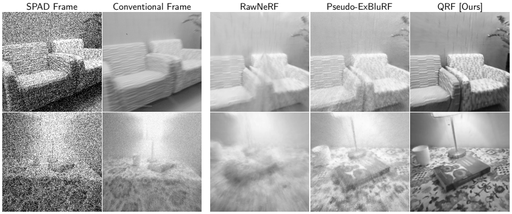
Fig. 11 .Qualitative results on real-world captures:We capture a room-scale and tabletop scene with a single photon camera in about8seconds and show reconstructions made using emulated raw conventional frames at30fps [ 40], a blur-specific baseline [26], and with quanta radiance fields. Overall QRFs exhibit fewer artifacts and better reconstruction quality than baseline methods. Please see the supplemental material for video results of these scenes.
원문 · CC BY 4.0 · Sacha Jungerman, Aryan Garg, Mohit Gupta · Radiance Fields from Photons · 원문 그림 인용 · 원본 PDF 14쪽에서 그림 영역을 추출했습니다.논문 정보
- 저자
- Sacha Jungerman, Aryan Garg, Mohit Gupta
- 학회·저널
- arXiv · 프리프린트
- 최초 공개일
- 2024년 7월 12일
- 등록일
- 2026년 11월 4일
- 수정일
- 2026년 1월 26일
- 버전
- v3
- arXiv
- 2407.09386
- 분류
- cs.CV · eess.IV
- 원문 이용 조건
- CC BY 4.0
- 제공 범위
- 논문 정보, 해설, 허용된 원문 그림
AI 해설은 논문 원문과 별개의 설명이며 오류가 있을 수 있습니다. 원문과 그림은 각 출처의 이용 조건과 따로 표시된 권리를 따릅니다.
초록
Neural radiance fields, or NeRFs, have become the de facto approach for high-quality view synthesis from a collection of images captured from multiple viewpoints. However, many issues remain when capturing images in-the-wild under challenging conditions, such as low light, high dynamic range, or rapid motion leading to smeared reconstructions with noticeable artifacts. In this work, we introduce quanta radiance fields, a novel class of neural radiance fields that are trained at the granularity of individual photons using single-photon cameras (SPCs). We develop theory and practical computational techniques for building radiance fields and estimating dense camera poses from unconventional, stochastic, and high-speed binary frame sequences captured by SPCs. We demonstrate, both via simulations and a SPC hardware prototype, high-fidelity reconstructions under high-speed motion, in low light, and for extreme dynamic range settings.
원문 인용
Sacha Jungerman, Aryan Garg, Mohit Gupta (2024). Radiance Fields from Photons. arXiv:2407.09386v3. https://arxiv.org/abs/2407.09386v3
BibTeX
@misc{jungerman2024radiance,
  title = {{Radiance Fields from Photons}},
  author = {Sacha Jungerman and Aryan Garg and Mohit Gupta},
  year = {2024},
  eprint = {2407.09386},
  archivePrefix = {arXiv},
  url = {https://arxiv.org/abs/2407.09386v3}
}