논문 해설
GaRField++: Reinforced Gaussian Radiance Fields for Large-Scale 3D Scene Reconstruction
GaRField++: 대규모 3D 장면 재구성을 위한 강화된 가우시안 방사장
- 연구 문제 대규모 도시 장면에서 3DGS는 확장성, 기하·배경 세부 묘사, 불균일 조명에서의 정확도 문제를 겪습니다. 이 논문은 이를 cell 분할과 가시성 기반 카메라 선택으로 다룹니다.
- 연구 방법 장면을 cell로 나누고 인접 카메라와 점군을 포함한 뒤, ray-Gaussian intersection, 개선된 density control, ConvKAN 외형 보정과 결합 손실로 cell별 Gaussian을 학습합니다.
- 주요 결과 Table I에서 제안 방법은 비교된 장면에서 SSIM, PSNR, LPIPS 기준 기존 방법보다 나은 Building 결과를 보고합니다. 자체 Campus-YNU 데이터에서는 3DGS 대비 SSIM 0.896, PSNR 31.58, LPIPS 0.151을 보고합니다.
대규모 장면 3DGS 재구성의 문제
대규모 도시 장면의 3D 재구성은 넓은 영역을 고충실도로 실시간 렌더링해야 하는 과제입니다. 기존 NeRF 계열 방법은 세부 묘사가 부족하고, 3D Gaussian splatting(3DGS)은 시각 품질과 렌더링 속도에서 강점을 보이지만 대규모 장면에서는 확장성과 정확도 문제를 겪습니다. 원문은 복잡한 기하 구조와 하늘·수면 같은 넓은 배경이 있으며, 3DGS가 이를 충분히 모델링하지 못한다고 지적합니다. 또 불균일한 조명에서는 큰 크기와 낮은 불투명도를 가진 Gaussian이 생겨 novel view에 떠다니는 아티팩트를 만들 수 있고, 전체 장면을 최적화하는 데 많은 반복이 필요합니다.
이 연구는 이 문제를 cell 분할, 가시성 기반 카메라 선택, 렌더링 모델 개선, 외형 보정, 결합 손실로 다룹니다. 따라서 질문은 이 구성요소들이 대규모 장면에서 렌더링 충실도를 높이는지입니다.
장면 분할과 가시성 기반 카메라 선택
방법은 입력 영상 집합에서 시작합니다. COLMAP으로 sparse point cloud와 각 영상의 초기 카메라 pose를 추정하고, 점군의 Z축을 지면에 수직이 되도록 Manhattan world alignment를 적용합니다. 이후 장면을 N개의 cell로 나누고 좌표 기준으로 점군을 배분합니다.
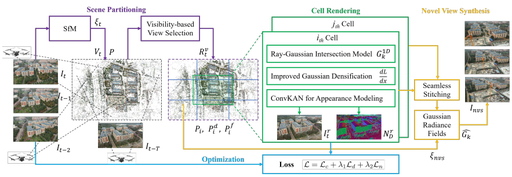
Fig. 2 : Overview of our GaRField++ framework. Scene Partitioning: We implement a sparse reconstruction based on the Structure-from-Motion (SfM) method, generating a point cloud and estimating the initial camera pose for each image. Concurrently, we performed Manhattan alignment on the point cloud. Subsequently, we employ a coordinate-based regionalization and a visibility-based view selection strategy to split the point cloud. Cell Rendering: By leveraging the ray-Gaussian intersection model, enhanced Gaussian density control, and convolution KAN (Kernelized Attention Network)-based decoupled appearance modeling, we obtained the reconstruction results for each partition. Optimization: We employ a newly constructed loss function to optimize the training process. This loss function encompasses depth distortion loss, normal consistency loss, and color loss, thereby enhancing the accuracy and efficiency of large-scale reconstruction. Novel View Synthesis: we seamlessly stitched together the separate Gaussian fields from various cells to obtain a complete Gaussian field for the large-scale scene. This step enables the entire large-scale area model to support cross-border rendering, providing the possibility for the generation of novel view synthesis.
원문 · CC BY 4.0 · Hanyue Zhang, Zhiliu Yang, Xinhe Zuo, Yuxin Tong, Ying Long, Chen Liu · GaRField++: Reinforced Gaussian Radiance Fields for Large-Scale 3D Scene Reconstruction · 원문 그림 인용 · 원본 PDF 3쪽에서 그림 영역을 추출했습니다.각 cell의 경계는 비율 β만큼 확장되어 인접 cell과 공통으로 보이는 영역을 포함합니다. 인접 cell j의 카메라 뷰가 cell i에 포함되는지는 식 (1)의 Rvt = Aproj / Ajt 값으로 판단하며, 여기서 Aproj는 cell i가 영상 I_jt에 투영된 면적이고 Ajt = W_jt × H_jt는 영상 픽셀 면적입니다. Rvt가 미리 정한 임계값을 넘는 카메라만 선택되고, 그 뒤 새로 추가된 카메라에서 관측되는 인접 cell의 점만 추가됩니다. 이 단계는 학습 전에 실행되며, 원문은 인접 cell의 정보를 학습에 넣어 경계 부근의 떠다니는 아티팩트를 줄이려는 목적을 밝힙니다.
ray-Gaussian intersection과 density control
각 Gaussian은 색 ck, 불투명도 αk, 중심 uk, 크기 s, 회전 R로 표현됩니다. 원문의 식 (2)는 점 x에 대한 Gaussian 값을 Gk(x) = αk exp(−½(x−uk)ᵀΣk⁻¹(x−uk))로 정의합니다. 기존 3DGS가 Gaussian을 2D 화면 공간에 투영해 검사하는 것과 달리, 이 방법은 ray-Gaussian intersection으로 3D Gaussian을 카메라 ray 위의 1D Gaussian G1D_k(x)로 변환합니다. 각 Gaussian의 ray 기여도 ψ(G1D_k, ξt)를 사용하여 식 (3)의 alpha blending으로 픽셀 색을 계산합니다.
또한 흐린 영역을 다루기 위해 density control을 개선합니다. 기존 cloning과 splitting은 그대로 유지하지만, view position gradient의 크기를 식 (4)처럼 각 픽셀 gradient 노름의 합으로 바꿔 서로 다른 픽셀의 gradient 신호가 상쇄되지 않게 합니다. 이 개선은 학습 중 일정한 iteration마다 실행됩니다.
ConvKAN 외형 보정과 결합 손실
조명 차이를 다루기 위해 외형 보정 네트워크는 KAN을 CNN에 삽입한 ConvKAN 구조를 사용합니다. 구조는 초기 convolution, downsampling block, KAN이 들어간 마지막 convolution으로 이루어지며, sigmoid 출력은 0과 1 사이의 값입니다. 이 모듈은 학습 후 제거되어 렌더링 시간에 영향을 주지 않는다고 원문은 설명합니다.
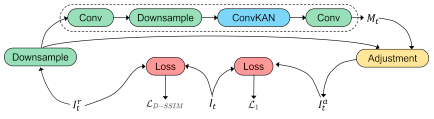
Fig. 3 : Architecture of our ConvKAN-based decoupled appearance modeling.
원문 · CC BY 4.0 · Hanyue Zhang, Zhiliu Yang, Xinhe Zuo, Yuxin Tong, Ying Long, Chen Liu · GaRField++: Reinforced Gaussian Radiance Fields for Large-Scale 3D Scene Reconstruction · 원문 그림 인용 · 원본 PDF 4쪽에서 그림 영역을 추출했습니다.전체 손실은 식 (5)의 L = Lc + λ1Ld + λ2Ln으로 정의됩니다. Ld는 2DGS에서 가져온 depth distortion loss이고, Ln은 깊이 맵의 gradient로 추정한 normal과 normal consistency를 맞추는 항입니다. Lc는 3DGS의 RGB 손실로, 식 (6)에서 보정된 렌더링 영상 Ia와 원본 영상 It 사이의 L1 항과 D-SSIM 항으로 구성됩니다. 원문은 렌더링 영상 Ir를 이용한 D-SSIM 항이 구조적 정합을 강조하고, 학습된 외형 임베딩과 ConvKAN 네트워크가 외형 특징을 담당한다고 설명합니다.
공개 데이터셋 비교와 자체 데이터 검증
Mill-19의 Rubble과 Building, MatrixCity의 small city, UrbanScene3D의 Residence, 그리고 저자들이 DJI Mini 3 Pro로 구축한 Campus-YNU가 실험 장면입니다. Table I은 Building, Rubble, Residence, MatrixCity에서 Mega-NeRF, Switch-NeRF, GP-NeRF, 3DGS, CityGaussian과 GaRField++를 SSIM, PSNR, LPIPS로 비교합니다. Building 장면에서 GaRField++는 SSIM 0.818, PSNR 25.32, LPIPS 0.227이고, 3DGS는 SSIM 0.731, PSNR 20.50, LPIPS 0.307입니다.
이 값은 해당 장면과 지표 조건에서의 비교입니다.

원문 그림 TABLE I: Quantitative comparison on four challenging datasets with SOTA large-scale reconstruction methods. Symbol ‘-’ indicates that Mega-NeRf and Switch-NeRF are not evaluated on MatrixCity because of the difficulty in training them on different configuration. The red , orange and yellow colors respectively denote the best, the second best, and the third best results.
원문 · CC BY 4.0 · Hanyue Zhang, Zhiliu Yang, Xinhe Zuo, Yuxin Tong, Ying Long, Chen Liu · GaRField++: Reinforced Gaussian Radiance Fields for Large-Scale 3D Scene Reconstruction · 원문 그림 인용 · 원본 PDF 5쪽에서 그림 영역을 추출했습니다.3DGS 비교 설정은 densification을 15k iteration에서 멈추고, 입력 영상 수가 많은 데이터셋에 맞춰 총 학습 iteration을 60k로 조정한 조건입니다. 자체 Campus-YNU 데이터에서는 1,600장, 3768 × 2118 해상도 영상으로 3DGS와 비교했고, 3DGS는 SSIM 0.831, PSNR 28.95, LPIPS 0.241이고 GaRField++는 SSIM 0.896, PSNR 31.58, LPIPS 0.151입니다. 이 결과는 해당 자체 수집 데이터에서의 관찰이며, 다른 드론 영상에 대한 일반화를 직접 보인 것은 아닙니다.

Fig. 1 : Rendered RGB images and corresponding rendered depth normals from our GaRField++ framework on the self-collected data. Randomly rendered images from multiple views of the large-scale scenes are complete, smooth and detailed. This is achieved by constructing a divide-and-conquer Gaussian radiance field, which is reinforced by precisely modeling the color and opacity information and improving the training efficiency. The data is collected from the monocular camera of a DJI drone.
원문 · CC BY 4.0 · Hanyue Zhang, Zhiliu Yang, Xinhe Zuo, Yuxin Tong, Ying Long, Chen Liu · GaRField++: Reinforced Gaussian Radiance Fields for Large-Scale 3D Scene Reconstruction · 원문 그림 인용 · 원본 PDF 1쪽에서 그림 영역을 추출했습니다.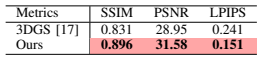
원문 그림 TABLE II: Experiments on Self-collected Campus-YNU Dataset. We validate the effectiveness of our method compared to vanilla 3DGS on our self-collected data.
원문 · CC BY 4.0 · Hanyue Zhang, Zhiliu Yang, Xinhe Zuo, Yuxin Tong, Ying Long, Chen Liu · GaRField++: Reinforced Gaussian Radiance Fields for Large-Scale 3D Scene Reconstruction · 원문 그림 인용 · 원본 PDF 6쪽에서 그림 영역을 추출했습니다.절제 실험의 구성요소별 관찰
절제 실험은 Rubble 장면과 Campus-YNU 데이터에서 수행되었습니다. Rubble은 이미지의 95%를 학습에, 5%를 테스트에 사용했고 Campus-YNU도 같은 비율을 유지했습니다. camera visibility는 Vis R0, Vis R1, Vis R2로 0, 0.50, 0.25를 비교했으며 이 실험은 full loss와 CNN+KAN 구성을 유지했습니다.
Rubble에서 Lc Only는 SSIM 0.795, PSNR 27.29, LPIPS 0.205이고 Full은 SSIM 0.854, PSNR 29.09, LPIPS 0.201입니다. 이 비교는 RGB 손실만 쓴 설정과 제안 손실을 쓴 설정의 차이를 보여 줍니다. 색 보정에서는 CNN 단독 구성보다 KAN과 CNN을 결합한 구성이 색 변화를 줄이는 결과를 보고했습니다. 다만 이 절제 결과는 Rubble과 Campus-YNU의 설정에 한정되며, 각 구성요소를 제거한 실험이 모든 장면에서 같은 기여를 보인다고 일반화할 수는 없습니다.
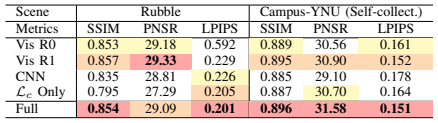
원문 그림 TABLE III: Quantitative Results of the Ablation Study. The red ,
원문 · CC BY 4.0 · Hanyue Zhang, Zhiliu Yang, Xinhe Zuo, Yuxin Tong, Ying Long, Chen Liu · GaRField++: Reinforced Gaussian Radiance Fields for Large-Scale 3D Scene Reconstruction · 원문 그림 인용 · 원본 PDF 6쪽에서 그림 영역을 추출했습니다.적용 범위와 남은 질문
저자들은 camera visibility와 coordinate partitioning의 최적 해를 아직 탐구하지 않았다고 밝힙니다. 또한 모델이 초기 sparse point cloud의 정확도에 의존하며, 일부 장면에서는 더 나은 렌더링을 위해 hyper-parameter tuning이 필요하다고 설명합니다.
주요 지표인 SSIM, PSNR, LPIPS는 렌더링 품질을 보여 주지만, 이 글의 근거에서 3D 표면 정확도나 mesh 품질을 직접 측정했다고 볼 수는 없습니다. 원문도 3D mesh 추출을 향후 적용 가능성으로만 언급합니다.
논문 정보
- 저자
- Hanyue Zhang, Zhiliu Yang, Xinhe Zuo, Yuxin Tong, Ying Long, Chen Liu
- 학회·저널
- arXiv · 프리프린트
- 최초 공개일
- 2024년 9월 19일
- 등록일
- 2026년 11월 4일
- 수정일
- 2024년 9월 24일
- 버전
- v3
- arXiv
- 2409.12774
- 분류
- cs.CV · cs.AI · cs.RO
- 원문 이용 조건
- CC BY 4.0
- 제공 범위
- 논문 정보, 해설, 허용된 원문 그림
AI 해설은 논문 원문과 별개의 설명이며 오류가 있을 수 있습니다. 원문과 그림은 각 출처의 이용 조건과 따로 표시된 권리를 따릅니다.
초록
This paper proposes a novel framework for large-scale scene reconstruction based on 3D Gaussian splatting (3DGS) and aims to address the scalability and accuracy challenges faced by existing methods. For tackling the scalability issue, we split the large scene into multiple cells, and the candidate point-cloud and camera views of each cell are correlated through a visibility-based camera selection and a progressive point-cloud extension. To reinforce the rendering quality, three highlighted improvements are made in comparison with vanilla 3DGS, which are a strategy of the ray-Gaussian intersection and the novel Gaussians density control for learning efficiency, an appearance decoupling module based on ConvKAN network to solve uneven lighting conditions in large-scale scenes, and a refined final loss with the color loss, the depth distortion loss, and the normal consistency loss. Finally, the seamless stitching procedure is executed to merge the individual Gaussian radiance field for novel view synthesis across different cells. Evaluation of Mill19, Urban3D, and MatrixCity datasets shows that our method consistently generates more high-fidelity rendering results than state-of-the-art methods of large-scale scene reconstruction. We further validate the generalizability of the proposed approach by rendering on self-collected video clips recorded by a commercial drone.
원문 인용
Hanyue Zhang, Zhiliu Yang, Xinhe Zuo, Yuxin Tong, Ying Long, Chen Liu (2024). GaRField++: Reinforced Gaussian Radiance Fields for Large-Scale 3D Scene Reconstruction. arXiv:2409.12774v3. https://arxiv.org/abs/2409.12774v3
BibTeX
@misc{zhang2024garfield,
  title = {{GaRField++: Reinforced Gaussian Radiance Fields for Large-Scale 3D Scene Reconstruction}},
  author = {Hanyue Zhang and Zhiliu Yang and Xinhe Zuo and Yuxin Tong and Ying Long and Chen Liu},
  year = {2024},
  eprint = {2409.12774},
  archivePrefix = {arXiv},
  url = {https://arxiv.org/abs/2409.12774v3}
}