논문 해설
When Answer Decodability Is Not a Decision: Separating Final-Answer and Imminent-Emission Signals in Chain-of-Thought
답변 해독 가능성은 결정이 아니다: 사고 연쇄에서 최종 답변 신호와 임박한 출력 신호의 분리
- 연구 문제 Chain-of-thought 은닉 상태의 답 probe가 결정 신호인지 다음 후보 방출 신호인지 분리합니다.
- 연구 방법 같은 위치에서 다음 언급 후보와 최종 답을 같은 reader 계열로 따로 적합하고 목표별 null로 emission gap을 계산합니다.
- 주요 결과 DecisionDepth에서는 다음 언급 후보가 최종 답보다 훨씬 강하게 읽혔지만, Qwen3-8B의 사전 지정 MMLU 평가에서는 순서가 반대였습니다.
답 probe의 해석 문제
Chain-of-thought 은닉 상태에 대한 답 probe는 모델이 이미 최종 답을 정했다는 증거로 자주 읽힙니다. 그러나 추론 문장은 후보를 쓰기 직전에 그 이름을 만들어 낼 정보를 은닉 상태에 담고 있어야 하므로, 최종 답과 다음에 언급될 후보가 같은 위치에서 경쟁하는 신호가 됩니다. 이 논문은 이 두 신호를 같은 위치에서 분리하는 것을 문제로 삼습니다. 정답 롤아웃에서 최종 답이 아직 나오지 않은 첫 distractor 언급 직전 토큰이 핵심 위치입니다.
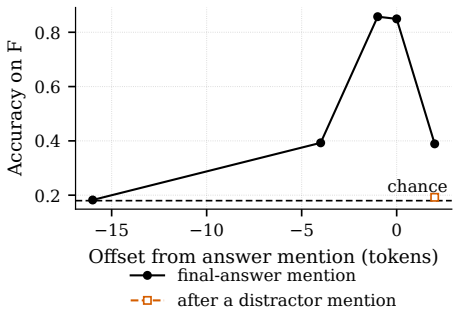
Figure 3 : Final-answer readout aligned to the first mention of the answer in the conclusion (Qwen3.5-4B, DD, all correct rollouts). The readout peaks one token before the answer is written and decays after it. The square is the readout two tokens after a distractor mention.
원문 · CC BY 4.0 · Han, Hyojung, Kim, Jongmin, Jeon, Seung-Hun · When Answer Decodability Is Not a Decision: Separating Final-Answer and Imminent-Emission Signals in Chain-of-Thought · 원문 그림 인용 · 원본 PDF 7쪽에서 그림 영역을 추출했습니다.ECDP의 목표와 emission gap
ECDP는 같은 위치에서 다음 언급 후보 Mt와 최종 답 F를 같은 low-rank reader 계열로 따로 적합합니다. 두 목표의 null은 다르게 둡니다. F는 K개 후보에 대한 균등 기준인 E[1/K]를, Mt는 정답이 아니라는 사실만 학습해도 얻는 E[1/(K−1)]을 사용합니다. Emission gap은 [Acc(Mt)−E[1/(K−1)]]−[Acc(F)−E[1/K]]로 정의되며, 이 값이 크면 같은 위치에서 다음 언급 후보가 최종 답보다 강하게 읽힌다는 뜻입니다. Emission Separated 판정은 Mt의 z 값과 null 대비 향상, F의 낮은 z, 차이의 크기, 구간 하한 조건을 함께 요구합니다.

Table 1 : Emission-controlled probing results. Nulls in parentheses:E[1/(K− 1)]for M, E[1/K]for F. † marks the decision set selected by the pre-specified rule for each setting (BBH uses the secondary set because its primary set falls below 150 items). The pre-specified verdicts come from the original single-seed analysis; accuracies andz shown here are post-hoc medians over reader seeds 1–3, and applying the same decision rule to them leaves every decision-set verdict unchanged. The bracketed interval is a 10,000-resample item bootstrap for the median-gap seed; it is descriptive and does not include training-seed variation. Shuffled:M labels permuted, scored against trueM. Position: a random non-mention position in the same item (controls from seed 1).
원문 · CC BY 4.0 · Han, Hyojung, Kim, Jongmin, Jeon, Seung-Hun · When Answer Decodability Is Not a Decision: Separating Final-Answer and Imminent-Emission Signals in Chain-of-Thought · 원문 그림 인용 · 원본 PDF 7쪽에서 그림 영역을 추출했습니다.DecisionDepth에서의 분리 결과
DecisionDepth의 Qwen3.5-4B 주 분석 세트(n=353)에서 다음 언급 후보는 .966으로 null .234보다 높게 읽히고, 최종 답은 .221로 null .186에 가깝습니다. 이 설정의 emission gap은 .696 [.648, .744]입니다. 같은 모델에서 모든 distractor 위치를 쓰는 보조 세트(n=883)는 최종 답도 약하게 읽혀 두 목표가 모두 읽힌다고 판정되며, 이 세트의 gap은 .511 [.473, .549]입니다. Llama-3.1-8B의 주 세트에서도 Mt는 .867, F는 .240으로 gap이 .575 [.514, .632]입니다. 이 구간은 median-gap seed의 항목 부트스트랩 구간이며 학습 seed 변동과 다중성 조정을 포함하지 않습니다.
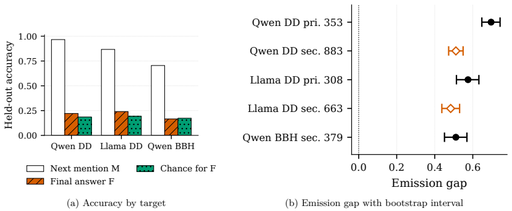
Figure 2 : Same positions and reader architecture, separately fitted to two targets. (a) Held-out accuracy for the next mentionM and the final answerF on each setting’s pre-specified decision set; the third bar is the uniform null forF. (b) Emission gap∆emit with nominal 95% within-seed item-bootstrap intervals from the median-gap seed (training-seed variation is not included); filled markers are decision sets, open markers the other set. The BBH primary set (n= 61) is below the pre-specified 150-item floor and is omitted.
원문 · CC BY 4.0 · Han, Hyojung, Kim, Jongmin, Jeon, Seung-Hun · When Answer Decodability Is Not a Decision: Separating Final-Answer and Imminent-Emission Signals in Chain-of-Thought · 원문 그림 인용 · 원본 PDF 6쪽에서 그림 영역을 추출했습니다.층·planted 신호·용량 통제
층 분석에서 Qwen3.5-4B는 층 20 이후부터 다음 언급 후보가 .906에서 .966까지 읽히는 반면 최종 답은 모든 층에서 z=3 임계값 아래에 머뭅니다. 다만 이것은 선택한 방향과 용량에 대한 민감도이며 최종 답 신호가 없다는 증명이 아닙니다. 별도 용량 연구에서는 학습 정확도가 .300에서 .959까지 오르지만 held-out 정확도는 .157에서 .193 사이에 머뭅니다.
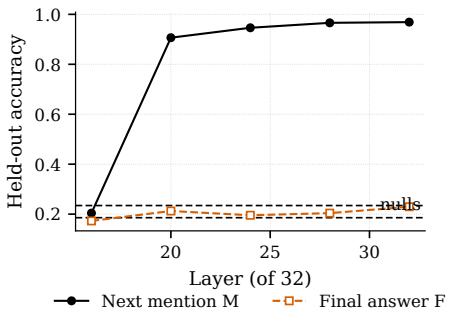
Figure 4 : Readout by layer at the primary positions (Qwen3.5-4B, DD; medians over three reader seeds). Dashed lines are the nulls forM (upper) andF (lower). The next mention becomes readable from layer 20; the final answer stays below thez= 3threshold at every layer.
원문 · CC BY 4.0 · Han, Hyojung, Kim, Jongmin, Jeon, Seung-Hun · When Answer Decodability Is Not a Decision: Separating Final-Answer and Imminent-Emission Signals in Chain-of-Thought · 원문 그림 인용 · 원본 PDF 8쪽에서 그림 영역을 추출했습니다.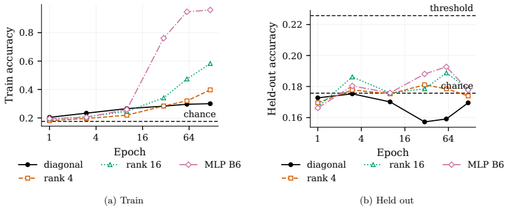
Figure 6 : Readers from a diagonal scorer to a 6.3M-parameter MLP trained to convergence without early stopping (median of three seeds). Training accuracy grows with capacity, while held-out accuracy stays between .157 and .193 and never reaches the pre-specified hidden-signal threshold in any reader-by-checkpoint cell.
원문 · CC BY 4.0 · Han, Hyojung, Kim, Jongmin, Jeon, Seung-Hun · When Answer Decodability Is Not a Decision: Separating Final-Answer and Imminent-Emission Signals in Chain-of-Thought · 원문 그림 인용 · 원본 PDF 9쪽에서 그림 영역을 추출했습니다.Qwen3-8B 반례와 최종 답 우세
사전 지정된 Qwen3-8B MMLU 평가에서는 full-prefix attention reader가 모든 thinking 위치에서 두 목표를 모두 읽었고, 최종 답이 더 강하게 읽혔습니다. 층 22에서 Mt−F 차이는 −.398 [−.459, −.336]이며 Mt는 .230, F는 .628의 lift를 보였습니다. 이 평가는 모델, 과제, 위치, reader가 함께 바뀌므로 DecisionDepth 결과의 순서가 뒤집힌 원인을 분리하지 못합니다. 위치 0 masking은 주 reader에서 적용되었지만 attention sink 메커니즘을 검증한 것은 아닙니다.
매칭 교차 비교의 미완성
모델과 과제를 교차하려던 시도에서 Qwen3.5-4B와 Qwen3-8B의 DD 셀은 imminent mention probe가 안정적으로 학습되지 않아 유효한 통계를 얻지 못했습니다. Qwen3-8B DD에서는 한 seed의 학습 손실이 시작보다 높아져 사전 규칙에 따라 통계가 없습니다. 따라서 어떤 요인이 순서를 뒤집는지는 확인되지 않습니다. 학습 실패는 정보가 없다는 증거가 아니라 이 reader와 학습 절차가 목표를 안정적으로 추출하지 못했다는 뜻입니다.

Table 3 : Outcome of each cell of the attempted matched comparison. C2x is the Qwen3.5-4B MMLU cell scored under a protocol written after the training checks that gated its main run failed; that failure is retained.
원문 · CC BY 4.0 · Han, Hyojung, Kim, Jongmin, Jeon, Seung-Hun · When Answer Decodability Is Not a Decision: Separating Final-Answer and Imminent-Emission Signals in Chain-of-Thought · 원문 그림 인용 · 원본 PDF 20쪽에서 그림 영역을 추출했습니다.인과 개입 시도의 한계
Gradient steering은 apparatus 검사에서 답을 바꾸지 못해 인과 판정이 불가능했습니다. 이후 탐색적으로 수행한 full-state interchange에서는 층 20 상태를 다른 후보의 상태로 바꾸었을 때 다음 언급이 C′로 바뀐 비율이 .700이었지만, 최종 답은 교체된 항목에서 .005만 바뀌었습니다. 이 관찰은 사전에 정한 동등성 경계가 없으므로 최종 답이 교체 상태에 둔감하다는 증명이 아닙니다.
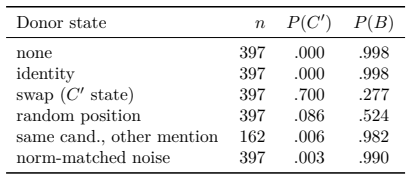
Table 2 : Exploratory full-state interchange at layer 20 (Qwen3.5-4B, DD). The state at the position before a mention ofB is replaced by a donor state from the same trajectory; columns give the probability that the next mention isC ′ or B. The same-candidate control is defined only for items with a second mention ofB.
원문 · CC BY 4.0 · Han, Hyojung, Kim, Jongmin, Jeon, Seung-Hun · When Answer Decodability Is Not a Decision: Separating Final-Answer and Imminent-Emission Signals in Chain-of-Thought · 원문 그림 인용 · 원본 PDF 14쪽에서 그림 영역을 추출했습니다.적용 범위와 증거 등급
이 결과는 정답 롤아웃, 네 개의 4B~8B 모델, 합성 DecisionDepth와 공개 객관식 과제에 한정됩니다. DD의 대칭 후보 구조는 자연 과제의 순서 편향을 반영하지 않으므로 자연 과제에는 순서 인식 null이 필요합니다. 여러 증거 등급 중 주 결과, 제한적 결과, 탐색적 결과, 지지하지 않는 결과가 구분됩니다. 따라서 높은 답 readout이 결정 시점의 증거라고 단정할 수 없고, 주된 결론은 같은 위치의 경쟁 목표를 함께 측정해야 한다는 점입니다.
논문 정보
- 저자
- Han, Hyojung, Kim, Jongmin, Jeon, Seung-Hun
- 학회·저널
- arXiv · 프리프린트
- 최초 공개일
- 2026년 11월 9일
- 등록일
- 2026년 11월 10일
- 수정일
- 2026년 11월 9일
- 버전
- v1
- arXiv
- 2611.11892
- 분류
- cs.LG · cs.CL
- 원문 이용 조건
- CC BY 4.0
- 제공 범위
- 논문 정보, 해설, 허용된 원문 그림
AI 해설은 논문 원문과 별개의 설명이며 오류가 있을 수 있습니다. 원문과 그림은 각 출처의 이용 조건과 따로 표시된 권리를 따릅니다.
초록
Answer probes applied to chain-of-thought hidden states are often read as evidence that a language model has already decided its final response. This reading overlooks a competing signal, the candidate the model is about to mention. We introduce emission-controlled dual-target probing (ECDP), which fits the same low-rank reader family separately to the imminent mention and to the final answer at identical positions, with target-specific nulls and thresholds fixed before any fit. On correct DecisionDepth (DD) rollouts in which a distractor is mentioned before the final answer, Qwen3.5-4B decodes the next mention at .966 (null .234) but the final answer only at .221 (null .186), an emission gap of .696 [.648, .744]; Llama-3.1-8B gives .575 [.514, .632]. This pattern is not universal. In a pre-specified evaluation of Qwen3-8B with thinking enabled on held-out MMLU questions, using a full-prefix attention reader over every thinking position, both targets are decodable and the final answer is read far more strongly (mention-minus-answer lift -.398 [-.459, -.336] at layer 22 over 467 questions). Model, task, positions, and reader change together between these settings, and an attempted matched comparison on DD produced no valid statistics because the imminent-mention probe did not train reliably, so we do not identify what reverses the order. On DD, planted-signal controls show that the reader recovers an injected final-answer signal at one tenth of full dose. Answer-candidate decodability is therefore target-relative and protocol-dependent: a strong answer readout does not by itself establish when a model commits, and a probe that fails to train is not evidence that the information is absent. ECDP is a practical control for distinguishing imminent text emission from evidence of a settled decision.
원문 인용
Han, Hyojung, Kim, Jongmin, Jeon, Seung-Hun (2026). When Answer Decodability Is Not a Decision: Separating Final-Answer and Imminent-Emission Signals in Chain-of-Thought. arXiv:2611.11892v1. https://arxiv.org/abs/2611.11892v1
BibTeX
@misc{hyojung2026when,
  title = {{When Answer Decodability Is Not a Decision: Separating Final-Answer and Imminent-Emission Signals in Chain-of-Thought}},
  author = {Han, Hyojung and Kim, Jongmin and Jeon, Seung-Hun},
  year = {2026},
  eprint = {2611.11892},
  archivePrefix = {arXiv},
  url = {https://arxiv.org/abs/2611.11892v1}
}