논문 해설
FERN: Cross-Benchmark Table Retrieval for Text-to-SQL with Frozen Retrievers and Learned Ranking
FERN: 고정된 리트리버와 학습된 랭킹을 활용한 Text-to-SQL을 위한 벤치마크 간 테이블 검색
- 연구 문제 테이블 검색은 Text-to-SQL에서 누락 테이블과 불필요한 테이블을 모두 줄여야 하는 단계이며, 기존 방법은 호스팅 LLM 호출에 의존하는 경우가 많습니다.
- 연구 방법 고정된 세 검색기로 100개 후보를 만든 뒤, 최대 120개 특징을 계산하고 BIRD 학습 질문에 한 번 적합된 LightGBM 랭커로 재정렬합니다.
- 주요 결과 Spider에서 recall@5는 RASL에 0.3점 낮고 recall@15는 1.1점 높으며, 증거 힌트가 있는 BIRD에서는 recall@5가 0.9점 낮습니다. 증거 힌트가 없으면 recall@5 차이가 8.2점으로 커집니다.
테이블 검색이 필요한 이유와 연구 질문
Text-to-SQL 시스템은 정답 SQL이 참조하는 테이블을 먼저 확보해야 하며, 여러 데이터베이스가 섞인 카탈로그에서는 이 검색 단계가 특히 어렵습니다. 누락된 테이블은 질의를 틀리게 만들고, 불필요한 테이블은 생성기의 문맥을 소모합니다. 기존 연구의 상당수는 질문 해석과 테이블 선택에 호스팅 LLM을 사용하며, 이는 정확도 외에도 비용과 외부 전송 문제를 낳습니다. FERN은 이 질문을 생성형 LLM 없이 고정된 검색기와 한 번 학습된 랭커로 답할 수 있는지 검토합니다. 비교 기준은 RASL이 게시한 공개 recall 값입니다.
고정 검색기와 학습된 랭커의 결합
FERN은 BM25, Qwen3-Embedding-0.6B, BGE-large-en-v1.5의 세 검색 신호를 고정된 상태로 사용합니다. 각 테이블은 열 이름을 포함한 전체 카드와 이름만 나눈 이름 카드로 표현되며, 세 신호의 전체 카탈로그 순위로 계산한 풀 점수 상위 100개 테이블이 후보가 됩니다. 풀 점수는 신호별 순위 rank에 대해 1/(60+rank)를 더한 값이며, 순위는 전체 카탈로그에서 0부터 매겨집니다. 이후 후보마다 점수, 순위, 데이터베이스 단위 집계, 어휘 겹침, 외래키 그래프 등 최대 120개 특징이 계산됩니다. LightGBM 랭커는 질문별 후보 목록을 하나의 그룹으로 보는 lambdarank 목적함수로 BIRD 학습 질문에 한 번 적합되며, 평가 질문은 학습에 쓰이지 않습니다.
증거 힌트가 있는 BIRD에는 FERN-ev, 질문만 쓰는 BIRD와 Spider에는 FERN-q, Fiben과 BEA VER에는 셀 값과 열 타입을 쓰지 않는 FERN-schema가 적용됩니다.
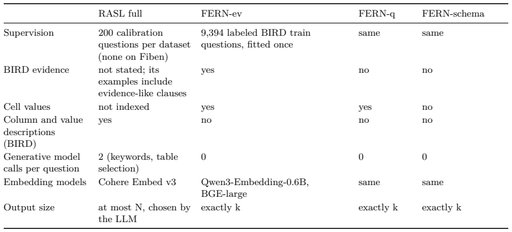
Table 2 . Inputs available to each system. FERN-ev, FERN-q and FERN-schema are defined in Section 4.
원문 · CC BY 4.0 · Arjun Rao, Nishant Gopinath · FERN: Cross-Benchmark Table Retrieval for Text-to-SQL with Frozen Retrievers and Learned Ranking · 원문 그림 인용 · 원본 PDF 5쪽에서 그림 영역을 추출했습니다.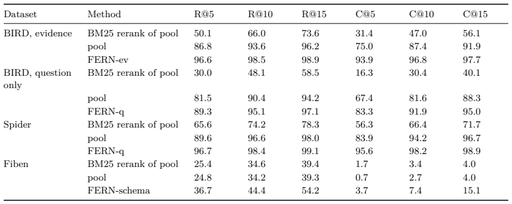
Table 6 . Recall and complete@k against the candidate pool on the same catalogs. “BM25 rerank of pool” ranks the 100 candidates by BM25 score. C@k is complete@k.
원문 · CC BY 4.0 · Arjun Rao, Nishant Gopinath · FERN: Cross-Benchmark Table Retrieval for Text-to-SQL with Frozen Retrievers and Learned Ranking · 원문 그림 인용 · 원본 PDF 10쪽에서 그림 영역을 추출했습니다.RASL 공개 값과의 비교 결과
Spider에서 FERN의 recall@5는 96.7로 RASL의 게시 값 97.0보다 0.3점 낮고, 증거 힌트가 있는 BIRD에서는 96.6으로 RASL의 97.5보다 0.9점 낮습니다. 두 데이터셋의 recall@15에서는 FERN이 각각 99.1과 98.9를 보여 RASL보다 1.1점 높지만, RASL은 최대 15개를 반환하고 FERN은 정확히 15개를 반환하므로 실제 출력 크기가 같지 않습니다. 증거 힌트가 없는 BIRD에서는 recall@5가 89.3으로 RASL보다 8.2점 낮습니다. 이 차이들은 저자들이 보고한 점 차이이며, RASL의 질문별 결과가 없어 검정 구간은 제공되지 않습니다. Spider에서는 후보 풀만으로 recall@15가 98.0에 도달하고, 랭커는 complete@5를 83.9%에서 95.6%로 높입니다.
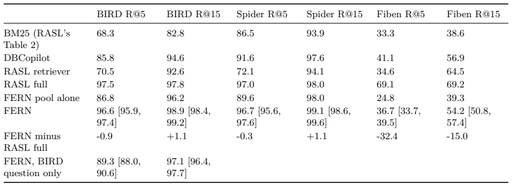
Table 5 . Table recall on the pooled catalogs. RASL full uses Claude 3.5 Haiku keywords and Claude 3.5 Sonnet v2 table selection and returns at most N tables; RASL retriever ranks by retrieval with the Haiku keywords, without LLM table selection. The BM25, DBCopilot, RASL retriever, and RASL full rows are from RASL’s Table 2. Differences are FERN minus RASL full, in points. FERN intervals: 95% bootstrap over questions.
원문 · CC BY 4.0 · Arjun Rao, Nishant Gopinath · FERN: Cross-Benchmark Table Retrieval for Text-to-SQL with Frozen Retrievers and Learned Ranking · 원문 그림 인용 · 원본 PDF 9쪽에서 그림 영역을 추출했습니다.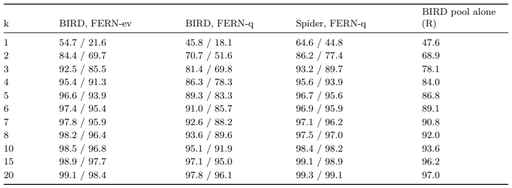
Table 7 . Recall@k and complete@k for k = 1 to 8, 10, 15 and 20 (R / C).
원문 · CC BY 4.0 · Arjun Rao, Nishant Gopinath · FERN: Cross-Benchmark Table Retrieval for Text-to-SQL with Frozen Retrievers and Learned Ranking · 원문 그림 인용 · 원본 PDF 11쪽에서 그림 영역을 추출했습니다.Fiben과 BEA VER에서의 전이 결과
Fiben에서 FERN-schema의 recall@15는 54.2로 RASL의 69.2보다 낮지만, 두 시스템이 서로 다른 질문 집합을 사용하므로 직접 비교는 제한됩니다. BEA VER의 실제 121개 dw 질문에서는 FERN-schema의 recall@15가 82.1로, 목표 데이터로 학습된 두 검색기 80.8과 84.5 사이에 있습니다. 그러나 complete@15는 49.6으로 두 기준선의 54.5와 62.0보다 낮습니다. 이 BEA VER 비교 행은 NIFT-SQL 확인 실행에서 가져온 것이며 쌍체 구간이 없으므로 기술적 서술로만 읽어야 합니다.
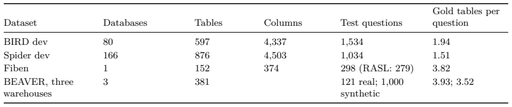
Table 1 . Catalogs and test questions.
원문 · CC BY 4.0 · Arjun Rao, Nishant Gopinath · FERN: Cross-Benchmark Table Retrieval for Text-to-SQL with Frozen Retrievers and Learned Ranking · 원문 그림 인용 · 원본 PDF 4쪽에서 그림 영역을 추출했습니다.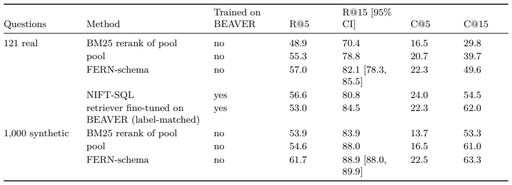
Table 8 . BEA VER, real questions (121) and a sample of synthetic questions (1,000). “BM25 rerank of pool” ranks the 100 candidates by BM25 score. Rows trained on BEA VER come from the NIFT- SQL confirmation run; their complete@15 values are published in Rao & Gopinath (2026, Table 9).
원문 · CC BY 4.0 · Arjun Rao, Nishant Gopinath · FERN: Cross-Benchmark Table Retrieval for Text-to-SQL with Frozen Retrievers and Learned Ranking · 원문 그림 인용 · 원본 PDF 12쪽에서 그림 영역을 추출했습니다.검색 신호와 비검색 특징의 기여
BIRD dev에서 검색 신호만 쓴 랭커와 비검색 특징만 쓴 랭커는 recall@15가 각각 98.2와 98.5 수준으로 비슷합니다. 그러나 두 특징군을 합치면 complete@5가 검색 신호 단독보다 7.7점 높아집니다. 이 비교는 BIRD dev에서 얻은 결과이며, 전이 데이터셋에서 같은 특징군 비교를 수행하지 않았다는 점이 적용 범위입니다.
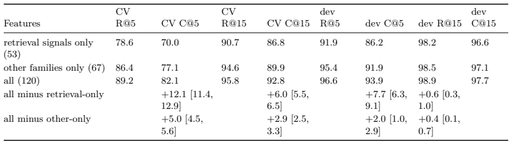
Table 9 . Feature groups in the frozen configuration, FERN-ev inputs. CV: database-grouped cross- validation within BIRD train with a shared unsupervised PCA (development diagnostic). The last two rows give all features minus the subset, paired over questions, with 95% bootstrap intervals; differences are computed from unrounded per-question values.
원문 · CC BY 4.0 · Arjun Rao, Nishant Gopinath · FERN: Cross-Benchmark Table Retrieval for Text-to-SQL with Frozen Retrievers and Learned Ranking · 원문 그림 인용 · 원본 PDF 13쪽에서 그림 영역을 추출했습니다.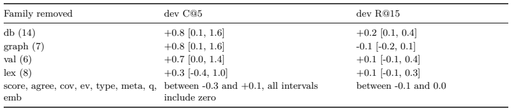
Table 10 . Removing one family (BIRD dev; all features minus the reduced set, 95% paired bootstrap, computed from unrounded values; twelve exploratory comparisons, not corrected for multiplicity).
원문 · CC BY 4.0 · Arjun Rao, Nishant Gopinath · FERN: Cross-Benchmark Table Retrieval for Text-to-SQL with Frozen Retrievers and Learned Ranking · 원문 그림 인용 · 원본 PDF 13쪽에서 그림 영역을 추출했습니다.적용 범위와 남은 제약
FERN은 풀 상위 100개 안에 있는 정답 테이블만 회수할 수 있으며, 평균 recall@100은 BIRD dev에서 99.4, Fiben에서 82.8입니다. BIRD dev와 BEA VER은 설계 결정에 영향을 주었으므로 Spider와 Fiben만큼 깨끗한 비교가 아닙니다. RASL과의 차이는 점 차이로만 보고되며, 평가 범위는 테이블 검색에 한정되고 SQL 생성이나 데이터베이스 라우팅은 포함하지 않습니다.
논문 정보
- 저자
- Arjun Rao, Nishant Gopinath
- 학회·저널
- arXiv · 프리프린트
- 최초 공개일
- 2026년 11월 10일
- 등록일
- 2026년 11월 12일
- 수정일
- 2026년 11월 10일
- 버전
- v1
- arXiv
- 2611.14477
- 분류
- cs.IR · cs.CL
- 원문 이용 조건
- CC BY 4.0
- 제공 범위
- 논문 정보, 해설, 허용된 원문 그림
AI 해설은 논문 원문과 별개의 설명이며 오류가 있을 수 있습니다. 원문과 그림은 각 출처의 이용 조건과 따로 표시된 권리를 따릅니다.
초록
Text-to-SQL systems over large pooled catalogs must first retrieve the tables a question needs. We compare against the published table recall of RASL, which uses Claude 3.5 models to extract keywords and select tables, on pooled BIRD, Spider, and Fiben catalogs. FERN (Feature-Engineered Ranking with No generative LLM) instead fuses three frozen retrievers into 100 candidates, describes each with up to 120 features, and reorders them with LightGBM rankers fitted once on BIRD's training questions. On Spider, where it was not fitted, its candidate pool alone reaches RASL's published recall at fifteen tables (98.0), and the ranker raises the share of questions with every gold table in the top five (complete@5) from 83.9% to 95.6%. At five tables, FERN's recall is within one point of RASL's on Spider (96.7 vs 97.0) and on BIRD with its evidence hints (96.6 vs 97.5), and 8.2 points below on BIRD without them (89.3). On 121 real BEAVER questions, without BEAVER fitting, its recall at fifteen (82.1) falls between two BEAVER-trained retrievers (80.8, 84.5), but its complete@15 is below both (49.6 vs 54.5 and 62.0). On Fiben, it falls far short at fifteen tables (54.2 vs 69.2, different question sets), although its recall at fifty is numerically close to RASL's question-only retrieval result (80.7 vs 79.4). On BIRD dev with evidence, non-retrieval features raise complete@5 by 7.7 points over retrieval signals alone. On BIRD dev, median latency is 208 ms per question on one A100, without hosted model calls.
원문 인용
Arjun Rao, Nishant Gopinath (2026). FERN: Cross-Benchmark Table Retrieval for Text-to-SQL with Frozen Retrievers and Learned Ranking. arXiv:2611.14477v1. https://arxiv.org/abs/2611.14477v1
BibTeX
@misc{rao2026fern,
  title = {{FERN: Cross-Benchmark Table Retrieval for Text-to-SQL with Frozen Retrievers and Learned Ranking}},
  author = {Arjun Rao and Nishant Gopinath},
  year = {2026},
  eprint = {2611.14477},
  archivePrefix = {arXiv},
  url = {https://arxiv.org/abs/2611.14477v1}
}