논문 해설
T3R: Training-Free Two-Stage Token Refinement Towards Efficient and Robust VLA Models
- 연구 문제 VLA 모델은 매 제어 단계마다 긴 시각 토큰 시퀀스를 처리해 추론 비용이 크고, 배경 토큰이 분포 변화에서 행동 예측을 흩뜨릴 수 있습니다.
- 연구 방법 T3R은 훈련 없이 SigLIP 유사도와 EfficientTAM 마스크로 무관한 패치를 가지치기하고, 남은 시퀀스에서 Integrated Gradients로 고른 중요 토큰과 보존 패치에 중간 층 어텐션 바이어스를 줍니다.
- 주요 결과 LIBERO-Spatial의 OpenVLA-OFT 설정에서 장면 카메라 토큰 85%를 제거하면서 성공률 96%를 보고하며, 기준선 97%와 1 pp 이내입니다.
VLA 추론의 시각 토큰 부담
VLA 모델은 이미지와 언어 지시를 받아 로봇 행동을 직접 출력하지만, 매 제어 단계마다 긴 시각 토큰 시퀀스를 대형 언어 백본에 통과시켜야 합니다. 이 긴 시퀀스에 대한 어텐션은 지연을 키워 실시간 제어에 불리하고, 배경의 무관한 토큰이 분포 변화에서 행동 예측을 흩뜨릴 수 있습니다.
이 논문은 두 가지 중복이 함께 있다고 봅니다. 하나는 많은 시각 토큰이 공간적으로 과제와 무관하다는 점이고, 다른 하나는 남은 토큰 사이의 어텐션 배분도 잘못 이루어진다는 점입니다. 저자들은 이 두 문제를 훈련 없이 해결하는 방법을 제안합니다.
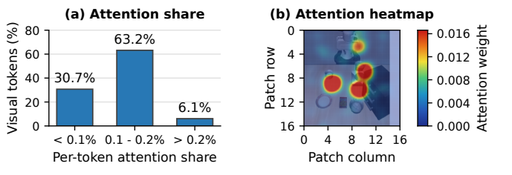
Figure 3 : Most visual tokens are near-inert. (a) Across all 32 decoder layers, 93.9% of visual tokens receive <0.2% of the action queries’ attention each. (b) Per-patch action-query attention concentrates on a few task-relevant patches (here the gripper and target bowls), while the background receives negligible weight.
원문 · CC BY 4.0 · Mohammed Hassan, Zhenyang Chen, Zheng Wang, Zhixin Zhu, Tianlong Chen, Yingyan, Lin, Chaojian Li · T3R: Training-Free Two-Stage Token Refinement Towards Efficient and Robust VLA Models · 원문 그림 인용 · 원본 PDF 5쪽에서 그림 영역을 추출했습니다.두 단계 토큰 정제 구조
T3R은 훈련 없이 적용되는 두 단계 프레임워크입니다. 첫 단계는 분할 기반 위치 보존 토큰 가지치기입니다. SigLIP 텍스트-패치 유사도 맵에서 명사와 형용사 쪽에 더 큰 가중치를 준 점수를 계산하고, 이를 EfficientTAM-S의 점 프롬프트로 바꾸어 객체 마스크를 얻습니다. 마스크와 겹치는 비율이 τ=0.3 이상인 패치만 보존하며, 보존 패치에는 원래 RoPE 위치 ID를 그대로 부여합니다. 원래 위치를 다시 번호 매기면 pre-training 때 보지 못한 위치로 밀려 성공률이 거의 0으로 떨어졌다고 저자들은 보고합니다.
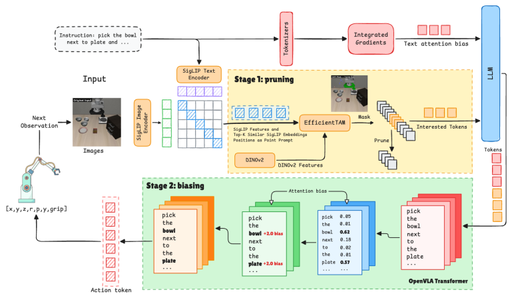
Figure 1 : Two-stage T3R pipeline. Stage 1 (pruning): POS-weighted SigLIP text–patch similarity localizes the target; the top- scoring patch positions (with SigLIP/DINOv2 features) prompt EfficientTAM to produce an object mask, which is converted to a patch-level pruning decision while preserving original RoPE positions, so only the “interested tokens” enter the LLM. Stage 2 (biasing): Integrated Gradients over the instruction identifies salient words; an additive attention bias ( 𝛽=2.0) is injected into the middle decoder layers for action-token queries, steering attention toward salient text tokens and retained visual patches before the action chunk is decoded.
원문 · CC BY 4.0 · Mohammed Hassan, Zhenyang Chen, Zheng Wang, Zhixin Zhu, Tianlong Chen, Yingyan, Lin, Chaojian Li · T3R: Training-Free Two-Stage Token Refinement Towards Efficient and Robust VLA Models · 원문 그림 인용 · 원본 PDF 2쪽에서 그림 영역을 추출했습니다.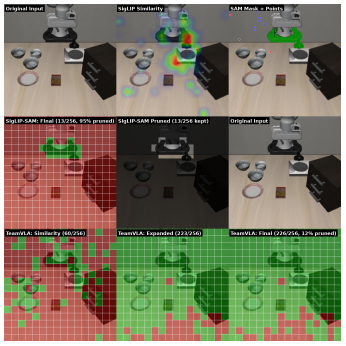
Figure 2 : Qualitative pruning on a sparse LIBERO-Spatial scene (“pick up the bowl between the plate and the ramekin”). Top: input, POS-weighted SigLIP similarity, and the Efficient- TAM mask with its point prompts. Middle: T3R keeps only 13/256 patches (95% pruned), tightly localized on the tar- get. Bottom: TeamVLA’s similarity+expansion+merge retains 226/256 (12% pruned), leaving most of the background in the sequence through the early decoder layers.
원문 · CC BY 4.0 · Mohammed Hassan, Zhenyang Chen, Zheng Wang, Zhixin Zhu, Tianlong Chen, Yingyan, Lin, Chaojian Li · T3R: Training-Free Two-Stage Token Refinement Towards Efficient and Robust VLA Models · 원문 그림 인용 · 원본 PDF 3쪽에서 그림 영역을 추출했습니다.둘째 단계는 중요도 기반 어텐션 바이어싱입니다. Integrated Gradients로 지시문 토큰의 기여도를 구해 상위 30%를 중요 토큰으로 정하고, 보존된 시각 패치와 함께 중간 디코더 층 8–23에서 행동 토큰 질의의 어텐션 로짓에 가산 바이어스를 줍니다. 바이어스 강도는 β=2.0입니다. 이 바이어스는 행동 토큰 질의에만 적용되며, 가지치기 자체는 디코더 진입 전에 이루어집니다.
LIBERO-Spatial에서의 가지치기와 성공률
주요 검증은 OpenVLA-OFT를 LIBERO-Spatial에서 평가하는 설정입니다. 이 설정은 듀얼 카메라 입력으로 호출당 512개의 시각 토큰을 처리하며, 과제당 10개 에피소드를 시드 7의 공칭 설정으로 평가합니다. 이 조건에서 T3R은 장면 카메라 토큰의 85%를 가지치기하면서 성공률 96%를 보고했습니다. 같은 설정의 비가지치기 기준선은 97%이므로 차이는 1 pp 이내입니다. 같은 85% 감소율에서 FastV는 14%, ADP는 66%를 기록했습니다.
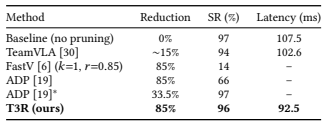
Table 1 : LIBERO-Spatial (OpenVLA-OFT). “Reduction” is scene-camera tokens pruned before decoder execution; la- tency is per VLA inference call. ∗ADP native operating point (67% of steps×50%/step≈33.5% reduction).
원문 · CC BY 4.0 · Mohammed Hassan, Zhenyang Chen, Zheng Wang, Zhixin Zhu, Tianlong Chen, Yingyan, Lin, Chaojian Li · T3R: Training-Free Two-Stage Token Refinement Towards Efficient and Robust VLA Models · 원문 그림 인용 · 원본 PDF 4쪽에서 그림 영역을 추출했습니다.이 결과는 단일 백본과 단일 과제 묶음에서 얻은 것이므로, LIBERO-Spatial 밖의 과제에 같은 수치가 그대로 적용된다고 볼 수는 없습니다.
추론 지연과 해상도 확장
지연 측정은 L40S에서 호출당 VLA 추론 시간을 비교합니다. 여기서 각 호출은 여덟 개 행동의 청크를 만드는 단위이며 환경 한 스텝이 아닙니다. LLM 부분만 보면 58.9 ms에서 36.1 ms로 줄고, VLA 호출 전체의 감소는 107.5 ms에서 92.5 ms입니다. 두 감소량의 차이인 7.8 ms는 가지치기와 바이어스 적용 비용으로 해석됩니다. 다만 이 분해는 비교 시간 조건이 같다는 가정에 기대며 개별 구성요소를 따로 측정한 것은 아닙니다.
저자들은 이 결과를 가지치기가 연산을 메모리 바운드 영역으로 되돌린다는 해석과 연결합니다. 이 해석은 저자의 해석이며, 에너지 측정이나 엣지 장치 테스트는 수행되지 않았습니다.
객체 배치 교란에서의 강건성
강건성 실험은 객체 배치에 가우시안 위치 교란을 0에서 5 cm까지 21개 수준으로 더해 평가합니다. 작은 교란에서는 T3R이 기준선과 1–2 pp 안에서 비슷하게 움직이고, 2 cm 이상에서는 기준선과 같거나 더 높습니다. 4 cm에서는 T3R 전체 파이프라인이 기준선보다 최대 7 pp 높으며, 4 cm 이상 평균 차이는 4.8 pp입니다. 5 cm에서는 TeamVLA가 35%, T3R이 48%입니다.
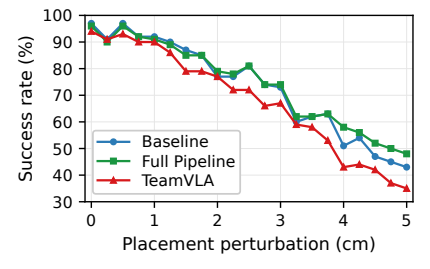
Figure 4 : OOD robustness under object-placement perturba- tion (21 noise levels, 10 episodes/task). T3R (Full Pipeline) tracks the unpruned baseline for small shifts and pulls ahead beyond∼2cm, leading by up to 7 pp at 4 cm, while TeamVLA degrades fastest. The crossover is consistent with pruning reducing misleading background context.
원문 · CC BY 4.0 · Mohammed Hassan, Zhenyang Chen, Zheng Wang, Zhixin Zhu, Tianlong Chen, Yingyan, Lin, Chaojian Li · T3R: Training-Free Two-Stage Token Refinement Towards Efficient and Robust VLA Models · 원문 그림 인용 · 원본 PDF 5쪽에서 그림 영역을 추출했습니다.저자들은 이 교차가 가지치기가 오도하는 배경 맥락을 줄이고 어텐션 보정이 과제 관련 증거를 강조한 결과와 일치한다고 해석합니다. 이 결과는 객체 배치 교란이라는 한 종류의 분포 변화에서 얻은 것입니다.
백본과 카메라 구성에 대한 일반화
일반화 실험은 CogACT를 SIMPLER에서 단일 제3자 카메라로, π0.5를 RoboTwin에서 세 대의 카메라로 평가합니다. 두 평가는 미세조정 없이 수행되어 절대 성공률은 낮지만, 기준선과 경쟁 가지치기 방법을 같은 예산에서 비교합니다. CogACT에서 T3R은 60% 유지 비율로 Bridge에서는 기준선과 같고 Google Robot에서는 기준선 73.2보다 낮은 67.7을 기록했습니다. 저자들은 한 카메라에서는 교차 센서 중복이 적어 공격적인 가지치기가 필요한 토큰을 제거한다고 해석합니다.
π0.5 RoboTwin에서는 다섯 과제, 과제당 12 에피소드, 총 60 에피소드를 사용합니다. 따라서 세 카메라 설정에서 가지치기 여유가 크다는 해석은 이 두 평가의 상대적 비교에 근거합니다.
시뮬레이션 범위와 실패 사례
저자들은 모든 평가가 시뮬레이션에서 수행되었으며 실제 로봇 제어와 비동기 실행은 검증되지 않았다고 밝힙니다. 하드웨어 프로파일링도 NVIDIA L40S에 한정되어 에너지 측정과 엣지 장치 테스트가 없으므로 지연 개선이 곧 에너지 절감이나 엣지 성능을 뜻하지 않습니다. 가림과 조명 변화가 분할 품질을 떨어뜨려 과제 관련 패치를 버릴 수 있지만, 이 효과를 성공률 측면에서 분리해 확인하지는 않았습니다.
객체 탐지 측면에서 LIBERO-Object는 T3R이 82%로 TeamVLA의 86%보다 낮습니다. 목적지 객체가 시각적으로 우세한 경우 SigLIP 유사도가 두 객체에 나뉘어 잘못된 영역이 분할될 수 있다고 설명됩니다. LIBERO-Long처럼 중간에 관련 영역이 바뀌는 다단계 과제에서도 전체 지시문 기준 유사도가 현재 단계를 반영하지 못할 수 있습니다.
논문 정보
- 저자
- Mohammed Hassan, Zhenyang Chen, Zheng Wang, Zhixin Zhu, Tianlong Chen, Yingyan, Lin, Chaojian Li
- 학회·저널
- arXiv · 프리프린트
- 최초 공개일
- 2026년 11월 5일
- 등록일
- 2026년 11월 7일
- 수정일
- 2026년 11월 5일
- 버전
- v1
- arXiv
- 2611.08413
- 분류
- cs.RO · cs.CV
- 원문 이용 조건
- CC BY 4.0
- 제공 범위
- 논문 정보, 해설, 허용된 원문 그림
AI 해설은 논문 원문과 별개의 설명이며 오류가 있을 수 있습니다. 원문과 그림은 각 출처의 이용 조건과 따로 표시된 권리를 따릅니다.
초록
Vision-Language-Action (VLA) models enable end-to-end robot control, but inference is increasingly expensive. Each decision processes hundreds of visual tokens, often across multiple cameras, leading to substantial computation while allowing irrelevant background content to distract action prediction under distribution shift. We argue that these issues stem from two complementary forms of redundancy: many visual tokens are spatially irrelevant, while attention over the remaining tokens is often misallocated. Based on this observation, we propose T3R, a Training-Free Two-Stage Token Refinement framework. In the first stage, segmentation-guided token pruning removes irrelevant visual patches to reduce computation and eliminate distracting context. In the second stage, saliency-guided attention biasing reallocates attention toward action-critical visual regions and language instructions within the retained tokens. Together, pruning produces a cleaner candidate set, while attention biasing further emphasizes the most decision-relevant evidence, yielding a better accuracy-efficiency frontier than either stage alone. On LIBERO-Spatial, T3R removes 85% of scene-camera visual tokens while essentially matching the unpruned success rate, and improves success by up to 7 percentage points under out-of-distribution object-placement perturbations. The timing comparison attributes 7.8 ms per inference call to pruning and attention-bias application. As input resolution increases, LLM-forward profiling shows up to a 3.3x speedup over the unpruned baseline. Evaluations across LIBERO, SIMPLER, and RoboTwin with three VLA backbones show the strongest accuracy-efficiency benefits in multi-camera settings. These results demonstrate that training-free token refinement is a practical approach to efficient and robust VLA inference.
원문 인용
Mohammed Hassan, Zhenyang Chen, Zheng Wang, Zhixin Zhu, Tianlong Chen, Yingyan, Lin, Chaojian Li (2026). T3R: Training-Free Two-Stage Token Refinement Towards Efficient and Robust VLA Models. arXiv:2611.08413v1. https://arxiv.org/abs/2611.08413v1
BibTeX
@misc{hassan2026training,
  title = {{T3R: Training-Free Two-Stage Token Refinement Towards Efficient and Robust VLA Models}},
  author = {Mohammed Hassan and Zhenyang Chen and Zheng Wang and Zhixin Zhu and Tianlong Chen and Yingyan and Lin and Chaojian Li},
  year = {2026},
  eprint = {2611.08413},
  archivePrefix = {arXiv},
  url = {https://arxiv.org/abs/2611.08413v1}
}