논문 해설
Variational Quantum Circuits for Deep Reinforcement Learning
심층 강화학습을 위한 변분 양자 회로
- 연구 문제 고전 심층 Q-학습을 잡음이 있는 중간 규모 양자 장치에서 실행할 수 있도록 변분 양자 회로로 바꾸고, frozen lake와 cognitive radio에서 정책 학습 가능성을 확인합니다.
- 연구 방법 관측 상태를 계산 기저 상태로 인코딩하고, CNOT과 학습 가능한 단일 큐빗 회전으로 이루어진 회로의 출력 기댓값으로 행동을 고릅니다. 학습에는 경험 재현과 목표 네트워크를 사용합니다.
- 주요 결과 frozen lake 구성 (a)에서 총 보상 0.9에 수렴하고, cognitive radio의 2채널과 5채널 설정에서 최대 보상 100에 도달했습니다. frozen lake의 매개변수 수는 표 형식 Q-학습 대비 56.25% 적은 28개입니다.
NISQ 장치에서 심층 강화학습을 다루려는 이유
고전 심층 강화학습은 신경망으로 행동-가치 함수를 근사하며 경험 재현과 목표 네트워크로 학습을 안정화합니다. 이 논문은 이러한 방식을 잡음이 있는 중간 규모 양자(NISQ) 장치에서 실행할 수 있는 변분 양자 회로로 바꾸는 문제를 다룹니다. 양자 오류 정정이 부족한 현재 장치에서는 깊은 회로를 실행하기 어렵기 때문에, 얕은 회로와 고전 컴퓨터에서의 반복 최적화를 결합하는 하이브리드 방식이 필요합니다. 저자들은 이 방식으로 frozen lake와 cognitive radio 환경에서 정책 학습이 가능한지 확인합니다. 이 연구는 작은 규모의 증명 사례이며, 큐빗 수가 큰 시스템을 다룬 것은 아닙니다.
상태 인코딩과 변분 회로 구조
관측된 상태는 먼저 이진수로 바뀝니다. 이후 각 큐빗에 단일 큐빗 회전을 적용하여 계산 기저 상태로 인코딩합니다. frozen lake에서는 16개의 상태를 4큐빗으로 표현하며, 상태 11은 이진수 1011이므로 대응하는 큐빗 상태는 |1011⟩입니다. 이 준비 단계의 회전 각도는 학습 대상이 아닙니다. 인코딩 뒤에는 CNOT 게이트로 큐빗을 얽히게 하는 층과, 학습 가능한 일반 단일 큐빗 유니터리 층을 이어 붙인 블록을 두 번 반복합니다. 이 블록의 학습 가능한 매개변수는 α, β, γ로 표시되며, 4큐빗 설정에서 블록 하나당 큐빗 4개와 매개변수 3개를 쓰고 두 번 반복하면 24개가 됩니다. 여기에 측정 뒤의 편향 벡터 4개를 더해 frozen lake의 총 매개변수는 28개가 됩니다.
cognitive radio에서는 채널 수 n에 맞춰 큐빗 수를 조절하며, 3채널 경우에는 상태 수가 3²=9보다 큰 32이므로 4큐빗 시스템을 사용합니다.
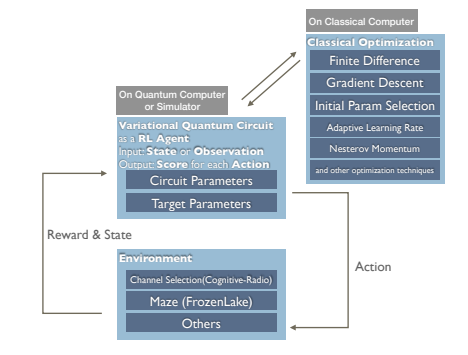
FIGURE 4 : Overview of variational quantum circuits for DRL. In this work, we study the capability of variational quantum circuits in performing DRL tasks. This DRL agent includes a quantum part and a classical part. Under cur- rent limitations on the scale of quantum machines and the capabilities of quantum simulations, we select frozen-lake and cognitive-radio environments for the proof-of-principle study. The proposed framework is rather general and is ex- pected to solve complicated tasks when larger-scale quantum machines are available.
원문 · CC BY 4.0 · Samuel Yen-Chi Chen, Chao-Han Huck Yang, Jun Qi, Pin-Yu Chen, Xiaoli Ma, Hsi-Sheng Goan · Variational Quantum Circuits for Deep Reinforcement Learning · 원문 그림 인용 · 원본 PDF 5쪽에서 그림 영역을 추출했습니다.행동 선택과 경험 재현 기반 학습
행동은 회로의 출력 큐빗 측정값 가운데 기댓값이 가장 큰 큐빗의 인덱스로 정합니다. 시뮬레이터에서는 기댓값을 해석적으로 계산하지만, 실제 장치에서는 여러 번 측정한 평균으로 추정합니다. 이 과정은 단일 측정 결과보다 기댓값을 쓰기 위해 같은 상태를 반복 측정하는 방식입니다. 학습은 고전 Q-학습과 같은 목표 값을 사용하며, 예측값 Q(s,a;θ)와 목표 r+γ max Q(s′,a′;θ⁻) 사이의 MSE 손실을 줄이는 방향으로 진행됩니다. 전이 (s,a,r,s′)는 재현 메모리에 저장되고 미니배치 크기 5로 무작위 표본이 뽑힙니다. 목표 네트워크의 매개변수 θ⁻는 주 회로와 달리 20 단계마다 갱신됩니다.
이 방식은 연속된 상태 사이의 상관을 낮추고 목표 값을 상대적으로 고정하여 학습을 안정화하는 역할을 합니다. 최적화기는 RMSprop이며 학습률은 0.01로 설정되었고, 이 값은 본 논문의 이 최적화 설정에 대한 것입니다.
검증 환경과 보상 설계
검증에는 frozen lake와 cognitive radio 두 환경을 사용합니다. frozen lake에서는 목표에 도달하면 +1.0, 구멍에 빠지면 -0.2, 각 이동마다 -0.01의 보상을 받아 최단 경로를 학습하도록 설계되어 있습니다. cognitive radio에서는 주 사용자와 충돌하지 않은 채널을 고르면 +1, 충돌하면 -1을 받습니다. 한 에피소드는 세 번 연속 실패하거나 100 단계를 넘기면 끝나므로, 최대 점수는 100입니다. 채널 간섭은 주기 패턴으로 주어지며, 관측은 채널과 시간의 쌍으로 구성됩니다. 실험은 frozen lake의 세 구성과 cognitive radio의 2, 3, 4, 5채널 설정을 포함하며, 기본 cognitive radio 설정은 구성 (a)입니다.
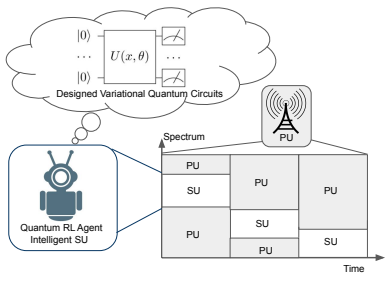
FIGURE 2 : Cognitive-Radio environment for the varia- tional quantum DRL agent. In the cognitive-radio environ- ment, the agent is expected to select a channel that is free of interference in each time step. For example, there is a primary user (PU) that will occupy a specific channel in each time step periodically. Our agent, which is the secondary user (SU), can only select the channels that are not occupied without the knowledge of the PU in advance. The agent is expected to learn the policy through the interaction with the environment.
원문 · CC BY 4.0 · Samuel Yen-Chi Chen, Chao-Han Huck Yang, Jun Qi, Pin-Yu Chen, Xiaoli Ma, Hsi-Sheng Goan · Variational Quantum Circuits for Deep Reinforcement Learning · 원문 그림 인용 · 원본 PDF 2쪽에서 그림 영역을 추출했습니다.학습 결과와 매개변수 비교
frozen lake 구성 (a)에서 변분 양자 회로 기반 DQL 에이전트는 총 보상 0.9에 도달하며, 198번째 에피소드 이후 수렴한다고 보고됩니다. 같은 실험에서 최근 100개 에피소드의 평균과 표준편차로 안정성을 확인했고, 301번째 반복 이후 정책이 더 안정된다고 설명합니다. cognitive radio에서는 2채널과 5채널 설정에서 에이전트가 최대 보상 100에 여러 반복 이내에 도달했고, 3채널과 4채널은 거의 최적에 가까운 정책에 도달했습니다. 잡음 모델을 적용한 IBM 시뮬레이션에서는 2채널과 4채널 설정이 약 110번의 반복 이내에 최적 보상에 가까워졌습니다. 매개변수 수에서는 frozen lake의 VQ-DQL이 28개이고 표 형식 Q-학습의 표 크기 64와 비교해 56.25% 적습니다.
이 비율은 frozen lake 설정의 비교이며, cognitive radio의 신경망 기준 비교와는 별도로 읽어야 합니다. IBM Q 실제 장치 실험은 frozen lake 구성 (c)와 cognitive radio 4채널 구성 (c)에서 각각 5회와 7회의 에피소드로 수행되었고, 총 보상은 시뮬레이터 결과와 비슷한 0.94에서 0.95 범위였습니다. 이 장치 실험의 에피소드 수는 제한적입니다.

TABLE 2 : Comparison of the number of parameters in classical Q-learning and variational quantum deep Q network (VQ- DQN).
원문 · CC BY 4.0 · Samuel Yen-Chi Chen, Chao-Han Huck Yang, Jun Qi, Pin-Yu Chen, Xiaoli Ma, Hsi-Sheng Goan · Variational Quantum Circuits for Deep Reinforcement Learning · 원문 그림 인용 · 원본 PDF 8쪽에서 그림 영역을 추출했습니다.
TABLE 3 : Results of the trained VQ-DQL (VQ-DQN) for the cognitive-radio experiment conducted on the IBM Q quantum computer, ibmq-valencia. In this experiment, we test the trained quantum DRL model in the cognitive- radio experiment of configuration (c) in the 4-channel case described in Fig. 3. Even if the training is on the simulation software without the quantum noise, the trained model still performs well on the real quantum computer.
원문 · CC BY 4.0 · Samuel Yen-Chi Chen, Chao-Han Huck Yang, Jun Qi, Pin-Yu Chen, Xiaoli Ma, Hsi-Sheng Goan · Variational Quantum Circuits for Deep Reinforcement Learning · 원문 그림 인용 · 원본 PDF 12쪽에서 그림 영역을 추출했습니다.
TABLE 4 : Results of the trained VQ-DQL (VQ-DQN) for the frozen-lake experiment conducted on the IBM Q quantum computer, ibmq-valencia. In this experiment, we test the trained quantum DRL model in the frozen-lake experiment of configuration (c) in Fig.1. Even if the training is on the simulation software without the quantum noise, the trained model still performs well on the real quantum computer.
원문 · CC BY 4.0 · Samuel Yen-Chi Chen, Chao-Han Huck Yang, Jun Qi, Pin-Yu Chen, Xiaoli Ma, Hsi-Sheng Goan · Variational Quantum Circuits for Deep Reinforcement Learning · 원문 그림 인용 · 원본 PDF 13쪽에서 그림 영역을 추출했습니다.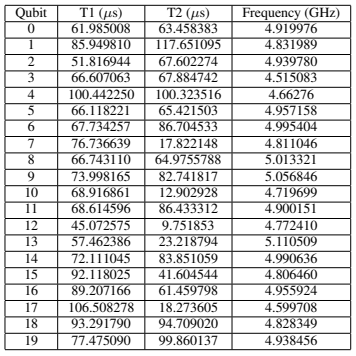
TABLE 6 : Qubit relaxation time T1, dephasing time T2 and qubit frequency data of the 20-qubit machine ibmq-poughkeepsie downloaded from the IBM Q sys- tem service at the time when the numerical simulation in Sec.VI-C performed.
원문 · CC BY 4.0 · Samuel Yen-Chi Chen, Chao-Han Huck Yang, Jun Qi, Pin-Yu Chen, Xiaoli Ma, Hsi-Sheng Goan · Variational Quantum Circuits for Deep Reinforcement Learning · 원문 그림 인용 · 원본 PDF 16쪽에서 그림 영역을 추출했습니다.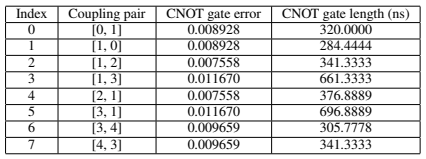
TABLE 7 : Two-qubit coupling and CNOT gate error and gate length data of the 5-qubit machine ibmq-valencia downloaded from the IBM Q system service at the time when the experiment in Sec.VI-E performed.
원문 · CC BY 4.0 · Samuel Yen-Chi Chen, Chao-Han Huck Yang, Jun Qi, Pin-Yu Chen, Xiaoli Ma, Hsi-Sheng Goan · Variational Quantum Circuits for Deep Reinforcement Learning · 원문 그림 인용 · 원본 PDF 16쪽에서 그림 영역을 추출했습니다.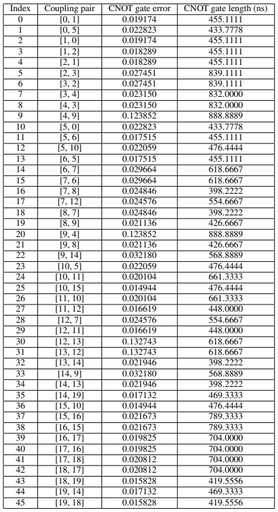
TABLE 8 : Two-qubit coupling and CNOT gate er- ror and gate length data of the 20-qubit machine ibmq-poughkeepsie downloaded from the IBM Q sys- tem service at the time when the numerical simulation in Sec.VI-C performed. The two-qubit CNOT gate error and lengths are usually different for different two-qubit coupling pairs due to different coupling strength and different qubit frequencies in the qubit pairs.
원문 · CC BY 4.0 · Samuel Yen-Chi Chen, Chao-Han Huck Yang, Jun Qi, Pin-Yu Chen, Xiaoli Ma, Hsi-Sheng Goan · Variational Quantum Circuits for Deep Reinforcement Learning · 원문 그림 인용 · 원본 PDF 16쪽에서 그림 영역을 추출했습니다.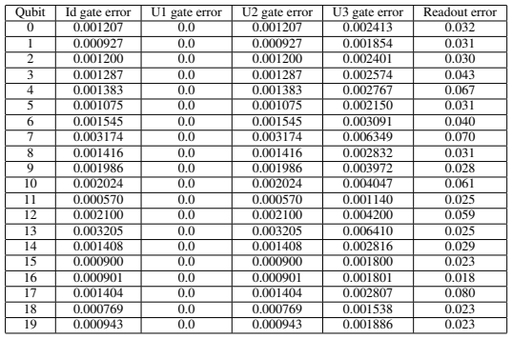
TABLE 9 : Single-qubit U1, U2 and U3 gate errors, and readout error data of the 20-qubit machine ibmq-poughkeepsie downloaded from the IBM Q system service at the time when the numerical simulation in Sec. VI-C performed. Different single-qubit gates have different gate lengths, but the gate length of the same single-qubit gate is the same for every qubit. The gate lengths of the Identity (Id) gate, U1 gate, U2 gate, and U3 gate, are 113.7778 ns, 0.0 ns, 103.1111 ns, and 206.2222 ns, respectively.
원문 · CC BY 4.0 · Samuel Yen-Chi Chen, Chao-Han Huck Yang, Jun Qi, Pin-Yu Chen, Xiaoli Ma, Hsi-Sheng Goan · Variational Quantum Circuits for Deep Reinforcement Learning · 원문 그림 인용 · 원본 PDF 17쪽에서 그림 영역을 추출했습니다.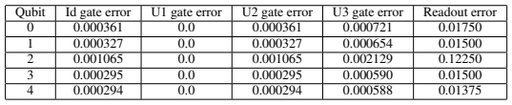
TABLE 10 : Single-qubit U1, U2 and U3 gate errors, and readout error data of the 20-qubit machine ibmq-valencia downloaded from the IBM Q system service at the time when the experiment in Sec. VI-E performed. The gate lengths of the Identity (Id) gate, U1 gate, U2 gate, and U3 gate, are 35.55556 ns, 0.0 ns, 35.55556 ns, and 71.11111 ns, respectively.
원문 · CC BY 4.0 · Samuel Yen-Chi Chen, Chao-Han Huck Yang, Jun Qi, Pin-Yu Chen, Xiaoli Ma, Hsi-Sheng Goan · Variational Quantum Circuits for Deep Reinforcement Learning · 원문 그림 인용 · 원본 PDF 17쪽에서 그림 영역을 추출했습니다.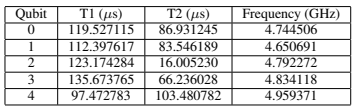
TABLE 11 : Qubit relaxation time T1, dephasing time T2 and qubit frequency data of the 5-qubit machine ibmq-valencia downloaded from the IBM Q system ser- vice at the time when the experiment in Sec.VI-E performed.
원문 · CC BY 4.0 · Samuel Yen-Chi Chen, Chao-Han Huck Yang, Jun Qi, Pin-Yu Chen, Xiaoli Ma, Hsi-Sheng Goan · Variational Quantum Circuits for Deep Reinforcement Learning · 원문 그림 인용 · 원본 PDF 17쪽에서 그림 영역을 추출했습니다.해석의 범위와 남은 제약
이 결과는 frozen lake와 cognitive radio라는 작은 규모의 환경에서 얻은 것입니다. 저자들은 현재 NISQ 장치가 양자 오류 정정이 부족하여 깊은 회로에 적합하지 않으므로, 회로 깊이를 낮게 유지하는 설계가 필요하다고 설명합니다. 진폭 인코딩은 매개변수 수를 로그 규모로 줄일 가능성이 있으나, 고전 벡터를 양자 레지스터에 효율적으로 준비하는 알려진 알고리즘이 없어 이 논문에서는 구현되지 않았습니다. 따라서 매개변수 감소 주장은 본 논문의 계산 기저 인코딩과 측정한 환경에 한정해 읽어야 합니다. 또한 실제 장치 평가는 제한된 에피소드 수에서 이루어졌으며, 대규모 큐빗 시스템의 성능은 아직 검증되지 않았습니다.
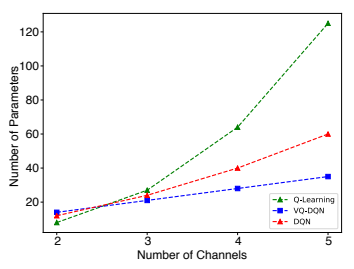
FIGURE 11 : Comparison of memory consumption in different learning schemes. The figure shows our pro- posed variational quantum circuits based DQL-agent has the quantum advantage in memory consumption compared to classical Q-learning and DQL (DQN). Specifically, in our cognitive-radio channel selection experiment, we set up four different testing environments with 2,3,4,5 possible channels, respectively. With the classical Q-learning, the number of parameters grow with n3, and in DQL (DQN), the number of parameters grow with n2. However, with our proposed variational quantum circuits based DQL (DQN), the number of parameters grows asn× (3× 2 + 1) only.
원문 · CC BY 4.0 · Samuel Yen-Chi Chen, Chao-Han Huck Yang, Jun Qi, Pin-Yu Chen, Xiaoli Ma, Hsi-Sheng Goan · Variational Quantum Circuits for Deep Reinforcement Learning · 원문 그림 인용 · 원본 PDF 13쪽에서 그림 영역을 추출했습니다.논문 정보
- 저자
- Samuel Yen-Chi Chen, Chao-Han Huck Yang, Jun Qi, Pin-Yu Chen, Xiaoli Ma, Hsi-Sheng Goan
- 학회·저널
- arXiv · 프리프린트
- 최초 공개일
- 2019년 6월 30일
- 등록일
- 2026년 11월 6일
- 수정일
- 2020년 7월 20일
- 버전
- v3
- arXiv
- 1907.00397
- 분류
- cs.LG · cs.AI · quant-ph · stat.ML
- 원문 이용 조건
- CC BY 4.0
- 제공 범위
- 논문 정보, 해설, 허용된 원문 그림
AI 해설은 논문 원문과 별개의 설명이며 오류가 있을 수 있습니다. 원문과 그림은 각 출처의 이용 조건과 따로 표시된 권리를 따릅니다.
초록
The state-of-the-art machine learning approaches are based on classical von Neumann computing architectures and have been widely used in many industrial and academic domains. With the recent development of quantum computing, researchers and tech-giants have attempted new quantum circuits for machine learning tasks. However, the existing quantum computing platforms are hard to simulate classical deep learning models or problems because of the intractability of deep quantum circuits. Thus, it is necessary to design feasible quantum algorithms for quantum machine learning for noisy intermediate scale quantum (NISQ) devices. This work explores variational quantum circuits for deep reinforcement learning. Specifically, we reshape classical deep reinforcement learning algorithms like experience replay and target network into a representation of variational quantum circuits. Moreover, we use a quantum information encoding scheme to reduce the number of model parameters compared to classical neural networks. To the best of our knowledge, this work is the first proof-of-principle demonstration of variational quantum circuits to approximate the deep $Q$-value function for decision-making and policy-selection reinforcement learning with experience replay and target network. Besides, our variational quantum circuits can be deployed in many near-term NISQ machines.
원문 인용
Samuel Yen-Chi Chen, Chao-Han Huck Yang, Jun Qi, Pin-Yu Chen, Xiaoli Ma, Hsi-Sheng Goan (2019). Variational Quantum Circuits for Deep Reinforcement Learning. arXiv:1907.00397v3. https://arxiv.org/abs/1907.00397v3
BibTeX
@misc{chen2019variational,
  title = {{Variational Quantum Circuits for Deep Reinforcement Learning}},
  author = {Samuel Yen-Chi Chen and Chao-Han Huck Yang and Jun Qi and Pin-Yu Chen and Xiaoli Ma and Hsi-Sheng Goan},
  year = {2019},
  eprint = {1907.00397},
  archivePrefix = {arXiv},
  url = {https://arxiv.org/abs/1907.00397v3}
}