논문 해설
Agentic Framework for Epidemiological Modeling
역학 모델링을 위한 에이전트 프레임워크
- 연구 문제 역학 모델을 정책 시나리오마다 손으로 다시 설계하고 구현하는 작업은 느리고 구조적 오류가 생기기 쉽습니다.
- 연구 방법 EPIAGENT는 시나리오를 검증 가능한 flow graph로 먼저 표현하고, 검증된 그래프를 기계론적 시뮬레이터 코드로 변환한 뒤 보정과 다중 에이전트 V&V를 반복합니다.
- 주요 결과 절제 실험에서 그래프 검증을 제거하면 잘못된 그래프가 over 87% 사례에서 잘못된 시나리오 투영으로 이어졌다고 보고됩니다. Table 1에서는 Nationwide 기준 시간 가변 모델의 RMSE가 시간 불변 모델보다 낮습니다.
연구 문제와 기존 방식의 한계
역학 모델은 정책, 변이, 면역 가정이 바뀔 때마다 모델 구조를 다시 설계하고 시뮬레이터를 다시 구현해야 하는 경우가 많습니다. 이 논문은 이 반복 작업을 에이전트 기반 파이프라인으로 자동화하려고 합니다. 저자들은 LLM에 시나리오를 직접 주어 구획 모델과 시뮬레이터를 생성하면 구조적 불일치와 불안정한 동작이 자주 나타난다고 보고합니다. 따라서 연구 질문은 에이전트 시스템이 역학 모델링과 분석을 실제로 도울 수 있는지로 설정됩니다. 이 질문에 답하기 위해 EPIAGENT는 시나리오 명세와 시뮬레이터 사이에 검증 가능한 중간 표현을 둡니다.
flow graph 중간 표현과 생성 파이프라인
EPIAGENT의 핵심 설계는 시나리오 명세를 바로 코드로 바꾸지 않고, 먼저 역학 flow graph로 표현하는 것입니다. 시나리오 설명은 문장 임베딩으로 표현되고 FAISS 색인에서 관련 역학 지식을 검색하여 지식 증강 프롬프트를 만듭니다. 생성된 그래프는 허용되지 않는 구획이나 전이를 가진 경우 거부되고 피드백으로 다시 생성됩니다. 검증된 그래프와 골격 코드를 받은 LLM 계획 에이전트는 미분 가능한 시뮬레이터 코드를 만들며, 실행 오류는 제한된 횟수만큼 복구합니다. 이후 시뮬레이터 파라미터는 감염 및 사망 수준과 1차 차분에 대한 MSE 손실로 보정됩니다. 마지막으로 다중 에이전트 V&V가 구조와 시나리오 일관성을 검사하며, 실패하면 구조 수정 피드백이 다음 생성에 전달됩니다.
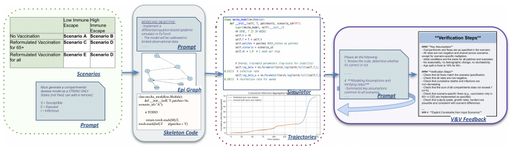
Figure 1 .Data flow in EPIAGENThas the following structure:Prompt ↔ Flow Graph → Simulator Code → Results. The flow graph is an abstract representation of the epidemic model being learned, and supports easier verification. The flow graph is then transformed into the actual epidemic model and is calibrated, and fully verified. The components here map to those in the architecture of EPIAGENT, shown in Figure 2.
원문 · CC BY 4.0 · Rituparna Datta, Zihan Guan, Baltazar Espinoza, Yiqi Su, Priya Pitre, Srini Venkatramanan, Naren Ramakrishnan, Anil Vullikanti · Agentic Framework for Epidemiological Modeling · 원문 그림 인용 · 원본 PDF 2쪽에서 그림 영역을 추출했습니다.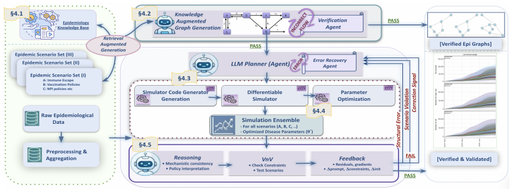
Figure 2 .Agentic pipeline for epidemic scenario modeling and ensemble simulation. Natural-language scenarios are augmented with domain knowledge (§4.1), to produce prompts that guide flow-graph synthesis (§4.2). Generated graphs are iteratively verified to enforce valid compartmental structure and transitions. Given a verified graph and scenario description, an LLM planner instantiates executable simulator code with automated error recovery (§4.3). Simulators are calibrated on observed data and evaluated as a scenario ensemble (§4.4). A multi-agent verification and validation stage enforces epidemiological and scenario-consistency constraints, retaining only structurally and behaviorally valid models (§4.5).
원문 · CC BY 4.0 · Rituparna Datta, Zihan Guan, Baltazar Espinoza, Yiqi Su, Priya Pitre, Srini Venkatramanan, Naren Ramakrishnan, Anil Vullikanti · Agentic Framework for Epidemiological Modeling · 원문 그림 인용 · 원본 PDF 4쪽에서 그림 영역을 추출했습니다.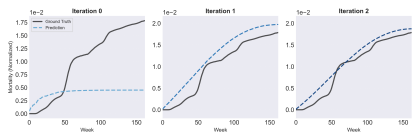
Figure 5 .Iterative refinement of epi models under agentic veri- fication and feedback. Subsequent feedback corrects structural violations and progressively refines model expressiveness.
원문 · CC BY 4.0 · Rituparna Datta, Zihan Guan, Baltazar Espinoza, Yiqi Su, Priya Pitre, Srini Venkatramanan, Naren Ramakrishnan, Anil Vullikanti · Agentic Framework for Epidemiological Modeling · 원문 그림 인용 · 원본 PDF 8쪽에서 그림 영역을 추출했습니다.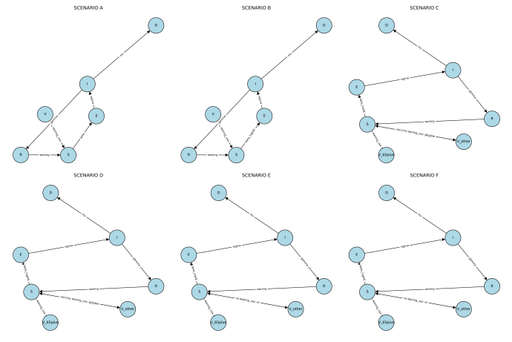
Figure 9 .Scenario-based epidemiological flow graph construction.Retrieved domain knowledge constrains graph structure, enabling the LLM planner to generate compartmental models.
원문 · CC BY 4.0 · Rituparna Datta, Zihan Guan, Baltazar Espinoza, Yiqi Su, Priya Pitre, Srini Venkatramanan, Naren Ramakrishnan, Anil Vullikanti · Agentic Framework for Epidemiological Modeling · 원문 그림 인용 · 원본 PDF 13쪽에서 그림 영역을 추출했습니다.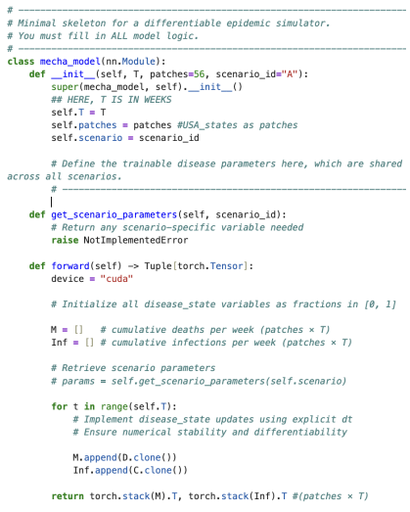
Figure 13 .Skeleton Code for Case Study I
원문 · CC BY 4.0 · Rituparna Datta, Zihan Guan, Baltazar Espinoza, Yiqi Su, Priya Pitre, Srini Venkatramanan, Naren Ramakrishnan, Anil Vullikanti · Agentic Framework for Epidemiological Modeling · 원문 그림 인용 · 원본 PDF 15쪽에서 그림 영역을 추출했습니다.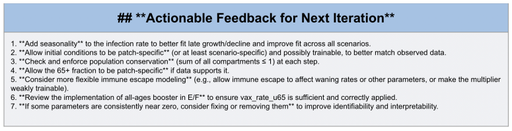
Figure 15 .Actionable feedback generated by the agentic refinement loop in model generation phase.
원문 · CC BY 4.0 · Rituparna Datta, Zihan Guan, Baltazar Espinoza, Yiqi Su, Priya Pitre, Srini Venkatramanan, Naren Ramakrishnan, Anil Vullikanti · Agentic Framework for Epidemiological Modeling · 원문 그림 인용 · 원본 PDF 16쪽에서 그림 영역을 추출했습니다.검증 범위: 그래프 검증과 코드 수준 검사
논문은 flow graph 검증이 잘못된 구조가 실행 코드로 전파되는 것을 막는다고 주장합니다. 이를 확인하기 위해 그래프 검증을 제거한 절제 실험을 두었고, 이 설정에서 잘못된 그래프는 over 87%의 사례에서 잘못된 시나리오 투영을 낳았다고 보고됩니다. Figure 4는 부정확한 그래프가 그럴듯한 결과를 만들 수도 있고 명백히 잘못된 궤적을 만들 수도 있음을 보여 줍니다. 코드 수준에서는 음수 구획 값, 인구 보존 위반, 누적 사망의 비단조성 같은 퇴화된 저손실 해를 V&V가 걸러내는 것으로 설명됩니다. 다만 이 검증의 수치는 저자가 보고한 절제 설정에서 얻은 결과이며, 다른 데이터셋이나 모든 모델 조합에 대한 일반 보장으로 읽지 않습니다.
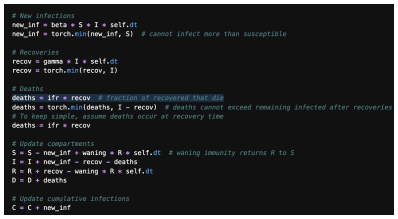
Figure 11 .Simulator well fitted, but mechanistic equation invalid. Death is not a fraction of recovered
원문 · CC BY 4.0 · Rituparna Datta, Zihan Guan, Baltazar Espinoza, Yiqi Su, Priya Pitre, Srini Venkatramanan, Naren Ramakrishnan, Anil Vullikanti · Agentic Framework for Epidemiological Modeling · 원문 그림 인용 · 원본 PDF 14쪽에서 그림 영역을 추출했습니다.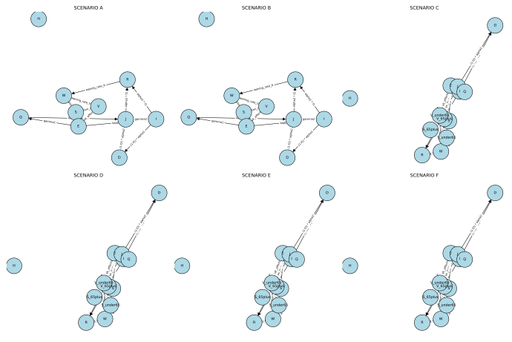
Figure 12 .Ifno constraintsare written, the graph generation model will generate themost complicated flow dynamics, introducing unnecessary states which are not relevant to the scenarios
원문 · CC BY 4.0 · Rituparna Datta, Zihan Guan, Baltazar Espinoza, Yiqi Su, Priya Pitre, Srini Venkatramanan, Naren Ramakrishnan, Anil Vullikanti · Agentic Framework for Epidemiological Modeling · 원문 그림 인용 · 원본 PDF 15쪽에서 그림 영역을 추출했습니다.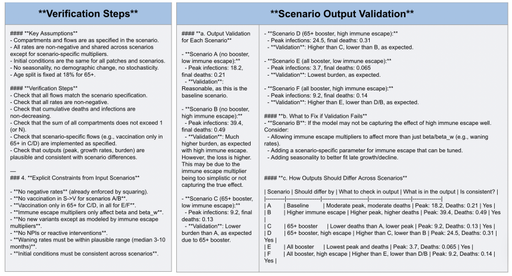
Figure 14 .Verification and scenario-output validation in EPIAGENT. Left: Explicit verification steps and hard constraints enforced on synthesized epidemiological simulators, including mechanistic validity, parameter constraints, and scenario compliance. Right: Scenario-wise output validation illustrating expected qualitative ordering of peak infections and cumulative deaths across counterfactual scenarios, along with diagnostic guidance when validation fails.
원문 · CC BY 4.0 · Rituparna Datta, Zihan Guan, Baltazar Espinoza, Yiqi Su, Priya Pitre, Srini Venkatramanan, Naren Ramakrishnan, Anil Vullikanti · Agentic Framework for Epidemiological Modeling · 원문 그림 인용 · 원본 PDF 16쪽에서 그림 영역을 추출했습니다.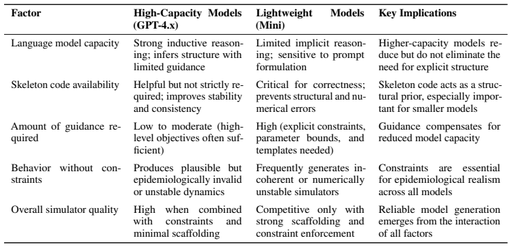
Table 3 .Impact of language model capacity, structural priors, and constraints on the quality of automatically generated epidemiological simulators.
원문 · CC BY 4.0 · Rituparna Datta, Zihan Guan, Baltazar Espinoza, Yiqi Su, Priya Pitre, Srini Venkatramanan, Naren Ramakrishnan, Anil Vullikanti · Agentic Framework for Epidemiological Modeling · 원문 그림 인용 · 원본 PDF 17쪽에서 그림 영역을 추출했습니다.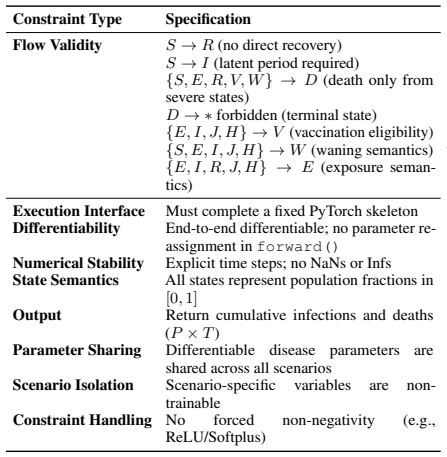
Table 4 .Unified hard constraints enforced during flow-graph veri- fication and simulator synthesis. Here ∗ denotes any compartment.
원문 · CC BY 4.0 · Rituparna Datta, Zihan Guan, Baltazar Espinoza, Yiqi Su, Priya Pitre, Srini Venkatramanan, Naren Ramakrishnan, Anil Vullikanti · Agentic Framework for Epidemiological Modeling · 원문 그림 인용 · 원본 PDF 17쪽에서 그림 영역을 추출했습니다.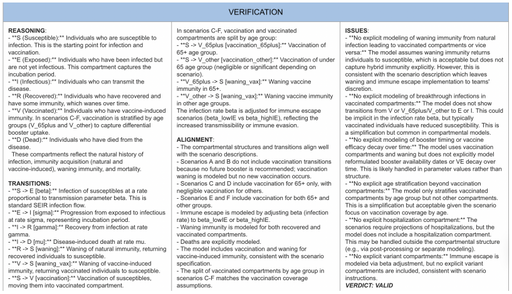
Figure 16 .Graph Verification checks and reasoning while generating the flow to ensure consistency between the scenarios
원문 · CC BY 4.0 · Rituparna Datta, Zihan Guan, Baltazar Espinoza, Yiqi Su, Priya Pitre, Srini Venkatramanan, Naren Ramakrishnan, Anil Vullikanti · Agentic Framework for Epidemiological Modeling · 원문 그림 인용 · 원본 PDF 18쪽에서 그림 영역을 추출했습니다.모델 구조별 적합 비교
Table 1은 시간 불변 기계론적 모델, 시간 가변 (βt, γt) 모델, 신경망 결합 모델을 비교합니다. Nationwide 행에서 시간 불변 모델의 RMSE는 3.09×10^-1이고, 시간 가변 (βt, γt) 모델의 RMSE는 5.03×10^-2입니다. 신경망 결합 모델의 RMSE는 2.67×10^-2로 보고됩니다. 이 비교는 시간 변화 파라미터가 단기 예측 정확도를 높일 수 있음을 보여 주지만, 표가 보고하는 것은 해당 지표와 조건에서의 적합 성능입니다. 저자들은 기본 설정으로 해석 가능성을 위해 시간 불변 모델을 우선한다고 설명합니다. 신경망 결합 모델은 예측 정확도가 우선될 때 더 적합하다고 제시되며, 이 논문의 주요 실험 초점은 기계론적 질병 모델링에 있다고 밝혀져 있습니다.
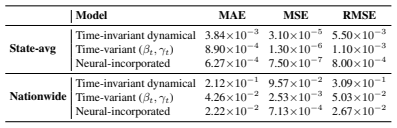
Table 1 .Performance comparison of modeling approaches.
원문 · CC BY 4.0 · Rituparna Datta, Zihan Guan, Baltazar Espinoza, Yiqi Su, Priya Pitre, Srini Venkatramanan, Naren Ramakrishnan, Anil Vullikanti · Agentic Framework for Epidemiological Modeling · 원문 그림 인용 · 원본 PDF 6쪽에서 그림 영역을 추출했습니다.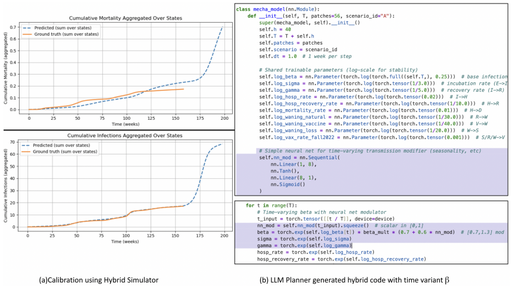
Figure 17 .Neural Augmented Dynamics with time variant disease parameters.
원문 · CC BY 4.0 · Rituparna Datta, Zihan Guan, Baltazar Espinoza, Yiqi Su, Priya Pitre, Srini Venkatramanan, Naren Ramakrishnan, Anil Vullikanti · Agentic Framework for Epidemiological Modeling · 원문 그림 인용 · 원본 PDF 21쪽에서 그림 영역을 추출했습니다.한계와 남은 질문
저자들은 현재 시스템이 고정 최적화 전략과 제한된 반복 개선에 의존한다고 밝힙니다. 이 때문에 후기 세대에서 잡음 누적으로 인한 회귀가 발생할 수 있으며, 수렴을 고려한 보정과 적응적 중단 기준이 향후 과제로 제시됩니다. 자동 오류 복구도 고정된 재시도 한도 안에서만 작동합니다. 따라서 이 결과는 제안된 파이프라인의 현재 설계와 보고된 사례 연구에 대한 것이며, 모든 역학 모델링 과제에서 같은 안정성이 있다는 주장으로 확대되지 않습니다.
논문 정보
- 저자
- Rituparna Datta, Zihan Guan, Baltazar Espinoza, Yiqi Su, Priya Pitre, Srini Venkatramanan, Naren Ramakrishnan, Anil Vullikanti
- 학회·저널
- arXiv · 프리프린트
- 최초 공개일
- 2026년 1월 30일
- 등록일
- 2026년 10월 29일
- 수정일
- 2026년 2월 26일
- 버전
- v2
- arXiv
- 2602.00299
- 분류
- cs.LG
- 원문 이용 조건
- CC BY 4.0
- 제공 범위
- 논문 정보, 해설, 허용된 원문 그림
AI 해설은 논문 원문과 별개의 설명이며 오류가 있을 수 있습니다. 원문과 그림은 각 출처의 이용 조건과 따로 표시된 권리를 따릅니다.
초록
Epidemic modeling is essential for public health planning, yet traditional approaches rely on fixed model classes that require manual redesign as pathogens, policies, and scenario assumptions evolve. We introduce EPIAGENT, an agentic framework that automatically synthesizes, calibrates, verifies, and refines epidemiological simulators by modeling disease progression as an iterative program synthesis problem. A central design choice is an explicit epidemiological flow graph intermediate representation that links scenario specifications to model structure and enables strong, modular correctness checks before code is generated. Verified flow graphs are then compiled into mechanistic models supporting interpretable parameter learning under physical and epidemiological constraints. Evaluation on epidemiological scenario case studies demonstrates that EPIAGENT captures complex growth dynamics and produces epidemiologically consistent counterfactual projections across varying vaccination and immune escape assumptions. Our results show that the agentic feedback loop prevents degeneration and significantly accelerates convergence toward valid models by mimicking professional expert workflows.
원문 인용
Rituparna Datta, Zihan Guan, Baltazar Espinoza, Yiqi Su, Priya Pitre, Srini Venkatramanan, Naren Ramakrishnan, Anil Vullikanti (2026). Agentic Framework for Epidemiological Modeling. arXiv:2602.00299v2. https://arxiv.org/abs/2602.00299v2
BibTeX
@misc{datta2026agentic,
  title = {{Agentic Framework for Epidemiological Modeling}},
  author = {Rituparna Datta and Zihan Guan and Baltazar Espinoza and Yiqi Su and Priya Pitre and Srini Venkatramanan and Naren Ramakrishnan and Anil Vullikanti},
  year = {2026},
  eprint = {2602.00299},
  archivePrefix = {arXiv},
  url = {https://arxiv.org/abs/2602.00299v2}
}