논문 해설
MoE-LLaVA: Mixture of Experts for Large Vision-Language Models
MoE-LLaVA: 대규모 시각-언어 모델을 위한 전문가 혼합
- 연구 문제 대규모 시각-언어 모델은 모든 파라미터가 토큰마다 계산되어 학습과 추론 비용이 큽니다. 이 논문은 희소 MoE 구조를 LVLM에 적용하면서 성능 저하를 막는 학습 전략을 제안합니다.
- 연구 방법 MoE-Tuning은 MLP 학습, 전체 LLM 명령 학습, FFN 복제 후 MoE 층만 학습하는 3단계 전략입니다. 라우터는 토큰마다 상위 k개 전문가만 활성화합니다.
- 주요 결과 저자들은 MoE-LLaVA가 약 3B 활성 파라미터로 여러 시각 이해 벤치마크에서 LLaVA-1.5-7B와 비슷한 성능을 보이고, POPE 객체 환각 평가에서 LLaVA-1.5-13B보다 높다고 보고합니다.
문제 설정: 밀집 LVLM의 비용
대규모 시각-언어 모델(LVLM)은 이미지 인코더와 투영 층으로 시각 토큰을 만들고, 이를 LLM에 함께 입력하여 시각 이해 성능을 높여 왔습니다. 그러나 기존 확장 방식은 모델의 모든 파라미터가 토큰마다 계산에 참여하므로 학습과 추론 비용이 함께 커집니다. 이 논문은 파라미터 수는 키우면서 토큰당 계산량은 일정하게 유지하는 희소 혼합 전문가(MoE) 구조를 LVLM에 적용하려 합니다.
그런데 LLM을 LVLM으로 바꾸는 일과 밀집 모델을 희소 모델로 바꾸는 일을 동시에 하면 성능이 크게 떨어진다고 저자들은 관찰합니다. 따라서 논문의 핵심 질문은 단순히 MoE 층을 끼워 넣을 수 있는지가 아니라, 멀티모달 희소화에서 성능 저하를 막을 학습 절차가 필요한지입니다.
MoE-Tuning과 MoE-LLaVA 구조
MoE-Tuning은 세 단계로 진행됩니다. Stage I에서는 MLP만 학습하여 이미지 패치를 LLM 입력 공간의 의사 텍스트 토큰으로 바꿉니다. Stage II에서는 MoE 층 없이 LLM 전체 파라미터를 멀티모달 명령 데이터로 학습해 밀집 LVLM을 만듭니다. Stage III에서는 Stage II의 FFN을 여러 전문가로 복제하고, 라우터가 토큰마다 상위 k개의 전문가만 활성화하도록 MoE 층만 학습합니다.
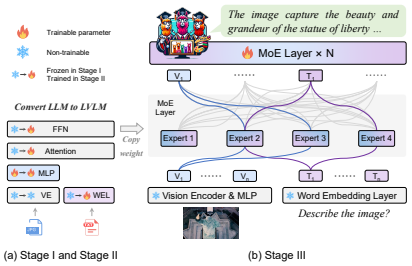
Figure 2 . Illustration of MoE-Tuning. The MoE-Tuning consists of three stages. In stage I, only the MLP is trained. In stage II, all parameters are trained except for the Vision Encoder (VE). In stage III, FFNs are used to initialize the experts in MoE, and only the MoE layers are trained. For each MoE layer, only two experts are activated for each token, while the other experts remain silent.
원문 · CC BY 4.0 · Bin Lin, Zhenyu Tang, Yang Ye, Jinfa Huang, Junwu Zhang, Yatian Pang, Peng Jin, Munan Ning, Jiebo Luo, Li Yuan · MoE-LLaVA: Mixture of Experts for Large Vision-Language Models · 원문 그림 인용 · 원본 PDF 2쪽에서 그림 영역을 추출했습니다.라우터는 선형 층으로 각 토큰의 전문가별 확률을 계산하며, 상위 k개 전문가의 출력을 확률로 가중합합니다. 이때 활성화되지 않은 전문가는 해당 토큰의 계산에 참여하지 않습니다. 저자들은 Stage II의 가중치를 초기값으로 쓰는 이유를, 밀집 LVLM을 먼저 확보하면 희소 모델로의 전환이 더 쉬워진다는 실험적 관찰에 두고 있습니다. 학습 목적은 자기회귀 손실과 전문가 간 부하 균형을 위한 보조 손실의 합으로 구성됩니다.
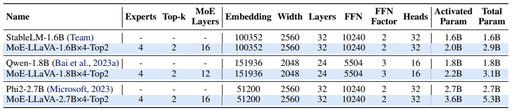
Table 1 . Architecture details of the MoE-LLaV A model.“FFN Factor” represents the number of linear layers in the FFN. “1.6B×4-Top2” represents a dense foundation model with 1.6B parameters, which is equipped with a total of four experts, two of them being activated.
원문 · CC BY 4.0 · Bin Lin, Zhenyu Tang, Yang Ye, Jinfa Huang, Junwu Zhang, Yatian Pang, Peng Jin, Munan Ning, Jiebo Luo, Li Yuan · MoE-LLaVA: Mixture of Experts for Large Vision-Language Models · 원문 그림 인용 · 원본 PDF 4쪽에서 그림 영역을 추출했습니다.
Figure 4 . Distribution of expert loadings. The discontinuous lines represent a perfectly balanced distribution of tokens among different experts or modalities. The first figure on the left illustrates the workload among experts, while the remaining four figures depict the preferences of experts towards different modalities.
원문 · CC BY 4.0 · Bin Lin, Zhenyu Tang, Yang Ye, Jinfa Huang, Junwu Zhang, Yatian Pang, Peng Jin, Munan Ning, Jiebo Luo, Li Yuan · MoE-LLaVA: Mixture of Experts for Large Vision-Language Models · 원문 그림 인용 · 원본 PDF 7쪽에서 그림 영역을 추출했습니다.이미지 이해와 객체 환각 평가
이미지 질의응답 평가에서 MoE-LLaVA는 여러 벤치마크에서 밀집 모델과 비교되었습니다. 저자들은 MoE-LLaVA-Phi-2.7B×4가 3.6B의 희소 활성 파라미터로 LLaVA-1.5-7B보다 SQA-I에서 2.7% 높다고 보고합니다. 또한 MoE-LLaVA-1.6B×4-Top2는 약 2.0B의 활성 파라미터로 IDEFICS-80B보다 여러 지표에서 우위를 보인다고 설명됩니다.
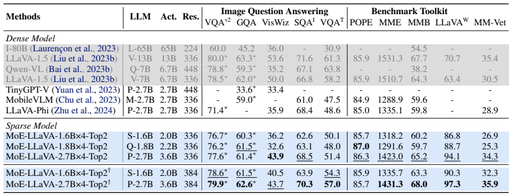
Table 3 . Comparison among different LVLMs on image understanding benchmarks. “Res.”, “Act.”, “L”, “V”, “S”, “Q”, “P”, “M” and “I” respectively represent the input image resolution, activated parameters, LLaMA (Touvron et al., 2023a), Vicuna (Chiang et al., 2023), StableLM (Team), Qwen (Bai et al., 2023a), Phi-2 (Microsoft, 2023) MobileLLaMA (Chu et al., 2023) and IDEFICS (Laurenc ¸on et al., 2023). Evaluation Benchmarks include VQA-v2 (Goyal et al., 2017); GQA (Hudson & Manning, 2019); VisWiz (Gurari et al., 2018); SQAI: ScienceQA-IMG (Lu et al., 2022); VQAT: TextVQA (Singh et al., 2019); POPE (Li et al., 2023d); MME (Fu et al., 2023); MMB: MMBench (Liu et al., 2023d); LLaV AW: LLaV A-Bench (in-the-Wild) (Liu et al., 2023c); MM-Vet (Yu et al., 2023).∗ donates that there is some overlap in the training data.† donates that the model is trained with an image resolution of 384. The best results and second best results are indicated by boldface and underline, respectively.
원문 · CC BY 4.0 · Bin Lin, Zhenyu Tang, Yang Ye, Jinfa Huang, Junwu Zhang, Yatian Pang, Peng Jin, Munan Ning, Jiebo Luo, Li Yuan · MoE-LLaVA: Mixture of Experts for Large Vision-Language Models · 원문 그림 인용 · 원본 PDF 6쪽에서 그림 영역을 추출했습니다.객체 환각은 POPE의 Adversarial, Popular, Random 세 하위 집합으로 평가되었습니다. 이 평가에서 MoE-LLaVA-1.8B×4-Top2는 2.2B 활성 파라미터로 LLaVA-1.5-13B보다 각각 1.0%, 1.5%, 0.8% 높다고 보고됩니다. 이 결과는 해당 모델 설정과 POPE 조건에서의 관찰이며, 다른 모든 환각 평가로 일반화된 결론으로 읽으면 안 됩니다.
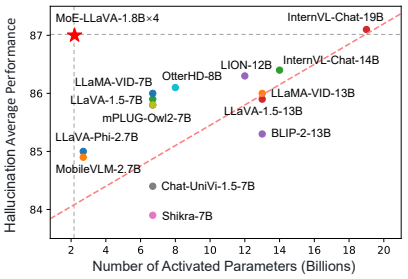
Figure 1 . Comparison between MoE-LLaV A-1.8B×4 and open- source LVLMs on object hallucination benchmark. We report the average performance on the POPE (Li et al., 2023d) benchmark, which includes three subsets of Adversarial, Random, and Popular. The red dashed line represents the linear fit to the data points of all models except MoE-LLaV A.
원문 · CC BY 4.0 · Bin Lin, Zhenyu Tang, Yang Ye, Jinfa Huang, Junwu Zhang, Yatian Pang, Peng Jin, Munan Ning, Jiebo Luo, Li Yuan · MoE-LLaVA: Mixture of Experts for Large Vision-Language Models · 원문 그림 인용 · 원본 PDF 1쪽에서 그림 영역을 추출했습니다.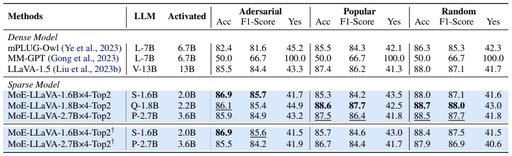
Table 4 . Zero-shot object hallucination evaluation results. “Yes” indicates the proportion of positive responses to the given question.
원문 · CC BY 4.0 · Bin Lin, Zhenyu Tang, Yang Ye, Jinfa Huang, Junwu Zhang, Yatian Pang, Peng Jin, Munan Ning, Jiebo Luo, Li Yuan · MoE-LLaVA: Mixture of Experts for Large Vision-Language Models · 원문 그림 인용 · 원본 PDF 6쪽에서 그림 영역을 추출했습니다.남은 한계와 적용 범위
저자들은 MoE-LLaVA가 경쟁력 있는 성능을 보이지만, 특히 16비트 부동소수점 정밀도에서 학습 안정성의 어려움이 있었다고 밝힙니다. 또한 OpenChat-7B 기반 실험에서는 현재 멀티모달 명령 데이터가 희소 전문가 패턴을 학습하기에 부족할 수 있다고 저자들이 추정합니다. 이 추정은 실험에서 확인된 원인이 아니라 저자의 해석입니다.
따라서 결과는 주로 1.6B, 1.8B, 2.7B급 백본과 제시된 데이터 구성, 평가 벤치마크 범위 안에서 읽어야 합니다. 더 큰 모델이나 다른 데이터 구성에서의 동작은 이 논문의 실험으로 확인되지 않은 질문입니다.
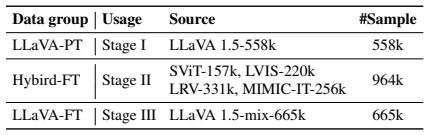
Table 2 . Composition of the data groups. For MIMIC-IT, and SViT datasets, we only use the LA split, and core split, respectively.
원문 · CC BY 4.0 · Bin Lin, Zhenyu Tang, Yang Ye, Jinfa Huang, Junwu Zhang, Yatian Pang, Peng Jin, Munan Ning, Jiebo Luo, Li Yuan · MoE-LLaVA: Mixture of Experts for Large Vision-Language Models · 원문 그림 인용 · 원본 PDF 5쪽에서 그림 영역을 추출했습니다.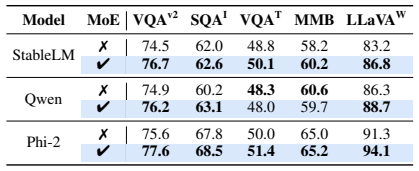
Table 7 . Ablation study about the model size of MoE-LLaV A.
원문 · CC BY 4.0 · Bin Lin, Zhenyu Tang, Yang Ye, Jinfa Huang, Junwu Zhang, Yatian Pang, Peng Jin, Munan Ning, Jiebo Luo, Li Yuan · MoE-LLaVA: Mixture of Experts for Large Vision-Language Models · 원문 그림 인용 · 원본 PDF 8쪽에서 그림 영역을 추출했습니다.논문 정보
- 저자
- Bin Lin, Zhenyu Tang, Yang Ye, Jinfa Huang, Junwu Zhang, Yatian Pang, Peng Jin, Munan Ning, Jiebo Luo, Li Yuan
- 학회·저널
- arXiv · 프리프린트
- 최초 공개일
- 2024년 1월 29일
- 등록일
- 2026년 11월 6일
- 수정일
- 2024년 12월 23일
- 버전
- v5
- arXiv
- 2401.15947
- 분류
- cs.CV
- 원문 이용 조건
- CC BY 4.0
- 제공 범위
- 논문 정보, 해설, 허용된 원문 그림
AI 해설은 논문 원문과 별개의 설명이며 오류가 있을 수 있습니다. 원문과 그림은 각 출처의 이용 조건과 따로 표시된 권리를 따릅니다.
초록
Recent advances demonstrate that scaling Large Vision-Language Models (LVLMs) effectively improves downstream task performances. However, existing scaling methods enable all model parameters to be active for each token in the calculation, which brings massive training and inferring costs. In this work, we propose a simple yet effective training strategy MoE-Tuning for LVLMs. This strategy innovatively addresses the common issue of performance degradation in multi-modal sparsity learning, consequently constructing a sparse model with an outrageous number of parameters but a constant computational cost. Furthermore, we present the MoE-LLaVA, a MoE-based sparse LVLM architecture, which uniquely activates only the top-k experts through routers during deployment, keeping the remaining experts inactive. Extensive experiments show the significant performance of MoE-LLaVA in a variety of visual understanding and object hallucination benchmarks. Remarkably, with only approximately 3B sparsely activated parameters, MoE-LLaVA demonstrates performance comparable to the LLaVA-1.5-7B on various visual understanding datasets and even surpasses the LLaVA-1.5-13B in object hallucination benchmark. Through MoE-LLaVA, we aim to establish a baseline for sparse LVLMs and provide valuable insights for future research in developing more efficient and effective multi-modal learning systems. Code is released at https://github.com/PKU-YuanGroup/MoE-LLaVA.
원문 인용
Bin Lin, Zhenyu Tang, Yang Ye, Jinfa Huang, Junwu Zhang, Yatian Pang, Peng Jin, Munan Ning, Jiebo Luo, Li Yuan (2024). MoE-LLaVA: Mixture of Experts for Large Vision-Language Models. arXiv:2401.15947v5. https://arxiv.org/abs/2401.15947v5
BibTeX
@misc{lin2024llava,
  title = {{MoE-LLaVA: Mixture of Experts for Large Vision-Language Models}},
  author = {Bin Lin and Zhenyu Tang and Yang Ye and Jinfa Huang and Junwu Zhang and Yatian Pang and Peng Jin and Munan Ning and Jiebo Luo and Li Yuan},
  year = {2024},
  eprint = {2401.15947},
  archivePrefix = {arXiv},
  url = {https://arxiv.org/abs/2401.15947v5}
}