논문 해설
Scientific Coding with Large Language Models: Evidence from Finite Element Analysis
대규모 언어 모델을 이용한 과학 코딩: 유한요소해석에서 얻은 증거
- 연구 문제 LLM이 유한요소 계산을 실행 가능하게 쓰는 것을 넘어 수치적으로 올바르게 구현하고 검증할 수 있는지가 문제입니다.
LLM 코드는 수치적으로 맞는가
유한요소 해석 코드는 요소 정식화, 재료 거동, 경계 조건, 해법 알고리즘이 맞물려야 하므로 실행이 된다고 해서 올바른 계산이라고 볼 수 없습니다. 이 논문은 LLM이 명세대로 유한요소 계산을 구현하고, 그 결과를 검증하는 테스트를 생성할 수 있는지 묻습니다. 실행 피드백과 에이전트 수정을 허용했을 때 이 능력이 어떻게 바뀌는지도 함께 살핍니다. 실행 가능하고 그럴듯한 출력을 내는 코드가 실제로는 잘못된 계산을 할 수 있다는 점이 문제의 핵심입니다.
과제 구성과 평가 절차
연구진은 기존 FEM-Bench를 확장해 17개 유한요소 과제를 만들었습니다. 과제에는 history-dependent 탄소성, 비선형 cohesive zone, 판 굽힘, 3차원 연속체와 동역학이 포함됩니다. 각 과제는 함수 시그니처와 상세 독스트링으로 제시되며, H는 참조 구현이 쓰는 도우미 함수 수, T는 프롬프트에 제공되는 도우미 함수의 범위를 뜻합니다. 구현 트랙은 검증 입력에서 참조 구현과 출력을 비교하고, 테스트 생성 트랙은 참조 구현을 받아들이고 Expected Failure 사례를 거부해야 성공합니다.
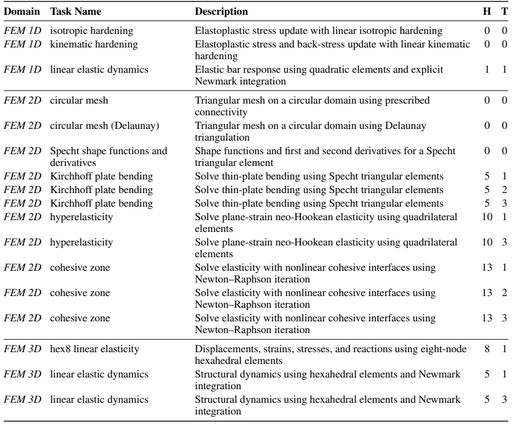
Table 1 :Summary of the 17 tasks evaluated in this study.Tasks are grouped by domain. H denotes the reference- helper count, and T the helper-availability tier. Section 3.1 defines these annotations.
원문 · CC BY 4.0 · Hamdi, Erfan, Shor, Joel, Lejeune, Emma · Scientific Coding with Large Language Models: Evidence from Finite Element Analysis · 원문 그림 인용 · 원본 PDF 4쪽에서 그림 영역을 추출했습니다.SimpleAgent와 OpenHands 하네스
SimpleAgent는 Python 실행과 제출 두 행동만 가진 최소 에이전트입니다. 실행은 매번 새 샌드박스에서 상태 없이 이루어지고, 제출은 최소 한 번 실행하고 최신 종료 코드가 0일 때만 허용됩니다. OpenHands는 작업 공간 파일이 반복 사이에 유지되며, 웹 탐색, 터미널, 파일 편집 등 도구를 씁니다. 연구진은 OpenHands를 Singularity 컨테이너에 넣어 로컬 참조 구현에 접근하지 못하게 했습니다. 두 하네스 모두 시행당 토큰 예산 2,000,000과 최대 200회 반복을 적용했습니다.
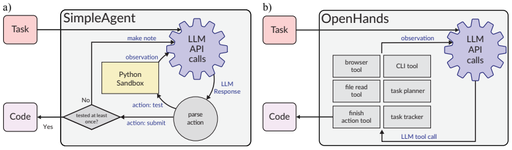
Figure 1 :Overview of agentic harnesses studied.(a) Overview of SimpleAgent. SimpleAgent follows a ReAct-style loop with two actions: Python execution (test) and submission (submit). The Python execution action runs code in a fresh sandbox preloaded with the task’s required imports and helper functions. Execution is stateless: variables and files do not persist between executions, while the LLM retains the conversation history and receives execution output and exit codes as observations. Submission is permitted only after at least one execution and only if the most recent execution returned exit code 0. (b) Overview of the OpenHands coding agent. OpenHands is an open-source framework for coding agents. In this study, the agent had access to tools for web browsing, terminal execution, file editing, task tracking, planning, delegation to subagents, and a finish action to end the session. The agent ran inside a Singularity container configured to isolate it from the local reference implementations while retaining internet access.
원문 · CC BY 4.0 · Hamdi, Erfan, Shor, Joel, Lejeune, Emma · Scientific Coding with Large Language Models: Evidence from Finite Element Analysis · 원문 그림 인용 · 원본 PDF 8쪽에서 그림 영역을 추출했습니다.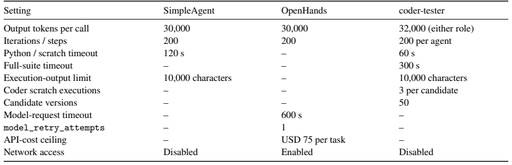
Table 12 :Agent harness operational limits.Timeouts apply separately to each action or request. Other limits apply per trial unless stated. A dash indicates that no explicit setting is reported here.
원문 · CC BY 4.0 · Hamdi, Erfan, Shor, Joel, Lejeune, Emma · Scientific Coding with Large Language Models: Evidence from Finite Element Analysis · 원문 그림 인용 · 원본 PDF 27쪽에서 그림 영역을 추출했습니다.코더와 테스터 분리 구성
탐색적 구성은 구현 역할과 검증 역할을 두 에이전트로 나눕니다. 코더는 함수를 개발하고 테스터는 명세에서 pytest 테스트를 만들어 컴파일된 후보를 실행합니다. 테스터는 테스트 세트를 여러 반복에 걸쳐 유지하며, 최종 제출 승인은 테스터만 할 수 있습니다. 코더 실행 횟수는 후보당 최대 세 번으로 제한되었습니다. GPT-6 Astra와 Claude Fable 5.1 쌍을 두 역할 배정으로 평가했고, 각 쌍은 17개 과제에서 과제당 다섯 번 시행되었습니다.
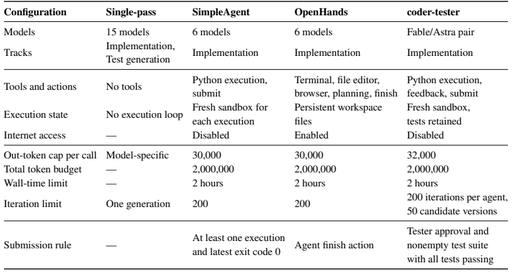
Table 3 :Experimental configurations.Each setting uses the 17 tasks in Table 1, with five trials per task and model or coder-tester pairing. Single-pass implementation and test generation are separate tracks. The six shared models and Fable/Astra pairings are identified in Table 8.
원문 · CC BY 4.0 · Hamdi, Erfan, Shor, Joel, Lejeune, Emma · Scientific Coding with Large Language Models: Evidence from Finite Element Analysis · 원문 그림 인용 · 원본 PDF 7쪽에서 그림 영역을 추출했습니다.단일 패스 구현과 테스트 생성 결과
단일 패스 구현에서 Claude Fable 5.1은 함수 정확도 87.1%로 가장 높았습니다. 테스트 생성 트랙에서는 GPT-6 Astra가 공동 테스트 성공률 82.6%로 가장 높았고, Claude Fable 5.1은 49.9%를 기록했습니다. 따라서 구현 능력이 높은 모델이 테스트를 잘 만든다고 단정할 수 없습니다. 두 트랙은 성공 기준과 집계 방식이 달라 서로 다른 보완 지표로 읽어야 합니다.
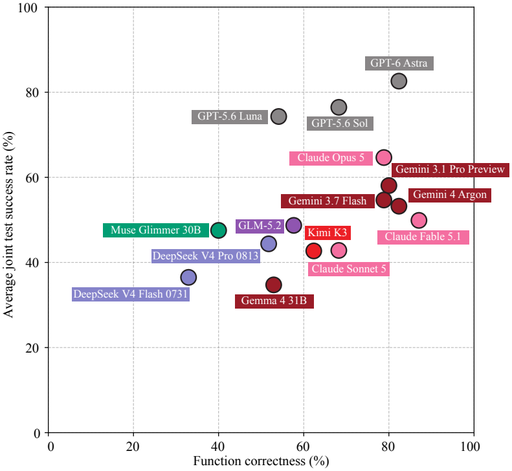
Figure 3 :Single-pass performance on implementation and test-generation tasks.Each point represents one of the 15 evaluated models listed in Table 2. Results are computed separately for the implementation and test-generation tracks. Each track uses five trials per task (5 × 17 = 85 runs per model). The horizontal axis shows function correctness: the percentage of generated implementations that pass the benchmark evaluation. The vertical axis shows the average joint test success rate: the fraction of generated tests that both pass the reference implementation and reject the designated buggy implementations. Both of these metrics are averaged across tasks and trials. Higher values indicate better performance on each metric. The differing model rankings across the two axes show that stronger implementation performance does not necessarily mean stronger test-generation performance.
원문 · CC BY 4.0 · Hamdi, Erfan, Shor, Joel, Lejeune, Emma · Scientific Coding with Large Language Models: Evidence from Finite Element Analysis · 원문 그림 인용 · 원본 PDF 11쪽에서 그림 영역을 추출했습니다.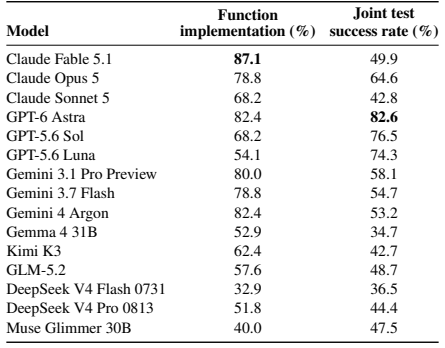
Table 4 :Single-pass implementation and test-generation performance.Function implementation measures the fraction of submissions that pass the benchmark evaluation. Joint test success rate measures the fraction of generated tests that accept the reference implementation and reject all designated faulty implementations. Both metrics follow Section 3.3 and are percentages averaged over five trials per task, with equal weight across 17 tasks. Bold marks the highest value in each column.
원문 · CC BY 4.0 · Hamdi, Erfan, Shor, Joel, Lejeune, Emma · Scientific Coding with Large Language Models: Evidence from Finite Element Analysis · 원문 그림 인용 · 원본 PDF 20쪽에서 그림 영역을 추출했습니다.실행과 수정이 바꾼 신뢰도
SimpleAgent는 여섯 모델 모두에서 단일 패스보다 Pass@3를 높였습니다. Claude Opus 5는 SimpleAgent에서 Pass@3 96.5%를 기록했지만 Pass3는 77.1%였습니다. OpenHands는 GPT-5.6 Sol에서 Pass@3 88.2%와 Pass3 72.4%로 더 높았습니다. 반면 일부 조합은 예산 소진과 회귀를 보였으며, 예산 소진은 전체 회귀의 원인을 모두 설명하지는 않습니다.
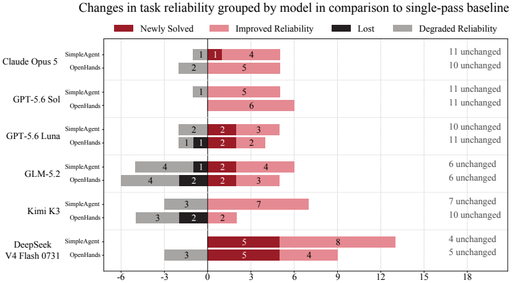
Figure 4 :Changes in task reliability relative to the single-pass baseline.Each row represents one model–harness combination across 17 tasks, with reliability measured by the number of successful runs out of five trials. Tasks are classified as newly solved when the success count increases from zero to a positive value, and as improved reliability when it increases from an already positive value. Degraded reliability indicates a decrease that remains above zero, whereas lost tasks have a positive baseline success count that falls to zero. Improvements extend to the right and regressions to the left. Unchanged task counts are shown separately. Most gains reflect improved reliability on previously solved tasks.
원문 · CC BY 4.0 · Hamdi, Erfan, Shor, Joel, Lejeune, Emma · Scientific Coding with Large Language Models: Evidence from Finite Element Analysis · 원문 그림 인용 · 원본 PDF 12쪽에서 그림 영역을 추출했습니다.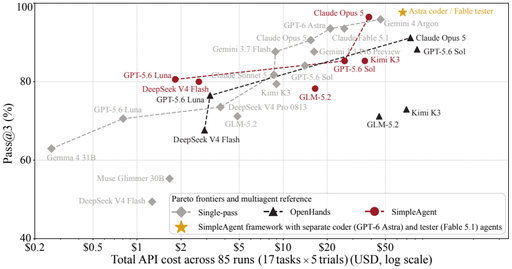
Figure 5 :Pass@3 performance versus recorded cost.Pass@3 is estimated from five trials per task and averaged across 17 tasks. The horizontal axis shows the total recorded cost across all 85 runs on a logarithmic scale. Dashed lines connect the Pareto-optimal configurations within the single-pass, SimpleAgent, and OpenHands settings. The star denotes a multi-agent configuration built on SimpleAgent, with GPT-6 Astra as the coder and Claude Fable 5.1 as the tester. SimpleAgent offers competitive performance at lower recorded cost than OpenHands for the evaluated models, while the coder-tester configuration achieves the highest Pass@3 among the configurations shown.
원문 · CC BY 4.0 · Hamdi, Erfan, Shor, Joel, Lejeune, Emma · Scientific Coding with Large Language Models: Evidence from Finite Element Analysis · 원문 그림 인용 · 원본 PDF 13쪽에서 그림 영역을 추출했습니다.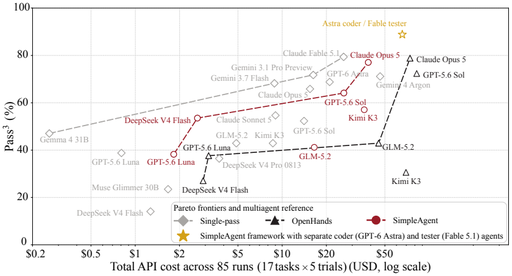
Figure 6 :Pass 3 performance versus recorded cost.Pass 3 estimates the probability that all three attempts succeed, using five trials per task and averaging across 17 tasks. The horizontal axis shows the total recorded cost across all 85 runs on a logarithmic scale. Dashed lines connect the Pareto-optimal configurations within the single-pass, SimpleAgent, and OpenHands settings. The star denotes a multi-agent configuration built on SimpleAgent, with GPT-6 Astra as the coder and Claude Fable 5.1 as the tester. SimpleAgent achieves higher Pass3 than OpenHands for three of the six shared models at lower recorded cost, while the coder-tester configuration achieves the highest Pass3 among the configurations shown.
원문 · CC BY 4.0 · Hamdi, Erfan, Shor, Joel, Lejeune, Emma · Scientific Coding with Large Language Models: Evidence from Finite Element Analysis · 원문 그림 인용 · 원본 PDF 14쪽에서 그림 영역을 추출했습니다.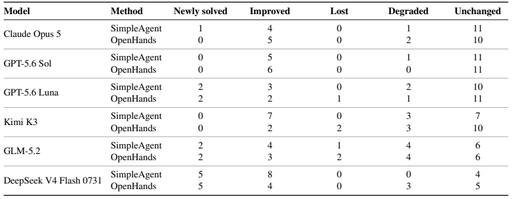
Table 5 :Changes in task reliability relative to single-pass generation.Each task has five implementation trials. Newly solved tasks increase from zero to at least one successful trial. Improved tasks increase from a positive success count. Lost tasks fall to zero successes, while degraded tasks decrease but retain at least one success. Unchanged tasks have the same success count. Entries count tasks, and each row sums to 17.
원문 · CC BY 4.0 · Hamdi, Erfan, Shor, Joel, Lejeune, Emma · Scientific Coding with Large Language Models: Evidence from Finite Element Analysis · 원문 그림 인용 · 원본 PDF 20쪽에서 그림 영역을 추출했습니다.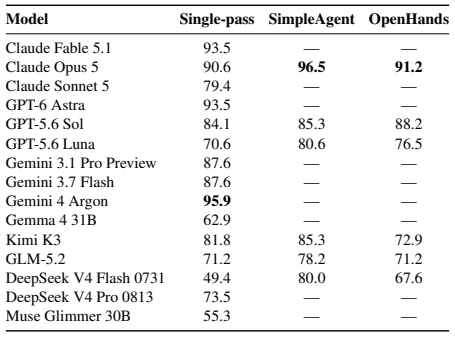
Table 6 :Pass@3 (implementation) by model and method.Pass@3 estimates the probability of at least one successful implementation in three attempts (Equation 4). Values are percentages estimated from five trials per task and averaged equally across 17 tasks. Dashes indicate unevaluated combinations. Bold marks the highest score in each method column.
원문 · CC BY 4.0 · Hamdi, Erfan, Shor, Joel, Lejeune, Emma · Scientific Coding with Large Language Models: Evidence from Finite Element Analysis · 원문 그림 인용 · 원본 PDF 21쪽에서 그림 영역을 추출했습니다.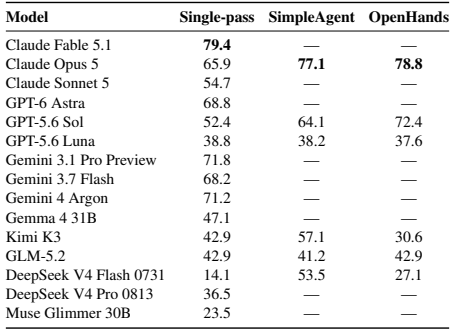
Table 7 :Pass 3 (implementation) by model and method.Pass 3 estimates the probability that all three implementations succeed in three attempts (Equation 5). Values are percentages estimated from five trials per task and averaged equally across 17 tasks. Dashes indicate unevaluated combinations. Bold marks the highest score in each method column.
원문 · CC BY 4.0 · Hamdi, Erfan, Shor, Joel, Lejeune, Emma · Scientific Coding with Large Language Models: Evidence from Finite Element Analysis · 원문 그림 인용 · 원본 PDF 21쪽에서 그림 영역을 추출했습니다.자기검증 실패 범주
연구진은 자체 검사를 통과했지만 독립 평가에서 실패한 249개 궤적을 여섯 범주로 분류했습니다. 가장 많은 범주는 테스트 구성과 범위 부족(VF-01, 73.1%)과 일반적 일관성 검사(VF-02, 70.3%)였습니다. 구현과 기준 계산이 같은 오류를 공유한 사례(VF-04)는 28.5%였습니다. 분류는 세 판정자와 최종 조정자가 수행했고, 초기 판정자 불일치가 있던 145건은 조정자가 최종 분류했습니다.
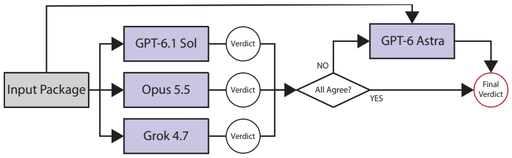
Figure 2 :Overview of the LLM-as-judge workflow for categorizing self-verification failures.Three initial judges independently assess each input package using the codebook, assigning all applicable labels with a short rationale for each. Their label sets are then compared case by case. When all three judges assign identical label sets, the shared classification is retained as final. Cases with any label disagreement are passed to a final adjudicator. The final adjudicator uses the original input package, all three judges’ verdicts and rationales, and the codebook to determine the final classification.
원문 · CC BY 4.0 · Hamdi, Erfan, Shor, Joel, Lejeune, Emma · Scientific Coding with Large Language Models: Evidence from Finite Element Analysis · 원문 그림 인용 · 원본 PDF 10쪽에서 그림 영역을 추출했습니다.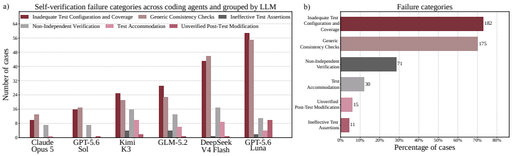
Figure 7 :Self-verification failure categories among completed failed submissions.(a) Categories grouped by model. Each bar shows the number of analyzed failed cases assigned to a particular category, pooled across SimpleAgent and OpenHands. Models are ordered by increasing number of analyzed failed cases. Inadequate Test Configuration and Coverage and Generic Consistency Checks are the most frequently assigned categories. A case may receive multiple labels, so category counts can sum to more than the number of cases for a model. (b) Distribution of self-verification failure categories. Bars show the percentage of the 249 analyzed failed cases assigned to each category, pooled across models and agentic harnesses. Categories are ordered by decreasing frequency, and numbers beside the bars indicate case counts. A case may receive multiple labels, so the percentages do not sum to 100%.
원문 · CC BY 4.0 · Hamdi, Erfan, Shor, Joel, Lejeune, Emma · Scientific Coding with Large Language Models: Evidence from Finite Element Analysis · 원문 그림 인용 · 원본 PDF 15쪽에서 그림 영역을 추출했습니다.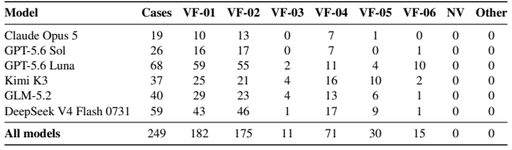
Table 10 :Self-verification failure categories by model.Counts pool failed SimpleAgent and OpenHands submissions. Cases gives the number of analyzed failed submissions for each model. Final labels combine 104 unanimous three-judge decisions and 145 adjudicated decisions. A case may receive multiple categories, so category counts can exceed the number of cases. Codes are expanded in Table 11.
원문 · CC BY 4.0 · Hamdi, Erfan, Shor, Joel, Lejeune, Emma · Scientific Coding with Large Language Models: Evidence from Finite Element Analysis · 원문 그림 인용 · 원본 PDF 24쪽에서 그림 영역을 추출했습니다.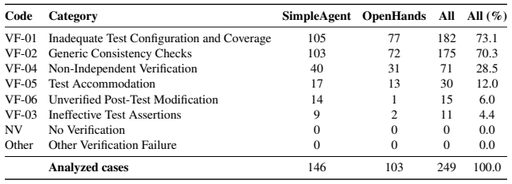
Table 11 :Distribution of self-verification failure categories.Counts cover 146 SimpleAgent and 103 OpenHands failed submissions. Percentages use all 249 analyzed failed cases as the denominator. A case may receive multiple labels, so category percentages need not sum to 100%. The last row reports cohort sizes rather than a sum of category counts.
원문 · CC BY 4.0 · Hamdi, Erfan, Shor, Joel, Lejeune, Emma · Scientific Coding with Large Language Models: Evidence from Finite Element Analysis · 원문 그림 인용 · 원본 PDF 24쪽에서 그림 영역을 추출했습니다.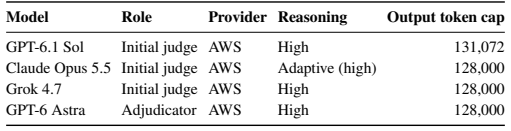
Table 13 :LLM judge configuration.Output token caps are measured in tokens per call. High denotes the configured reasoning effort. Claude Opus 5.5 uses adaptive reasoning with high effort.
원문 · CC BY 4.0 · Hamdi, Erfan, Shor, Joel, Lejeune, Emma · Scientific Coding with Large Language Models: Evidence from Finite Element Analysis · 원문 그림 인용 · 원본 PDF 28쪽에서 그림 영역을 추출했습니다.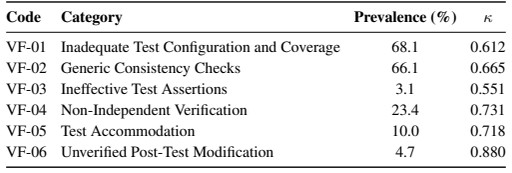
Table 14 :Initial-judge agreement and category prevalence.Fleiss’ κ measures agreement among three judges across 249 failed submissions before adjudication. Prevalence is the percentage of the 747 individual judgments assigning each category.
원문 · CC BY 4.0 · Hamdi, Erfan, Shor, Joel, Lejeune, Emma · Scientific Coding with Large Language Models: Evidence from Finite Element Analysis · 원문 그림 인용 · 원본 PDF 28쪽에서 그림 영역을 추출했습니다.범위와 남은 문제
이 연구는 17개 유한요소 과제와 과제당 다섯 번의 시행으로 제한됩니다. 테스트 생성 트랙은 미리 준비한 참조 구현과 결함 구현에서 평가했으므로 에이전트가 자기 코드의 오류를 찾는 능력을 직접 측정하지 않습니다. 판정자 분류는 수작업 검토로 만든 코드북을 쓰므로 오분류 가능성이 남습니다.
논문 정보
- 저자
- Hamdi, Erfan, Shor, Joel, Lejeune, Emma
- 학회·저널
- arXiv · 프리프린트
- 최초 공개일
- 2026년 11월 16일
- 등록일
- 2026년 11월 17일
- 수정일
- 2026년 11월 16일
- 버전
- v1
- arXiv
- 2611.21176
- 분류
- cs.SE · cs.AI · cs.CE
- 원문 이용 조건
- CC BY 4.0
- 제공 범위
- 논문 정보, 해설, 허용된 원문 그림
AI 해설은 논문 원문과 별개의 설명이며 오류가 있을 수 있습니다. 원문과 그림은 각 출처의 이용 조건과 따로 표시된 권리를 따릅니다.
초록
Large language models (LLMs) offer a potential route to automating scientific programming, but their usefulness depends on consistently producing numerically correct code. We extend FEM-Bench to 17 finite element tasks involving nonlinear and history-dependent mechanics and structural dynamics, and evaluate 15 models on implementation and test generation without execution feedback. The best model succeeds in 87.1% of single-pass implementation trials, but rankings differ between tracks. The leading implementer achieves 49.9% joint test success, while the leading tester reaches 82.6%. For six models, we compare single-pass generation with two agentic harnesses that allow code execution and revision. Agentic execution solves some tasks that never succeeded in single-pass trials and improves consistency on others, but gains vary across models and harnesses, and regressions also occur. Claude Opus 5 with SimpleAgent reaches 96.5% Pass@3, the probability of at least one success in three attempts, but 77.1% Pass$^3$, the probability that all three succeed. No model-harness combination exceeds 78.8% Pass$^3$. To understand why agents submit incorrect code after passing their own checks, we analyze 249 failed agentic trajectories and identify six categories of self-verification failure. The most common are inadequate test coverage (73.1%) and reliance on generic consistency checks (70.3%), and in 28.5% of cases the tests share an error with the implementation. Motivated by these findings, an exploratory configuration with separate coder and tester agents achieves the highest observed scores, with 97.6% Pass@3 and 88.8% Pass$^3$. These results identify consistency across attempts and independent verification as the main obstacles to trusting LLM-generated scientific code.
원문 인용
Hamdi, Erfan, Shor, Joel, Lejeune, Emma (2026). Scientific Coding with Large Language Models: Evidence from Finite Element Analysis. arXiv:2611.21176v1. https://arxiv.org/abs/2611.21176v1
BibTeX
@misc{erfan2026scientific,
  title = {{Scientific Coding with Large Language Models: Evidence from Finite Element Analysis}},
  author = {Hamdi, Erfan and Shor, Joel and Lejeune, Emma},
  year = {2026},
  eprint = {2611.21176},
  archivePrefix = {arXiv},
  url = {https://arxiv.org/abs/2611.21176v1}
}