논문 해설
LoopQ: Fair, Closed-Loop Evaluation of Quantized Vision-Language-Action Models
LoopQ: 양자화된 Vision-Language-Action 모델의 공정한 폐루프 평가
- 연구 문제 VLA 전용 PTQ의 주장이 일반 양자화 기준선과 같은 조건에서도 유지되는지 공정하게 확인하는 문제입니다.
- 연구 방법 체크포인트, 레이어, 엔진을 고정하고 양자화 방법만 바꾸는 폐루프 벤치마크로 LIBERO와 LIBERO-plus에서 성공률과 실행 속도를 함께 측정합니다.
- 주요 결과 4비트에서 RTN, AWQ, GPTQ는 VLA 전용 방법과 같거나 나은 성공률을 보이며, 교란 아래에서는 일부 VLA 전용 방법의 손실이 드러납니다. 실제 저비트 모델은 메모리를 줄이지만 H100에서는 지연을 줄이지 못하고 L4의 int8 커널만 소폭 빨라집니다.
VLA 양자화 비교의 어려움
VLA 모델은 수십억 개 파라미터의 백본을 가지므로 로봇의 메모리, 지연 시간, 전력 예산에 맞추려면 PTQ가 배포의 전제 조건으로 다뤄집니다. 최근 VLA 전용 PTQ 방법들은 행동 인식 민감도, 혼합 정밀도, 활성화 평활화를 통해 더 작고 빠른 정책을 손실 없이 만든다고 주장합니다. 그러나 이 주장들은 대부분 저자 자신의 설정에서 평가되었고, 단순한 RTN과의 비교가 드물었습니다. 따라서 이 연구는 VLA 전용 방법이 일반 방법보다 실제로 나은지, 그리고 성공률과 속도 주장이 같은 조건에서도 유지되는지를 함께 묻습니다. LoopQ는 이 질문에 답하기 위해 같은 체크포인트, 같은 양자화 레이어, 같은 엔진을 유지하고 양자화 방법과 커널만 바꾸는 폐루프 벤치마크로 제시됩니다.
같은 조건을 유지하는 평가 설계
LoopQ는 RTN, AWQ, GPTQ, ActQuant, QuantVLA를 π0.5, GR00T N1.5, UniVLA, OpenVLA-OFT에 적용합니다. 각 비교에서 바뀌는 것은 양자화기 자체이며, 체크포인트, 양자화 대상 레이어, 실행 엔진은 같게 유지됩니다. π0.5와 OpenVLA-OFT는 실제 저비트 가중치를 실행하고, GR00T N1.5와 UniVLA는 QuantVLA와 QVLA를 따라 양자화를 시뮬레이션합니다. 보정에는 같은 512개 프레임을 사용하며, AWQ는 공식 llm-awq 탐색과 클리핑을 쓰고 GPTQ는 참조 코드와 맞춰 구현되었습니다. 결과의 해석을 위해 각 구성의 실행 경로도 따로 보고하며, 같은 저비트 파일이라도 커널이 다르면 별개의 경로로 읽어야 합니다.
평가 규모는 LIBERO에서 구성당 1,000–2,000 에피소드이고, LIBERO-plus에서는 기준 정책과 같은 과제를 쌍으로 실행합니다. 쌍을 이룬 비교이므로 절대 점수는 각 쌍 안에서만 비교하도록 되어 있습니다.
LIBERO에서 드러나지 않는 차이
LIBERO에서는 8비트와 4비트의 RTN, AWQ, GPTQ 구성이 거의 같은 성공률을 보입니다. π0.5에서 RTN, AWQ, GPTQ 구성은 96.7–97.6%로 측정되어 FP16 기준선과 구분되지 않습니다. 다만 AWQ를 MMQ 경로에서 실행하면 FP16 오버플로로 Goal suite의 성공률이 84.4%까지 떨어지며, 이는 방법 자체보다 수치 경로의 문제로 보고됩니다. ActQuant는 4bpw에서 자체 엔진의 F16과 비슷하지만 OpenVLA-OFT에서는 1.3점의 유의한 손실을 보입니다. 저자들은 보정이 RTN 대비 측정 가능한 이득을 주지 않는다고 보고하며, 이는 LLM에서 AWQ와 GPTQ의 이득이 주로 3비트에서 나타난다는 선행 관찰과 맞물린다고 해석합니다.
또한 오프라인 행동 오차는 방법 사이의 성공률 차이를 예측하지 못합니다. π0.5에서 RTN, AWQ, GPTQ의 오차는 약 20배 차이 나지만 성공률은 같습니다.
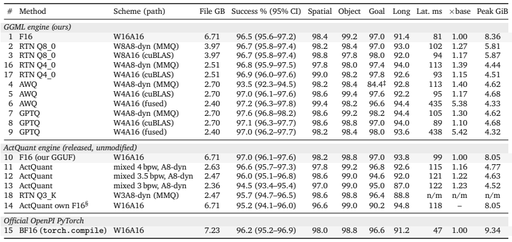
Table 9 :π0.5 on LIBERO: quantized models match their baseline (except AWQ on MMQ and the 3-bitint8-activationmodels), andnoneisfasterthanitsownengine’s16-bitmodel(2,000episodes each). Latency is the closed-loop median per call;×base is relative to that engine’s unquantized model (grey row). Peak memory is device-wide, including the simulator.‡One FP16 overflow in AWQ closed the server; the 68 affected episodes count as failures (97.7% on the 432 executed).§ActQuant’s own F16 release, built from a different (LeRobot) checkpoint than its quantized files; reference only. Row 18 reports task success only (n/m: closed-loop latency and memory not measured); its isolated speed is in table 2.
원문 · CC BY 4.0 · Syed Umer Bukhari, Magnus Almgren, Ahmed Ali-Eldin · LoopQ: Fair, Closed-Loop Evaluation of Quantized Vision-Language-Action Models · 원문 그림 인용 · 원본 PDF 18쪽에서 그림 영역을 추출했습니다.
Table 12 :Offline action error does not predict closed-loop success(π0.5; mean relative L2 of the action chunk against an unquantized reference, same frames and noise per engine). RTN, AWQ and GPTQ differ by about 20× in error yet reach the same success; ActQuant 4bpw has an error similar to AWQ’s yet loses 2.3 points on LIBERO-plus. ActQuant runs only on its own engine, which draws its own noise, so it is compared with that engine’s F16.
원문 · CC BY 4.0 · Syed Umer Bukhari, Magnus Almgren, Ahmed Ali-Eldin · LoopQ: Fair, Closed-Loop Evaluation of Quantized Vision-Language-Action Models · 원문 그림 인용 · 원본 PDF 19쪽에서 그림 영역을 추출했습니다.LIBERO-plus 교란에서 드러나는 손실
LIBERO-plus는 LIBERO 과제에 카메라, 로봇 초기 상태, 언어, 조명, 배경, 센서 노이즈, 객체 배치의 교란을 더한 벤치마크입니다. 이 연구는 양자화된 정책을 기준 정책과 같은 교란 과제에서 실행하고 쌍을 이룬 차이를 계산합니다. 그 결과 LIBERO에서 유의한 손실이 없던 구성도 1.5–4.3점 낮아지는 경우가 있습니다. 특히 ActQuant와 QuantVLA는 4비트에서도 교란 아래의 손실이 크며, 4비트 UniVLA도 generic 방법 중 손실이 뚜렷한 사례입니다. 반면 π0.5와 GR00T N1.5에서는 generic 4비트 방법의 손실이 대부분 유의하지 않습니다. 교란 강도별로 보면 레벨 3 이상에서 VLA 전용 방법이 뒤처지기 시작하며, 이는 작은 오차가 어려운 입력에서 결정을 뒤집는 현상으로 해석됩니다.
따라서 이 결과는 LIBERO만으로는 교란 아래의 손실을 판단할 수 없다는 점을 보여 줍니다.
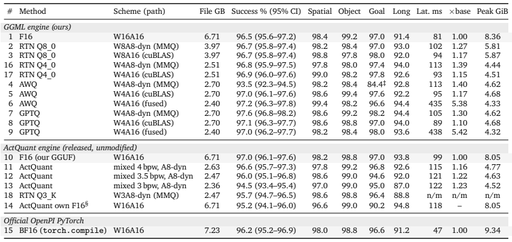
Table 10 : LIBERO-plus success (%) per difficulty level. UniVLA and OpenVLA-OFT levels from their 50% subset (tasks without a level label omitted).
원문 · CC BY 4.0 · Syed Umer Bukhari, Magnus Almgren, Ahmed Ali-Eldin · LoopQ: Fair, Closed-Loop Evaluation of Quantized Vision-Language-Action Models · 원문 그림 인용 · 원본 PDF 18쪽에서 그림 영역을 추출했습니다.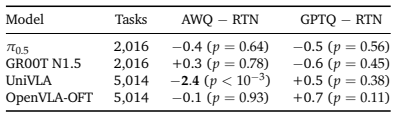
Table 13 : Paired change in LIBERO-plus success of AWQ and GPTQ relative to RTN W4 (points; exact McNemarp). Positive: the calibrated method is more robust than RTN.
원문 · CC BY 4.0 · Syed Umer Bukhari, Magnus Almgren, Ahmed Ali-Eldin · LoopQ: Fair, Closed-Loop Evaluation of Quantized Vision-Language-Action Models · 원문 그림 인용 · 원본 PDF 20쪽에서 그림 영역을 추출했습니다.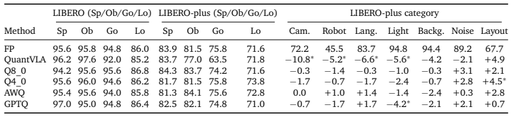
Table 14 : GR00T N1.5 per suite and per LIBERO-plus category. Category columns: success of FP, and paired∆for the others (∗ p<0.05, uncorrected).
원문 · CC BY 4.0 · Syed Umer Bukhari, Magnus Almgren, Ahmed Ali-Eldin · LoopQ: Fair, Closed-Loop Evaluation of Quantized Vision-Language-Action Models · 원문 그림 인용 · 원본 PDF 20쪽에서 그림 영역을 추출했습니다.메모리 절감과 지연 증가
실제 저비트 모델은 피크 메모리를 2–3배 줄이지만 H100의 배치 1 실행에서는 지연 시간을 줄이지 못합니다. π0.5와 OpenVLA-OFT의 양자화 구성은 같은 엔진의 16비트 모델보다 느리며, 라이브러리 커널에서 1.06–1.58배 느린 것으로 측정되었습니다. 이 이유는 연산 특성으로 설명됩니다. π0.5의 PaliGemma 백본은 컴퓨트 바운드 연산이라 가중치 비트를 줄여도 이득이 작고, 메모리 바운드인 action expert는 전체 GPU 시간의 63%를 차지하면서 16비트로 남습니다. 따라서 양자화된 레이어를 모두 제거하더라도 전체 호출은 최대 1.09배 빨라질 수 있다고 계산됩니다. 엔진 선택 자체도 지연에 큰 영향을 주며, 같은 16비트 π0.5의 지연은 엔진에 따라 2.1배 차이가 납니다.
따라서 속도 향상은 같은 엔진에서 측정해야 합니다.
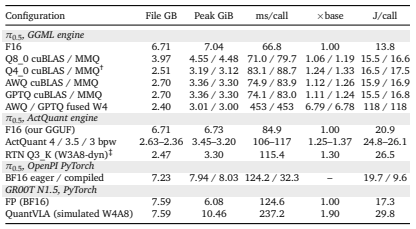
Table 2 :Isolated efficiency on the H100: quan- tization cuts memory but raises latency and energy.Batch 1, 50 calls after warm-up;×base: latency vs. the same engine’s F16.†Later session. ‡Separate session with its own ActQuant-engine F16 (88.5ms; ActQuant 3bpw: 119.3ms,1.35×); ratio vs. that F16.
원문 · CC BY 4.0 · Syed Umer Bukhari, Magnus Almgren, Ahmed Ali-Eldin · LoopQ: Fair, Closed-Loop Evaluation of Quantized Vision-Language-Action Models · 원문 그림 인용 · 원본 PDF 7쪽에서 그림 영역을 추출했습니다.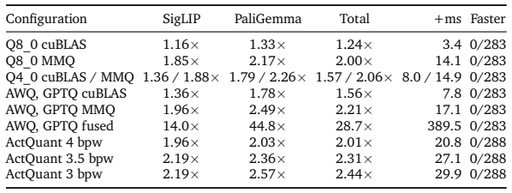
Table 8 : Where the officialπ0.5 BF16 policy spends GPU time (OpenPI PyTorch, eager, batch 1, 10 flow steps). AI: median arithmetic intensity of the component’s weight GEMMs. TFLOP/s, GB/s and % of roof: median achieved values (time-weighted TFLOP/s in parentheses); peaks are datasheet values. PyTorch runs SigLIP on three image slots (two cameras, one masked) and pads the prompt to 200 tokens, giving a 968-token prefix. The total also includes the projector and kernels outside the three components (1.0ms). GEMM includes SigLIP’s patch-embedding convolution; Figure 2 shows only the quantizable linears (11ms).
원문 · CC BY 4.0 · Syed Umer Bukhari, Magnus Almgren, Ahmed Ali-Eldin · LoopQ: Fair, Closed-Loop Evaluation of Quantized Vision-Language-Action Models · 원문 그림 인용 · 원본 PDF 17쪽에서 그림 영역을 추출했습니다.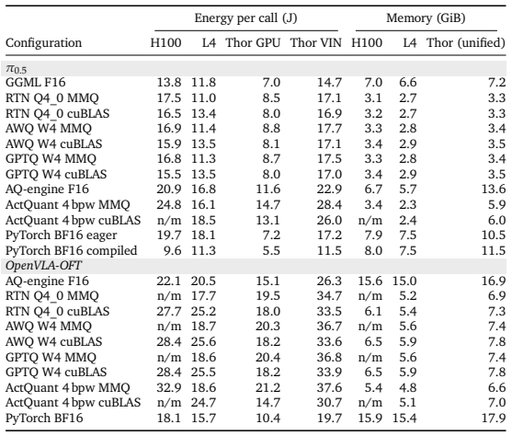
Table 18 : Energy per call (J) and memory (GiB) of the real low-bit configurations. H100 and L4: GPU-board energy (NVML) and per-process peak GPU memory. Thor: GPU-rail (VDD_GPU) and whole-module (VIN) energy, and unified-memory growth (not comparable with the discrete GPUs). n/m: not measured.
원문 · CC BY 4.0 · Syed Umer Bukhari, Magnus Almgren, Ahmed Ali-Eldin · LoopQ: Fair, Closed-Loop Evaluation of Quantized Vision-Language-Action Models · 원문 그림 인용 · 원본 PDF 23쪽에서 그림 영역을 추출했습니다.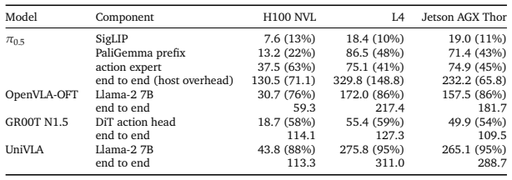
Table 19 : GPU time per policy call by component for the official unquantized models (eager PyTorch, batch 1; ms, share of GPU time in parentheses), and end-to-end time.
원문 · CC BY 4.0 · Syed Umer Bukhari, Magnus Almgren, Ahmed Ali-Eldin · LoopQ: Fair, Closed-Loop Evaluation of Quantized Vision-Language-Action Models · 원문 그림 인용 · 원본 PDF 23쪽에서 그림 영역을 추출했습니다.GPU와 커널 경로에 따른 속도 변화
L4와 Jetson AGX Thor에서는 같은 저비트 파일이라도 결과가 달라집니다. L4에서 int8 커널을 쓰는 실제 W4 방법은 π0.5에서 4–7%, OpenVLA-OFT에서 9–14% 빠릅니다. 반면 dequantize 경로는 L4에서도 느립니다. Thor에서는 모든 W4 구성이 F16보다 느리며, int8 커널 경로는 최대 1.93배 느립니다. 저자들은 L4의 낮은 대역폭이 ridge를 높여 가중치 바이트 감소가 더 중요해지는 것으로 추정하지만, 이는 L4 연산자 프로파일링이 필요한 가설입니다. 작업 성공률은 세 GPU에서 대체로 일치했습니다. 같은 에피소드에서 세 GPU는 결과의 90–99%를 공유하며, 4비트 파일은 세 GPU 모두에서 메모리를 2–3배 줄였습니다.
이 결과는 속도 주장이 GPU와 커널 경로를 함께 명시해야 한다는 점을 보여 줍니다.
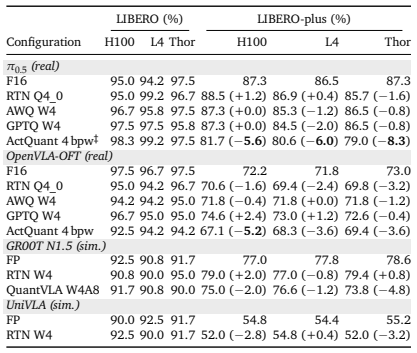
Table 4 :Task success on identical episodes across GPUs(LIBERO: 120 episodes; LIBERO- plus: 252tasks, pairedchangevs.F16onthesame GPU; bold: p<0.05 ). OpenVLA-OFT: real low-bit at ActQuant’s scope.‡Compared with GGML F16, so includes the≈3.7-point engine effect.
원문 · CC BY 4.0 · Syed Umer Bukhari, Magnus Almgren, Ahmed Ali-Eldin · LoopQ: Fair, Closed-Loop Evaluation of Quantized Vision-Language-Action Models · 원문 그림 인용 · 원본 PDF 11쪽에서 그림 영역을 추출했습니다.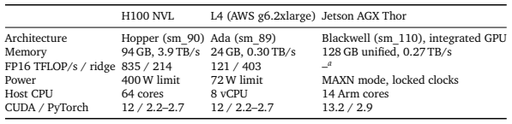
Table 16 :Three platforms, from data center to robot.Ridge: dense FP16 throughput / memory bandwidth (FLOP/B, datasheets); above it, a layer is compute-bound. Energy: GPU-board counter on H100 and L4; GPU rail and whole module on the Thor.aNo published dense FP16 figure.
원문 · CC BY 4.0 · Syed Umer Bukhari, Magnus Almgren, Ahmed Ali-Eldin · LoopQ: Fair, Closed-Loop Evaluation of Quantized Vision-Language-Action Models · 원문 그림 인용 · 원본 PDF 21쪽에서 그림 영역을 추출했습니다.적용 범위와 남은 질문
이 연구의 속도 결과는 주로 배치 1과 세 GPU에서 얻은 것입니다. 더 큰 배치나 빠른 INT8/FP8 가중치-활성화 커널에서는 결과가 달라질 수 있습니다. GR00T N1.5와 UniVLA는 시뮬레이션 양자화이므로 작업 성공률만 평가할 수 있고, 속도와 메모리를 직접 측정하지 못합니다. 교란 아래 손실의 원인도 활성화 양자화만으로 완전히 설명되지 않으며, ActQuant와 QuantVLA의 엔진 차이 중 일부는 설명되지 않은 채 남아 있습니다. 교차 GPU 부분집합은 252개 LIBERO-plus 과제로 제한되어 약 5점 이상의 손실만 확인할 수 있습니다. 또한 release 감사에서 세 개의 VLA 양자화 릴리스는 부동소수점 시뮬레이션이라 속도를 측정할 수 없었습니다.
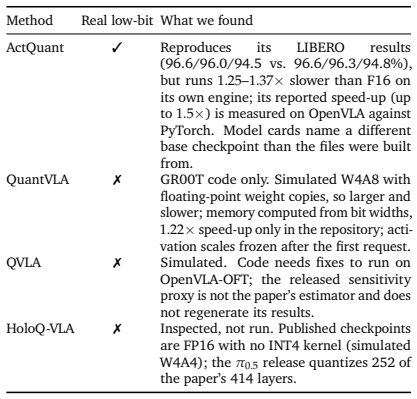
Table 5 :What each VLA-quantization release letsareaderverify(checked October 2026). Real low-bit: low-bit weights and kernels whose mem- ory and speed can be measured.
원문 · CC BY 4.0 · Syed Umer Bukhari, Magnus Almgren, Ahmed Ali-Eldin · LoopQ: Fair, Closed-Loop Evaluation of Quantized Vision-Language-Action Models · 원문 그림 인용 · 원본 PDF 12쪽에서 그림 영역을 추출했습니다.논문 정보
- 저자
- Syed Umer Bukhari, Magnus Almgren, Ahmed Ali-Eldin
- 학회·저널
- arXiv · 프리프린트
- 최초 공개일
- 2026년 11월 3일
- 등록일
- 2026년 11월 6일
- 수정일
- 2026년 11월 3일
- 버전
- v1
- arXiv
- 2611.05093
- 분류
- cs.RO
- 원문 이용 조건
- CC BY 4.0
- 제공 범위
- 논문 정보, 해설, 허용된 원문 그림
AI 해설은 논문 원문과 별개의 설명이며 오류가 있을 수 있습니다. 원문과 그림은 각 출처의 이용 조건과 따로 표시된 권리를 따릅니다.
초록
Post-training quantization (PTQ) for vision-language-action (VLA) models promises smaller and faster VLA deployments. However, when analyzing existing VLA quantization works, we realised that it is hard to reason about the performance of the suggested quantization method compared to existing, similar, or in many cases, simpler PTQ methods. We present LoopQ, a closed-loop benchmark that compares multiple quantization policies on the same checkpoint, layers and engine, varying only the method and the kernels. We evaluate RTN, AWQ, GPTQ, ActQuant and QuantVLA on four VLAs with more than 180,000 episodes of LIBERO and LIBERO-plus, compare against QVLA's reported results on the same layers, and benchmark whether the four public VLA-quantization releases can be reproduced. We benchmark the methods on an NVIDIA H100, an L4, and a Jetson AGX Thor. Our results show that while quantization reliably saves memory, 2-3x for real low-bit models, VLA-specific PTQ methods underperform compared to simpler generic baselines. At 4 bits, RTN, AWQ and GPTQ match or exceed ActQuant and QuantVLA, plain RTN matches the calibrated methods, and plain AWQ matches the success QVLA reports for itself. Standard LIBERO hides the losses that do exist: configurations with no significant LIBERO loss lose 1.5-4.3 points under paired LIBERO-plus perturbations. Speed is a weaker story. At batch 1 on the H100, no quantized pi0.5 or OpenVLA-OFT configuration is faster than its 16-bit model (1.06-1.58x slower on library kernels); only the L4 with int8 kernels gains (4-14%), the Thor is slower on every 4-bit configuration, and the engine alone changes latency by 2.1x. Profiling explains why: pi0.5's quantized backbone is compute-bound, while its memory-bound action expert, 63% of GPU time and 13% of the parameters, stays in 16 bits.
원문 인용
Syed Umer Bukhari, Magnus Almgren, Ahmed Ali-Eldin (2026). LoopQ: Fair, Closed-Loop Evaluation of Quantized Vision-Language-Action Models. arXiv:2611.05093v1. https://arxiv.org/abs/2611.05093v1
BibTeX
@misc{bukhari2026loopq,
  title = {{LoopQ: Fair, Closed-Loop Evaluation of Quantized Vision-Language-Action Models}},
  author = {Syed Umer Bukhari and Magnus Almgren and Ahmed Ali-Eldin},
  year = {2026},
  eprint = {2611.05093},
  archivePrefix = {arXiv},
  url = {https://arxiv.org/abs/2611.05093v1}
}