논문 해설
LUCID: Attention with Preconditioned Representations
LUCID: 전처리된 표현을 이용한 어텐션
- 연구 문제 긴 문맥에서 softmax 어텐션은 관련 없는 토큰에 확률을 퍼뜨려 검색 성능을 떨어뜨리며, 온도를 낮춰 날카롭게 만들면 그래디언트가 사라지는 문제가 있습니다.
- 연구 방법 LUCID Attention은 키-키 유사도로 만든 preconditioner를 softmax 확률에 적용하여 RKHS에서 키를 비상관화하고, 표준 온도에서 정확한 검색과 그래디언트 흐름을 함께 얻으려 합니다.
- 주요 결과 LUCID는 MNIAH 표 3에서 표준 어텐션보다 높은 정확도를 보였고, BABILong의 LUCID-PaTH 변형은 긴 문맥에서 안정적인 정확도를 유지했다고 보고됩니다.
긴 문맥에서 softmax 어텐션이 겪는 문제
Transformer의 softmax 내적 어텐션은 문맥이 길어질수록 확률 질량을 관련 없는 토큰에도 나누어 주는 한계를 보입니다. 저자들은 이 현상을 어텐션 노이즈라고 부르며, 그 근본 원인을 키들 사이의 상관으로 봅니다. 이를 줄이기 위해 softmax 온도를 낮추면 분포가 날카로워지지만, 확률이 원핫에 가까워지면 softmax 야코비안 diag(a)−aa⊤가 0에 가까워져 그래디언트가 전달되지 않습니다. 따라서 정확한 검색과 학습 가능성 사이에 긴장이 생깁니다. 이 논문은 낮은 온도에 기대지 않고 키 상관 자체를 다루는 방법을 제안합니다.
LUCID 어텐션의 preconditioner와 계산 흐름
LUCID Attention은 softmax 어텐션의 확률에 키-키 유사도로 만든 preconditioner를 적용하는 구조 변경입니다. 지수 커널 exp(⟨k_i,k_j⟩)은 RKHS의 내적으로 해석되며, preconditioner는 마스크가 적용된 지수 커널 행렬 M◦exp(KK⊤)의 역행렬로 정의됩니다. 구현에서는 키를 RMS 정규화하여 단위 대각과 제어된 비대각 크기를 얻고, 그 하삼각 선형계를 풀어 전처리된 값 Y를 구합니다. 최종 출력은 softmax 가중치와 Y의 곱으로 계산되며, 전체 계산 복잡도는 표준 어텐션과 같은 O(N²d)로 보고됩니다. 이 방법은 선형 어텐션의 델타 규칙을 무한차원 RKHS로 일반화한 관점에서 설명됩니다.
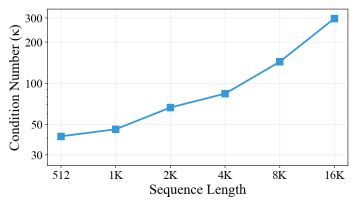
Figure 2 . Condition number κ of the LUCID preconditioner matrix grows with sequence length. Higher κ indicates stronger key correlations, where LUCID’s correction becomes more essential.
원문 · CC BY 4.0 · Sai Surya Duvvuri, Nirmal Patel, Nilesh Gupta, Inderjit S. Dhillon · LUCID: Attention with Preconditioned Representations · 원문 그림 인용 · 원본 PDF 4쪽에서 그림 영역을 추출했습니다.온도 대신 preconditioner로 날카로운 검색을 얻는 방식
논문은 LUCID가 softmax를 표준 온도에 두면서도 정확한 검색을 얻는다고 주장합니다. 정리 1은 LUCID 출력 o에 대해 조건을 만족하면 ∂o/∂q≠0이라고 말합니다. 증명은 preconditioner가 마스크된 하삼각 행렬이며 양의 대각을 가져 가역이고 null-space가 없다는 점에 기대고 있습니다. 또한 그래디언트가 사라지는 경우로 원핫 어텐션, K=0, 열 조건 등을 제시합니다. 합성 실험에서는 자기 복사 단계 뒤 누적 평균 단계로 전환했을 때 표준 softmax는 야코비안을 약 10³배 줄인 뒤 적응하지 못했고, LUCID는 야코비안 크기를 유지하며 빠르게 적응했다고 보고합니다.
하삼각 계산과 디코딩 비용
구현에서 preconditioner 적용은 하삼각 선형계 (M◦exp(…))Y=V를 푸는 과정으로 바뀝니다. 이 계산은 전진 대입으로 수행되며 cuBLAS TRSM 커널을 사용합니다. 학습 중 오버헤드는 모델에 따라 0%에서 5.5% 사이로 보고되며, 32K 문맥의 추론 지연은 77ms 대 76ms로 약 1.3% 차이입니다. 디코딩에서는 과거 키와 전처리된 값을 KV 캐시에 저장하고 Y_new = V_new − exp(S)·Y_past를 계산합니다. 추가 학습 실험에서는 표준 어텐션을 10% 더 학습해도 LUCID와 같은 다중 needle 향상이 나타나지 않았다고 보고됩니다.
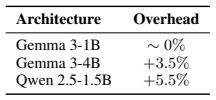
Table 1 .LUCID training overhead across Gemma 3(Team et al., 2025) and Qwen 2.5(Team et al., 2024) remains modest. Modern trends toward grouped-query attention(GQA) with fewer KV heads further reduce LUCID’s overhead.
원문 · CC BY 4.0 · Sai Surya Duvvuri, Nirmal Patel, Nilesh Gupta, Inderjit S. Dhillon · LUCID: Attention with Preconditioned Representations · 원문 그림 인용 · 원본 PDF 5쪽에서 그림 영역을 추출했습니다.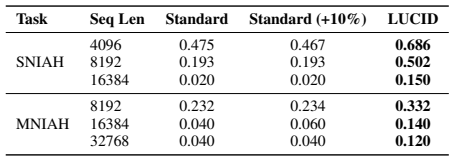
Table 7 .Compute ablation: Standard Attention trained for +10% additional steps vs. LUCID on needle-in-a-haystack tasks. Extra training compute does not close the performance gap.
원문 · CC BY 4.0 · Sai Surya Duvvuri, Nirmal Patel, Nilesh Gupta, Inderjit S. Dhillon · LUCID: Attention with Preconditioned Representations · 원문 그림 인용 · 원본 PDF 20쪽에서 그림 영역을 추출했습니다.검색 과제와 장문 평가 결과
NIAH 계열 평가에서 LUCID는 RULER의 SNIAH·MNIAH 과제를 수정한 harness로 평가되었습니다. 22층 디코더 전용 모델을 시퀀스 길이 2048에서 사전학습한 뒤 65536에서 미세조정했습니다. 표 3의 MNIAH 2048 설정에서 LUCID는 2, 4, 6개 바늘에 대해 76.6, 55.8, 43.6을 기록했으며 표준 어텐션은 74.2, 51.0, 38.8입니다. BABILong에서는 LUCID-PaTH 변형이 32K–128K 문맥에서 0.21–0.25의 정확도를 유지했다고 보고됩니다. 저자들은 이 결과를 LUCID가 분산된 사실에 더 잘 접근한다는 해석으로 제시합니다. 한편 이 BABILong 결과는 PaTH 위치 인코딩과 결합된 변형의 결과입니다.
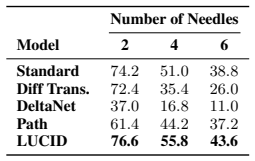
Table 3 .Performance comparison of different models against LUCID Attention for MNIAH task at 2048 sequence length.
원문 · CC BY 4.0 · Sai Surya Duvvuri, Nirmal Patel, Nilesh Gupta, Inderjit S. Dhillon · LUCID: Attention with Preconditioned Representations · 원문 그림 인용 · 원본 PDF 7쪽에서 그림 영역을 추출했습니다.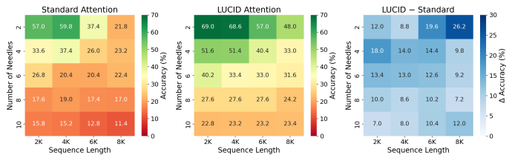
Figure 4 .Performance comparison on MNIAH across varying number of needles and sequence lengths.Left:Standard Attention accuracy degrades sharply as task difficulty increases (more needles, longer sequences), dropping to 11.4% in the hardest configuration.Middle: LUCID Attention maintains substantially higher accuracy across all settings.Right:The difference highlights consistent improvements of 10–26%, with LUCID providing the largest gains at longer sequence lengths where Standard Attention struggles most.
원문 · CC BY 4.0 · Sai Surya Duvvuri, Nirmal Patel, Nilesh Gupta, Inderjit S. Dhillon · LUCID: Attention with Preconditioned Representations · 원문 그림 인용 · 원본 PDF 8쪽에서 그림 영역을 추출했습니다.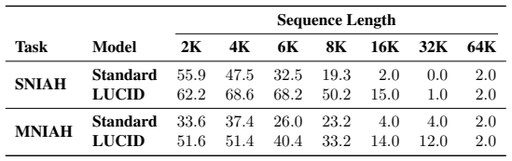
Table 6 .Performance comparison of Standard Attention and LUCID Attention models for SNIAH and MNIAH tasks across different sequence lengths after fine-tuning.
원문 · CC BY 4.0 · Sai Surya Duvvuri, Nirmal Patel, Nilesh Gupta, Inderjit S. Dhillon · LUCID: Attention with Preconditioned Representations · 원문 그림 인용 · 원본 PDF 20쪽에서 그림 영역을 추출했습니다.LongBench와 SCROLLS 결과
장문 이해 평가는 LongBench의 2WikiMQA, HotpotQA, MultifieldQA와 SCROLLS의 QMSum, Qasper에서 수행되었습니다. 표 4에서 LUCID-PaTH는 여섯 과제 중 네 개에서 최고 성능을 보이며, Qasper에서 PaTH 대비 +1.14 F1을 기록합니다. LUCID 단독은 HotpotQA F1 0.0862와 QMSum ROUGE-L 12.60에서 최고 수치를 보입니다. 선형 어텐션 변형인 DeltaNet은 2WikiMQA에서 0.036 F1로 LUCID의 0.274보다 크게 낮습니다. 이 평가는 각 데이터셋의 학습 분할 일부로 미세조정한 설정이므로, 결과를 모든 장문 과제로 일반화하지 않습니다.
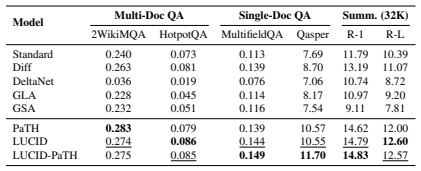
Table 4 .LongBench and SCROLLS evaluation results.F1 scores for QA tasks and ROUGE scores for summarization. Best results are inbold, second-best are underlined .
원문 · CC BY 4.0 · Sai Surya Duvvuri, Nirmal Patel, Nilesh Gupta, Inderjit S. Dhillon · LUCID: Attention with Preconditioned Representations · 원문 그림 인용 · 원본 PDF 8쪽에서 그림 영역을 추출했습니다.정답 바늘 토큰의 어텐션 가중치 분석
논문은 어텐션 노이즈가 줄었는지 확인하기 위해 hit rate를 측정합니다. 이 지표는 NIAH 과제에서 정답 바늘 토큰이 받는 평균 어텐션 가중치입니다. LUCID의 hit rate는 0.2845이고 표준 어텐션은 0.1817로, 상대 향상은 56.6%입니다. 저자들은 이를 preconditioner가 확률 질량을 관련 토큰에 더 모은다는 증거로 해석합니다. 이 수치는 정답 토큰에 대한 집중도를 나타내며, 다른 과제 전반의 노이즈를 직접 측정한 것은 아닙니다.
적용 범위와 한계
저자들은 이 연구가 인과적 언어 모델링에 초점을 둔다고 밝힙니다. 인과 마스크 아래에서는 preconditioner가 하삼각 구조를 가져 효율적인 선형 해법을 쓸 수 있습니다. 반면 확산 모델과 같은 양방향 설정에서는 이 삼각 구조가 사라져 선형계 해법 비용이 커질 수 있으며, 이 경우의 효율적인 해법은 향후 과제로 남습니다. 또한 대부분의 실험은 Dolma 일부로 사전학습한 약 1B 파라미터 모델의 설정에서 보고됩니다. 따라서 결과는 이 모델 규모와 데이터, 평가 설정의 조건에서 읽어야 합니다.
논문 정보
- 저자
- Sai Surya Duvvuri, Nirmal Patel, Nilesh Gupta, Inderjit S. Dhillon
- 학회·저널
- arXiv · 프리프린트
- 최초 공개일
- 2026년 2월 11일
- 등록일
- 2026년 10월 30일
- 수정일
- 2026년 2월 11일
- 버전
- v1
- arXiv
- 2602.10410
- 분류
- cs.LG
- 원문 이용 조건
- CC BY 4.0
- 제공 범위
- 논문 정보, 해설, 허용된 원문 그림
AI 해설은 논문 원문과 별개의 설명이며 오류가 있을 수 있습니다. 원문과 그림은 각 출처의 이용 조건과 따로 표시된 권리를 따릅니다.
초록
Softmax-based dot-product attention is a cornerstone of Transformer architectures, enabling remarkable capabilities such as in-context learning. However, as context lengths increase, a fundamental limitation of the softmax function emerges: it tends to diffuse probability mass to irrelevant tokens degrading performance in long-sequence scenarios. Furthermore, attempts to sharpen focus by lowering softmax temperature hinder learnability due to vanishing gradients. We introduce LUCID Attention, an architectural modification that applies a preconditioner to the attention probabilities. This preconditioner, derived from exponentiated key-key similarities, minimizes overlap between the keys in a Reproducing Kernel Hilbert Space, thus allowing the query to focus on important keys among large number of keys accurately with same computational complexity as standard attention. Additionally, LUCID's preconditioning-based approach to retrieval bypasses the need for low temperature and the learnability problems associated with it. We validate our approach by training ~1 billion parameter language models evaluated on up to 128K tokens. Our results demonstrate significant gains on long-context retrieval tasks, specifically retrieval tasks from BABILong, RULER, SCROLLS and LongBench. For instance, LUCID achieves up to 18% improvement in BABILong and 14% improvement in RULER multi-needle performance compared to standard attention.
원문 인용
Sai Surya Duvvuri, Nirmal Patel, Nilesh Gupta, Inderjit S. Dhillon (2026). LUCID: Attention with Preconditioned Representations. arXiv:2602.10410v1. https://arxiv.org/abs/2602.10410v1
BibTeX
@misc{duvvuri2026lucid,
  title = {{LUCID: Attention with Preconditioned Representations}},
  author = {Sai Surya Duvvuri and Nirmal Patel and Nilesh Gupta and Inderjit S. Dhillon},
  year = {2026},
  eprint = {2602.10410},
  archivePrefix = {arXiv},
  url = {https://arxiv.org/abs/2602.10410v1}
}