논문 해설
Preserve-Then-Quantize: Balancing Rank Budgets for Quantization Error Reconstruction in LLMs
Preserve-Then-Quantize: LLM에서 양자화 오차 복원을 위한 랭크 예산 균형 맞추기
- 연구 문제 기존 양자화 오차 재구성 방법은 고정된 랭크 예산을 모두 양자화 잔차 보정에 쓰므로 저비트에서 지배적 가중치 방향의 손상을 충분히 다루지 못할 수 있습니다.
- 연구 방법 SRR은 스케일된 가중치의 상위 k 랭크 방향을 양자화 전에 보존하고 잔차만 양자화한 뒤, 남은 r−k 랭크로 양자화 오차를 재구성합니다.
- 주요 결과 SRR은 여러 PTQ 설정에서 WikiText2 perplexity를 낮추고, RoBERTa-base의 GLUE QPEFT에서 기존 QERA 대비 2비트 설정에서 5.9 percentage points 높은 평균 정확도를 보고합니다.
양자화 오차 재구성의 랭크 배분 문제
저비트 양자화는 사전 학습된 가중치를 낮은 비트로 바꾸면서 정확도를 떨어뜨립니다. 기존 양자화 오차 재구성(QER) 방법은 양자화된 행렬 Q에 저랭크 보정항 LR을 더해 W≈Q+LR 형태의 근사를 만들며, 주어진 랭크 예산 r을 모두 양자화 잔차의 재구성에 사용합니다. 이 방식은 잔차 자체가 저랭크일 때에만 적절합니다. 저비트 영역에서는 양자화 오차가 조밀하고 고랭크인 경우가 많아, 스케일된 가중치 SW가 가진 지배적인 특이 방향이 양자화 과정에서 손상되고 제한된 보정 용량이 그 손상을 메우는 데 소모됩니다.
보존 후 양자화하는 SRR의 연산
SRR은 랭크 예산 r을 두 역할로 나눕니다. 먼저 스케일된 가중치 SW의 상위 k 랭크 특이부분공간을 추출하여 S⁻¹ 공간으로 되돌린 L(1)R(1)을 만들고, 그 나머지 잔차 W−L(1)R(1)만 양자화하여 Q를 얻습니다. 그다음 양자화 오차 E_k를 S 공간에서 r−k 랭크로 절단 SVD하여 L(2)R(2)를 구성하고, 최종 근사는 Q+LR 형태가 됩니다. 분할점 k는 식 k⋆=argmin ρ_k(SW)ρ_{r−k}(SE)로 선택합니다. 여기서 ρ_p(A)는 상위 p 랭크 근사 뒤에 남는 에너지 비율이며, 무작위 행렬 프로브 E에서 얻은 SE로 양자화 오차 스펙트럼을 근사합니다. 이 선택은 두 가정, 즉 양자화 오차 에너지가 입력 에너지에 대략 비례한다는 가정과 정규화된 오차 스펙트럼이 무작위 행렬 스펙트럼으로 근사된다는 가정에 기대고 있습니다.
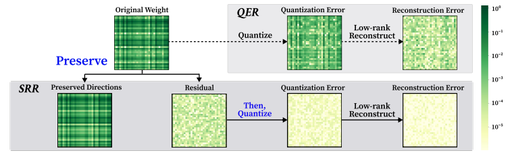
Figure 1 . Preserve-then-quantize mechanism in Structured Residual Reconstruction (SRR), compared with standard QER. Top: In QER, quantizing the entire weight matrix destroys the intrinsic low-rank structure of the original weight, leaving errors that cannot be recovered by low-rank reconstruction. Bottom: In contrast, SRR preserves the dominant low-rank structure prior to quantization, preventing structural damage and resulting in a substantially smaller reconstruction error ∥W − Q − LR∥F under the same rank budget.
원문 · CC BY 4.0 · Yoonjun Cho, Dongjae Jeon, Soeun Kim, Moongyu Jeon, Albert No · Preserve-Then-Quantize: Balancing Rank Budgets for Quantization Error Reconstruction in LLMs · 원문 그림 인용 · 원본 PDF 2쪽에서 그림 영역을 추출했습니다.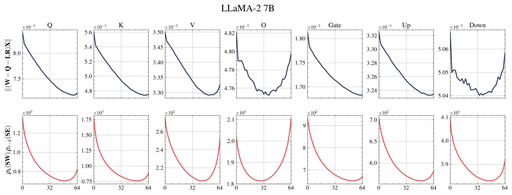
Figure 6 .Alignment between reconstruction error and the rank-selection objective in LLaMA-2 7B (layer 10). Reconstruction error (Top) and surrogate objective (Bottom) as functions of the preserved rankkunder a rank budget ofr= 64.
원문 · CC BY 4.0 · Yoonjun Cho, Dongjae Jeon, Soeun Kim, Moongyu Jeon, Albert No · Preserve-Then-Quantize: Balancing Rank Budgets for Quantization Error Reconstruction in LLMs · 원문 그림 인용 · 원본 PDF 16쪽에서 그림 영역을 추출했습니다.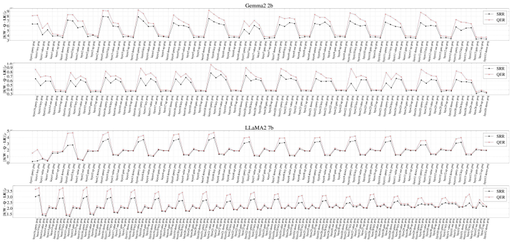
Figure 7 .Layer-wise full reconstruction error under ZeroQuant-V2 ( S=I ), comparing QER and SRR. All results are obtained using 3-bit MXINT quantizer with rank 64. SRR consistently achieves lower reconstruction error than QER across all layers for both Gemma-2 2B (top) and LLaMA-2 7B (bottom).
원문 · CC BY 4.0 · Yoonjun Cho, Dongjae Jeon, Soeun Kim, Moongyu Jeon, Albert No · Preserve-Then-Quantize: Balancing Rank Budgets for Quantization Error Reconstruction in LLMs · 원문 그림 인용 · 원본 PDF 17쪽에서 그림 영역을 추출했습니다.QPEFT 초기화와 그래디언트 스케일링
QPEFT에서는 양자화된 백본 Q를 고정하고 저랭크 어댑터만 학습합니다. SRR은 학습된 어댑터의 초기값을 LR=L(1)R(1)+L(2)R(2)로 제공합니다. 보존된 방향의 성분 L(1)R(1)은 특이값이 커서 그대로 학습하면 상위 방향이 과도하게 갱신될 수 있으므로, 보존 방향에 대응하는 그래디언트만 γ∈(0,1)로 줄입니다. 나머지 재구성 성분의 그래디언트는 바뀌지 않습니다. 기본 설정은 γ=0.1이며, 저자들은 γ=0.1과 0.5가 모두 잘 작동한다고 보고합니다.
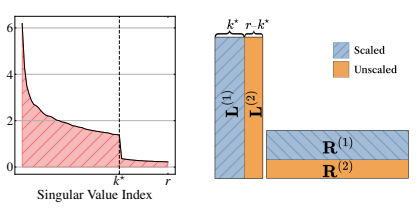
Figure 3 . (a) Singular-value spectrum with the selected split k ⋆ . (b) Illustration of the corresponding low-rank factors, where gradients along the k ⋆ preserved directions are scaled, while the remaining r − k
원문 · CC BY 4.0 · Yoonjun Cho, Dongjae Jeon, Soeun Kim, Moongyu Jeon, Albert No · Preserve-Then-Quantize: Balancing Rank Budgets for Quantization Error Reconstruction in LLMs · 원문 그림 인용 · 원본 PDF 5쪽에서 그림 영역을 추출했습니다.
Table 6 .Average zero-shot accuracy ( ↑) of SRR-based QPEFT on GLUE for RoBERTa-base, comparing top-k⋆ gradient scaling settings (γ∈ {0,0.1,0.5,1} and SGP (α= 5 )). Best results are highlighted inbold, with the second-best results underlined. Full results are provided in Appendix D.
원문 · CC BY 4.0 · Yoonjun Cho, Dongjae Jeon, Soeun Kim, Moongyu Jeon, Albert No · Preserve-Then-Quantize: Balancing Rank Budgets for Quantization Error Reconstruction in LLMs · 원문 그림 인용 · 원본 PDF 8쪽에서 그림 영역을 추출했습니다.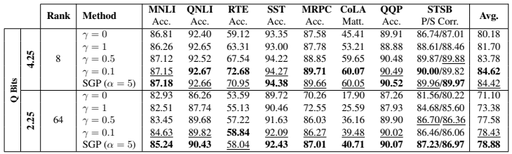
Table 17 .Full GLUE zero-shot results (↑) of SRR-based QPEFT for RoBERTa-base under MXINT quantization, comparing top-k gradient scaling strategies: fixed scaling factors γ∈ {0,0.1,0.5,1} and SGP (Saha & Roy, 2023) with α= 5. Best results are inbold, with the second-best results underlined.
원문 · CC BY 4.0 · Yoonjun Cho, Dongjae Jeon, Soeun Kim, Moongyu Jeon, Albert No · Preserve-Then-Quantize: Balancing Rank Budgets for Quantization Error Reconstruction in LLMs · 원문 그림 인용 · 원본 PDF 19쪽에서 그림 영역을 추출했습니다.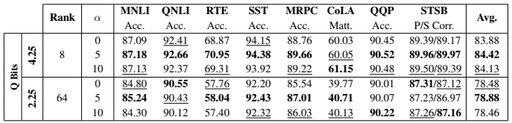
Table 18 .SGP hyperparameter sensitivity on full GLUE results ( ↑) for SRR-based QPEFT under MXINT quantization. We vary the SGP exponent α∈ {0,5,10} in the rank-wise scaling rule while keeping all other settings fixed (same quantization bits and rank). Best results are inbold, with the second-best results underlined.
원문 · CC BY 4.0 · Yoonjun Cho, Dongjae Jeon, Soeun Kim, Moongyu Jeon, Albert No · Preserve-Then-Quantize: Balancing Rank Budgets for Quantization Error Reconstruction in LLMs · 원문 그림 인용 · 원본 PDF 19쪽에서 그림 영역을 추출했습니다.PTQ에서의 perplexity와 제로샷 정확도 비교
PTQ 실험은 3비트 MXINT 양자화에서 TinyLlama, Gemma-2 2B, LLaMA-2 7B와 13B, LLaMA-3.1 8B와 70B를 대상으로 합니다. 저랭크 설정은 r=32와 r=64이며, SRR은 LQER, QERA-approx, QERA-exact 같은 QER 기준선에 각각 적용되어 WikiText2 perplexity로 비교됩니다. 보고된 결과에서 SRR은 Gemma-2 2B에서 최대 12.2%, LLaMA-2 7B에서 27.1%, LLaMA-3.1 8B에서 3.6%의 상대 감소를 보입니다. 제로샷 정확도는 r=64의 QERA-exact 설정에서 다섯 과제의 평균으로 보고되며, SRR은 여러 모델 규모에서 기준선보다 높은 평균을 보입니다.
이 결과는 정확한 스케일 기반 해법에도 구조적 저랭크 항이 추가 개선 여지를 남긴다는 해석으로 이어집니다.

Table 1 .Perplexity ( ↓) on WikiText2 under 3-bit MXINT quantization, evaluated with low rank settingsr=32 and r=64. SRR is applied to three QER methods across six models. Lowest perplexity values are highlighted inbold. For SRR, results are reported as mean ± std over three random seeds. All evaluations are conducted usinglm-evalframework.
원문 · CC BY 4.0 · Yoonjun Cho, Dongjae Jeon, Soeun Kim, Moongyu Jeon, Albert No · Preserve-Then-Quantize: Balancing Rank Budgets for Quantization Error Reconstruction in LLMs · 원문 그림 인용 · 원본 PDF 6쪽에서 그림 영역을 추출했습니다.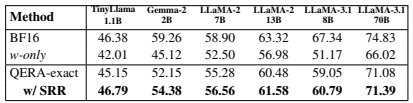
Table 2 .Average zero-shot accuracy (↑) on five downstream tasks under low-rank setting r=64, using 3-bit MXINT quantizer. SRR is applied on QERA-exact, and best results are highlighted inbold. Full results and other setups are provided in Appendix C.1.
원문 · CC BY 4.0 · Yoonjun Cho, Dongjae Jeon, Soeun Kim, Moongyu Jeon, Albert No · Preserve-Then-Quantize: Balancing Rank Budgets for Quantization Error Reconstruction in LLMs · 원문 그림 인용 · 원본 PDF 6쪽에서 그림 영역을 추출했습니다.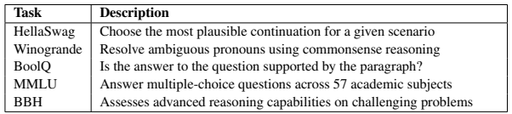
Table 8 .Descriptions of five downstream tasks used in our PTQ evaluation.
원문 · CC BY 4.0 · Yoonjun Cho, Dongjae Jeon, Soeun Kim, Moongyu Jeon, Albert No · Preserve-Then-Quantize: Balancing Rank Budgets for Quantization Error Reconstruction in LLMs · 원문 그림 인용 · 원본 PDF 12쪽에서 그림 영역을 추출했습니다.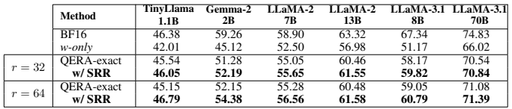
Table 13 .Average zero-shot accuracy (↑) on five downstream tasks under two low-rank settings r=32 and r=64, using 3-bit MXINT quantizer. SRR is applied on QERA-exact, and best results are highlighted inbold.
원문 · CC BY 4.0 · Yoonjun Cho, Dongjae Jeon, Soeun Kim, Moongyu Jeon, Albert No · Preserve-Then-Quantize: Balancing Rank Budgets for Quantization Error Reconstruction in LLMs · 원문 그림 인용 · 원본 PDF 16쪽에서 그림 영역을 추출했습니다.GLUE에서의 QPEFT 결과
QPEFT 검증은 RoBERTa-base를 GLUE에서 4/3/2비트 MXINT로 미세조정하는 설정으로 수행됩니다. 각 방법은 5 epoch 동안 작업별 학습률로 학습되며 결과는 세 번의 실행의 평균과 표준편차로 보고됩니다. QERA 대비 SRR의 평균 이득은 4비트에서 1.5, 3비트에서 4.7, 2비트에서 5.9 percentage points입니다. 2비트 설정에서는 반복 방식인 LoftQ와 LQ-LoRA보다 10 percentage points 이상 높다고 보고됩니다. 학습 손실 곡선에서도 SRR이 기준선보다 빠르게 감소한다고 보고됩니다. 이 결과는 GLUE 분류 과제와 RoBERTa-base에서 얻은 것이며, LLaMA 계열의 SlimPajama·GSM8K 결과와는 별도로 읽어야 합니다.
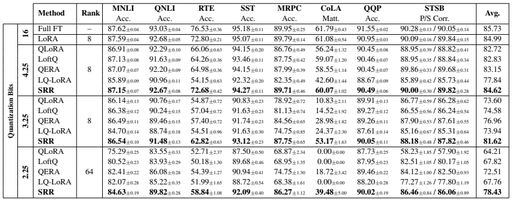
Table 3 .Fine-tuning results on the GLUE using RoBERTa-base under 4/3/2-bit MXINT quantizer. All methods are trained for 5 epochs using best-performing learning rates (see Appendix A.3). Results are reported as mean±std over runs with best results inbold.
원문 · CC BY 4.0 · Yoonjun Cho, Dongjae Jeon, Soeun Kim, Moongyu Jeon, Albert No · Preserve-Then-Quantize: Balancing Rank Budgets for Quantization Error Reconstruction in LLMs · 원문 그림 인용 · 원본 PDF 7쪽에서 그림 영역을 추출했습니다.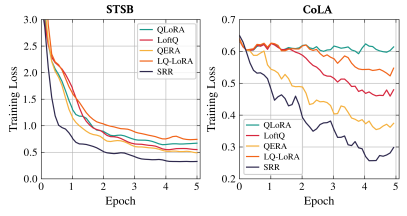
Figure 4 .Training loss curves for QPEFT baselines on two GLUE tasks: STSB (Left) and CoLA (Right), over five epochs. Each method uses its best-performing learning rate (see Appendix A.3). SRR shows faster training loss reduction than the other baselines.
원문 · CC BY 4.0 · Yoonjun Cho, Dongjae Jeon, Soeun Kim, Moongyu Jeon, Albert No · Preserve-Then-Quantize: Balancing Rank Budgets for Quantization Error Reconstruction in LLMs · 원문 그림 인용 · 원본 PDF 7쪽에서 그림 영역을 추출했습니다.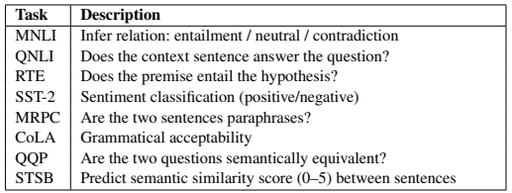
Table 9 .Descriptions of the eight GLUE tasks used in our evaluation.
원문 · CC BY 4.0 · Yoonjun Cho, Dongjae Jeon, Soeun Kim, Moongyu Jeon, Albert No · Preserve-Then-Quantize: Balancing Rank Budgets for Quantization Error Reconstruction in LLMs · 원문 그림 인용 · 원본 PDF 13쪽에서 그림 영역을 추출했습니다.
Table 10 .Learning rates of RoBERTa-base experiments on GLUE.
원문 · CC BY 4.0 · Yoonjun Cho, Dongjae Jeon, Soeun Kim, Moongyu Jeon, Albert No · Preserve-Then-Quantize: Balancing Rank Budgets for Quantization Error Reconstruction in LLMs · 원문 그림 인용 · 원본 PDF 13쪽에서 그림 영역을 추출했습니다.
Table 19 .Full GLUE results ( ↑) on RoBERTa-base under MXINT 4/2-bit quantization, comparing QERA with and without SGP. Best results are inbold.
원문 · CC BY 4.0 · Yoonjun Cho, Dongjae Jeon, Soeun Kim, Moongyu Jeon, Albert No · Preserve-Then-Quantize: Balancing Rank Budgets for Quantization Error Reconstruction in LLMs · 원문 그림 인용 · 원본 PDF 19쪽에서 그림 영역을 추출했습니다.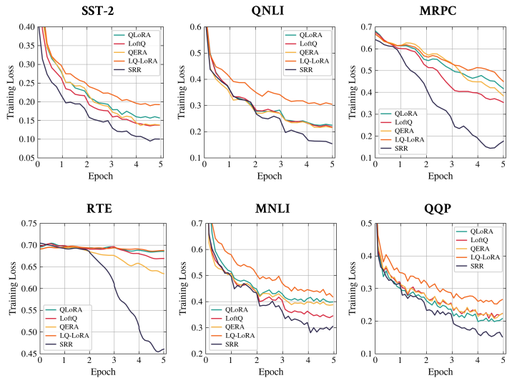
Figure 8 .Training loss curves for QPEFT baselines on six GLUE tasks: SST-2, QNLI, MRPC, RTE, MNLI, and QQP, over 5 training epochs. Each curve corresponds to the best-performing learning rate for each method (learning rate details in Table 10). SRR tends to show a faster reduction in training loss compared to other baselines.
원문 · CC BY 4.0 · Yoonjun Cho, Dongjae Jeon, Soeun Kim, Moongyu Jeon, Albert No · Preserve-Then-Quantize: Balancing Rank Budgets for Quantization Error Reconstruction in LLMs · 원문 그림 인용 · 원본 PDF 21쪽에서 그림 영역을 추출했습니다.가정 검증과 랭크 선택 안정성
무작위 행렬 프로브에 대한 Assumption 4.2는 MRE로 검증됩니다. LLaMA-2 7B에서 MXINT 3비트의 MRE는 4.46%, 4비트는 2.31%로 보고됩니다. GPTQ에서는 MRE가 약 10%로 보고되어 가정으로부터의 편차가 관찰됩니다. 저자들은 이 편차가 GPTQ의 채널 간 오차 누적에서 비롯될 수 있다고 해석합니다. 또한 무작위 시드를 바꾸어 얻은 k⋆는 대부분 최대 ±1 랭크 이내에서 변하며, 이 변화는 perplexity에 미치는 영향이 작다고 보고됩니다. 프로젝션별로는 Q와 K가 V보다 큰 보존 랭크를 받는 경향이 보고됩니다.
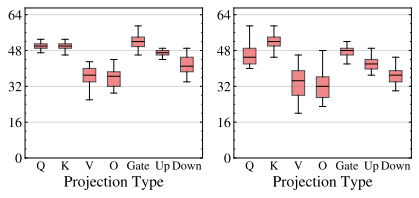
Figure 5 .Projection-wise distribution of the selected rank k⋆ under a rank budget of r= 64 . Each box plot summarizes layer-wise variations for (a) LLaMA-2 7B and (b) LLaMA-3.1 8B.
원문 · CC BY 4.0 · Yoonjun Cho, Dongjae Jeon, Soeun Kim, Moongyu Jeon, Albert No · Preserve-Then-Quantize: Balancing Rank Budgets for Quantization Error Reconstruction in LLMs · 원문 그림 인용 · 원본 PDF 8쪽에서 그림 영역을 추출했습니다.적용 범위와 한계
SRR의 이득은 여러 PTQ 설정과 QPEFT 설정에서 보고되지만, 모든 조건에서 같은 크기로 나타나는 것은 아닙니다. Assumption 4.2는 MXINT에서는 낮은 MRE로 지지되지만 GPTQ에서는 편차가 관찰됩니다. 제시된 ODLRI 비교는 동일한 QERA-exact 설정의 perplexity에 대한 비교이며, LLaMA-2 7B에서 SRR 10.76과 ODLRI 10.86, LLaMA-3.1 8B에서 SRR 11.24와 ODLRI 11.72로 보고됩니다. 이 비교는 특정 설정의 결과로 읽어야 합니다. 또한 SRR은 추가 SVD를 수행하지만 randomized SVD와 전체 파이프라인 측정에서 전체 시간 증가는 1% 이내로 보고됩니다.

Table 11 .Computation time (in GPU minutes) on LLaMA-2 7B, measured using a single NVIDIA L40S GPU.Scalingdenotes the time to compute the scaling matrix.QERandSRRreport the time for quantization and reconstruction without and with SRR, respectively, withTotalincluding scaling time.QER vs. SRRreports the overhead measured on the quantization and reconstruction stage, whileFull Pipelineincludes scaling and reflects the end-to-end overhead.
원문 · CC BY 4.0 · Yoonjun Cho, Dongjae Jeon, Soeun Kim, Moongyu Jeon, Albert No · Preserve-Then-Quantize: Balancing Rank Budgets for Quantization Error Reconstruction in LLMs · 원문 그림 인용 · 원본 PDF 14쪽에서 그림 영역을 추출했습니다.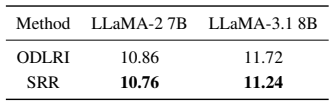
Table 16 .Perplexity comparison between ODLRI and SRR under the same QERA-exact setting. Best results are inbold.
원문 · CC BY 4.0 · Yoonjun Cho, Dongjae Jeon, Soeun Kim, Moongyu Jeon, Albert No · Preserve-Then-Quantize: Balancing Rank Budgets for Quantization Error Reconstruction in LLMs · 원문 그림 인용 · 원본 PDF 18쪽에서 그림 영역을 추출했습니다.논문 정보
- 저자
- Yoonjun Cho, Dongjae Jeon, Soeun Kim, Moongyu Jeon, Albert No
- 학회·저널
- arXiv · 프리프린트
- 최초 공개일
- 2026년 2월 2일
- 등록일
- 2026년 10월 29일
- 수정일
- 2026년 5월 13일
- 버전
- v2
- arXiv
- 2602.02001
- 분류
- cs.LG · cs.AI
- 원문 이용 조건
- CC BY 4.0
- 제공 범위
- 논문 정보, 해설, 허용된 원문 그림
AI 해설은 논문 원문과 별개의 설명이며 오류가 있을 수 있습니다. 원문과 그림은 각 출처의 이용 조건과 따로 표시된 권리를 따릅니다.
초록
Quantization Error Reconstruction (QER) reduces accuracy loss in Post-Training Quantization (PTQ) by approximating weights as $\mathbf{W} \approx \mathbf{Q} + \mathbf{L}\mathbf{R}$, using a rank-$r$ correction to reconstruct quantization error. Prior methods devote the full rank budget to error reconstruction, which is suboptimal when $\mathbf{W}$ has intrinsic low-rank structure and quantization corrupts dominant directions. We propose Structured Residual Reconstruction (SRR), a rank-allocation framework that preserves the top-$k$ singular subspace of the activation-scaled weight before quantization, quantizes only the residual, and uses the remaining rank $r-k$ for error reconstruction. We derive a theory-guided criterion for selecting $k$ by balancing quantization-exposed energy and unrecoverable error under rank constraints. We further show that resulting $\mathbf{Q} + \mathbf{L}\mathbf{R}$ parameterization naturally supports Quantized Parameter-Efficient Fine-Tuning (QPEFT), and stabilizes fine-tuning via gradient scaling along preserved directions. Experiments demonstrate consistent perplexity reductions across diverse models and quantization settings in PTQ, along with a 5.9 percentage-point average gain on GLUE under 2-bit QPEFT. The project page is available at https://ai-isl.github.io/srr.
원문 인용
Yoonjun Cho, Dongjae Jeon, Soeun Kim, Moongyu Jeon, Albert No (2026). Preserve-Then-Quantize: Balancing Rank Budgets for Quantization Error Reconstruction in LLMs. arXiv:2602.02001v2. https://arxiv.org/abs/2602.02001v2
BibTeX
@misc{cho2026preserve,
  title = {{Preserve-Then-Quantize: Balancing Rank Budgets for Quantization Error Reconstruction in LLMs}},
  author = {Yoonjun Cho and Dongjae Jeon and Soeun Kim and Moongyu Jeon and Albert No},
  year = {2026},
  eprint = {2602.02001},
  archivePrefix = {arXiv},
  url = {https://arxiv.org/abs/2602.02001v2}
}