Paper commentary
ROAD: The ROad event Awareness Dataset for Autonomous Driving
Dataset of road events helps test driving awareness in autonomous vehicles
- Problem Autonomous vehicles need to know what road users are doing, but existing action benchmarks label only humans in short clips. Those benchmarks miss how road agents act and interact over long driving videos.
- Method ROAD is a dataset of road events, each a triplet of an active agent, its actions and its location. The authors also propose 3D-RetinaNet, an online detector that links detections into tubes, instead of one tube per class.
- Results Frame-level test mAP with the I3D backbone reaches 65.4 for agentness and 16.8 for events. The authors attribute the lower scores on other tasks to nuisance factors such as camera motion and weather.
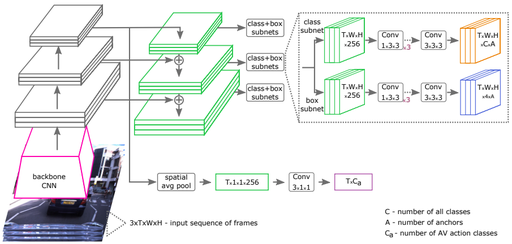
Fig. 3 . Proposed 3D-RetinaNet architecture for online video processing.
Original paper · CC BY 4.0 · Gurkirt Singh, Stephen Akrigg, Manuele Di Maio, Valentina Fontana, Reza Javanmard Alitappeh, Suman Saha, Kossar Jeddisaravi, Farzad Yousefi, Jacob Culley, Tom Nicholson, Jordan Omokeowa, Salman Khan, Stanislao Grazioso, Andrew Bradley, Giuseppe Di Gironimo, Fabio Cuzzolin · ROAD: The ROad event Awareness Dataset for Autonomous Driving · Original paper figure · Extracted the figure area from page 9 of the original PDF.Why detecting objects is not enough for driving
An autonomous vehicle has to read how drivers, pedestrians and cyclists behave before it decides how to move. Detector networks help the vehicle see what is around it, but they don't say what those agents are doing or where they stand relative to the car.
The end-to-end alternative learns a direct mapping from the scene to control inputs, and it needs a huge amount of data. Fridman et al. had to use a whole fleet of vehicles to collect 45 million frames, and that effort covered only highway driving. That mapping also skips modelling the significant facts in the scene and the reasoning of the agents therein.
Imitation learning, in this view, copies human driving without representing why other road users act as they do.
Most action benchmarks, such as UCF-101-24 and AVA, cover human actions in short or sparsely labelled videos. AVA is annotated at one frame per second, which limits how well it captures how an action evolves. ROAD, by contrast, provides ground truth for the actions of all road agents, not only humans. ROAD videos run about 8 minutes each, so they stress how events evolve and relate to one another.
The question the paper asks is whether an online detector can recognise such events from a stream of vehicle-camera video. The baseline, 3D-RetinaNet, extends the frame-wise online detector of Singh et al. with a single-stage detector.
How a road event is labelled
ROAD defines a road event as a triplet of an active agent, the action or actions it performs, and the location where this happens. Each element is a separate label type, so one event can carry several actions at once, such as moving away and turning left. Figure 1 shows the location label changing from in vehicle lane to in outgoing lane once a lane change is complete.
That is why the locations are tied to the lifetime of the event, since they may vary from its start to its end.
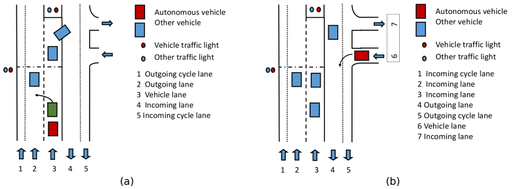
Fig. 1 . Use of labels in ROAD to describe typical road scenarios. (a) A green car is in front of the AV while changing lanes, as depicted by the arrow symbol. The associated event will then carry the following labels: in vehicle lane (location), moving left (action). Once the event is completed, the location label will change to: in outgoing lane . (b) Autonomous vehicle turning left from lane 6 into lane 4: lane 4 will be the outgoing lane as the traffic is moving in the same direction as the AV. However, if the AV turns right from lane 6 into lane 4 (a wrong turn), then lane 4 will become the incoming lane as the vehicle will be moving into the incoming traffic. The overall philosophy of ROAD is to use suitable combinations of multiple label types to fully describe a road situation, and allow a machine learning algorithm to learn from this information.
Original paper · CC BY 4.0Agents are people, vehicles and traffic lights, and the AV itself is labelled as one more agent by drawing a box on its bonnet. Only active agents are annotated, so a parked vehicle or a person located away from the road isn't labelled. Each agent always carries at least one action label, and a Car may be Indicating right while Turning right.
The AV's own actions form a separate set of seven labels, such as AV-move and AV-turn-left. The regular Moving label means moving perpendicular to the AV, whereas AV-move means the AV moves along its normal direction of travel.
ROAD contains 560K bounding boxes with 1.7M instances of individual labels. Those labels break down into 560K agent labels, 640K action labels and 499K location labels. The authors identified 603K duplex agent-action instances from the manually assigned labels. Combining the labels gives 454K event triplets, counted as instances of event labels.
How 3D-RetinaNet processes a frame sequence
3D-RetinaNet keeps the frame-wise online tube idea of Singh et al. and swaps the 2D detector for a 3D feature pyramid network. Its input is a sequence of T video frames, and the backbone outputs a series of forward feature pyramid maps. Lateral layers then produce the final feature pyramid, which is composed of T feature maps. Two sub-networks process these maps to output four box coordinates and C classification scores for each of A anchor locations.
The integer C sums the agent, action, location, duplex and event classes, plus one agentness class that flags whether an active agent is present.
With a 2D ResNet50 backbone, the detector stays completely online, with a delay of a single frame. An I3D or Slowfast backbone instead causes a 4-frame delay at detection time, because its max-pool layer with stride 2 halves the pyramid to T/2 maps. The authors linearly upscale that output back to T feature maps, so the prediction heads still see a full-length sequence.
For the AV's own actions, the last pyramid map goes through spatial average pooling and a temporal convolution layer. This branch gives one score for each of the Ca AV action classes, for every one of the T input frames.
The authors train with a binary cross-entropy based focal loss, because one agent can carry several labels at once. They expect the focal form to help the network handle the long tail and class imbalance visible in the label counts. Training uses T = 8 frames, while the authors unroll the same convolutional model to sequences of 32 frames at test time.
The authors show that this longer test sequence fits streaming use without changing the trained network.
Linking detections into tubes online
The authors adapt the tube-linking method of Singh et al. so that it builds agent tubes from a single agentness score rather than one tube per class. At video start, each detection initialises its own agentness tube.
At every time instant t, the highest scoring tubes, ranked by mean agentness score up to t − 1, are linked to the detections in frame t. A detection is linked only when its Intersection-over-Union (IoU) overlap with the latest box in the tube exceeds a minimum threshold λ. Each chosen detection is removed from the pool of frame-t detections, so it cannot join a second tube.
Remaining detections at time t start new tubes, and a tube terminates after no suitable detection is found for n consecutive frames.
For ROAD they obtain λ = 0.5 and k = 4 by cross validation, while for UCF-101-24 they get λ = 0.25 and k = 4. Most tubelet-based methods skip temporal trimming, so they don't decide when a tube should start or end. Temporal trimming by label consistency didn't improve performance on ROAD, so the authors apply it only on UCF-101-24.
The authors evaluate these tubes with video mean average precision, the standard metric in action detection. The UCF-101-24 results with these tube settings appear in the next section.
Checking the baseline on UCF-101-24
The authors test 3D-RetinaNet on UCF-101-24 first, to see whether the baseline is competitive before they apply it to ROAD. They benchmark it with the corrected annotations from Singh et al. [19], reporting both frame-mAP and video-mAP. Its video-mAP at the 0.5 threshold is 82.4 for the I3D backbone, compared to 58.2 at 0.5 for the 2D version of the same model.
The 82.4 result sits close to the 82.8 that Li et al. [82] reach, though their method uses both RGB and optical flow as input. The 3D-RetinaNet baseline uses RGB frames only, so the comparison is against methods that have access to more input. Against the methods that rely on appearance alone, 3D-RetinaNet outperforms them by large margins, as the bottom block of Table 3 shows.
The 2D variant reaches a video-mAP of 73.5 at 0.5, against 72.1 for RGB-SSD from Singh et al. [19].
The model keeps the simplicity of a single-stage detector, and its backbone can be swapped to change its behaviour. They don't test that optimisation here, so the boost stays a claim rather than a measured result.
ROAD frame-level and video-level results against UCF-101-24
With the I3D backbone and 32-frame test clips, frame-level test mAP at threshold 0.5 ranges from 16.8 for events to 65.4 for agentness. Slowfast reaches 23.9 to 69.2 over the same tasks, so agentness is the one task that comes close to the UCF-101-24 level. The authors compare these figures with the 75.2 that their I3D baseline reaches on UCF-101-24.
They attribute the gap for every other task to nuisance factors in ROAD, such as significant camera motion and weather conditions. Agentness amounts to agent detection on ROAD, which explains why it sits closest to the UCF-101-24 score.
At video level and threshold 0.2, the non-YOLOv5 models score between 20.5 for actions and 33.0 for locations. That range sits well below the 82.4 that UCF-101-24 reaches with the same IoU threshold. At threshold 0.5 the range falls to 4.7 for actions and 11 for locations, compared to 58.2 on UCF-101-24. The authors read the difference as a large jump in difficulty for perception in autonomous driving over a benchmark of human actions only.
Video-level trends follow the frame-level ones, but at a much lower absolute level.
For agent detection at video level and threshold 0.2, YOLOv5 reaches 38.8 on validation and 43.3 on test. Slowfast-08 scores 24.1 and 29.0 on the same agent task, so the off-the-shelf detector is well ahead for agents. The paper reports these YOLOv5 numbers next to the RetinaNet-based models, and it doesn't test YOLOv5 on the other tasks.
Training on 8 frames, testing on 32
The 3D-RetinaNet is trained on clips of 8 frames, a length the authors chose because of GPU memory limits. Input frames are resized to 512 × 682, and the backbone starts from weights pretrained on Kinetics. At test time the convolutional model is unrolled over sequences of 32 frames, so it can run in a streaming fashion.
The frame-level comparison pits 8-frame against 32-frame test clips for each backbone, averaged over the three splits. For I3D, agentness moves from 52.3/65.1 at 8 frames to 52.7/65.4 at 32 frames, in validation/test order. Agents drop slightly on test, from 39.5 at 8 frames to 39.2 at 32 frames. Events rise from 12.3/16.5 to 12.6/16.8, and duplexes follow the same small pattern.
At video level with threshold 0.2, I3D agents move from 23.2/26.5 at 8 frames to 24.4/26.9 at 32 frames. I3D actions rise from 14.1/15.8 to 14.3/17.5, a bigger test change than for agents. At threshold 0.5, I3D agents change from 9.2/9.6 to 9.7/10.2. Slowfast agentness goes from 68.8/69.2 at 8 frames to 69.3/68.7 at 32 frames, so its test score falls a little.
The authors read these small changes as a sign that the network can be deployed on longer streams. The heads are fully convolutional in the temporal direction, so the 8-frame model can process 32-frame input. The evidence covers only the 8-frame and 32-frame lengths, so the claim holds for that range. They didn't test clip lengths beyond 32 frames, so longer streams remain unexamined.
What the ROAD challenge winners reached
The ROAD challenge ran on three tasks: agent detection, action detection and event detection, all judged by video mean average precision. Challenge participants had 18 videos for training and validation, and the remaining 4 videos were kept to test the final performance. In the validation phase, between three and five teams submitted 15 to 17 entries to each of the three challenges.
In the test phase the organisers received 138 submissions from 9 teams to the agent challenge, 98 from 8 teams to the action challenge, and 93 from 6 teams to the event detection challenge.
For agent detection, the winning entry added post-processing to a YOLOv5 detector. Its authors link agents across frames by comparing their similarity and grouping them into a tube, then fill gaps in discontinuous tubes using motion information. They also filter out the shorter tubes, because YOLOv5 produces incorrect boxes scattered across different frames.
This postprocessing significantly outperforms the off-the-shelf YOLOv5 implementation of the paper on agent detection. For action detection, team CMU-INF adapted its Argus++ framework from the NIST ActEV challenge to build tube proposals instead of frame-level proposals.
For event detection, team IFLY built on the 3D-RetinaNet baseline with several amendments. Their event entry improves on Slowfast by above 2%, which suggests that the ensemble technique could help Slowfast too. The winners' results therefore show gains over the baselines, but the action entry stays at a relatively low level.
Limits of the evidence
Frame-level scores for every task except agentness stay far below the UCF-101-24 score of 75.2%. The authors attribute this gap to nuisance factors such as significant camera motion and weather conditions. Video-level results at a threshold of 0.5 lie between 4.7% (actions) and 11% (locations), compared to 58.2% on UCF-101-24. The authors describe their results as preliminary, and they stress that the ROAD challenge findings call for a broader analysis.
The test set has only four videos, one per weather condition, so each condition rests on a single test video. The snow condition has just one video in the whole dataset, so the authors didn't design a split to test snowy bias. Split-2 keeps all three night videos in validation, so the night condition isn't learned from during training. The authors didn't test a model trained on the full training set and evaluated on a held-out set of mixed weather.
The baseline comparison with YOLOv5 covers only agent detection, since YOLOv5 wasn't run for the other tasks. Temporal trimming doesn't improve performance on ROAD, so the authors use it only on UCF-101-24. The paper leaves the mapping of RobotCar LiDAR points onto the 2D images to future extensions. The authors didn't fuse LiDAR or radar data in their experiments, so multi-modal action detection remains untested.
Which follow-up tasks the dataset opens next
The authors present ROAD as a playground for action and event anticipation, a topic of growing interest in vision. The authors will shortly propose a baseline for this task, but they don't yet provide one.
For autonomous decision making, the output should be the decision the AV makes in response to a road situation, represented as a collection of events. The AV's own action is already part of the annotation, so the necessary meta-data is there.
Machine theory of mind refers to giving machines a limited ability to guess the reasoning of other intelligent agents. The authors plan to work with psychologists and neuroscientists to annotate mental states and reasoning processes for road agents. Theory of mind models can be validated by how closely their predicted agent behaviour matches observed behaviour.
ROAD's conceptual setting is incremental, since the autonomous vehicle keeps learning from the data it observes. Each video lasts 8 minutes, which gives a long string of events to learn from. The authors plan a protocol for continual learning of event classifiers and detectors. They propose ROAD as the first continual learning benchmark in this area.
The conclusions list 22 videos, 122K annotated frames and 560K bounding boxes as the dataset's base.
Paper info
- Authors
- Gurkirt Singh, Stephen Akrigg, Manuele Di Maio, Valentina Fontana, Reza Javanmard Alitappeh, Suman Saha, Kossar Jeddisaravi, Farzad Yousefi, Jacob Culley, Tom Nicholson, Jordan Omokeowa, Salman Khan, Stanislao Grazioso, Andrew Bradley, Giuseppe Di Gironimo, Fabio Cuzzolin
- Venue
- arXiv · Preprint
- First published
- 2021-2-23
- Added
- 2026-11-6
- Updated
- 2022-4-1
- Version
- v3
- arXiv
- 2102.11585
- DOI
- 10.1109/tpami.2022.3150906
- Category
- cs.CV · cs.AI · cs.RO
- Original paper terms
- CC BY 4.0
- What we show
- Paper info, commentary and permitted figures from the original paper
AI commentary is a separate explanation from the original paper and may contain errors. The original paper and figures follow each source's terms of use and any rights noted separately.
Abstract
Humans drive in a holistic fashion which entails, in particular, understanding dynamic road events and their evolution. Injecting these capabilities in autonomous vehicles can thus take situational awareness and decision making closer to human-level performance. To this purpose, we introduce the ROad event Awareness Dataset (ROAD) for Autonomous Driving, to our knowledge the first of its kind. ROAD is designed to test an autonomous vehicle's ability to detect road events, defined as triplets composed by an active agent, the action(s) it performs and the corresponding scene locations. ROAD comprises videos originally from the Oxford RobotCar Dataset annotated with bounding boxes showing the location in the image plane of each road event. We benchmark various detection tasks, proposing as a baseline a new incremental algorithm for online road event awareness termed 3D-RetinaNet. We also report the performance on the ROAD tasks of Slowfast and YOLOv5 detectors, as well as that of the winners of the ICCV2021 ROAD challenge, which highlight the challenges faced by situation awareness in autonomous driving. ROAD is designed to allow scholars to investigate exciting tasks such as complex (road) activity detection, future event anticipation and continual learning. The dataset is available at https://github.com/gurkirt/road-dataset; the baseline can be found at https://github.com/gurkirt/3D-RetinaNet.
Quote from the paper
Gurkirt Singh, Stephen Akrigg, Manuele Di Maio, Valentina Fontana, Reza Javanmard Alitappeh, Suman Saha, Kossar Jeddisaravi, Farzad Yousefi, Jacob Culley, Tom Nicholson, Jordan Omokeowa, Salman Khan, Stanislao Grazioso, Andrew Bradley, Giuseppe Di Gironimo, Fabio Cuzzolin (2021). ROAD: The ROad event Awareness Dataset for Autonomous Driving. arXiv:2102.11585v3. https://doi.org/10.1109/tpami.2022.3150906
BibTeX
@article{singh2021road,
  title = {{ROAD: The ROad event Awareness Dataset for Autonomous Driving}},
  author = {Gurkirt Singh and Stephen Akrigg and Manuele Di Maio and Valentina Fontana and Reza Javanmard Alitappeh and Suman Saha and Kossar Jeddisaravi and Farzad Yousefi and Jacob Culley and Tom Nicholson and Jordan Omokeowa and Salman Khan and Stanislao Grazioso and Andrew Bradley and Giuseppe Di Gironimo and Fabio Cuzzolin},
  year = {2021},
  eprint = {2102.11585},
  archivePrefix = {arXiv},
  doi = {10.1109/tpami.2022.3150906},
  url = {https://arxiv.org/abs/2102.11585v3}
}