Paper commentary
Visual Spatial Reasoning
VSR tests whether vision-and-language models understand spatial relations between objects
- Problem Current vision-and-language models struggle with spatial relations, but existing benchmarks blend syntax errors and relation errors into one score. Synthetic benchmarks like CLEVR cover only four relations and ignore object orientation.
- Method VSR is a dataset of over 10k natural text-image pairs covering 66 spatial relations. Annotators write a caption that is true for one image and false for the other, and validators filter the labels.
- Results LXMERT reached 70.1 accuracy on the random split, while human annotators reached 95.4. Models also performed close to chance on orientation relations.
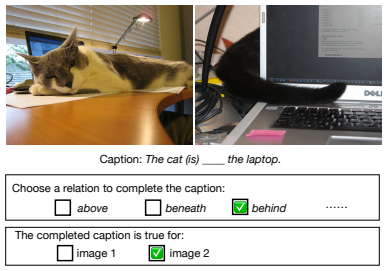
Figure 3 : An annotation example of concepts “cat” & “laptop” in contrastive caption generation. The example generates two data points for our dataset: one “True” instance when the completed caption is paired with image 2 (right) and one “False” in- stance when paired with image 1 (left).
Original paper · CC BY 4.0 · Fangyu Liu, Guy Emerson, Nigel Collier · Visual Spatial Reasoning · Original paper figure · Extracted the figure area from page 3 of the original PDF.Why current benchmarks can't isolate spatial reasoning
Benchmarks such as NLVR2 and VQA have driven broad progress, but they blend several sources of error into one score. A wrong answer can come from the sentence's syntax or from the relation itself, and the two are hard to tell apart. Spatial reasoning proves harder for current models than capturing properties of individual entities, even for CLIP.
Synthetic benchmarks such as CLEVR let researchers control which relations appear, so each relation can be isolated. CLEVR, however, bounds its expressivity, because objects relate through only four relationships. The VSR dataset covers 66 relations, which is a much wider range than those four. Spheres in synthetic scenes have no orientation, so these datasets miss how orientation shapes human descriptions.
Synthetic images also ignore the scene as context, although the scene changes how closeness is read.
Visual Genome contains spatial relations, but it holds only true statements and no negative ones. Without negatives, it can't be framed as a binary classification task, and building negatives automatically is hard. Yatskar et al. (2016) extract 6 types of visual spatial relations from MS COCO using bounding boxes. Most relations, however, can't be identified from bounding boxes alone, so this rule-based extraction is restrictive.
VALSE tests relations but has no training set and contains just 535 data points. Text-only probes can't link language to grounded spatial information, so VSR pairs vision and language input instead.
Building the VSR captions and labels
The pipeline starts by sampling two COCO concepts and retrieving images that contain both from the COCO 2017 train and validation sets. Images with several instances of either concept are dropped, and single-instance images with a pixel area below 30,000 are removed. Annotators fill a template with one relation so that the caption is correct for one image and incorrect for the other.
The template reads "The ENT1 (is) the ENT2.", and the copula is dropped for relations such as "contains". The relation comes from a fixed list of 71 options, and 66 of them appear in the final dataset.
Each annotated point then goes to at least three validators, who label it True or False without seeing the original label. A point doesn't stay in the data unless at least two validators agree with the original label. For left/right and front/behind relations, validators label a caption True when it holds under either the intrinsic or the relative frame.
The validation phase collected 39,507 labels for 12,809 raw data points. All validators agreed with the original label for 69.1% of the data points, and the filtering left 10,972 validated points.
The authors split the 10,972 validated points twice, once randomly and once by concept. The random split uses a 70/10/20 ratio, giving 7,680 train, 1,097 dev and 2,195 test examples. The concept zero-shot split groups concepts into 50/20/30 sets, so no concept overlaps across train, dev and test. That grouping filters out many mixed-concept points, so the zero-shot split leaves only 4,713, 231 and 616 examples, totalling 5,560.
Reference frames change what a caption means
Annotators had to decide what "left of" means, because a relation can hold from an object's own side or from the viewer's position. The paper calls these the intrinsic and relative frames, and it says both are widely used in practice. The authors told annotators to label a caption True when it holds under either frame. Only a caption that fails under both frames gets a False label.
In the potted plant example, the plant is on the viewer's left but on the bench's right.
Among the 616 left/right true statements, annotators used the intrinsic frame in 68 cases (11%). Relative frame use reached 518 instances, or 84%. Only 30 statements (5%) can be read under both frames. Annotators were 91% native English speakers. All of them were university-educated.
The authors then asked whether a person in the caption changes how annotators choose frames. Of the 198 person-involving instances, 32 (16%) used the intrinsic frame. Of the same 198 instances, 154 (78%) used the relative frame. Captions without a person used the intrinsic frame in 9% of cases and the relative frame in 87%. A two-tailed Fisher's exact test gives p=0.0054 when both-frame cases are ignored.
The authors suggest that a human in the scene makes the intrinsic frame more likely.
Fine-tuned models against the human ceiling
The authors fine-tuned VisualBERT, LXMERT and ViLT on the VSR training split, and each stacked Transformer takes image-text pairs as input. The three models differ mainly in how they encode the position of objects, which is the variable the authors later examine. The authors skipped direct inference from off-the-shelf checkpoints, since some pretraining objectives conflict with the binary VSR task.
Each model ran three times with three random seeds, and the best checkpoint on the dev set was kept for testing.
On the random split, LXMERT reached 70.1±0.9 and ViLT reached 69.3±0.9, while VisualBERT reached 55.2±1.4. On the concept zero-shot split, ViLT dropped to 63.0±0.9 and LXMERT dropped to 61.2±0.4. VisualBERT stayed only slightly above chance level on the random split, and it fell to 51.0±1.9 on the zero-shot split. Two additional annotators labelled 500 random-split test examples and reached an accuracy of 95.4% on them.
Every fine-tuned model therefore trails the human ceiling by more than 25%, which the authors read as substantial room for improvement.
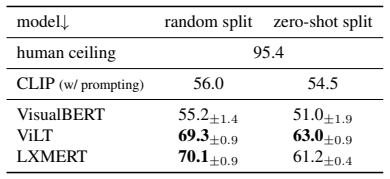
Table 4 : Model performance on VSR test set. CLIP is applied without finetuning but with carefully engineered prompts while the other three smaller models are finetuned on the training set.
Original paper · CC BY 4.0LXMERT and ViLT beat VisualBERT by more than 10% on both splits. LXMERT takes position features as part of its input, and these features describe where each object sits in the image. ViLT cuts the image into patches rather than object regions, and it adds positional encodings that signal each patch's position. VisualBERT has no explicit position encoding, and the authors link this gap to the importance of positional information for VSR.
Off-the-shelf CLIP with prompting compares the embedding similarity of each image-caption pair against its negated caption. CLIP with prompting scored 56.0 on the random split and 54.5 on the zero-shot split. The authors read these scores as close to chance, which points to weak spatial reasoning in CLIP. The gap between the random and zero-shot splits is large, and the authors attribute it to concept zero-shot learning being fundamentally hard rather than to the number of training examples.
Where the models fail: orientation and proximity
Orientation is the worst performing relation category on the random split, and average model accuracy stays close to chance level. The authors group the per-relation results by the seven categories from Marchi Fagundes et al. (2021) to get a higher-level view. Per-relation accuracy does not seem to correlate with how often each relation appears in training, which the authors read as evidence against a data-shortage explanation.
LXMERT failed on two examples in Fig. 9, one about a hair drier facing away from a person and one about a bench in front of a person. Both examples need the model to understand the front of an object, which is an orientation cue. Left/right relations are also difficult, because the intrinsic reference frame requires understanding the orientation of objects.
In Fig. 1, all three models predicted False, yet from the bench's point of view the potted plant is at the right. The authors also report other error types, such as Fig. 11, where two of the three models predicted wrongly on a cow at the back of a car.
Proximity falls from close to 75% accuracy on the random split to chance level on the zero-shot split, and the drop is particularly drastic across all models. The authors believe proximity is relative and depends heavily on the concept and its frequent physical context. A person being near an oven differs from a person being near a train or a truck, so the notion of closeness shifts with the concept.
Because the zero-shot split keeps test concepts out of training, models lack a grasp of close to or far from for those concepts and generalise poorly.
Reference frame labels as an auxiliary signal
The authors first fine-tuned ViLT to predict the reference frame of true left/right statements from the image. ViLT reaches a macro-averaged F1 of 56.9±4.4 on this frame prediction task.
Next, the frame-trained ViLT checkpoint initialises the VSR model, which is then fine-tuned on the left/right relations only. Accuracy on that subset rises from 54.2±0.6 for the original pretrained checkpoint to 59.2±1.8 with the frame-trained start. The authors call this a clear positive transfer from the reference frame prediction task to the VSR task.
Because the frame train, dev and test sets come from the VSR split, the authors note that no data leakage is possible.
The authors' reading is that simulating intrinsic and relative frames could be an intermediate reasoning step in judging a statement. Under this reading, learning to recognise reference frames helps the model with the downstream spatial reasoning task. The experiment changes only the starting checkpoint, so the gain comes from the frame labels rather than from more VSR training.
How training size changes results
The sample efficiency analysis asks whether more training data explains the gap between models and between the random and zero-shot splits. LXMERT reaches above 55% accuracy with 100 shots on both splits, and ViLT is also quite performant with 25% of the training data. The zero-shot split is substantially harder, so the authors treat LXMERT's few-shot start as a sign of its pretrained object detector.
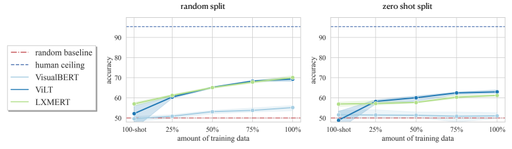
Figure 12 : Sample efficiency analysis: model performance under different amounts of training data (100-shot, 25%, 50%, 75% and 100% of training set). Results on both the random and zero-shot split test sets are shown. As training data increases, the performance plateaus on both sets but the flattening trend is more obvious on the zero-shot split.
Original paper · CC BY 4.0On the zero-shot split, most models plateau at around 75% of the training set, and the flattening is more obvious than on the random split. On the random split, all models keep improving with more data, although LXMERT and ViLT slow down substantially after 75%. The authors suggest that LXMERT's pretrained object detector gives it a strong inductive bias, since it doesn't need to learn concept boundaries and classes from scratch.
That early lead fades as the number of training examples increases. Their by-relation analysis shows no clear correlation between accuracy and relation frequency, so the zero-shot gap is unlikely to come from too few training examples.
What the results do not cover
The study fine-tunes only three VLMs: VisualBERT, LXMERT and ViLT. CLIP was tested only with prompting, because the authors didn't fine-tune it. Large dual-encoders such as ALIGN and LiT remain untested for spatial relations. Ultra-large-scale VLMs also fall outside the experiments.
Every caption is in English, and the dataset includes no absolute frames. Annotators were 91% native English speakers, and all were university-educated. No multilingual or cross-cultural model test was run, although the authors name both as future directions.
Of 100 sampled examples with high annotator disagreement, around 30 came from annotation errors. The remaining examples were judged genuinely ambiguous, which points to intrinsic ambiguity in the task. The standard splits exclude these ambiguous cases, so models are tested only on examples with human consensus. The authors didn't score models on the unfiltered data, which they release separately.
The human ceiling is above 95%, while the models reach about 70% at best. The reported ceiling comes from a sample of 500 random-split test examples.
Paper info
- Authors
- Fangyu Liu, Guy Emerson, Nigel Collier
- Venue
- arXiv · Preprint
- First published
- 2022-4-30
- Added
- 2026-11-6
- Updated
- 2023-3-22
- Version
- v3
- arXiv
- 2205.00363
- Category
- cs.CL · cs.AI · cs.CV
- Original paper terms
- CC BY 4.0
- What we show
- Paper info, commentary and permitted figures from the original paper
AI commentary is a separate explanation from the original paper and may contain errors. The original paper and figures follow each source's terms of use and any rights noted separately.
Abstract
Spatial relations are a basic part of human cognition. However, they are expressed in natural language in a variety of ways, and previous work has suggested that current vision-and-language models (VLMs) struggle to capture relational information. In this paper, we present Visual Spatial Reasoning (VSR), a dataset containing more than 10k natural text-image pairs with 66 types of spatial relations in English (such as: under, in front of, and facing). While using a seemingly simple annotation format, we show how the dataset includes challenging linguistic phenomena, such as varying reference frames. We demonstrate a large gap between human and model performance: the human ceiling is above 95%, while state-of-the-art models only achieve around 70%. We observe that VLMs' by-relation performances have little correlation with the number of training examples and the tested models are in general incapable of recognising relations concerning the orientations of objects.
Quote from the paper
Fangyu Liu, Guy Emerson, Nigel Collier (2022). Visual Spatial Reasoning. arXiv:2205.00363v3. https://arxiv.org/abs/2205.00363v3
BibTeX
@misc{liu2022visual,
  title = {{Visual Spatial Reasoning}},
  author = {Fangyu Liu and Guy Emerson and Nigel Collier},
  year = {2022},
  eprint = {2205.00363},
  archivePrefix = {arXiv},
  url = {https://arxiv.org/abs/2205.00363v3}
}