Paper commentary
HydroTuring: A physics probe benchmark testing mass, energy, and momentum conservation in hydrologic models
Black-box probes expose water-budget leaks that hydrograph scores miss
- Problem Streamflow scores miss models that lose 15% of their water.
- Method HydroTuring is a black-box benchmark of 37 physics probes. Each probe runs a controlled experiment on generated forcing and returns pass, fail or N/A, instead of a single weighted score.
- Results Only the three exact reference models pass every probe they are scored on. Process-based models pass 76% of scored probes and AI-based models pass 74%.
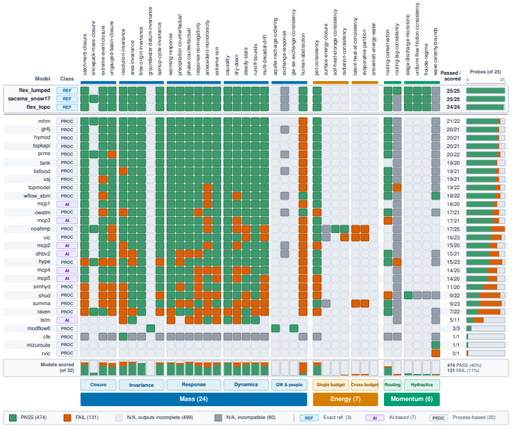
Figure 4 .Verdict matrix of 32 models on 37 probes in suite 0.1.0. Rows are models. The 3 exact references are on top, and the other models follow in order of the number of probes that they pass. Columns are probes, grouped by law. Green is PASS and orange is FAIL. Light gray is N/A because the model does not report the required variables (INCOMPLETE), and dark gray is N/A because model and probe disagree on an input or a time step (INCOMPATIBLE).
Original paper · CC BY 4.0 · Zhi Li, Changming Li, Siavash Shams, Han Wang, Qingyi Yang, Yuanhang Liu, Taiqi Lian, Xin Lan, Shunan Zhou, Binlan Zhang, Siddik Barbhuiya, Songkun Yan, Bing Li, Jinlong Hu, Yaji Wang, Zhenjiang Wu, Mofan Zhang, Kaihao Long, Jingzhi Chen, Yuan-Heng Wang · HydroTuring: A physics probe benchmark testing mass, energy, and momentum conservation in hydrologic models · Original paper figure · Extracted the figure area from page 16 of the original PDF.Why hydrograph scores miss physical failures
Hydrologic models are usually judged by how closely their simulated streamflow follows observed runoff. In a synthetic calibration experiment, reference_bucket conserves water and reaches a Nash-Sutcliffe efficiency of 0.97. Both values clear the 0.75 threshold that Moriasi et al. (2007) rate as very good, so the hydrograph score can't separate the two.
The leaky model loses 15% of every year's precipitation, which the score never shows.
The gap grows with model complexity, because a hydrologic system carries precipitation, temperature, evaporative demand, soil, snow and groundwater states. With 6 such dimensions and 10 bins each, a 40-year daily record of 14,610 samples visits at most 1.5% of the distinct regimes. A streamflow fit therefore sees only a thin slice of the conditions it will later face.
The authors argue that process-based models can fail the same way, so the test has to cover learned, physical and hybrid models alike.
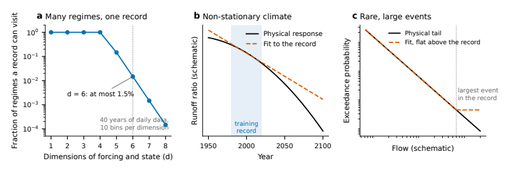
Figure 1 .Why a streamflow fit does not establish physics.a, Upper bound on the fraction of distinct regimes that a record can visit, for 14,610 daily samples and 10 bins per dimension. The count is arithmetic, not data.b,c, Schematics of 2 failure modes of a pure streamflow fit. A fit trained on a record departs from a drifting physical response (b), and it stays flat above the largest event in the record (c). Panelsbandcare illustrations and carry no data.
Original paper · CC BY 4.0Standard scores such as NSE and KGE are computed on observed basins. Physics-informed learning builds constraints into training, but no shared test checks whether a trained model honors them. HydroTuring instead tests the model after training, as delivered, without access to its weights.
Treating physics as a black-box test suite
HydroTuring treats physical laws as a test suite, where each probe asks one physical question and returns a verdict. The question shifts from how close a model gets to one record to what it must do under any record. Each probe returns PASS, FAIL or N/A, and every criterion keeps its own number. A composite score of 0.8 can't say which law a model violates, which is why the design avoids a weighted aggregate.
Each probe runs several seeds, and a model must pass all of them. Of the 37 probes, 22 use 3 seeds, 14 use 5, and 1 uses 12. The seeds are recorded, so any failure can be reproduced.
The harness writes the request, forcing and static attributes to a read-only directory, then reads the outputs from a result file. Paired cases add a second test type: a control run and one perturbed copy that differ in one input are compared.
How a probe turns a run into a verdict
A probe asks one physical question, and it returns PASS, FAIL or N/A after a controlled run. The paired cases are the design choice that lets a probe check response, not just the closure of a single run. Of the 37 probes, 18 compare two or more runs of the same case.
The mass probes start from the water budget of the control volume, written as P+G−E−Q−A = ΔS soil + ΔS snow + ΔS canopy + ΔS gw + ΔS ch. Here P is precipitation, E is evapotranspiration including sublimation, and Q is runoff. Every store must stay within its physical range, and evaporation must stay at or below demand.
The criteria each return a binary result and a measured value, so a reader sees how far a limit was missed. Each probe runs its criteria on several seeds, and a model passes only when every seed passes. A missing output gives N/A rather than FAIL, because a model that lacks a variable hasn't violated conservation. A model passes the suite only when at least one probe could be put to it and every scored probe passes.
Because N/A probes count neither for nor against a model, the paper always reports the pass fraction with the number of probes scored.
The 37 probes cover three laws: 24 for mass, 7 for energy and 6 for momentum. Each criterion inside a probe keeps its own number, so a failure names the violated law and the error size. The probes are labeled by regime, so errors of opposite sign in different regimes can't cancel. Before a probe is merged, it must pass the acceptance gate, which is described in the next section.
Validating probes against reference models
A probe only counts as a test once it has been checked against models whose answer is known in advance. Every probe must pass an acceptance gate before it is merged into the suite. The suite carries 77 reference models, 18 exact and 59 broken. The 37 probes carry 116 must-pass checks and 78 must-fail checks. The must-fail check also requires the broken reference to trip the specific criterion the probe was built to trip.
The exact references come from four common baselines plus 14 others written for the probes whose physics they exercise. Each of the 59 broken references carries one defect that the suite must detect. The reference_leaky model hides a silent 15% sink, so its budget doesn't close. An exact model sets the lower bound on tolerance, because a limit tighter than exact physics achieves would reject honest models.
Over 20 random seeds, the exact bucket, flex_lumped and sacsma_snow17 pass catchment-closure on all 20, with residuals below 2.3×10 −15 of precipitation. A broken model sets the upper bound: reference_leaky fails the closure criterion on 20 of 20 seeds.
The closure tolerance sits in an interval that separates the evaluated models from the broken model. Any change to the limit requires the governance process described in Section 5.
A single seed can miss a defect, so the probes draw several seeds and a model must pass all of them. Of the 120 three-seed subsets among the 10 seeds, 116 contain at least one seed that exposes the defect, which is why the probe uses 3 seeds.
Verdicts across 32 models
The verdict matrix covers 32 models on 37 probes, which gives 1,184 model-probe pairs. Of these pairs, 474 are PASS, 131 are FAIL and 579 are N/A. Among the N/A pairs, 499 are INCOMPLETE and 80 are INCOMPATIBLE. INCOMPLETE means the model doesn't report the variables a probe needs, while INCOMPATIBLE means the model and probe disagree on the time step, an input, or paired-perturbation support.
Only PASS and FAIL enter a model's score, so an N/A pair neither helps nor hurts a model.
Half of the matrix goes unscored: 49% of all model-probe pairs remain unscored. The main cause is missing output variables, and time-step mismatches add to it.
Only the three exact references pass every probe they are scored on, which is 74 of 74 pairs. Among the 28 models scored on 5 or more probes, no other model passes every scored probe. The 7 AI-based models pass 98 of 133 scored pairs (74%), compared to 302 of 398 (76%) for the 22 process-based models. Because the two pass rates are nearly identical, model class alone doesn't predict physical consistency.
Where scored models fail: which criteria trip, and what a closure pass means
Human_abstraction is the most common trip because most models don't account for the prescribed human withdrawal at all.
The 22 models that report a residual on catchment-closure stay small, with the largest at 2.5% of precipitation. A closing budget doesn't imply physical stores and fluxes, though.
Closure over the whole record doesn't guarantee closure event by event. The model xaj passes the whole-record check with a residual of 2.5%, yet it fails on 133 of 1,316 events. Shud fails on 130 of 1,257 events, while cwatm fails on only 4 of 1,257 events. Hype, simhyd and summa fail the same extreme-event probe on state bounds instead.
A streamflow-only LSTM under the probes
An LSTM flood-forecasting model shows what HydroTuring does with a model that reports only streamflow.
The model reports runoff and discharge only, so it is N/A on 26 of 37 probes. On the 11 probes it can be scored on, the LSTM passes 5 and fails 6. It also produces more runoff on a wetter catchment, which is a plausible climatological response.
The first failure group concerns input extremes. Over 2 rainless years, the discharge stays near 0.3 mm d−1 and never recedes. The exact bucket returns 0.56 to 1.00 of the added rain on the same probe, which makes the gap clear.
The second group concerns perturbation responses. Warming-response fails at 0.088 per unit of added demand, while the exact bucket falls by 0.20. Letting the static climate attributes update with the warmed record gives a stronger response.
The third group concerns physical consistency.
What the benchmark does not establish
Passing HydroTuring is a necessary condition for physical consistency, not a sufficient one for predictive accuracy. The suite therefore complements hydrograph evaluation rather than replacing it.
Public probes can be targeted, even though a fresh seed stops a model from memorizing a case. A fresh seed doesn't stop a developer from tuning a model to the rule that a probe tests. The suite offers 2 defenses, and the first is a private probe tree added with --probe-root. Holding out probes whose generators and tolerances are unpublished lets an evaluator test models that never saw them.
Each verdict also reports its measured quantity, so a model that barely passes can be identified. The authors therefore treat public-suite verdicts as a pre-deployment smoke test, not a certification.
The tolerances are conventions, not physical constants. The 5% closure limit and the 10% resolution limit are engineering choices. The sweep in Section 3.4 shows that closure verdicts don't change for any limit between 2.6% and 15%. Changing a tolerance requires the governance process in Section 5. The catchment and the weather are synthetic, with most probes running on one invented lumped catchment of 250 km 2.
A physical violation and a distribution shift can't always be separated on this synthetic setup.
All 3 of those models fail them, and the authors regard the archived scores as provisional. The suite checks the internal consistency of reported variables, not the physical realism of internal states. Paired and counterfactual probes make that adjustment harder to sustain, but they can't rule it out completely. Each model enters with one version and one adapter, and scores are comparable only within one suite version.
Paper info
- Authors
- Zhi Li, Changming Li, Siavash Shams, Han Wang, Qingyi Yang, Yuanhang Liu, Taiqi Lian, Xin Lan, Shunan Zhou, Binlan Zhang, Siddik Barbhuiya, Songkun Yan, Bing Li, Jinlong Hu, Yaji Wang, Zhenjiang Wu, Mofan Zhang, Kaihao Long, Jingzhi Chen, Yuan-Heng Wang
- Venue
- arXiv · Preprint
- First published
- 2026-11-8
- Added
- 2026-11-10
- Updated
- 2026-11-8
- Version
- v1
- arXiv
- 2611.11563
- Category
- physics.geo-ph · cs.AI · cs.LG · physics.app-ph
- Original paper terms
- CC BY 4.0
- What we show
- Paper info, commentary and permitted figures from the original paper
AI commentary is a separate explanation from the original paper and may contain errors. The original paper and figures follow each source's terms of use and any rights noted separately.
Abstract
Hydrologic models, including deep learning systems now deployed for operational flood forecasting, are evaluated primarily by how closely their simulated hydrographs match observed streamflow. However, high hydrograph skill does not guarantee physical consistency: in a synthetic calibration experiment, a conceptual model that loses 15% of its water input to an unreported sink still reaches a Nash-Sutcliffe efficiency of 0.93, and no shared benchmark tests whether models obey fundamental conservation laws. Here we introduce HydroTuring (v0.1.0), a black-box benchmark of 37 physics probes that test mass (24 probes), energy (7) and momentum (6) conservation in hydrologic models. Each probe runs a controlled experiment on forcing generated at run time from a recorded seed and applies binary pass or fail criteria validated against 18 physically exact and 59 deliberately broken reference models. Across 32 evaluated models (3 exact references, 7 AI-based models and 22 process-based models), only the 3 exact references pass every probe among the 28 models scored on 5 or more probes. Process-based and AI-based models pass similar shares of their scored probes (76% and 74%), and a pre-trained flood-forecasting LSTM fails 6 of the 11 runoff-only probes it can be scored on. Furthermore, 49% of all 1,184 model-probe pairs remain unscored because models omit the required state or flux variables, while the scored failures occur in perturbation responses and state bounds rather than long-term water-budget closure. HydroTuring provides a reproducible smoke test for model development, peer review and operational deployment under an open community protocol.
Quote from the paper
Zhi Li, Changming Li, Siavash Shams, Han Wang, Qingyi Yang, Yuanhang Liu, Taiqi Lian, Xin Lan, Shunan Zhou, Binlan Zhang, Siddik Barbhuiya, Songkun Yan, Bing Li, Jinlong Hu, Yaji Wang, Zhenjiang Wu, Mofan Zhang, Kaihao Long, Jingzhi Chen, Yuan-Heng Wang (2026). HydroTuring: A physics probe benchmark testing mass, energy, and momentum conservation in hydrologic models. arXiv:2611.11563v1. https://arxiv.org/abs/2611.11563v1
BibTeX
@misc{li2026hydroturing,
  title = {{HydroTuring: A physics probe benchmark testing mass, energy, and momentum conservation in hydrologic models}},
  author = {Zhi Li and Changming Li and Siavash Shams and Han Wang and Qingyi Yang and Yuanhang Liu and Taiqi Lian and Xin Lan and Shunan Zhou and Binlan Zhang and Siddik Barbhuiya and Songkun Yan and Bing Li and Jinlong Hu and Yaji Wang and Zhenjiang Wu and Mofan Zhang and Kaihao Long and Jingzhi Chen and Yuan-Heng Wang},
  year = {2026},
  eprint = {2611.11563},
  archivePrefix = {arXiv},
  url = {https://arxiv.org/abs/2611.11563v1}
}