Paper commentary
AVCC: Audio-Visual Conversation Corpus for Turn-Taking Prediction with a Human Benchmark
AVCC adds a public turn-taking benchmark with human reference scores
- Problem Turn-taking models for social robots lacked a public benchmark for a single camera and microphone. Studies also used different turn events, and no model had been compared against human performance on the same prediction.
- Method AVCC turns a 31-hour online conversation corpus into a public benchmark with a speaker-disjoint test set. Unlike earlier corpora with per-speaker sensors, it uses one static camera and microphone, and adds human scores on the same events.
- Results RoleVAP reached 66.5% on hold/shift prediction, compared with 64.0% for the mean participant. MuVAP, which adds video, reached 67.9%.
Why multiparty turn prediction is hard to compare
Each study defines its own turn events, so its results don't line up with those of other studies. The speech-only line instead treats turn taking as continuous prediction, using Voice Activity Projection (VAP) [17]. Its training corpora, such as Switchboard and Fisher, are dyadic telephone recordings with one clean channel per speaker.
Neither line offers a public benchmark for one camera and one microphone, the setup most social robots use for a whole group. Nor do the studies share prediction points, so systems can't be compared on the same events. Without a human reference, a model at 65% accuracy can't be read as near or far from what the signal allows. AMI uses close-talk microphones and a camera array, while EgoCom uses one egocentric camera per participant.
NoXi, AVA-ActiveSpeaker, MSDWild, WASD and MultiMediate target active-speaker detection or group behavior, with no hold/shift events.
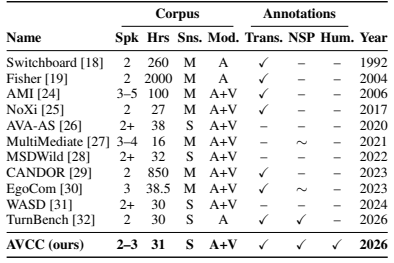
Table 1 . Corpora relevant to multiparty NSP. Spk: speakers per recording. Sns.: sensors, S = one camera at most and one audio channel, M = per-speaker microphones or several cameras. Mod.: modality, A = audio, V = video. Trans.: transcripts. NSP: hold/shift or next-speaker labels. Hum.: human NSP reference.∼= partial.
Original paper · CC BY 4.0AVCC, introduced with MuV AP, holds 31 hours of conversation from 29 online videos, each recorded with one static camera. Its release has training and validation partitions but no held-out test data, so a model can be trained on it but not compared. The authors add a seven-video test partition, word-level transcripts and a human study with 154 participants to close that gap.
A benchmark built on one camera
AVCC keeps its single static camera and monaural track, and the authors add a held-out test split, transcripts and a human reference. Each prediction point is a turn event at a mutual-silence gap, labeled shift when the floor changes speaker and hold when the same speaker continues. A candidate gap must be shorter than 3.0 s, and the next speaker must talk for at least 1.0 s within the 2.0 s after it.
Holds outnumber shifts, so the authors down-sample holds at random until the two classes match.
The split works by video, so no speaker in the test set appears in training or validation. Together they give 865 hold and 865 shift events, 1,730 in total, on which every model and participant is scored.
Participants came from the authors' personal network and from Prolific, and 188 people answered at least one trial. After three exclusion rules, 154 participants are retained. RoleV AP predicts a current and a next role, so the authors score it on hold/shift only. Human-Ind averages each participant's accuracy, while Human-Maj keeps only events with a plurality and drops ties.
Because all systems and participants share the same 1,730 events, a gap between a model and a participant doesn't come from different sample items. Under hold/shift scoring, the mean participant reaches 64.0%, while RoleV AP reaches 66.5% and MuV AP reaches 67.9%. The majority vote reaches 70.1% on 1,526 untied events, which gives the models an upper anchor.
From speech labels to turn events
InsightFace finds faces in every frame and gives each one a per-video speaker identity. It combines SCRFD detection, ArcFace identity embeddings, and Hungarian assignment for the matching step. The authors then checked every track by hand for identity swaps, lost tracks at segment boundaries, and false detections on photographs. TalkNet gives the first speech labels at its default confidence threshold, and the authors correct every segment with their own annotation tool.
The Montreal Forced Aligner, with an English acoustic model and the CMU dictionary, aligns the words within each transcribed segment. Hand correction follows the alignment, so the word timings in the transcripts are checked before any event is built. Words from one speaker separated by at most 0.1 s merge into inter-pausal units, which are then regrouped into utterances.
A candidate turn event must be a mutual-silence gap shorter than 3.0 s, with at least 0.1 s of silence left after 0.1 s of padding. The next speaker must produce at least 1.0 s of speech within 2.0 s after the gap, and be the only active speaker in the first 1.0 s.
A candidate event is also dropped when the gap contains laughter or other vocal noise. Holds outnumber shifts among the candidates, so the authors down-sample holds at random to match the shifts. The prediction point sits 0.1 s after the previous speaker's last word, and up to 10 s of context comes before it. The gap itself, at most 3 s long, and the following speech are withheld from the event.
After down-sampling, the test partition holds 865 shift and 865 hold events.
Human trials and quality filtering
Each trial plays the audio and video from up to 10 s before the gap onset, with face boxes labelled 0, 1 and 2 on every frame. The clip stops at the gap onset, and answer buttons unlock once the playback has finished one full pass. They can replay as often as they like, and then select the face they think will talk next and give a 1-to-5 confidence rating.
Every participant worked through 30 events split into three blocks of ten, and each block held five holds and five shifts. Events from one segment that sat within 10 s of each other never reached the same person. Recruitment combined 85 people from the authors' network and 103 Prolific participants, 188 in total.
Three rules removed participants: self-reported proficiency below advanced (13), automatic flags (18), and returned or timed-out Prolific submissions (6). Of the 188, 34 were removed by at least one rule, leaving 154. Partial sessions of at least four trials were kept, since each person's accuracy is a mean over their own responses. Human-Ind averages these per-person accuracies, while Human-Maj keeps only events with a plurality and drops ties.
Hold/shift accuracy against people
Under hold/shift scoring, picking the previous speaker counts as hold, and picking anyone else counts as shift. That makes RoleV AP usable here, because the model outputs roles and can't pick a face from its monaural input. For both models, a logistic regression probe reads the decision from the embedding at the prediction point, trained on the AVCC training partition.
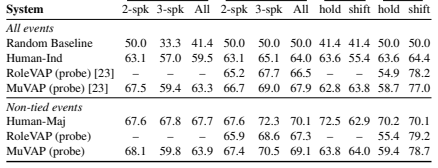
Table 3 . Accuracy (%) on the 1,730 A VCC test events (865 hold / 865 shift). Left: balanced accuracy by scoring and speaker count. Right: hold and shift accuracy by class. Human-Ind: mean per-participant accuracy (N=154). Human-Maj: plurality label per event, ties ex- cluded (251 under NSP scoring, 204 under hold/shift); the model rows beneath it are scored on the same retained events. Random Base- line: expected accuracy of a uniform guess over the faces (NSP) or over hold and shift, weighted by the events in each cell. Human-Maj baseline is 41.5. Scoring and the probe readout as in Sec. 3.4.
Original paper · CC BY 4.0 · Haotian Qi, Gabriel Skantze · AVCC: Audio-Visual Conversation Corpus for Turn-Taking Prediction with a Human Benchmark · Original paper figure · Extracted the figure area from page 3 of the original PDF.On 1,526 untied events, RoleV AP reached 66.5% balanced accuracy, compared to 64.0% for the mean participant and 70.1% for the majority vote. MuV AP reached 67.9%, 1.4 points higher than the audio-only RoleV AP. Adding video therefore helps, but only by a small margin on this decision. Both models gain with more speakers under this scoring: RoleV AP goes from 65.2% to 67.7% and MuV AP from 66.7% to 69.0%.
The per-class columns show where the gap sits. RoleV AP scored 78.2% on shifts but 54.9% on holds, and MuV AP scored 77.0% on shifts and 58.7% on holds. The lead over people therefore sits in shifts that participants missed, while the models lose on holds that participants call correctly. The authors read this as both models predicting shift too often.
The authors treat the gap of roughly 1 to 4 points below the majority vote, mostly on holds, as headroom left.
Naming the next speaker
MuV AP names the next speaker by first naming the current floor holder, then reading its own probe decision. On NSP, MuV AP reaches 63.3% balanced accuracy, which sits 3.8 points above the mean participant at 59.5%. That same 63.3% sits 4.4 points below the majority vote of 67.7% on 1,479 untied events. The majority vote drops tied events, so the models are compared with it only on the retained events.
Participants drop from 63.1% on two-speaker events to 57.0% on three-speaker events, a loss of 6.1 points. MuV AP falls from 67.5% to 59.4% on the same step, losing 8.1 points. Participants' hold/shift accuracy moves the other way, gaining 2.0 points when the group grows from two to three speakers.
The floor holder isn't the bottleneck for MuV AP, since it identifies that speaker in 93.4% of events. On those events alone, its NSP accuracy rises only from 63.3% to 64.4%. On three-speaker shifts, MuV AP names the incoming speaker in 57.4% of events. The loss therefore sits in choosing between the two candidates, not in finding the floor holder.
The extra speaker doesn't make the change harder to detect, but it makes the next speaker harder to pin down.
Participants find holds easier to name than shifts, with the majority vote reaching 72.5% on holds and 62.9% on shifts. Participants saw only the clip up to the gap onset, so cues inside the gap are missing to them.
Confidence and tied votes
Splitting per-participant accuracy by that rating shows how much the rating tells about each class. Hold accuracy climbs from 43.2% at confidence 1 to 85.0% at confidence 5. Shift accuracy stays between 51.5% and 60.1% at ratings 2 to 5, and it peaks at rating 4, not 5. Confidence therefore tracks holds closely, while for shifts it carries almost no information.
At confidence 1, three-speaker accuracy is 35.6%, and two-speaker accuracy is 52.8%. Both values sit close to chance at that rating. At confidence 5, both two-speaker and three-speaker accuracy exceed 75%. At the lowest rating both sit at chance, which the authors read as well-calibrated low confidence. The released ratings mark the events people cannot decide themselves, and the authors say those are shifts.
Votes tie on 251 events under NSP scoring, so no plurality label exists for those events. Of these tied events, 151 are shifts. 145 of the tied events come from three-speaker videos, so most ties are multiparty shifts.
Limitations of the clip design and the human sample
The human clips end at the gap onset, so participants never see or hear the gap itself. The lost cues include the fast visual signals an incoming speaker gives just before talking. Short gaps are easier, because the prediction point sits nearer the next turn. More of the next speaker's cues then fall inside the visible context.
Each clip shows at most 10 s of audio and video before the gap onset. They didn't test clips longer than 10 s, so the effect of more context stays unmeasured.
The human sample draws 85 people from the authors' personal network and 103 from Prolific. Of the 188 people who answered, 34 were removed by at least one rule, leaving 154 participants. Votes tie on 251 events under NSP scoring, so those events drop out of Human-Maj.
Participants were paid at the platform's recommended rate and could withdraw at any time.
Paper info
- Authors
- Haotian Qi, Gabriel Skantze
- Venue
- arXiv · Preprint
- First published
- 2026-11-10
- Added
- 2026-11-11
- Updated
- 2026-11-10
- Version
- v1
- arXiv
- 2611.13957
- Category
- cs.CL · cs.HC · cs.SD
- Original paper terms
- CC BY 4.0
- What we show
- Paper info, commentary and permitted figures from the original paper
AI commentary is a separate explanation from the original paper and may contain errors. The original paper and figures follow each source's terms of use and any rights noted separately.
Abstract
} Predicting who will speak next, and when, is a prerequisite for conversational agents and social robots that take turns without waiting for silence. Multiparty next-speaker prediction (NSP) has been studied on corpora with per-speaker sensors, each with its own event definitions. No public benchmark covers the single camera and microphone a robot has, and no model has been compared against how well people perform the same prediction. We turn AVCC, a 31-hour audio-visual corpus of two- and three-speaker online conversation recorded with a single static camera and microphone, into a public NSP benchmark. We add a speaker-disjoint seven-video test partition with 865 hold and 865 shift events at mutual-silence gaps, word-level forced-aligned transcripts for the whole corpus, and a human reference benchmark collected at the same events. We score an audio-only Role-Relative VAP model (RoleVAP) and the multimodal MuVAP model. Labels, transcripts, per-response human data, and the scripts that reproduce every number are released.
Quote from the paper
Haotian Qi, Gabriel Skantze (2026). AVCC: Audio-Visual Conversation Corpus for Turn-Taking Prediction with a Human Benchmark. arXiv:2611.13957v1. https://arxiv.org/abs/2611.13957v1
BibTeX
@misc{qi2026avcc,
  title = {{AVCC: Audio-Visual Conversation Corpus for Turn-Taking Prediction with a Human Benchmark}},
  author = {Haotian Qi and Gabriel Skantze},
  year = {2026},
  eprint = {2611.13957},
  archivePrefix = {arXiv},
  url = {https://arxiv.org/abs/2611.13957v1}
}