Paper commentary
Understanding Mixture-of-Experts Language Models Beyond Expert Boundaries
Neurons in MoE models show domain specialization that expert-level routing hides
- Problem Routing preferences alone don't show whether an MoE expert does one domain's computation. Routing may reflect surface token features instead, so the neuron-level organization was unclear.
- Method RAMP, Routing-Aware Magnitude Profiling, scores each neuron by its routed contribution. RAMPr then keeps top-scoring neurons across experts instead of removing whole experts.
- Results Neuron enrichment correlates with expert routing preference, with median Spearman correlations of 0.42 to 0.71 across models.
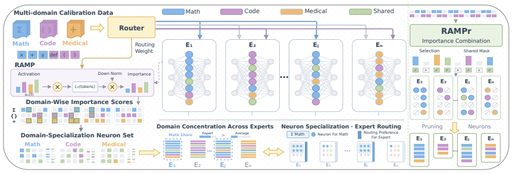
Figure 1 .Routing-weighted activation magnitudes and output projection norms quantify domain-wise neuron importance, revealing domain-specialized sets that span mixed experts. Their enrichment correlates with domain routing preferences. Aggregating these important scores guides multi-domain neuron pruning across experts, retaining different numbers of neurons in each expert.
Original paper · CC BY 4.0 · Zhenhong Zhou, Mao Zheng, Mingyang Song, Qiankun Li, Kun Wang, Junfeng Fang · Understanding Mixture-of-Experts Language Models Beyond Expert Boundaries · Original paper figure · Extracted the figure area from page 2 of the original PDF.Why routing patterns don't settle specialization
The usual picture of an MoE layer treats each expert as a unit of computational specialization, since only a subset of experts processes each token. Several lines of work treat expert specialization as a defining property of MoE architectures and try to induce or identify distinct expert functions. A contrasting line of work asks whether routing preferences alone are reliable evidence of functional specialization.
Other work argues that an expert's routing profile may mix fine-grained features instead of reflecting specialization in a single domain. So a routing profile that looks domain-like may come from surface features of the tokens rather than from domain computation.
Recent studies suggest that neurons inside MoE experts contribute unequally to model computation. That observation points to a finer unit than the expert, so the question becomes whether domain structure appears at the neuron level. The authors measure each neuron's contribution magnitude, weighted by its expert's routing coefficient, using Routing-Aware Magnitude Profiling (RAMP).
Domain-exclusive neurons are not spread evenly, since 62.64–82.50% of them reside in experts where they are disproportionately represented. This enrichment correlates positively with expert-level routing preferences in all models, with median Spearman correlations of 0.42–0.71.
Scoring neurons by routed contribution
RAMP starts from each expert's gated activation, a SiLU applied to the gate projection multiplied elementwise by the up projection of the hidden state. Each neuron writes into the output through its column of the down projection, so that column's norm also sets how much the neuron contributes. The routed branch output sums over experts, each term weighted by its routing weight, which is set to zero when the expert isn't selected for the token.
Activation magnitude alone misses part of a neuron's contribution, because the down-projection norm and the expert's routing weight also matter.
RAMP treats the routed contribution of one neuron as a vector built from the routing weight, the activation and the down-projection column. Because the routing weight and the activation both enter the product, a neuron scores high only when its expert is used and the neuron responds strongly. For calibration text from domain d, the score accumulates these contributions over the tokens dispatched to each expert.
The calibration text comes from nine groups covering chat, mathematics, medicine, Chinese text and code. Each group contains 128 documents, split equally into discovery and validation sets, so the selection and the check use separate text.
The authors use this to separate how strongly a neuron responds to each token from how many tokens an expert receives. The top 10% of experts still cover 36.40 to 49.95% of each domain's selected neurons, which the authors describe as 3.6 to 5.0 times the uniform reference.
Where domain neurons sit across experts
Domain neuron sets overlap more within a domain than across domains, and the gap is wide at 6.25% selection. Across six models, same-domain overlap reaches 58–74%, compared to 15–24% across domains. The sets are built from mixed-domain calibration data, so the overlap reflects which neurons RAMP ranks highly for each domain. Each of the nine groups holds 128 documents, split equally into discovery and validation sets.
Because the same-domain sets agree across samples while the cross-domain sets mostly don't, the neurons carry domain identity. Domain-specialized neuron sets therefore span mixed experts rather than sitting in one expert per domain.
The authors then ask where these domain neurons sit inside the experts. They find that 62.64–82.50% of domain-exclusive neurons lie in experts where their domain is disproportionately represented. This pattern means domain neurons concentrate in a few experts, yet they still recur within mixed experts. The enrichment also tracks routing: the median Spearman correlation with expert-level routing preference is 0.42–0.71 across models.
That correlation gives a neuron-level account of why routing looks domain-related in some experts while whole experts stay mixed.
Two RAMPr variants and their baselines
RAMPr-L and RAMPr-D each turn the routing-weighted importance scores into one neuron set that every domain shares. RAMPr-L works layer by layer and ranks neurons by their cumulative importance within each layer. RAMPr-D instead balances domains through normalized importance, so one domain's large scores don't crowd out the others. Both variants keep neurons that matter across several domains, as well as neurons important to one particular domain.
Cross-domain sharing and domain-dependent importance are the two observations that motivate keeping this shared set. Because the kept neurons are chosen across experts, each expert ends up holding a different number of neurons. REAP removes whole experts, and the authors have REAP checkpoints for two of their six models. Fisher pruning scores neurons by squared gradients and allocates neurons within each expert, calibrated on GSM8K or MBPP.
The authors estimate importance from 128 calibration texts in each of eleven domains, and test on 13 knowledge and generation tasks.
Scores are reported as an 11-task raw-score macro-average, which excludes the AIME tasks because two models score zero. Mean performance retention divides each task score by its Base score, so tasks of different difficulty count comparably. At 75% retention, RAMPr-L keeps 91.12–97.63% of the original performance. At 50% retention, both RAMPr variants beat both Fisher baselines on the 11-task macro-average in every model.
On GLM-4.7-Flash at 75% retention, RAMPr-D exceeds REAP by 2.91 points. That gain comes mainly from MMLU and CMMLU, at 69.37 and 68.08 versus 61.62 and 55.44. HumanEval and MBPP stay within 1.2 points, and 13-task retention is 95.61% versus 95.71%.
Capability kept at 75% and 50% retention
RAMPr-L keeps most of the original capability when a quarter of the routed neurons are removed. At 75% retention it keeps 91.12 to 97.63% of the original performance across the evaluated models. At 90% retention the range rises to 95.26 to 100.77%, so small removals cost little. The evaluation uses Table 2, and per-model curves sit in Appendix C.3.
Halving the routed neurons is a harder test for RAMPr-L. At 50% retention, RAMPr-L still keeps 83.05 to 88.47% of performance in four of the six models. Qwen3 and GLM-4.7 fall lower, at 61.04% and 66.16%, so they don't hold up as well under heavy pruning.
The comparison with REAP is different, because REAP removes whole experts instead of neurons. REAP retains more overall on Qwen3 at 50%, with 76.74%.
Memory and throughput at 50% retention
Pruning RAMPr-L to 50% retention cuts the memory a served model occupies on the GPU, and it speeds up the prefill stage. At batch 32 and 2048 input tokens, resident memory falls by 36 to 43%, and prefill throughput rises by 17 to 39%. Averaged across models, pruned RAMPr-L uses 60.68% of the original memory and reaches a 1.27-fold prefill speedup.
The authors ran these measurements with a fixed block width of 128, not the fastest layout chosen per setting. Since the pruned model's task scores were unchanged after pruning, the runtime numbers compare the same task behavior.
Decode behaves differently from prefill, because it stays close to the original model's speed. The geometric-mean decode speedup is 1.01, and per-model values run from 0.94 to 1.10. Savings grow as more neurons are removed, so the memory footprint shrinks steadily with lower retention. Mean memory is 92.66% at 90% retention, 81.07% at 75%, and 60.68% at 50%.
Mean prefill speedup rises from 1.12 at 90% retention to 1.17 at 75% and 1.27 at 50%.
RAMPr also reduces the routed-FFN active parameters each token uses, by an estimated 32.29 to 49.43%. REAP can't offer this saving, because removing whole experts leaves each token's activated experts unchanged in number and width. The authors also varied the calibration text size, which affects the quality of the neurons kept. Calibrating Qwen3 on five generation domains instead of all eleven raised its overall retention from 61.04% to 70.12%.
Removing a domain's top neurons
The authors ask whether zeroing a domain's highest-ranked neurons removes the capability that matches that domain.
Removing a domain's top-ranked neurons causes large losses on its matched tasks, while RAMPr removes the same count with small losses. Ablating either mathematics set cuts GSM8K to at most 1.06% and MATH-500 to at most 7.60%. The Chinese multiple-choice set drops CEval and CMMLU to 24.22–46.61% across the six models. In Qwen3.5, Qwen3.6 and GLM-4.7, the Chinese generation ablation hurts less, leaving 46.29–76.88% against 27.41–46.61% for the multiple-choice ablation.
The losses could also come from removing any 10% of neurons, so the authors removed 10% and 25% at random in every layer. Random removal drops Qwen3's HumanEval, MBPP and MATH-500 to at most 0.61%, while RAMPr keeps 80.60–95.00%.
On Qwen1.5 PubMedQA, the original model answers 'maybe' to 472 of 500 questions, below the 55.20% from always answering 'yes'. Its higher accuracy after ablation reflects a shift in label preference, so the authors exclude that entry from the comparison. In that sense, RAMP picks out the neurons a domain relies on and those whose removal is cheapest.
Neuron rankings across training checkpoints
The authors checked whether neuron-level organization keeps moving during training after expert-level rankings have settled. They compared adjacent checkpoint pairs, using 33 pairs from OLMoE pre-training and six from OpenMoE. Each pair was compared within cells of domain, layer and checkpoint pair, giving 7,458 cells in total. Within each cell, a Spearman correlation was computed for expert sums and a separate one for the flattened neuron importance matrix.
The gap between the two correlations was defined as the expert-minus-neuron difference.
Pre-training pairs gave median neuron-importance rank correlations of 0.842 to 0.939, while post-training pairs gave 0.997 to 0.998. For OLMoE pre-training, the median expert-level correlation was 0.989789 and the neuron-level median was 0.939291. So neuron rankings moved more than expert rankings during pre-training. The expert-minus-neuron gap was positive in 5775 of 5808 OLMoE pre-training cells.
Post-training pairs showed a much smaller gap, with a median of 0.000715 for OLMoE. Post-training largely preserves both rankings, so the reorganization sits mainly in pre-training.
Table 21 shows that the OLMoE pre-training spread is wide, with the neuron-level p10 at 0.889235. The OpenMoE pre-training group had a lower expert median of 0.916415 and a neuron median of 0.841811. OpenMoE's expert-minus-neuron gap was positive in 201 of 264 cells. OpenMoE and Instella are complementary families rather than one matched trajectory, so the two groups aren't a single curve.
Limits of the evidence
The overlap, spatial and enrichment results are correlational, so they don't show that a model needs these neurons for a domain's tasks. The ablation experiment answers that question only for the tested domains and tasks, zeroing each domain's top 10% of routed neurons. The paper reports that these ablation effects are limited to the six models and the nine buckets it tested.
The random-removal control is the comparison that makes the ablation result informative, since it isolates which neurons are removed. On Qwen1.5, the PubMedQA changes mainly reflect a shift in label preference, not better medical answers. The authors therefore exclude that PubMedQA entry from their comparison, so the task doesn't measure medical ability for this model.
Calibration choice matters: calibrating Qwen3 at 50% retention on five generation domains raised overall retention from 61.04% to 70.12%. Calibrating on five generation domains instead of all eleven raised RAMPr-L MBPP from 4.00 to 66.80. Larger calibration sets improved the 50% RAMPr-L endpoint in four models, with Qwen3 RAMPr-D as the one exception.
Fisher pruning was calibrated on GSM8K or MBPP, while REAP has checkpoints for only two of the six models. Baseline settings therefore differ, so the comparison with other pruning methods isn't a single matched setup.
Paper info
- Authors
- Zhenhong Zhou, Mao Zheng, Mingyang Song, Qiankun Li, Kun Wang, Junfeng Fang
- Venue
- arXiv · Preprint
- First published
- 2026-11-10
- Added
- 2026-11-11
- Updated
- 2026-11-10
- Version
- v1
- arXiv
- 2611.13975
- Category
- cs.AI · cs.CL
- Original paper terms
- CC BY 4.0
- What we show
- Paper info, commentary and permitted figures from the original paper
AI commentary is a separate explanation from the original paper and may contain errors. The original paper and figures follow each source's terms of use and any rights noted separately.
Abstract
In Mixture-of-Experts (MoE) models, the nature of expert specialization remains controversial. Reports of domain-associated expert preferences contrast with analyses attributing routing primarily to token identity or syntactic patterns. To clarify these differing accounts, we look beyond expert-level routing to investigate the neuron-level organization of domain-specialized computation using Routing-Aware Magnitude Profiling (RAMP), a measure developed for this analysis. Using mixed-domain calibration data, we identify domain-specialized neuron sets with 58-74% overlap across multi-source samples of the same domain, compared with 15-24% across domains. To understand how this organization evolves during training, we trace neuron importance throughout pre-training and post-training across three fully open MoE families. Neuron importance continues to reorganize between pre-training checkpoints despite comparatively stable expert-level importance rankings, while post-training largely preserves neuron rankings. Building on these neuron-level perspectives, we further introduce RAMP-based Pruning (RAMPr) to select neurons across experts for balanced multi-domain capability preservation. At 75% neuron retention, RAMPr preserves average 91-98% of original full performance across six models. At 50% retention, our pruning method can reduce resident GPU memory by 36-43% and improves batched prefill throughput by 17-39% effectively. Our code is available at https://github.com/ydyjya/Neuron-Level-Specialization-in-MoE
Figures from the paper
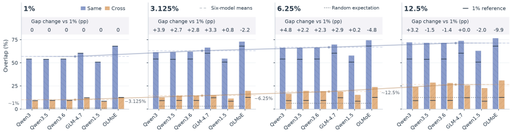
Figure 2 .Neuron-set overlap at four selection rates across six models. Blue and orange bars show same-domain and cross-domain overlap. Dashed lines and connected center points denote six-model means, while gray dotted lines mark random-set expectations. Dark ticks show each model’s overlap at 1% selection, and upper strips give the change in the same–cross gap relative to that setting, in percentage points.
Original paper · CC BY 4.0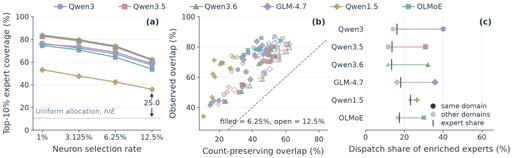
Figure 3 .(a) Share of each domain’s selected neurons held by the top ⌈0.1E⌉ experts, with the gray line marking uniform allocation and the arrow giving the gap in percentage points. (b) Observed overlap against the count-preserving expectation in Equation (5), with one marker per model, domain and selection rate, and the dashed line marking parity. (c) Validation dispatch share of each domain’s enriched experts, from the same domain in color and from other domains in gray, with black ticks marking their share of all experts.
Original paper · CC BY 4.0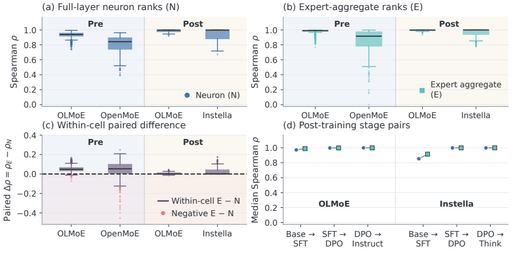
Figure 4 .Importance-rank correlations between adjacent checkpoints within each domain–layer–pair cell on validation text. (a) Neuron correlations ρN and (b) expert-aggregate correlations ρE for pre- and post-training. (c) Paired differences ∆ρ=ρ E −ρ N , with red dots where neurons are more stable. (d) Neuron and expert medians for each post-training stage pair on the scale of (a) and (b).
Original paper · CC BY 4.0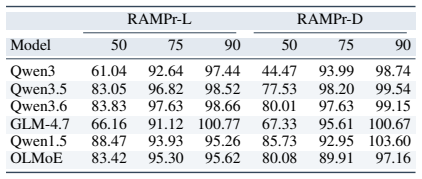
Table 2 .Mean performance retention (%) of RAMPr relative to the original model at 50%, 75% and 90% neuron retention.
Original paper · CC BY 4.0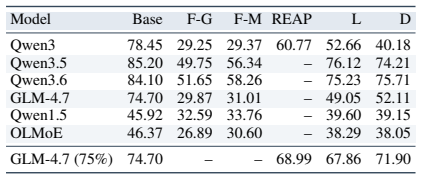
Table 3 .Raw-score 11-task macro-average against Fisher and REAP at 50% neuron retention, with GLM-4.7 also compared at 75%. F-G and F-M denote Fisher calibrated on GSM8K and MBPP, and REAP retains the same fraction of experts.
Original paper · CC BY 4.0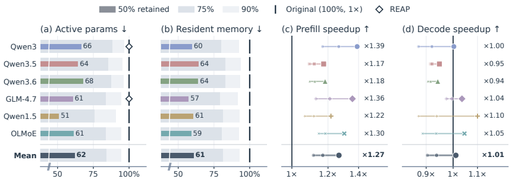
Figure 5 .RAMPr-L with fixed128 layout at batch 32 and 2048 input tokens, relative to the original model on the same GPU. The Mean row averages six models arithmetically in (a) and (b) and geometrically in (c) and (d). (a) Active parameters and (b) resident memory, with colored bars for 50% retention, gray bands for 75% and 90%, ticks at the original and diamonds for REAP. (c) Prefill and (d) decode speedups on log axes, with points from faint to solid for 90%, 75% and 50% retention and the original model at1×.
Original paper · CC BY 4.0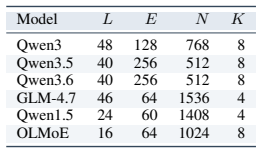
Table 4 .Routed FFN structures used for discovery. L counts observed MoE layers, E is experts per layer, N is intermediate width, and K is experts selected per token. GLM excludes decoder layer 0. All models have hidden dimension 2048.
Original paper · CC BY 4.0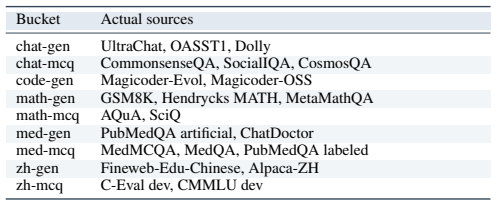
Table 5 .Dataset sources of the nine task buckets. Each bucket contributes 128 randomly sampled documents, split into 64 discovery and 64 validation documents.
Original paper · CC BY 4.0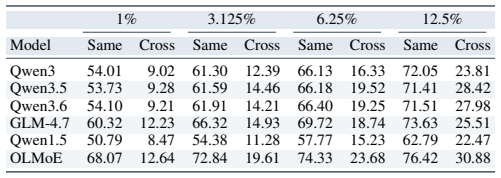
Table 6 .Routing-weighted RAMP overlap (%) at four selection fractions. Same compares discovery and validation sets within a domain; Cross compares discovery sets across domains.
Original paper · CC BY 4.0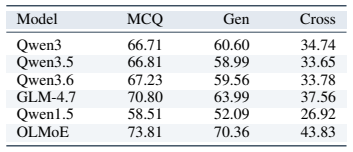
Table 7 .Task-format overlap (%) averaged over four selection fractions. MCQ and Gen compare discovery and validation sets within a bucket; Cross compares the two formats within a category.
Original paper · CC BY 4.0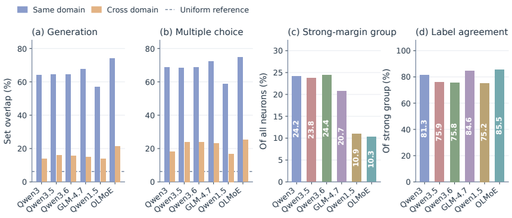
Figure 7 .Within-format overlap and dominant-domain identity under routing-weighted RAMP. (a, b) Same-domain replication and cross-domain overlap within generation and multiple-choice inputs at 6.25% selection, with the dashed line marking the uniform-set reference; Table 8 reports all four selection fractions. (c) Size of the strong-margin group relative to all routed neurons. (d) Validation dominant-label agreement within this group, which is selected on discovery text.
Original paper · CC BY 4.0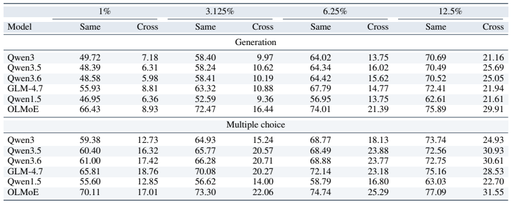
Table 8 .Routing-weighted fixed-format overlap (%) at four selection fractions: six models, four budgets and two formats. Same compares discovery and validation sets within a domain; Cross compares discovery sets across domains within the same format. Generation averages five domains or ten unordered pairs per layer, and multiple-choice averages four domains or six unordered pairs, followed by equal layer averaging.
Original paper · CC BY 4.0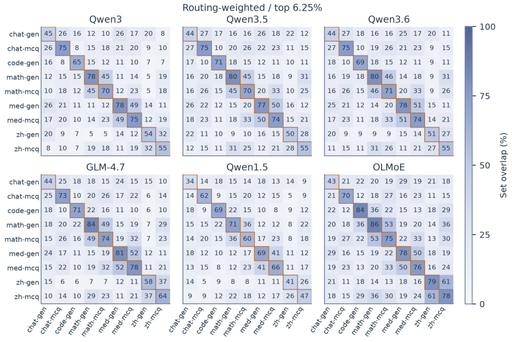
Figure 8 .Routing-weighted task-set overlap at 6.25% selection across all six models. Orange outlines identify diagonal entries, which measure same-domain discovery–validation replication. Off-diagonal entries compare discovery sets across domains. Cell annotations are percentages, rounded only for display. All panels use a 0–100% color scale.
Original paper · CC BY 4.0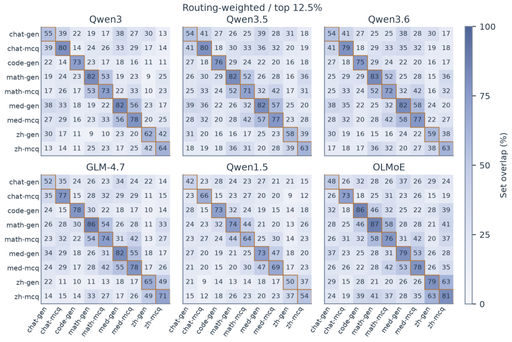
Figure 9 .Routing-weighted task-set overlap at 12.5% selection. The uniform-set reference is 12.5%.
Original paper · CC BY 4.0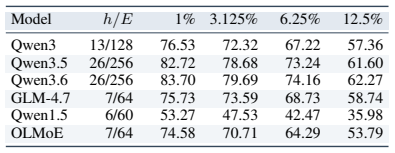
Table 9 .Routing-weighted selected-neuron coverage (%) of the top h=⌈0.1E⌉ experts. h/E is the actual expert fraction and also the coverage under uniform allocation.
Original paper · CC BY 4.0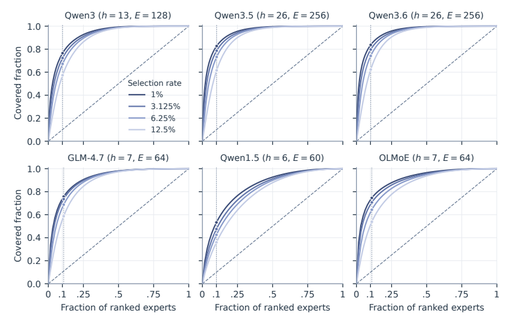
Figure 10 . Ranked selected-neuron coverage curves for the routing-weighted discovery sets. The horizontal axis is the fraction of experts included after sorting by selected-neuron count, and the vertical axis is the covered fraction G of the domain’s selected set. Darker blue indicates a smaller selection rate. Dots mark the top-10% point at the actual fraction h/E, indicated by the dotted vertical line, and the dashed diagonal is the uniform-allocation reference. Curves are computed within each domain–layer unit and averaged equally over layers and buckets.
Original paper · CC BY 4.0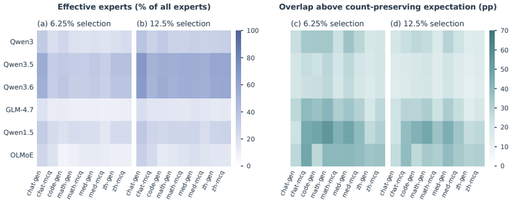
Figure 11 .Routing-weighted spatial statistics for each model and bucket at 6.25% and 12.5% selection, as layer means. (a, b) Normalized effective expert count, the inverse concentration of selected-neuron shares across experts. (c, d) Observed overlap above the count- preserving expectation, which is positive in every reported layer–bucket cell at both budgets.
Original paper · CC BY 4.0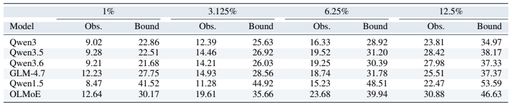
Table 10 .Observed cross-domain overlap (Obs.) and the routing-only bound (Bound) in Equation (17), in percent. Both quantities use routing-weighted discovery top sets and are averaged over the 36 domain pairs within each native layer and then over layers. The bound is the overlap expected if neurons within each expert kept the same order for every domain.
Original paper · CC BY 4.0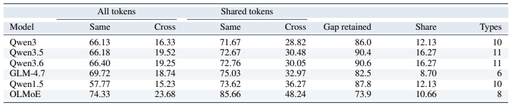
Table 11 .Same-domain and cross-domain overlap at 6.25% selection under all tokens and under token types shared by all 18 text groups, in percent. Gap retained is the shared-token same–cross gap divided by the all-token gap, and the last two columns give the shared tokens’ share of token positions and their number of types.
Original paper · CC BY 4.0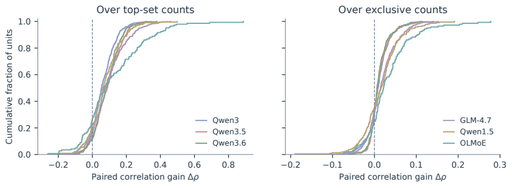
Figure 12 .Paired Spearman gains over original top-set counts (left) and exclusive counts (right) for validation relative dispatch preference. Each panel includes all 1926 domain–layer units, using routing-weighted 6.25% discovery sets and matched finite- F expert support. ECDFs retain negative gains; no units are selected by their routing outcome.
Original paper · CC BY 4.0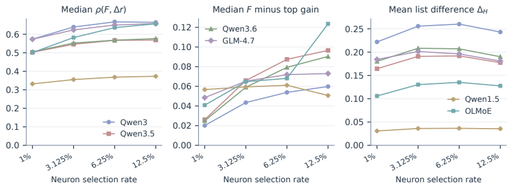
Figure 13 .Routing-weighted enrichment–routing sensitivity at four selection rates. Panels show the median ρ(F,∆r) , median within-unit advantage over top-set counts, and mean frozen-list preference difference. All six models are shown; the selection rates are discrete measured thresholds, not pruning settings.
Original paper · CC BY 4.0
Table 13 .Routing-weighted enrichment at four selection rates. M is the mean exclusive-neuron share carried by composition-enriched experts. The last two columns report mean list size and exclusive fraction at 6.25% only. All entries are percentages averaged equally over domain–layer units; each rate covers all 1926 units with nonempty enriched lists.
Original paper · CC BY 4.0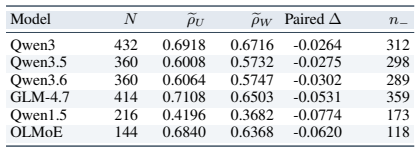
Table 16 .Paired scoring control at 6.25% selection with un- weighted (U) and routing-weighted (W ) scores. Paired ∆ is the median unit-wiseW−Udifference, negative inn − ofNunits.
Original paper · CC BY 4.0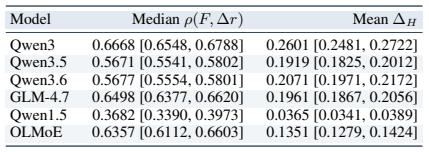
Table 17 .Document-bootstrap intervals at 6.25% selection. Entries are full-sample estimates ±1.96 standard errors from 200 replicates, conditional on the fixed discovery structure and the validation pool.
Original paper · CC BY 4.0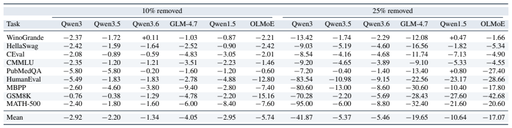
Table 19 .Score difference (percentage points) between random removal and RAMPr at the same budget: random 10% against RAMPr at 90% retention, and random 25% against RAMPr at 75%. Negative values mean random removal scores lower.
Original paper · CC BY 4.0
Table 20 .Unfiltered validation/all cell medians and positive-gap counts. Paired-gap medians summarize within-cell differences, not differences between marginal medians.
Original paper · CC BY 4.0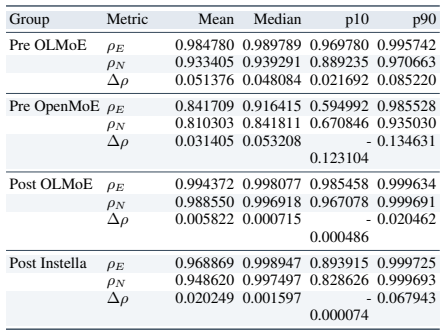
Table 21 .Same-cell distribution summaries for all four groups. Means and medians weight cells equally; p10/p90 are linearly interpolated percentiles. Each∆ρis computed before summarization.
Original paper · CC BY 4.0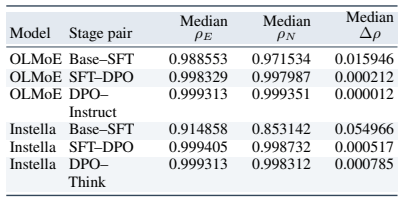
Table 22 .Post-training cell medians used in Figure 4d, distinct from interval means below. Each pair contains 176 OLMoE or 286 Instella domain–layer cells.
Original paper · CC BY 4.0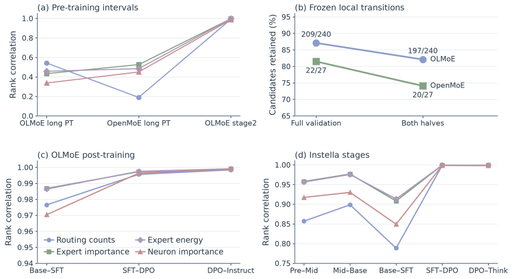
Figure 14 .Additional multi-granularity interval changes and local replication. Panels (a), (c) and (d) compare validation rank correlations for routing counts, summed neuron importance, full expert-output energy and neuron importance, using domain–layer means for each interval. Pre-training endpoint comparisons in (a) are separate intervals. Panels (c) and (d) show within-family stage comparisons. Panel (b) reports the original candidate counts retained by the full validation set and both halves. Connecting lines follow categorical comparisons and do not encode interval duration. Each panel labels its own vertical scale.
Original paper · CC BY 4.0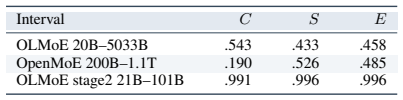
Table 23 .Validation expert-rank correlations over long pre- training intervals and OLMoE stage2. Columns correspond to dispatch counts, summed neuron importance and complete- output energy. Each entry is a domain–layer mean.
Original paper · CC BY 4.0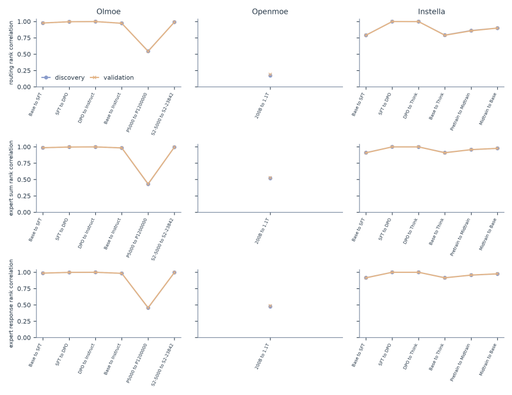
Figure 15 .Stage comparisons for dispatch counts, summed neuron importance and complete-output energy. Values are domain–layer mean rank correlations for each interval, computed separately on fixed discovery and validation text. Stage-pair positions are categorical and do not encode interval length. OLMoE’s P and S2 labels denote its separate pre-training and stage2 step counters. The three statistics summarize expert-level rank stability.
Original paper · CC BY 4.0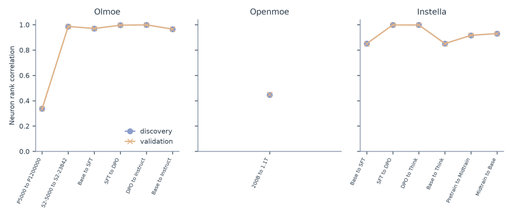
Figure 16 .Endpoint and released-stage neuron comparisons, including Base-to-final comparisons and Instella’s earlier stages. Points are domain–layer mean Spearman correlations. Lines join categorical comparisons only. Discovery and validation markers can overlap when their values are close.
Original paper · CC BY 4.0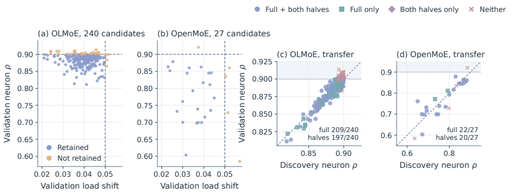
Figure 17 .Validation outcomes for all 267 frozen domain–layer transitions from OLMoE and OpenMoE pre-training. (a, b) Validation routing-load shift against validation neuron-rank correlation; dashed lines are the selection thresholds, and orange points fail at least one criterion and remain in the denominator. (c, d) Discovery versus validation neuron-rank correlation, marking outcomes on the full validation set and on both halves of 32 documents per bucket; the two tests are not nested and the panels use different axis ranges.
Original paper · CC BY 4.0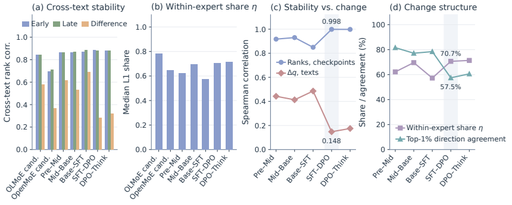
Figure 18 .Cross-text consistency and within-expert structure of neuron changes. (a) Early- and late-checkpoint cross-text rank correlations and the correlation of importance-share differences. (b) Median within-expert L1 share ηc on jointly observed experts; pre-training groups are frozen candidates, while Instella groups cover all 286 domain–layer cells per stage pair. (c) Instella’s mean cross-checkpoint rank correlation contrasted with the median cross-text correlation of ∆q. (d) ηc alongside pooled direction agreement of the top-1% ∆q changes, retaining unavailable validation coordinates in the denominator.
Original paper · CC BY 4.0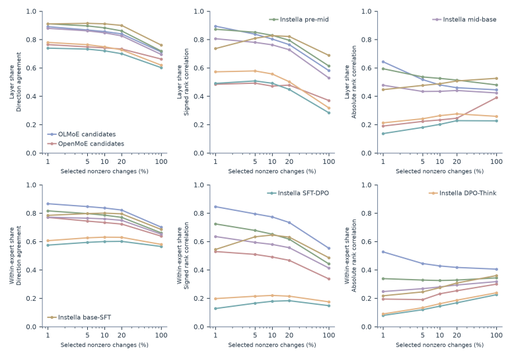
Figure 19 .Exploratory replication of discovery-selected changes. All five selection fractions are shown for layer-share and within-expert- share differences. Direction agreement is the pooled same-direction count divided by the pooled selected count, retaining unavailable validation coordinates in the denominator. Signed-change and absolute-magnitude Spearman correlations are computed separately on available selected coordinates and summarized by valid-cell medians.
Original paper · CC BY 4.0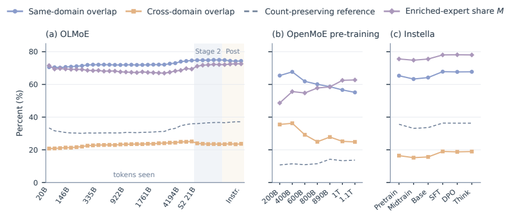
Figure 20 .Domain neuron-set statistics of Section 3 computed at every checkpoint, at 6.25% selection under routing-weighted RAMP. Same- and cross-domain overlaps follow Equation (4), the count-preserving reference follows Equation (5), and M is the share of each domain’s exclusive neurons held by its enriched experts, as in Table 1. Values are averaged over domains and layers. (a) OLMoE pre-training labelled by tokens seen, followed by the stage-2 and post-training checkpoints, ending at the OLMoE-0125-Instruct model of Section 3. (b) OpenMoE pre-training. (c) Instella’s released stages.
Original paper · CC BY 4.0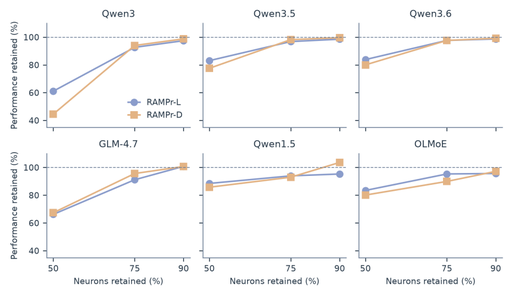
Figure 21 .n128 mean performance retention for both aggregation rules at all three neuron-retention rates. Ratios are averaged over tasks with nonzero Base scores. Qwen1.5 and OLMoE use eleven tasks, and the remaining complete rows use thirteen. Values exceeding 100% are retained. Lines connect only the evaluated budgets.
Original paper · CC BY 4.0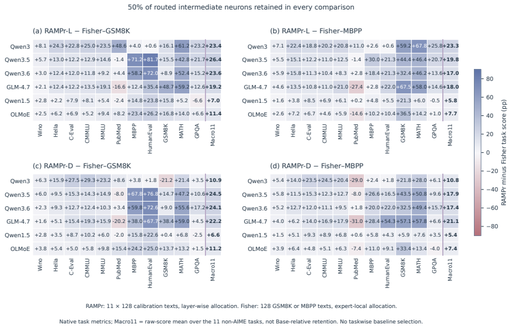
Figure 22 .All 264 task-score differences (six models, eleven non-AIME tasks and four RAMPr–Fisher comparisons) at 50% routed-neuron retention, in percentage points. RAMPr-L/D use 11×128 calibration texts and layer-wise allocation, while each Fisher baseline uses 128 GSM8K or MBPP texts and expert-local allocation. Macro11 averages raw task scores rather than Base-relative retention. All 24 macro differences are positive, and 246 of 264 task differences are non-negative, with the remaining negative differences retained.
Original paper · CC BY 4.0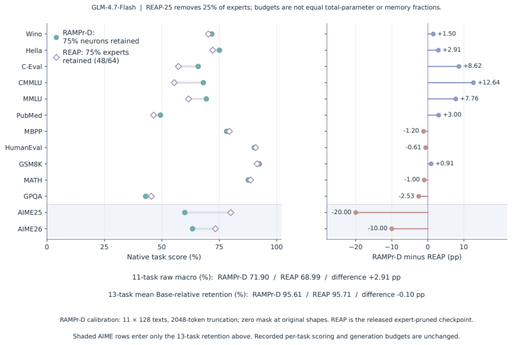
Figure 23 .GLM-4.7-Flash task scores and RAMPr-D-minus-REAP differences for all thirteen tasks. RAMPr-D retains 75% of routed neurons, whereas REAP-25 retains 75% of experts (48/64). RAMPr-D has the higher eleven-task raw macro-average (71.90% versus 68.99%, a difference of +2.91 percentage points). Its thirteen-task mean Base-relative retention including AIME is nearly identical (95.61% versus 95.71%).
Original paper · CC BY 4.0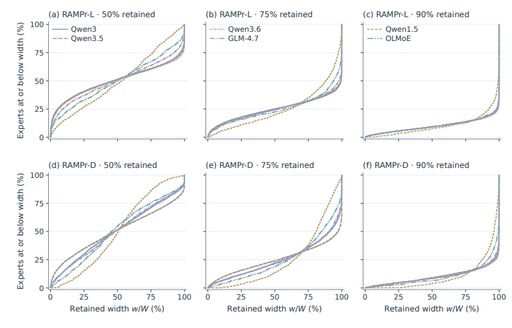
Figure 24 .Complete empirical distributions of normalized retained width for all 36 n64 masks. Rows show RAMPr-L/D and columns show neuron-retention budgets; the six-model legend is shared across panels. Every native integer width is represented without smoothing, including zero-width experts. Fixed expert counts within each model make pooled and layer-equally weighted ECDFs identical. Shared experts, GLM’s initial dense layer, and layout padding are excluded.
Original paper · CC BY 4.0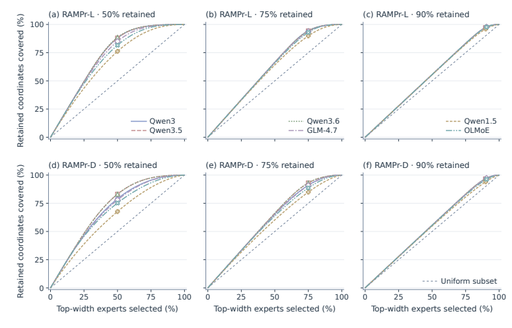
Figure 25 .Layer-equally weighted retained-coordinate coverage, 100G(k), at every integer expert countk, with the same panel and model ordering as Figure 24. The diagonal gives uniform-subset expected percentage coverage 100k/E; markers identify k=⌊rE+ 1/2⌋ for neuron-retention fraction r. Expert budgets are exactly matched at 50% and 75%; at nominal 90%, actual fractions are 89.84375% for Qwen3/3.5/3.6, 90% for Qwen1.5, and 90.625% for GLM-4.7/OLMoE.
Original paper · CC BY 4.0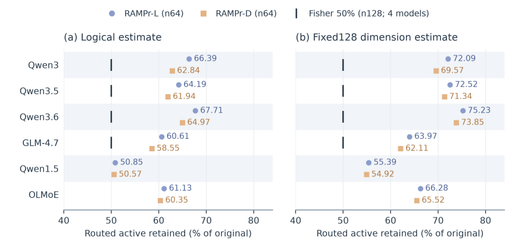
Figure 26 .Routed-FFN active retention at 50% neuron retention: (a) logical and (b) fixed128 execution-dimension estimates for RAMPr- L/D with n64 calibration. Both panels reuse original-model dispatch on the nine-domain validation probe; neither reports post-pruning active measurements. Fisher’s 50% reference is shown only for the four models covered by the available task-conditioned n128 masks, not for Qwen1.5 or OLMoE; its calibration differs from RAMPr’s. Axes show retained active percentages relative to each original model (100%), with a restricted display range. REAP is not plotted across six models; its two inspected configurations are reported in Table 28.
Original paper · CC BY 4.0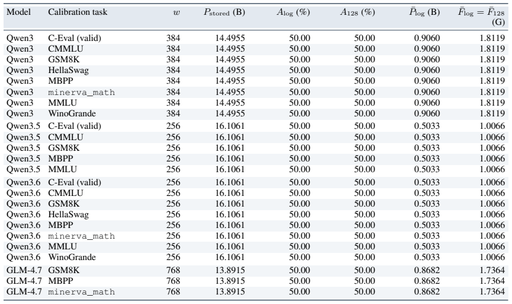
Table 27 .All 24 available Fisher rule-E masks. Each uses 128 task-conditioned calibration texts; retained width w is exactly half of each expert’s original width, unlike RAMPr’s cross-expert allocation. Both logical and fixed128 routed-active retention are 50%; retained widths are multiples of 128, so the two matrix-multiply estimates coincide. Columns use the units and original-routing probe of Table 25.
Original paper · CC BY 4.0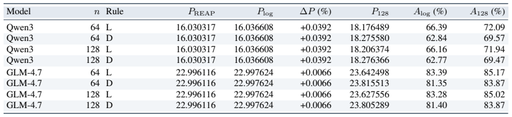
Table 28 .Backbone-parameter reconciliation with the two inspected REAP checkpoints. Qwen3 uses 50% neuron/expert retention and GLM-4.7 uses 75%; RAMPr rules L/D are separate. PREAP, Plog and P128 are backbone parameter counts in billions. ∆P is the logical RAMPr budget difference relative to REAP.Alog and A128 are original-routing RAMPr active percentages relative to REAP’s fixed-K, full-width routed structure (100% of its original model). Auxiliary MTP tensors and non-parameter buffers are excluded.
Original paper · CC BY 4.0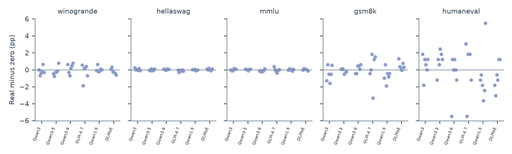
Figure 27 .Real-minus-zero task-score differences for all 180 n64 comparisons. Each model has six method–retention settings per task. HumanEval uses source-matched v3 scores, and the other tasks retain their recorded metrics. Horizontal offsets separate configurations without implying another quantitative axis.
Original paper · CC BY 4.0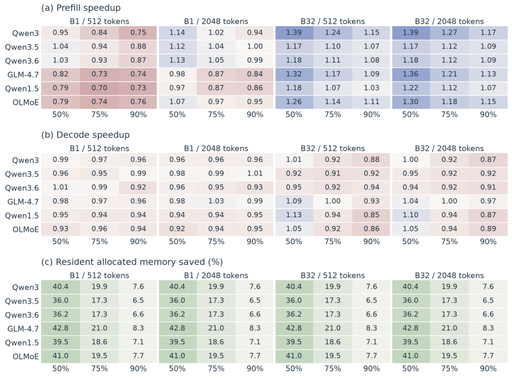
Figure 28 .Full fixed128 efficiency grid for RAMPr-L with n64 calibration. Every panel reports all six models at 50%, 75% and 90% neuron retention under four batch–input settings, giving 216 displayed values. Speedups compare the pruned model with its same-GPU Full baseline and share a color scale centered at one. Memory reductions use a separate 0–50% scale. Numbers are rounded only for display. Loading and layout conversion are outside inference timing.
Original paper · CC BY 4.0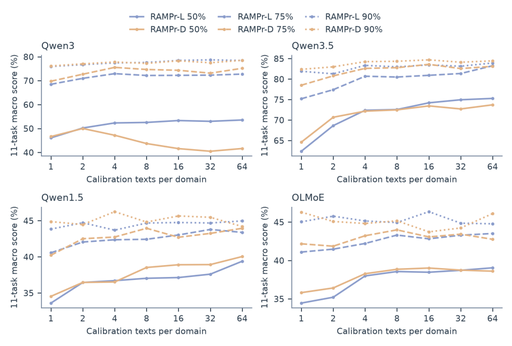
Figure 29 .Eleven-task raw macro scores over calibration-set size. Blue denotes RAMPr-L and orange RAMPr-D. Solid, dashed and dotted lines show 50%, 75% and 90% neuron retention. The n64 HumanEval scores use the v3 protocol. Curves show raw task-score averages.
Original paper · CC BY 4.0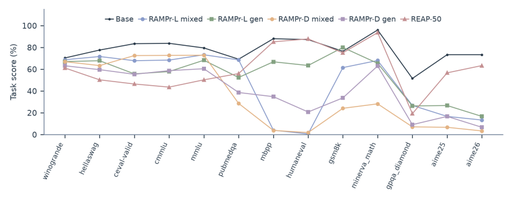
Figure 30 .All thirteen task scores in the Qwen3 calibration-composition comparison. Mixed and generation-only calibration contain different total numbers of texts. Both RAMPr variants and the available full-model and REAP results are shown. All task scores correspond to the same calibration-composition experiment.
Original paper · CC BY 4.0Quote from the paper
Zhenhong Zhou, Mao Zheng, Mingyang Song, Qiankun Li, Kun Wang, Junfeng Fang (2026). Understanding Mixture-of-Experts Language Models Beyond Expert Boundaries. arXiv:2611.13975v1. https://arxiv.org/abs/2611.13975v1
BibTeX
@misc{zhou2026understanding,
  title = {{Understanding Mixture-of-Experts Language Models Beyond Expert Boundaries}},
  author = {Zhenhong Zhou and Mao Zheng and Mingyang Song and Qiankun Li and Kun Wang and Junfeng Fang},
  year = {2026},
  eprint = {2611.13975},
  archivePrefix = {arXiv},
  url = {https://arxiv.org/abs/2611.13975v1}
}