Paper commentary
Perturbing Inputs Improves Pretraining Distillation
Adjacent-token blending lifts pretraining distillation of small language models
- Problem Distillation shows the student the teacher's predictions only on training text, so the teacher's behavior on other inputs never reaches the student. Augmentation usually corrupts only the student's input, leaving the teacher's view of corrupted text unused.
- Method Teacher and student read perturbed inputs early in training, then return to clean text.
- Results Adjacent-token blending lowered validation loss by 0.025 nats at 135M and by 0.020 nats at 0.5B, against standard distillation. The 135M gain is 1.45 times the gain distillation gives over next-token training.
Why distillation stops at the training text
Small language models are often pretrained by distilling from a larger teacher. So whatever the teacher predicts on other inputs never reaches the student.
Data augmentation looks like the obvious remedy, but in language-model pretraining it usually corrupts only the student's input. The original next token stays as the target, so the teacher's view of the corrupted input is never used. A teacher changes that, because it can predict on the corrupted input and give a target that matches what the student reads.
Teacher-labeled augmentation already helps in task-specific distillation and in vision. Pretraining from scratch is less clear, since training often doesn't repeat the data and the teacher's predictions on clean text already carry much supervision.
Perturbing the inputs of an early stage
The core idea is to change the inputs on which distillation is evaluated during an early stage of training. Teacher and student both read the same perturbed input, and the student matches the teacher's prediction on it. Once that stage ends, the run continues with ordinary distillation on clean text.
Each token is normally a one-hot vector over the vocabulary, and a perturbation replaces it with a sparse weighted mix of a few vocabulary items. The mixed vector is written as \( \tilde{o}_t = \sum_j w_j\, o_{v_j} \), and each model maps it through its own embedding matrix as \( E^\top \tilde{o}_t \). Because both models receive the same pairs of vocabulary items and weights, they see the same perturbation even when their embedding widths differ.
Additive token noise is \( \tilde{o}_t = o_{x_t} + \sigma u_t \), where \( u_t \) places Gaussian weights with variance 1/k on k=8 vocabulary items drawn uniformly, with replacement. The noise is resampled at every position and its weights are not normalized, so the true token can occasionally be one of the eight. The scale \( \sigma \) sets how large the noise is relative to the true token.
The parallel blend mixes two independent documents position by position, with weight \( \lambda \) on the first. The adjacent blend merges two consecutive tokens of one document into a single position, as \( \tilde{o}_t = \lambda\, o_{x_{2t}} + (1-\lambda)\, o_{x_{2t+1}} \). Sequences are drawn twice as long, so the model still sees its full input length, but the perturbed stage packs two corpus tokens into each position.
Section 5 tests whether that extra text matters.
The loss is the forward KL divergence from the teacher's next-token distribution to the student's at every position, at temperature 1. The learning rate follows a warmup, stable and decay schedule, with 10% warmup, a plateau spanning the stage boundary and a final 10% decay on clean inputs. The baseline is the same run with no perturbed stage.
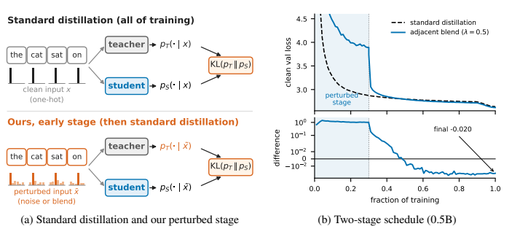
Figure 1 :Overview.(a) In standard distillation, teacher and student read the same clean text and the student is trained to match the teacher’s prediction on it. In the early stage of our method, both read a perturbed version of the text, and the student matches the teacher’s prediction on that perturbed input: the inputs on which the teacher supervises the student change, not only the student’s input. The bars under each token sketch its input vector over a toy vocabulary, one-hot for clean text and spread over several vocabulary items when perturbed (Fig. 2). The rest of training is standard distillation on clean text. (b) Clean validation loss of two 0.5B students trained from the same initialization on the same data order, one with standard distillation and one with adjacent blending (λ=0.5) for the first 30% of training, and their difference (symmetric log scale). While its inputs are perturbed, the blended student lags by about one nat. After the switch it recovers quickly, overtakes the baseline at about 47% of training and finishes 0.020 nats below it.
Original paper · CC BY 4.0 · Ziyang Cai, Yihe Dong, Dimitris Papailiopoulos, Shivam Garg · Perturbing Inputs Improves Pretraining Distillation · Original paper figure · Extracted the figure area from page 2 of the original PDF.Setup and paired comparisons
The 0.5B student uses the Qwen2.5-0.5B architecture, distilled from Qwen2.5-1.5B.
Every run at a scale reads the same data in the same order and starts from the same initialization. The runs differ only in the training objective, so any gap between them comes from that objective.
At 135M, they report the validation loss from the training run's evaluation pass instead. Differences below about 0.003 nats fall within that resolution.
Adjacent blending at 135M lowers the loss by 0.025 nats against standard distillation, and this is the first result the paired setup supports.
Where adjacent blending gains most
Adjacent blending gives the largest drop in validation loss, so its gain over the baseline is the comparison that matters most. Distillation itself improves on next-token prediction by 0.017 nats, so the 0.025 nats figure is 1.45 times that gain. Noise at σ=0.4 gains 0.019 nats and parallel blending at λ=0.7 gains 0.018 nats at the same scale.
At 0.5B, the even blend with λ=0.5 improves on standard distillation by 0.020 nats, with a paired standard error of 0.0003. Two more initialization seeds of that run and its baseline gave 0.021 and 0.019 nats. Noise at σ=0.75 gains 0.012 nats at 0.5B, and parallel blending gains 0.009 nats with a 30% perturbed stage. Since the two documents play symmetric roles, λ=0.5 is the heaviest parallel blend the family allows.
The 0.5B student uses the Qwen2.5-0.5B architecture, distilled from Qwen2.5-1.5B, so the two scales use different teachers and token budgets. The 0.025 and 0.020 nats figures are therefore two separate measurements, not one scaling curve. Still, the same ordering of families appears at both sizes, with adjacent blending ahead of noise and parallel blending.
How long the perturbed stage should run, and how much noise is too much
A shorter stage gives less of the gain. Noise is more forgiving, doing best with half of training perturbed and still helping at three quarters.
At 0.5B the ordering repeats. Adjacent blending is again best with a 30% stage. Noise does about equally well with 30% or 50%. In the conclusion, the authors summarise the perturbed stage as short, at 15 to 50% of training depending on perturbation strength.
Noise size first helps and then hurts at both scales. Small noise barely changes the teacher's predictions, so the student gets little extra signal. At 0.5B, σ=0.4 raises the frozen teacher's loss by only 0.07 nats, and σ=0.5 gives less than half the gain of σ=0.75. At σ=1.2 the teacher's loss rises by 3.5 nats, and the student ends worse than under standard distillation.
The useful range lies between these extremes, where the teacher's predictions change without becoming uninformative.
The best σ was 0.4 at 135M and 0.75 at 0.5B. The authors found these values by sweeping. They don't have a principled way to locate the useful range in advance. The ablations that follow use token noise at σ=0.4 for the first half of training, the best 135M setting.
Teacher side versus student side
The noise gain needs a teacher, and most of it comes from perturbing the teacher's input rather than the student's. Seed-to-seed variation reaches 0.008 nats, which matters when reading the smaller differences.
For adjacent blending the contrast is stronger, since training on the blended inputs with next-token targets ends 0.03 nats behind plain next-token prediction.
With additive noise, the student sees clean text while the teacher predicts on a perturbed version of it. This teacher-only arm recovers about 90% of the gain, averaged over three seeds. When only the student's input is perturbed, the teacher's prediction on clean text is the target, and the gain falls to about a third.
So the two effects combine roughly additively, and the teacher-side effect carries most of the noise gain. They didn't test noise on the student side alone at other scales.
Ruling out softer targets and extra text
The first question is whether a flatter teacher target alone could explain the gain from perturbed inputs. A stronger temperature gains nothing, and applying the usual distillation temperature to both models is slightly harmful. The authors use this to show that the perturbed teacher's softer prediction is not the source of the gain.
The second question is whether a weaker early teacher can reproduce the gain as a curriculum. All three weaker-teacher runs end within 0.003 nats of standard distillation.
The blended student in this control packs those tokens into half as many positions, so it sees no extra text.
This variant reads exactly the baseline's text at every position, yet it ends 0.008 nats worse than standard distillation. They didn't test the overlapping variant over several seeds, so its result rests on the single comparison reported.
Gains under repeated data
The data-constrained test reuses the first 262M tokens for 16 epochs within the same 4.2B-token budget at 135M. Training repeats the text, so regularization matters more than in the single-pass runs. The authors swept AdamW weight decay over 0.1, 0.3, 1, 3 and 10 for standard distillation, and weight decay 10 diverges. They used token noise at σ=0.4 for the first 50% of training.
Weight decay matters under repetition, and raising it from the default 0.1 to 1.0 lowers the standard distillation loss by 0.033 nats. Weight decay 1.0 was the best value for standard distillation in this sweep. Standard distillation itself differs by only 0.001 between the two seeds, and noise doesn't shift the best weight decay. Across two seeds, the noise gain stays between 0.020 and 0.023 nats, which is the data-constrained result the authors report.
Much of that larger number is regularization that a tuned weight decay also provides. With fresh data and weight decay 1.0, noise gains 0.020 nats, so the gain doesn't shrink under repetition on the tuned baseline.
On the tuned baseline, adjacent blending gains 0.035 nats in a single run. At the default weight decay, adjacent blending gains 0.025 nats, so the tuned baseline widens its gain. In that milder setting, the gain is 0.023 nats. Figure 5 plots the final validation loss against weight decay and the gain from noise, with exact values in Table 4 in Appendix B.
Quantization and zero-shot transfer
The quantization study uses the final 0.5B students, with every linear layer except the output head quantized to int4 or int3 in groups of 128 weights. Damage is the increase in validation loss over 512 fixed windows, paired across models. Round-to-nearest is compared with GPTQ and AWQ, and both calibrated methods use 256 windows of 1024 tokens from each model's own training data.
With GPTQ at int4, every perturbed student keeps its advantage over standard distillation quantized the same way. Under this method, adjacent blending's advantage grows from 0.020 to 0.024 nats. Under round-to-nearest at int4, the noise student loses more than standard distillation, while the blended students lose less.
At int3 under round-to-nearest, standard distillation's loss rises by 6.226 nats. Over the same setting, adjacent blend's loss rises by 1.203 nats and parallel blend's by 1.480 nats. The authors link this gap to weight distribution, since the mean excess kurtosis is about 0.5 for standard distillation and noise. For both blends, that kurtosis drops to 0.14, which the authors read as the source of their robustness.
On zero-shot tasks, the 0.5B noise student gains 1.1 points on average over standard distillation. Adjacent blending also gains 1.1 points, while parallel blending gains only 0.5 points. Parallel blending's largest gain is on SciQ, at about four points, and at 135M the differences in average accuracy stay within 0.6 points. Together these results show the perturbed students keep their validation-loss advantage after quantization.
Limits of the evidence
The noise size was not set by theory, and the authors don't claim a principled way to find it. At 0.5B, σ=0.4 raises the frozen teacher's loss by only 0.07 nats, so the student gets little beyond standard distillation. Large noise hurts: at σ=1.2 the teacher's loss rises by 3.5 nats, and the student ends worse than under standard distillation.
The best noise size differs between the two settings, σ=0.4 at 135M and 0.75 at 0.5B, and the authors found it by sweeping. A practitioner therefore has to tune the perturbation strength for each setting, because the useful range isn't known in advance.
The 135M differences in zero-shot accuracy are small, at most 0.6 points, so they don't separate the methods. The 0.5B zero-shot gain of about one point rests on seven tasks.
The authors state that the scale of their experiments is a real limitation. The experiments show a proof of concept that teacher predictions beyond ordinary training text can give useful supervision.
Paper info
- Authors
- Ziyang Cai, Yihe Dong, Dimitris Papailiopoulos, Shivam Garg
- Venue
- arXiv · Preprint
- First published
- 2026-11-8
- Added
- 2026-11-10
- Updated
- 2026-11-8
- Version
- v1
- arXiv
- 2611.11598
- Category
- cs.CL · cs.AI
- Original paper terms
- CC BY 4.0
- What we show
- Paper info, commentary and permitted figures from the original paper
AI commentary is a separate explanation from the original paper and may contain errors. The original paper and figures follow each source's terms of use and any rights noted separately.
Abstract
Knowledge distillation trains a student language model to match a teacher's predictions on the training text. We ask whether learning the teacher's behavior beyond the training text can further improve the student. We investigate this using three input perturbations: additive token noise, blending two documents, and blending neighboring tokens. Specifically, for an early part of pretraining we perturb the inputs and train the student to match the teacher on them, and we spend the rest of the same token budget on ordinary distillation. When pretraining from scratch, the best method improves on standard distillation at both scales we tried, by 0.025 nats at 135M parameters and by 0.020 nats at 0.5B (mean of three seeds). At 135M this is 1.45 times the gain that distillation itself provides over next-token training. We also observe promising downstream transfer: at 0.5B, the best variant improves average zero-shot accuracy by about one percentage point across seven tasks. It also retains its validation-loss advantage after low-bit weight quantization. We also test a data-limited setting in which training data must be reused, and find that the gains persist. Finally, ablations suggest that, for additive noise, perturbing the teacher's inputs contributes most of the gain, while perturbing only the student's inputs yields much less.
Quote from the paper
Ziyang Cai, Yihe Dong, Dimitris Papailiopoulos, Shivam Garg (2026). Perturbing Inputs Improves Pretraining Distillation. arXiv:2611.11598v1. https://arxiv.org/abs/2611.11598v1
BibTeX
@misc{cai2026perturbing,
  title = {{Perturbing Inputs Improves Pretraining Distillation}},
  author = {Ziyang Cai and Yihe Dong and Dimitris Papailiopoulos and Shivam Garg},
  year = {2026},
  eprint = {2611.11598},
  archivePrefix = {arXiv},
  url = {https://arxiv.org/abs/2611.11598v1}
}