Paper commentary
Prune, Don't Merge: Expert Compression of Mixture-of-Experts LLMs on Multilingual Production Tasks
Deleting experts beats merging them on production LLM tasks
- Problem Expert compression shrinks MoE models, but pruning and merging had only been compared on academic benchmarks. Nobody had tested them on production tasks with strict output formats and many languages.
- Method The authors compare REAP, which deletes the least salient experts, with REAM, which merges experts into the most salient ones. Both run on the same calibration data, on five production tasks at 25% and 50% of experts removed.
- Results REAP is significantly better than REAM in 16 of 20 head-to-head comparisons, and REAM wins in only 2. At 25% removal, Qwen3-30B keeps 93.6% of its generative quality under REAP and 62.5% under REAM.
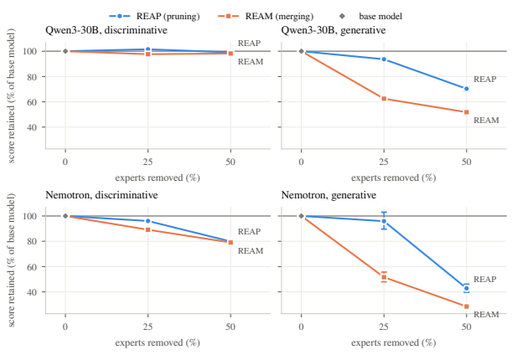
Figure 1 : Merging falls behind on generation.Mean score retained (% of the base model’s score) against the share of experts removed, for the discriminative tasks (website cues, brand names, categorisation; left) and the generative tasks (domain descriptions, email templates; right), one row per base model. Blue circles are REAP, orange squares REAM, and the grey diamond is the base model (100% by definition). Error bars are 95% bootstrap CIs, and tasks have equal weight. On Qwen3-30B’s generative tasks, REAP at 50% keeps more than REAM at 25%.
Original paper · CC BY 4.0 · Tomas Rasymas, Povilas Kvedaras · Prune, Don't Merge: Expert Compression of Mixture-of-Experts LLMs on Multilingual Production Tasks · Original paper figure · Extracted the figure area from page 3 of the original PDF.Why expert memory is the serving bottleneck
Serving an MoE model in production is limited by how much GPU memory its experts occupy, not by the compute per token. That footprint is 61.1GB for Qwen3-30B-A3B-Instruct-2507 and 65.8GB for Nemotron-3.5-Lightning-30B-A3B in BF16. Expert compression targets this cost directly by deleting whole routed experts from every MoE layer. The result is a smaller checkpoint of the same architecture, which serving stacks such as vLLM load unchanged.
Two families compete for this job: pruning removes experts outright, while merging combines them into others.
REAP is the current state of the art in expert pruning, and REAM is the current state of the art in expert merging. Both methods are one-shot, so each needs only a calibration pass rather than retraining. REAM builds on REAP's own saliency and reports slightly higher generative scores than REAP at 25% on Qwen3.
Both papers report on academic benchmarks, which don't test strict output formats, many languages, long answers or product-traffic calibration. Production answers must satisfy an output contract, such as a JSON schema or HTML rules. Evaluations of compression on production data are rare, and the authors found none for MoE expert compression.
No comparison of pruning and merging on production tasks, output contracts or many languages existed before this study.
The key idea: same experts kept, different treatment of the rest
REAP and REAM both score every expert once with the same saliency, and that score decides each expert's fate. REAP deletes the fraction r of routed experts with the lowest saliency and deletes their router rows. REAM instead makes the (1−r)N most salient experts group centres and folds the rest into them. Because REAM chooses its centres with REAP's saliency, the two methods keep almost the same experts.
That overlap isolates what happens to the experts that are not kept.
An MoE layer sends each token x to the top-k experts chosen by its router and combines their gate-weighted outputs. The router then chooses its top-k among the experts that remain.
The authors set C to 16 at 25% removal and to 32 at 50% removal, following REAM. REAP is llm-compressor's pruning modifier, while the authors ported REAM's official code to the same pipeline. The original REAM code supported only Qwen-style layers, which is why the port was needed.
Shared experts, attention and Mamba layers are untouched by either method. Unit tests check that the grouping and alignment reproduce the original functions. All runs use deterministic kernels, so repeated runs give the same result. Both methods therefore differ only in how they treat the experts that fall outside the kept set.
Five production tasks, two models and one calibration set
The study compares REAP and REAM on five production tasks of Hostinger, each with 2,000 validation rows. Three tasks are discriminative: website cues and brand names are scored by exact match, and categorisation by the production judge's pass rate. Two tasks are generative: domain descriptions must open with "This domain is" in the requested language.
Email templates ask for a complete, responsive HTML template returned inside JSON.
The two base models are Qwen3-30B-A3B-Instruct-2507 and NVIDIA-Nemotron-3.5-Lightning-30B-A3B, each with about 30B total and 3B active parameters. Both have 128 routed experts per MoE layer, and each method removes 25% or 50% of them, from 128 to 96 or 64. That produces eight compressed models, and the authors evaluate all ten models including the two bases.
Every compressed run of a model shares one calibration set, disjoint from the validation rows. Answers make up only 8.7% of the calibration tokens, and all 59 distinct system prompts are English.
Decoding differs by task: the three discriminative tasks decode greedily, while domain descriptions and email templates use sampling. Brand names and categorisation are constrained to their JSON schema, with answers capped at 1,024 tokens for those tasks. Email templates use the production rubric, which sets the score to 0 when any of five hard gates fails.
The base Qwen3-30B often returns a body without the html wrapper, failing html_complete in 1,230 of 2,000 answers and scoring 26.1. The authors relax two gates, which lifts the base model to 70.2, and they report the production score alongside it.
Every comparison is paired on the same 2,000 rows, either a compressed model against its base or REAP against REAM. The authors report 95% paired bootstrap intervals with 10,000 resamples. Holm correction runs separately over the 40 base comparisons and the 20 head-to-head comparisons.
Head-to-head results: pruning wins on generation
On the same rows, REAP is significantly better than REAM in 16 of 20 head-to-head comparisons. REAM is better in only 2 comparisons, both on Qwen3-30B brand names at 50% of experts removed. The remaining 2 comparisons, website cues on Qwen3-30B, show no significant difference. The largest gaps sit on generation, where the two methods differ most in production.
Holm correction over the 20 head-to-head comparisons decides which of these gaps count as significant.
The contrast is sharpest on generation, because the two methods diverge most on that side of the task mix. At 25% removal, Qwen3-30B keeps 93.6% of its generative score under REAP and 62.5% under REAM. Qwen3-30B's discriminative retention at 25% is 101.5% under REAP and 97.7% under REAM. Nemotron is different: merging also loses on the discriminative tasks at 25%, with 89.1% retention against 96.0% under REAP.
REAP with half the experts removed keeps 70.3% of the generative score, still more than REAM with a quarter removed.
The largest single gap is on email templates, where REAP leads by 30.2 rubric points at 25% removal on Qwen3-30B. That lead is an interval of +28.4 to +32.0 rubric points, so it stays clear of zero. Under the production gates, the lead grows to 51.0 rubric points at 25% removal. At 50% removal, the production-gate lead on Qwen3-30B is 35.8 rubric points.
The two REAM brand wins differ from REAP's wins in kind, and the mechanism is detection rather than accuracy. REAM returns a brand more often on Qwen3-30B, with detection at 95.2% against 91.5% for REAP. REAP's returned brands are slightly more often right, with precision at 75.5% against 74.3%.
How the compressed models fail: the output contract
Email template losses come mostly from answers that fail hard gates rather than from weaker template content. For every significant loss, 89.8–95.2% of the drop comes from the gate part, computed by splitting the score into pass rate times mean score of passing answers. Passing templates change much less, with 79.2 for the base model, 76.5 for REAP at 50% and 75.0 for REAM at 25%.
Three failures dominate, and overflowing a narrow screen is one of them. Narrow-screen overflow rose from 10.0% of the base model's answers to 35.1% at REAP 50%. Runaway answers that reach the 32k-token cap went from 6 for the base model to 102 at REAP 50% and 215 at REAM 50%. These runaway answers also cost GPU time, since REAM 50% generated 11,364 thousand email-template tokens where the base model generated 5,731 thousand.
Nemotron's base model already fails the contract, with 544 invalid JSON answers, so its low score mostly reflects instruction following.
Domain descriptions fail in another way, because compressed Qwen3-30B models copy the English opener 'This domain is' into non-English answers. At REAM 25%, 39.6% of non-English rows open in English, compared to 3.3% for the base model.
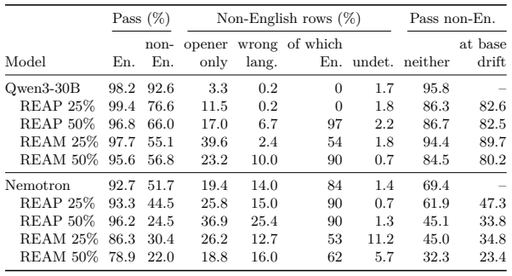
Table 4 : Domain descriptions: compressed Qwen3-30B copies the English opener.Judge pass rate on English and non-English rows; among non-English rows, the share that opens with the English “This” but is otherwise in the requested lan- guage, the share in the wrong language (and how many of those are English), the share the language detector could not classify, and the pass rate of rows with neither failure; and the non-English pass rate the model would have at its base model’s opener and wrong-language rates.
Original paper · CC BY 4.0Across tasks, the language gap is concentrated in domain descriptions, with 9 of 40 cells significant after Holm correction and 8 of them in that task.
Which benchmark diagnostics still order variants by production quality
It is positive in 9 of 10 cells. On Qwen3-30B's domain descriptions at 25%, the figures are 2.13 for REAM against 1.50 for REAP. Logit divergence agrees in level, with tau of +0.50, and it is larger for REAM in 20 of 20 cells.
Repetition is the diagnostic the authors measure most directly, by counting runaway email-template answers. At 25%, REAM produces 4.4 times as many runaway answers as REAP on Qwen3-30B, and 5.2 times as many on Nemotron. The loop rate tracks quality with tau of +0.74. n-gram diversity, which REAP offers for merged models, tracks quality only when the loops are counted.
Its tau is +0.70 with the loops included and +0.15 without them.
Effective rank is a weaker positive signal, with tau of +0.44. These diagnostics come without confidence intervals and rest on few cells. That makes them useful for checking a model on a given task, but they can't stand in for running that task.
What these results do not cover
The 20 head-to-head comparisons aren't independent, because they are correlated comparisons among eight checkpoints. They don't cover compression randomness or the choice of calibration data. It doesn't test other pruning or merging methods, such as frequency pruning, HC-SMoE or M-SMoE.
REAM is the authors' own port, and it carries documented deviations, including the group-size convention. The group size C follows the Qwen3 choice, and the authors don't tune it for Nemotron. References are outputs of an earlier production model that a judge accepted, not human labels. Both email scores are reported, so readers can compare the production and relaxed versions.
Two tasks are sampled, as in production, so their outputs vary between runs. The per-language cell intervals in Figure 6 are uncorrected for multiple comparisons. The study doesn't measure serving memory, latency or throughput. The tasks are private product data, so nobody can repeat the study on the same rows.
REAP is better than REAM in 16 of 20 comparisons, and the margins are widest on generation. Data and code aren't released, so the authors point readers to Sections 3 and 4 and the appendices.
Paper info
- Authors
- Tomas Rasymas, Povilas Kvedaras
- Venue
- arXiv · Preprint
- First published
- 2026-11-9
- Added
- 2026-11-10
- Updated
- 2026-11-9
- Version
- v1
- arXiv
- 2611.12240
- Category
- cs.CL · cs.LG
- Original paper terms
- CC BY 4.0
- What we show
- Paper info, commentary and permitted figures from the original paper
AI commentary is a separate explanation from the original paper and may contain errors. The original paper and figures follow each source's terms of use and any rights noted separately.
Abstract
Mixture-of-Experts language models are cheap to run per token but expensive to hold in GPU memory, which drives the cost of serving them in production. One-shot expert compression shrinks them after a single calibration pass. Its two current state-of-the-art methods are REAP for expert pruning, which deletes the least salient experts, and REAM for expert merging, which merges them into the most salient ones. Both have been evaluated only on academic benchmarks. We compare the two on five multilingual production tasks of a web-hosting company, from classification to the generation of marketing HTML email templates, with two 30B-parameter models (Qwen3-30B-A3B-Instruct-2507 and the hybrid Mamba-attention Nemotron-3.5-Lightning) at 25% and 50% of experts removed and the same calibration data. Pruning wins: on the same rows, REAP is significantly better in 16 of 20 comparisons and REAM in 2. At 25%, REAP keeps 93.6% of Qwen3-30B's generative quality and REAM 62.5%, although on benchmarks the two are within a point for the same model. The damage concentrates in the output contract rather than the content: 89.8-95.2% of each significant loss on email templates comes from hard-gate failures such as invalid JSON, broken mobile layouts and runaway generation, and most failed non-English domain descriptions copy the prompt's English opening phrase. Cross-perplexity and logit divergence, two diagnostics from the REAP paper, also track production quality, as does the rate of repetition loops; n-gram diversity does not. We close with practical guidance for compressing MoE models for production.
Quote from the paper
Tomas Rasymas, Povilas Kvedaras (2026). Prune, Don't Merge: Expert Compression of Mixture-of-Experts LLMs on Multilingual Production Tasks. arXiv:2611.12240v1. https://arxiv.org/abs/2611.12240v1
BibTeX
@misc{rasymas2026prune,
  title = {{Prune, Don't Merge: Expert Compression of Mixture-of-Experts LLMs on Multilingual Production Tasks}},
  author = {Tomas Rasymas and Povilas Kvedaras},
  year = {2026},
  eprint = {2611.12240},
  archivePrefix = {arXiv},
  url = {https://arxiv.org/abs/2611.12240v1}
}