Paper commentary
Gendered Misclassification from Surname-Based Race Imputation
Surname-based race imputation misclassifies married women and distorts gender gap estimates
- Problem Voter files infer race from surnames, which fails for women who take a husband's surname, especially after marrying outside their race. Those women are misclassified, so group gender gaps in politics come out biased.
- Method The authors recover maiden surnames from the middle name, or drop shared surnames, before imputing race. Using maiden names in North Carolina, where earlier surnames are recorded, is the direct test of this fix.
- Results Using maiden surnames raises accuracy up to fourfold for women married across racial lines. In a national replication, the correction more than triples the Asian gender gap in turnout.
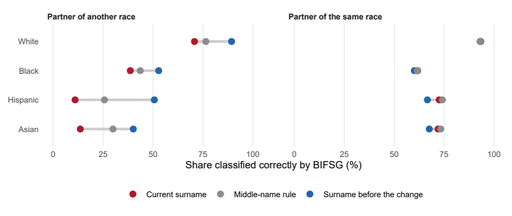
Figure 3 : BIFSG accuracy for women in North Carolina whose surname changed between 2005 and 2026. Panels give the race of the man who shares her current surname.
Original paper · CC BY 4.0 · Noah Dasanaike · Gendered Misclassification from Surname-Based Race Imputation · Original paper figure · Extracted the figure area from page 10 of the original PDF.Why a surname can mislead about race
BISG gives each voter a racial probability from their surname and census block, and BIFSG adds the first name. Both rely on the surname carrying no extra information about place or first name once race is held fixed. That assumption fails for married women who take a husband's surname, because the name then reflects his race rather than hers.
When the couple is interracial, the imputed race follows the husband, so the woman is misclassified. Earlier papers noted the problem in passing, but none measured it or proposed a fix.
Where the bias comes from in the expression
The derivation starts with a weighted estimate for women of race r, where each person counts by their chance of being race r. m stands for the proportion of women of race r whose surname comes from a husband of a different race. The averages a_m and a_o show how likely imputation is to place these women, and other race-r women, in race r.
Setting aside women of other races who imputation assigns to race r, married surnames shift the estimate by expression (1). The bias is a product of three quantities, so it vanishes when any one of them is zero. The first quantity is how common married surnames of another race are.
The bias should be largest for groups whose women often marry outside the group. It also grows when surnames are distinctive and when inter-married women differ politically. Because m can be estimated from census data on intermarriage, researchers can gauge the bias where maiden surnames are unavailable.
Expression (1) suggests two corrections, each targeting a different source of the bias. The first recovers the maiden surname from the middle name, which restores the information the surname holds about the woman's own race. The bias persists under BIRDiE because the surname fails the independence assumption through the race of the spouse.
Three ways to fix the married surname
The first correction swaps the married surname for the maiden surname a woman held before she married. Many voter files store a middle name, and for some married women that middle name is their maiden surname. Restoring the maiden name puts back the information about the woman's own race, so imputation can place her in her own group. This fix only works where maiden surnames are recorded, so South Carolina is excluded because its middle names aren't usable.
The second correction drops the shared surname, so race is predicted from first name and geography alone. This lowers individual accuracy, because for most married women with a same-race husband the surname is informative. For BIRDiE, dropping the surname removes the partner-race information that links the surname to the outcome. The authors expect this fix to help BIRDiE more than it helps individual classification.
It should hurt most for groups like Black women, whose surnames are highly informative about race.
The third correction down-weights the married surname instead of replacing or removing it. It also keeps part of the partner's race signal, so the authors expect it to help BIRDiE to a lesser extent than removal.
The study builds five versions of the surname used for women, from the current surname to omitting every shared or hyphenated one. The fifth version doesn't require middle names at all, because it omits every surname shared or hyphenated with a partner. Each version is scored by the most probable race against self-reported race, and by weighting and BIRDiE estimates.
North Carolina voter files record the earlier surname, which lets the authors validate the maiden-name rule directly.
Couples, voter files and the placebo rule
The author uses full-count TargetSmart voter files from six states that record self-reported race, and treats that race as ground truth. Across these states the author observes more than 38 million registered voters, along with their inferred co-resident partners. Party registration serves as an outcome in Florida, Louisiana, and North Carolina, while 2024 turnout covers all six states.
The household must hold between two and six registered voters, and the two ages can differ by no more than 12 years. Each person must belong to exactly one such pair, which keeps the matching strict. Each woman is then classified by her surname relative to her partner's: shared, hyphenated or compound, different, or no inferred partner. Same-sex couples could carry the same bias, but the author can't identify them directly.
For women who share their partner's surname, a maiden surname is recovered when the middle name looks like a family name rather than a given name. A middle name can also be a family name given at birth, so the same rule is applied to men who share their partner's surname as a placebo.
North Carolina voter files from 2005 to 2026 record the surname each voter held before changing it, so the author can test the rule directly. South Carolina has no usable middle names, so the author can only evaluate corrections that don't rely on them there. The author builds BISG and BIFSG probabilities from 2020 Census tables under five versions of the women's surname.
The first version keeps every voter's current surname, while the fourth uses the maiden surname or removes the married surname. The fifth version drops every woman who shares or hyphenates her partner's surname, so it needs no middle names at all. Downstream estimates come with intervals obtained by resampling counties within states.
How much accuracy women lose
BIFSG classifies 55.2% of Asian women correctly, compared to 64.8% of Asian men. For Hispanic women the rate is 79.0%, against 85.8% for Hispanic men. The gap shrinks among White voters, at 90.6% for women and 91.9% for men. Among Black voters the order reverses, with women at 77.8% and men at 76.0%.
Switching from the current surname to the maiden surname barely moves women whose partner shares their race, by -2.3 to 3.0 ppts. For women whose partner is of another race, the gain is 42.2 ppts for Hispanic women and 26.9 ppts for Asian women. It is smaller for White women at 16.2 ppts and for Black women at 8.5 ppts, whose surnames carry less racial information.
The authors read this as evidence that the married surname itself, not other traits of these women, drives much of the error.
North Carolina voter files record each woman's surname before she changed it, which allows a direct test. Among women who changed surname and live with a man of another race sharing their current surname, classifying by the earlier surname raises Hispanic women from 10.9% to 50.6%. For Asian women in the same group, the same switch moves accuracy from 13.5% to 40.1%.
For women whose partner shares their race, the earlier surname scores 66.6% for Hispanic women against 72.5% for the current one.
The middle-name rule recovers only 20.0% of those earlier surnames. As a result, it lifts accuracy to 25.6% for Hispanic women and 29.9% for Asian women. Women with a partner of another race make up 13.1% of Asian women, compared with 5.8% of Hispanic women.
Whether the misclassified women differ politically from other women of their race
Asian women with a Black partner are considerably more likely to register as Democrats, at 80.0%.
The same ordering holds among Hispanic women, at 42.6%, 48.3%, and 80.2%, and among Black and White women. Turnout follows the same pattern for Asian and Hispanic women with a White partner. Figure 4 displays these partisanship and turnout patterns by the race of the woman and her partner.
The paper can't tell whether these gaps reflect who marries whom or the influence of the partner. Either way, the misclassification is linked to the outcome of interest. White partners make up the largest group among Asian women in interracial couples, and many of them are imputed as White through their partner's surname. The imputed estimate for Asian women therefore draws on women who lean Democratic and vote less.
Neither weighting nor BIRDiE recovers the group-specific estimate in this case.
How big the expression says the bias is
The expression is meant to size the married-surname bias before anyone runs BIRDiE, so the key test is how its prediction compares with the bias BIRDiE actually produces. That 1.6 ppts is most of the bias from how imputation classifies Asian women themselves, rather than from women of other races assigned to the Asian category. Supplementary Note B5 breaks out that split, so the expression targets the self-classification part of the error.
The expression understates BIRDiE, which overstates the Asian gender gap in partisanship by 4.2 ppts in these states. The expression predicts only 1.4 ppts, so BIRDiE's error is roughly three times larger than the expression's prediction. Because the expression undershoots, the authors treat it as a conservative estimate of the bias rather than a full account.
The expression uses the share of women married to men of another race, taken from the American Community Survey of 2022, to predict bias for each state.
Those states have a large share of Asian women married to men of another race, which drives the prediction up. By contrast, the predicted bias is 0.9 ppts in California and 0.7 ppts in New York. For turnout, the predicted bias runs from −2.6 to −3.9 ppts in the small-group states, against −0.8 and −0.6 ppts in California and New York.
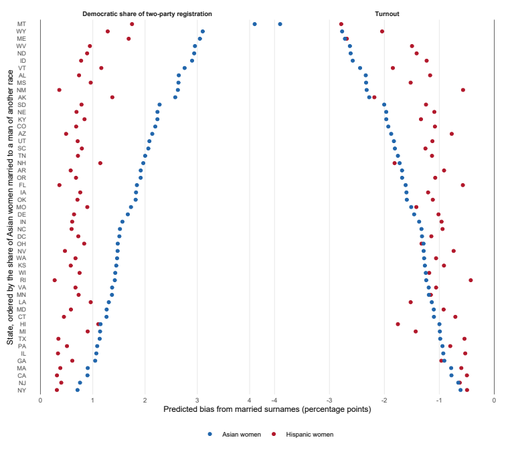
Figure 5 : Predicted bias in the weighted estimates for Asian and Hispanic women by state. Predic- tions use expression (1) and the American Community Survey of 2022.
Original paper · CC BY 4.0BIRDiE gender gap under each correction
With current surnames, BIRDiE overstates the Democratic share of Asian women by 7.5 ppts. That overstatement is more than twice the 3.4 ppts by which BIRDiE overstates the share for Asian men. On turnout, the same estimates understate the rates of Asian and Hispanic women, by 2.1 and 1.2 ppts. As a result, BIRDiE pushes the Asian partisanship gap to 9.4 ppts, against 5.2 ppts from self-reported race.
Recovering maiden surnames is the first correction, and it cuts the overstatement of the Asian partisanship gap from 4.2 to 2.8 ppts. Adding the middle-name rule for women without a partner cuts the overstatement further, to 2.1 ppts. Maiden surnames are recovered only where the middle name is likely a surname, which limits how far this step can go.
Omitting the shared surname goes furthest on partisanship, reducing the overstatement to 1.2 ppts. The same correction moves the Asian turnout gap to 4.4 ppts, against a true 4.0 ppts. The surname is informative about race for Black voters, so dropping it hurts their estimate.
This correction improves individual classification only marginally. It doesn't improve BIRDiE estimates, and BIRDiE still misses how the Asian partisanship gap narrows with age.
Turnout gaps across congressional districts
Those models use race imputed by Catalist, so they are the type of analysis most exposed to bias from married surnames. The replication uses nationwide TargetSmart voter files from the 2012, 2014, 2016 and 2018 general elections, covering four of the six elections that Stauffer and Fraga study. The controls include the group's share of registered voters, district competitiveness, and the Democratic share of the House vote.
With current surnames, the estimated gender gaps are 1.1 ppts for Asian registered voters and 1.5 ppts for Latino voters. Both sit close to the 0.7 ppts gap among White registered voters.
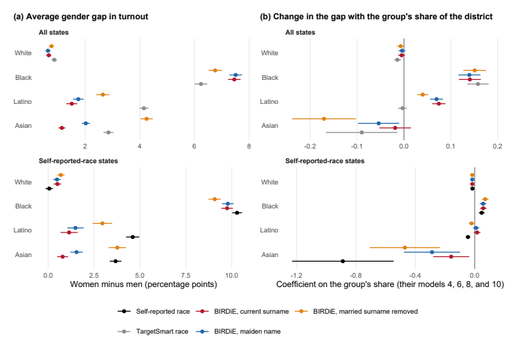
Figure 7 : Gender gap in turnout within each race across congressional districts, 2012–2018 (1,740 district-years). BIRDiE uses BIFSG probabilities. “TargetSmart race” is the race that the vendor imputes. In the bottom row, it equals self-reported race. Horizontal lines are 95% intervals. In panel (b), they are clustered by district.
Original paper · CC BY 4.0The figures are 3.8 ppts for BIRDiE and 3.7 ppts from self-reported race. The authors don't treat the maiden-name version as the full fix, since its coverage depends on the state.
The coefficients on the group's share of the district show that married surnames also distort how the Asian and Latino gaps vary with district composition. For Black and White voters, the coefficients are nearly identical under every version. The replication covers 1,740 district-years, with BIRDiE built on BIFSG probabilities.
Lebanon: the error comes through locality
In Lebanon, a woman's civil registration moves to her husband's locality on marriage, and she votes on his list. Her surname stays her own, and the registry still records her own religious sect. Because the registry records both the voter's sect and the sect of the list, the author can see cross-sect marriages directly, without inferring couples.
The author expects imputation to misclassify these women through the geographic prior rather than the name.
Women registered on another sect's list are more common than men on such lists, at 10.1% compared with 1.5% among the seven largest sects. Under ℓBISG, women on another sect's list are classified correctly 29.4% of the time, compared to 88.6% for women on their own sect's list. Locality alone classifies 16.8% of women on another sect's list correctly, while name alone classifies 52.0%, more than the combined prediction.
So the source of the error is the husband's locality, and the name still carries the sect.
The appropriate correction in Lebanon is therefore the reverse of the US correction, because the married woman keeps her surname but takes her husband's locality composition. The registry doesn't record marital status, so dropping the geographic prior for all women would lower accuracy for most women. Those methods do worse for women on their own sect's list, where locality is informative, at 68.8% compared with 88.6%.
Registration of married women also distorts counts of each locality's voters by sect, which misestimate mixed Christian localities. For most voters, the bias from this route is small, but it is structurally the same problem as the US case.
Limitations: where the results stop
Same-sex couples can't be identified directly, so the bias in those couples goes unmeasured. The authors note that the same bias could arise there, with either partner adopting a surname of another race.
Middle names correspond to maiden surnames only in some states, so the rule doesn't reach every married woman. South Carolina doesn't record usable middle names, so the authors evaluate only the corrections that skip them there. In North Carolina, the rule recovers only 20.0% of earlier surnames, so the maiden-surname correction stays partial.
Even so, the rule lifts accuracy only to 25.6% for Hispanic women and 29.9% for Asian women.
The expression for the bias is derived from four quantities: m, a_m, a_o and δ, each defined for a stated group of women. It takes m from census data on intermarriage, rather than from the voter files used in the rest of the analysis.
The Lebanese analysis rests on one voter file, the full-count registry of 3.7 million registered voters. The registry doesn't record marital status, though it shows which women sit on another sect's list.
What researchers should report given married-surname bias
Dasanaike's recommendation is simple: researchers who report race-by-sex estimates from imputed race should also report how those estimates change under the surname corrections. The authors call for this disclosure because the bias is not visible in a single headline estimate. The replication materials report the same shares by state and age, so readers can check the pattern locally.
The same problem reaches newer name-based methods, because they also take the current surname as input. Recent BISG extensions that predict race from name embeddings or group-specific name lists inherit the issue, as do LLM-based approaches that read names. The problem holds wherever a married woman's name is her husband's surname, as in the United States.
Dasanaike expects any attribute shared between spouses to carry a sex-based bias related to downstream quantities. National origin or religion inferred from names fall into this category, so researchers using those attributes should check for the same pattern.
Paper info
- Authors
- Noah Dasanaike
- Venue
- arXiv · Preprint
- First published
- 2026-11-7
- Added
- 2026-11-10
- Updated
- 2026-11-7
- Version
- v1
- arXiv
- 2611.10931
- Category
- cs.CL · stat.AP
- Original paper terms
- CC BY 4.0
- What we show
- Paper info, commentary and permitted figures from the original paper
AI commentary is a separate explanation from the original paper and may contain errors. The original paper and figures follow each source's terms of use and any rights noted separately.
Abstract
Researchers increasingly estimate political behavior based on race and gender from voter files, where race is imputed from surnames and geography. This only works where surnames suggest group membership, an assumption violated where surnames follow norms around marriage. Imputation is therefore biased against women who adopt their husband's surname, especially those who racially inter-marry, an outcome itself endogenous to partisanship. Using six US states recording self-reported race, I show that imputation is less accurate for Asian and Hispanic women, particularly those sharing the surname of a partner of another race, who differ politically from other women of their race. This violates assumptions behind downstream inference approaches, which nearly double the gender gap in partisanship among Asian voters. I derive an expression showing the bias is largest where a group is small. Using maiden rather than marriage-adopted surnames in North Carolina raises accuracy up to fourfold for women married across racial lines. Recovering maiden surnames, or omitting the married surname, removes much of the bias. In a national replication of a study of gender gaps in turnout, the correction more than triples the gap among Asian voters. In Lebanon, where wives register in their husband's locality, the error enters through geography.
Quote from the paper
Noah Dasanaike (2026). Gendered Misclassification from Surname-Based Race Imputation. arXiv:2611.10931v1. https://arxiv.org/abs/2611.10931v1
BibTeX
@misc{dasanaike2026gendered,
  title = {{Gendered Misclassification from Surname-Based Race Imputation}},
  author = {Noah Dasanaike},
  year = {2026},
  eprint = {2611.10931},
  archivePrefix = {arXiv},
  url = {https://arxiv.org/abs/2611.10931v1}
}