Paper commentary
SRA: Spatial Reasoning Adapter via Evolving Social Interaction Graphs for Trajectory Prediction
SRA rebuilds interaction graphs on predicted futures to refine trajectory predictions
- Problem Stochastic trajectory predictors read agent interactions once from the past and keep that context fixed. Relations between predicted futures, such as paths crossing, are never checked, so joint rollouts can be locally plausible yet globally inconsistent.
- Method SRA is a modular graph denoiser that plugs into existing diffusion and flow-matching predictors. At each reverse step it builds a sparse interaction graph on the current predicted trajectories and returns a residual correction to the host's estimate.
- Results SRA lowers ADE for all 12 host-dataset pairs across LED, MID, and MoFlow on SDD, NBA, Soccer, and Football. The average gains are 5.8% in ADE and 7.0% in FDE.
Why fixed interaction context falls short
Stochastic denoisers like MID, LED and MoFlow share one structural weakness: they encode agent interactions once from observed histories. That context is then held fixed for the whole rollout, so it never sees the futures the model is drafting. The relations that decide whether a joint future is plausible exist only between predicted futures, such as whether two predicted paths cross.
A context computed once from the past can't represent them, so each agent's future is refined without being checked against the others.
Some works do inject future-aware interactions, but they do it through cross-operations in a latent manifold. That implicit coupling lacks spatial precision, which leaves it hard to enforce geometric relations such as gaps, right-of-way, and group motion. The authors argue the bottleneck is not how well these models generate each trajectory, but how well they model interactions among the futures.
Rollouts therefore stay individually plausible yet globally inconsistent, with near-collisions or incoherent group behaviors.
SRA responds to this by recomputing an explicit interaction graph on the host's own future estimate at each denoising step. Because the graph is rebuilt on each sample's evolving estimate, the K modes receive K different interaction structures. A defender then reacts to an attacker's projected run rather than to the last two seconds of history.
Rebuilding the graph on each evolving estimate
SRA changes the denoising loop by reading the host's current future estimate at every reverse step and building a graph on it. The host's guess of the future is already a temporary scene, so distances and relative motions can be measured on its coordinates directly. Each reverse step returns a residual correction that the host adds to its own update, without redesigning the diffusion or flow-matching core.
A defender, in this view, responds to an attacker's projected run rather than to the last two seconds of history.
The authors contrast this with a history-based predictor, which computes its interaction context once as c = f(X) and reuses it for every step and mode. SRA instead builds the graph from each mode's current estimate, so interaction structure and trajectories sharpen together. Each step runs three parts: sparse neighborhood selection, agent-pair relational future encoding, and uncertainty-weighted message passing.
A host qualifies if it iteratively refines a continuous future estimate and exposes a point where a correction can enter. The host must also provide agent features from which an uncertainty head can be trained, though that head need not be native to the host. MoFlow is a flow-matching model whose Motion-Transformer decoder directly regresses clean trajectories.
The training objective stays the host's own, and SRA adds only one heteroscedastic NLL term for the log-variance head. The residual r_theta is detached from the NLL gradient path, so the host's denoising parameters stay untouched. Table 1 reports the effect of this loop on each host, with ADE and FDE measured as the best of K=20 modes.
Selecting neighbors and encoding pair relations
Scoring every pair at every reverse step would cost N(N−1) comparisons, so SRA first keeps a small neighborhood per target. For epsilon-prediction hosts, the clean future is recovered from the noisy sample by DDIM inversion, and the graph is built on that estimate. The retrieval score adds a query-key match over learned projections of the future plan and uncertainty to a geometric bias.
The query-key term can link agents converging on one region even while they are still far apart, while the geometric bias supplies the proximity prior that term lacks. The top five candidates by this score form the neighborhood, because Knbr is set to 5 throughout.
For each selected pair, SRA expresses the other agent's future in the target agent's own frame, so the features don't depend on scene orientation. The frame is a rotation that aligns the target's heading at t = 0 with the local x-axis. At every future timestep, the relative offset and the cosine and sine of the heading difference pass through a small MLP.
That MLP outputs one D-dimensional edge feature for each selected pair at each future timestep.
These per-timestep edge features feed the message step, where the uncertainty-weighted temporal pooling starts. SRA first applies temporal self-attention across the Tf frames, so the edge features mix information over time before pooling. Because the pooled edge vector depends on the predicted futures, it changes as the estimate sharpens at each step.
Uncertainty-weighted messages and training
The log-variance head predicts the uncertainty, and message passing uses it in three places. First, the per-timestep edge features are pooled over time, with the pooling weights receiving an additive bias equal to the uncertainty difference between target and source. Because frames where the target is uncertain and the source is confident get larger pooling weight, the pooled edge reflects where the source can be trusted.
Second, keys and values take the pooled edge feature, while queries come only from the target node. Those projections are conditioned on the noise level through learned biases, so the attention adapts across the denoising chain. Third, SRA averages the uncertainty over the horizon and turns the difference into a scalar message gate. The gate is w_ij = sigmoid(ζ(σ̄_i − σ̄_j) + b_w), with ζ=4 and b_w=0.5 fixed.
The gate grows when the target is more uncertain than the source, and it equals sigmoid(0.5) ≈ 0.62 for equally confident agents.
The gated messages are weighted by the attention scores and summed over the selected neighbors. Each layer adds this message to the node feature and passes the result through a feed-forward block with layer normalization. After L layers, a host-specific decoder maps the refined embedding to the residual δ. A learned gate then scales that residual before SRA adds it to the host's estimate.
The gate takes the host's agent feature and the temporally pooled message as inputs. SRA needs a host that refines a continuous future and exposes an injection point, so the design fits iterative hosts.
SRA leaves the host's generative objective unchanged and adds one heteroscedastic NLL term. Given the host's residual and predicted variance, the NLL term is minimized alongside the host loss. The total objective is the host loss plus λσ times the NLL term, with λσ = 10−2. The residual is detached from the NLL gradient path, so this term updates only the log-variance head.
The host's denoising parameters stay untouched by the NLL term.
Training and evaluation use the same ADE and FDE protocol, computed as the minimum over K=20 modes. The sports datasets use 10 past frames to predict 20 future frames, which sets the horizon the uncertainty covers.
Main results across hosts and datasets
Table 1 sets each host with and without SRA on NBA, Soccer, Football, and SDD, using the best of 20 modes for ADE and FDE. SRA lowers ADE for all 12 host-dataset pairs, with an average relative gain of 5.8% in ADE and 7.0% in FDE. FDE improves in 11 of the 12 pairs, and the one exception is MID on SDD, where FDE rises from 15.92 to 16.61.
The hosts differ in design: MID is a vanilla DDPM with a pure transformer denoiser, LED collapses the reverse chain to five steps, and MoFlow is a flow-matching model.
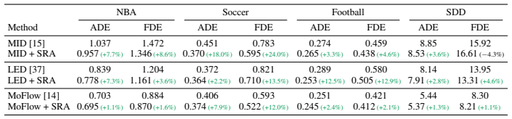
Table 1 :Main results.ADE / FDE (best of K=20 modes; lower is better) of three hosts with and without SRA on NBA, Soccer, Football, and SDD. Percentages are the relative improvement of SRA over its host; the only negative value (MID, FDE on SDD) is shown in black.
Original paper · CC BY 4.0 · Jaewoo Jeong, Seonkyu Song, Hyeonwoo Park, Jegyeong Cho, Yujin Bae, Giwon Lee, Daehee Park, Kuk-Jin Yoon · SRA: Spatial Reasoning Adapter via Evolving Social Interaction Graphs for Trajectory Prediction · Original paper figure · Extracted the figure area from page 7 of the original PDF.The largest gains appear on sports scenes, where MID on Soccer moves ADE from 0.451 to 0.370 and FDE from 0.783 to 0.595. Those numbers are 18.0% in ADE and 24.0% in FDE relative to the host, the biggest gains in the table. The authors tie this to dense, fast, ball-coupled interactions in sports, where future-conditioned coherence matters most.
Pedestrian motion in SDD is comparatively monotone, so it leaves less room for graph corrections. The sports datasets were chosen for this reason, since SDD only includes pedestrians walking.
The gain for MoFlow on NBA is much smaller, with ADE moving from 0.703 to 0.695, a 1.1% relative change. Its FDE on NBA moves from 0.884 to 0.870, a 1.6% change, so the NBA result for this host is modest. Ground-truth future trajectories are not needed at inference because the graph is built on the host's own estimate.
Which components matter in the cumulative ablation
The cumulative ablation adds the three SRA components one at a time on the three sports datasets, starting from the unmodified host. Adding future relational encoding over all neighbors already lowers ADE in 6 of the 9 host-dataset pairs. The authors explain this by top-Knbr selection committing hard to a still-noisy estimate, so a wrong choice discards neighbors that mattered.
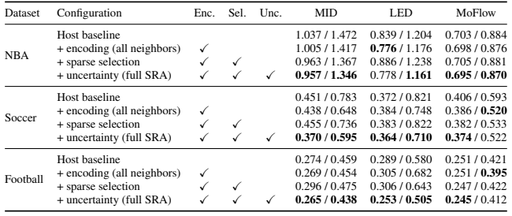
Table 2 :Cumulative component analysis(ADE / FDE). Starting from the unmodified host, we add one SRA component at a time: future relational encoding over all neighbors (Enc.), sparse top-Knbr neighbor selection (Sel.), and uncertainty-weighted message passing (Unc.). The last row of each block is the full SRA reported in Table 1. Best per dataset and host inbold.
Original paper · CC BY 4.0The authors therefore read the three components as one mechanism rather than independent additions.
Uncertainty-weighted message passing gives the largest relative ADE reductions in the table. MID on Soccer drops from 0.455 to 0.370, an 18.7% reduction. LED on Football drops from 0.306 to 0.253, a 17.3% reduction. Figure 5 shows the LED baseline ADE grows monotonically with σ, and SRA's gain is largest in the highest-σ bin, more than 2× the lowest-bin gain.
Relational features and neighbor scoring on NBA
On NBA, the authors compared four relational feature sets for the edge feature, starting from the simplest geometric cue, L2 distance. Even L2 distance alone gives gains over the base denoisers, which suggests that any explicit future-trajectory interaction beats latent-only attention. Relative position adds directional information and improves FDE on MID and LED.
Heading difference alone gives comparable ADE, but its FDE gains are stronger on MoFlow. Relative position plus heading gives the lowest ADE on MID and MoFlow, at 0.957 and 0.695. On LED, the combined feature ties with relative position alone at 0.778 ADE. The combined feature, the authors' default, captures both where agents head and how they face each other.
Table 4 pits the learned two-term retrieval score against a rule-based choice of the Knbr agents closest in mean future L2 distance. Rule-based selection gives FDE values of 1.367 on MID, 1.182 on LED, and 0.881 on MoFlow. Using only the geometric term lowers MID FDE to 1.348, while using only the semantic term gives 1.351. Both terms together reach 1.346 on MID, 1.161 on LED, and 0.870 on MoFlow.
Each learned term alone already beats the rule-based FDE for every host, and the two terms perform almost identically. The geometric bias supplies a proximity prior, whereas the semantic query-key match catches agents converging on one region from far apart.
The gaps between the rules are modest, so the authors conclude the graph is fairly robust to the selection rule. The comparison covers only the rule-based L2 choice, not other selection rules.
Limitations and what the evaluation leaves out
The authors say SRA is modular but not training-free, so it can't be bolted onto a host without any training. SRA needs a host-specific injection point, which means each host needs its own integration.
Extending SRA to those predictors is therefore an open task that the authors leave for later.
The relation graph rests on the host's own future estimate, so it carries over that estimate's errors. Neighbor selection commits to the current, still-noisy estimate, so a wrong choice can drop neighbors that mattered.
The evaluation covers four benchmarks, NBA, Soccer, Football and SDD, and reports ADE across three hosts. The supplementary material holds a longer discussion of these points.
Paper info
- Authors
- Jaewoo Jeong, Seonkyu Song, Hyeonwoo Park, Jegyeong Cho, Yujin Bae, Giwon Lee, Daehee Park, Kuk-Jin Yoon
- Venue
- arXiv · Preprint
- First published
- 2026-11-7
- Added
- 2026-11-10
- Updated
- 2026-11-7
- Version
- v1
- arXiv
- 2611.10506
- Category
- cs.CV
- Original paper terms
- CC BY 4.0
- What we show
- Paper info, commentary and permitted figures from the original paper
AI commentary is a separate explanation from the original paper and may contain errors. The original paper and figures follow each source's terms of use and any rights noted separately.
Abstract
Predicting where multiple agents will move next is fundamental to autonomous driving, robotics, and any system that must share space with people safely. Modern stochastic predictors read off inter-agent interactions once from the observed past and keep that view fixed throughout the generative rollout, so the reciprocal geometric constraints that emerge as the joint future sharpens are not re-examined. We address this gap with SRA (Spatial Reasoning Adapter), a modular graph denoiser that is integrated into existing diffusion and flow-matching predictors without redesigning their generative cores. At every reverse step, SRA reads the host's current future estimate, builds a sparse Euclidean interaction graph on the predicted trajectories, and returns a residual correction to the host's decoding path. Our adapter consists of three core components: a sparse neighborhood retrieved with a learned query-key score and a geometric bias, a future-conditioned relational feature recomputed on the evolving prediction, and uncertainty-weighted message passing where confident agents act as anchors for uncertain ones. We instantiate SRA on three structurally different hosts (LED, MID, and MoFlow) across four multi-agent benchmarks: SDD, NBA, Soccer, and Football. SRA improves ADE for every host on every dataset, with average gains of 5.8% in ADE and 7.0% in FDE. A cumulative ablation shows that the three components act as one mechanism: only together do they improve every host on every sports dataset, indicating that spatial reasoning over the model's own evolving future, weighted by how far that future can be trusted, is broadly useful across denoising architectures. Code is available at https://github.com/Jaewoo97/SRA.
Quote from the paper
Jaewoo Jeong, Seonkyu Song, Hyeonwoo Park, Jegyeong Cho, Yujin Bae, Giwon Lee, Daehee Park, Kuk-Jin Yoon (2026). SRA: Spatial Reasoning Adapter via Evolving Social Interaction Graphs for Trajectory Prediction. arXiv:2611.10506v1. https://arxiv.org/abs/2611.10506v1
BibTeX
@misc{jeong2026spatial,
  title = {{SRA: Spatial Reasoning Adapter via Evolving Social Interaction Graphs for Trajectory Prediction}},
  author = {Jaewoo Jeong and Seonkyu Song and Hyeonwoo Park and Jegyeong Cho and Yujin Bae and Giwon Lee and Daehee Park and Kuk-Jin Yoon},
  year = {2026},
  eprint = {2611.10506},
  archivePrefix = {arXiv},
  url = {https://arxiv.org/abs/2611.10506v1}
}