Paper commentary
Close and Sort: Exact Maximum-Likelihood Aggregation of Cyclic Rank-Two Preferences
CloseSort finds exact maximum-likelihood rankings from cyclic rank-two preferences
- Problem Turning pairwise probabilities into a maximum-likelihood ranking is NP-hard in general. Exact sign-only solvers for rank-two tournaments ignore the likelihood weights, so their orders can be suboptimal.
- Method CloseSort adds a closing vector to the rank-two factors, sorts the edges by polar angle, and cuts the cycle after that vector.
- Results On 1,249 cyclic LLM-judge profiles, CloseSort's normalized regret was 0.05531, versus 0.09859 for Borda.
Why weighted Kemeny stays hard
Turning pairwise probabilities into one list means solving a weighted Kemeny problem, and that problem is NP-hard in general. Exact dynamic programming costs O(n 2^n), so it only handles small sets of items. Rank-two tournaments are the known tractable exception, and minimum feedback arc set can be solved exactly on them, cycles included.
The known exact rank-two method looks only at the direction of each comparison, and it charges every reversed arc the same unit cost. Likelihood works differently, because reversing a preferred pair changes the log-likelihood by the absolute log-odds of that pair. So the sign-optimal order need not be the likelihood-optimal one, and the authors show this in Section 5.
Table 1 sets BT sort, rank-two MFAST, CloseSort and general Kemeny side by side by cycles, exact likelihood and complexity.
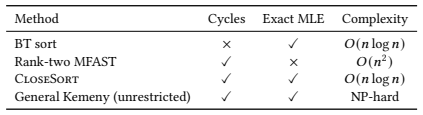
Table 1 : Comparison of exact-ranking methods for pairwise preferences under rank-two structure, alongside unrestricted general Kemeny. BT sort and CloseSort start from scores or factors; rank-two MFAST starts from tournament signs.
Original paper · CC BY 4.0The authors therefore need an exact method for the weighted objective itself, and they argue that rank-two structure can supply one. Their main result extends exact rank-two tractability from sign-only MFAST to weighted maximum likelihood. The extension rests on a planar representation, in which every rank-two log-odds matrix admits factors h_i in R^2 with W_ij = det(h_i, h_j).
From log-likelihood to a closed polygon
The likelihood objective becomes a polygon area because each rank-two log-odds entry is written as a determinant of two item vectors. With W_ij = det(h_i, h_j), the log-likelihood of an order splits into a constant plus half of J_W(π). The constant comes from the symmetric halves of each pair, so it doesn't depend on the order. Maximizing the likelihood is therefore the same as maximizing J_W, since the two objectives are identical up to that constant.
The authors add one closing vector, h_0 = −Σ h_i, so the n+1 edge vectors sum to zero and close into a loop. Any ordering of these vectors traces a closed polygon, and J_W(π) equals twice its signed area. The factors come from a dense W by fixing two reference items p and q, at O(n^2) cost with rank verification. When a determinant-logit model supplies the factors directly, the dense matrix isn't needed.
A classical edge-rearrangement result says the area is largest when the edges appear in cyclic polar-angle order. Cutting the angular cycle after the distinguished edge h_0 returns the item ranking. The proof checks that swapping two consecutive edge blocks changes the area by a determinant, so a maximizing order must have positive determinants between neighbouring blocks.
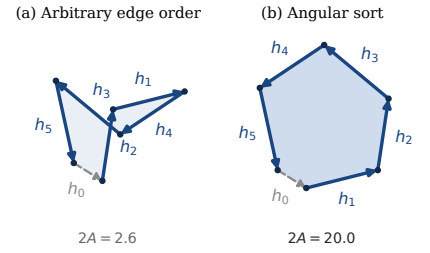
Figure 1 : The augmented edge vectors sum to zero. (a) An arbitrary order traces a self-intersecting polygon with small signed area. (b) Angular sorting produces a weakly con- vex, maximum-area polygon; removing the closing edge ℎ0 (dashed) yields the item ranking. The objective equals twice the signed area.
Original paper · CC BY 4.0 · Kehan Liu, Zhaoyun Chen, Xianquan Yan · Close and Sort: Exact Maximum-Likelihood Aggregation of Cyclic Rank-Two Preferences · Original paper figure · Extracted the figure area from page 3 of the original PDF.CloseSort, step by step
CloseSort starts by setting h0 to the negative sum of the factor vectors, so that the n+1 vectors sum to zero. It then polar-sorts the vectors counterclockwise, using half-plane and determinant comparisons instead of computing angles. Next it rotates the cyclic indices until 0 is first, deletes 0, and returns the remaining indices as the item order.
The procedure runs in O(n log n) time from the factors, because the closing vector is linear to build and polar sorting costs O(n log n).
Zero vectors can sit anywhere in the sorted list, and same-ray ties can be broken by radius and identifier. For a permutation π, the terms that contain h0 sum to zero, so the rest of the area is exactly J_W(π). Because the angular cycle maximizes that area, cutting it after h0 gives a global maximizer of J_W and of the likelihood. Theorem 1 gives O(n log n) time from the factors and O(n^2 + n log n) from a dense W.
Setting W_ij = s_i − s_j reduces the problem to sorting scores, because the factors can be taken as (s_i, 1). The authors treat this as the Bradley–Terry case, and rank two extends it because the factors can leave a line and induce cycles. The determinant-logit model in Section 4.1 is this rank-two class, and it coincides with the one-dimensional blade-chest-inner model of Chen and Joachims.
Runner-up gap and residual stability
The smallest determinant of two consecutive edges, written δ, sets the scale for both the gap and the stability threshold. When δ > 0, it equals the best-to-runner-up log-likelihood gap. Theorem 2 puts the gap at 2δ in J and at δ in the log-likelihood. The argument needs a swap of two consecutive edge blocks, and the cheapest such swap is the one on a minimum ear.
Lemma 2 says a minimum-area triangle of a convex polygon is an ear formed by three consecutive vertices. Swapping the two edges of that minimum ear reaches the bound δ, so the authors can say the gap is exact.
For W = W0 + E with an arbitrary skew residual E, the CloseSort order of W0 can lose at most the sum of |E_ij| over i < j. Each reversed residual entry changes J by at most 2|E_ij|, which yields the bound on the objective. If that sum is below δ, the CloseSort order of W0 stays the unique global optimum for W. The threshold is worst-case tight: a residual of magnitude δ on a reversed pair makes the two orders tie.
A simpler sufficient check uses Cauchy–Schwarz and skew symmetry, which bounds the ℓ1 sum by the Frobenius norm times sqrt(n(n−1)/2).
The regret bound and stability certificate need δ > 0 only for the exact gap and uniqueness claims. When δ = 0, the optimum need not be unique, but CloseSort stays globally optimal. The regret bound still holds for an arbitrary skew residual in that case. The rank-two projection can therefore be read as an approximation to a real matrix, with the residual's ℓ1 size as the price.
The authors also note that the best Frobenius skew-rank-two approximation comes from the leading two-dimensional singular subspace.
Sign-only ranking can pick a worse list
A four-item example shows how a sign-only method can miss the likelihood optimum. The factors are hA = (4,−3), hB = (1,3), hC = (−3,−4) and hD = (0,2). Sign-only MFAST works from comparison directions alone, so every reversed arc costs one unit. It returns (A,B,D,C), which agrees with five of six edges but has J = 11. CloseSort returns (C,A,B,D), which agrees with only four signs but reaches J = 39.
The gap comes from magnitudes, because reversing a preferred pair changes log-likelihood by |W_ij|, which signs ignore.
To measure how often this happens, the authors drew 2,000 random rank-two instances per size. The sign-only method was solved exactly with the circular-order and cyclic-shift characterization from prior work. Under the weighted objective, the sign-optimal order fails in 14.7% of four-item instances.
The two objectives separate more often as the number of items grows. Sign-only MFAST and CloseSort also disagree on which item leads, since CloseSort puts C first. They didn't test sparse comparison graphs here, because the exact reduction assumes complete pairwise objectives.
Exact checks and residual stability
The authors enumerated every order for Gaussian rank-two factors with n from 3 to 9, covering 419 instances. Across those instances, they compared both the optimum and the runner-up score with Theorems 1 and 2.
For the residual tests, the authors drew Gaussian rank-two factors and added skew Gaussian residuals. They recovered the global optimum with an exact MILP solver, using 25 trials for every residual level and n in {8, 12, 16}. At 64δ, recovery is 36%, 80%, and 100% for n = 8, 12, 16.
The threshold δ is worst-case tight, so the bound is sharp for this construction. Diffuse random residuals, by contrast, left the optimum intact at n = 16 even at 64δ.
Finite samples under a determinant-logit truth
The finite-sample study asks whether projecting noisy log-odds onto rank two helps ranking when the truth is a determinant-logit model. The authors draw 5,120 latent profiles with n = 14, from five independent seeds of 1,024 profiles each. Each profile samples two-dimensional Gaussian factors at a fixed signal scale, which define the population log-odds det(h_i, h_j).
Every order is scored by regret on the population matrix W★, so the evaluation measures recovery of the population objective.
For each profile, the authors sample m Bernoulli comparisons per pair, with m set to 4, 16, or 64. They form add-half empirical log-odds from the win counts, which corresponds to Jeffreys smoothing, and fit the best skew-rank-two approximation to them. The CloseSort order of that projection is compared with Borda, Copeland, and the empirical plug-in optimum, which is computed by exact DP on the empirical matrix.
Rank-two projection has lower population regret than the plug-in optimum on 68.6% of profiles at m = 4 and on 85.7% at m = 64. At m = 16 the figure is 84.7%, so the win rate rises with the sample size.
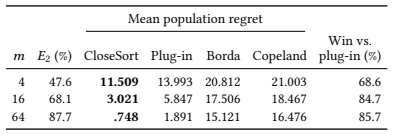
Table 3 : Finite-sample study over 5,120 latent determinant- logit profiles (𝑛= 14) with𝑚 observations per pair. 𝐸2: log- odds energy captured by rank two. Plug-in: exact optimum of the empirical log-odds. Win vs. plug-in is the percentage of profiles on which CloseSort has lower population regret.
Original paper · CC BY 4.0The captured energy E2 rises from 47.6% to 87.7% as m grows, because the empirical matrix moves closer to rank two. Table 3 reports the mean population regret for CloseSort, plug-in, Borda, and Copeland across all five seeds. Rank-two projection regularizes the empirical estimate toward the latent determinant-logit structure, which explains the gain.
The result holds only under a determinant-logit population, which makes rank two the correct latent model. Under misspecification, projection trades variance reduction against approximation error, and the authors leave that trade-off open. The conclusion repeats that rank-two projection lowers population regret relative to the empirical plug-in optimum under sampling noise.
Arena-Hard LLM-judge profiles
The Arena-Hard profiles test whether CloseSort helps on real LLM-judge comparisons that contain cycles. The authors use Arena-Hard v0.1 with the TokenProbs scores released by JuStRank, covering 63 systems and ten LLM judges. They built fixed ability-matched cohorts from 100 construction questions and evaluated on a disjoint set of 200 questions.
The evaluation split forms 40 five-question blocks, and crossing blocks with judges and cohorts yields 40 × 10 × 9 = 3,600 profiles.
A directed majority triangle appears in 1,249 of the 3,600 profiles, which is 34.69%. The authors test on the cyclic subset because a single list must summarize cyclic evidence there. On the 1,249 empirical-cyclic profiles, CloseSort has mean normalized regret 0.05531, compared with 0.09859 for Borda. That gap is an absolute normalized gain of 0.04328, a 43.9% reduction in regret.
On the same-factor comparisons, the gain over the sign-only cut is 0.00107 on empirical-cyclic profiles. That positive gain shows that keeping determinant magnitudes helps when the rank-two representation becomes an order. The exception is full-data Copeland, which exceeds CloseSort by 0.00102 on average.
On the empirical-acyclic profiles, Copeland and Schulze attain higher empirical objectives. The same-factor sign-only cut nearly ties CloseSort on those profiles.
Runtime when factors are supplied
The runtime benchmark measures only the ranking stage, starting from two-dimensional factors that are already supplied. For n = 6, 8, ..., 18, the authors draw 25 independent factor sets with h_i drawn from N(0, I_2) and define W_ij = det(h_i, h_j). Both methods start from the same factors, so the comparison isolates what each method does after the factors exist.
CloseSort's timer covers closing-vector construction, angular sorting, and order reconstruction. The exact baseline's timer covers materializing W, running Held–Karp DP, and reconstructing the order. Each instance gets an untimed warm-up, then five single-threaded repeats, with CloseSort timed in batches of 256 and DP timed one call at a time.
The median paired speedup reaches 2,247-fold at n = 16 and 8,407-fold at n = 18. The gap widens with n because exact DP's exponential term dominates while angular sorting stays near O(n log n).
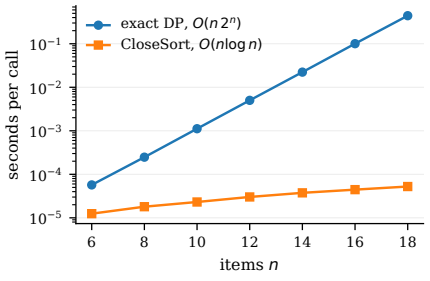
Figure 3 : Single-thread ranking-stage runtime from supplied two-dimensional factors. Each point is the median over 25 exact Gaussian rank-two instances after taking the median of five repeats within each instance.
Original paper · CC BY 4.0These timings exclude factor recovery from a dense matrix, which Equation (6) performs in O(n^2) time. When a determinant-logit model supplies the factors directly, the dense matrix never needs to be built. Recovering factors from a dense matrix would therefore add O(n^2) cost on top of the reported CloseSort timings.
Where the guarantees and experiments stop
The exact reduction needs every unordered pair to contribute a determinant term to the polygon-area identity. The authors leave open the problem of identifying sparse graph families that keep an exact geometric reduction.
The finite-sample experiment assumes a determinant-logit population, which makes rank two the correct latent model. Under misspecification, projection trades variance reduction against approximation error.
The runner-up formula and stability certificate need δ > 0, because the proof of the gap uses that positive margin. CloseSort stays globally optimal at δ = 0, and the regret bound (10) still holds for an arbitrary skew residual. The LLM study uses one benchmark, Arena-Hard, with JuStRank scores from ten judges. The profiles therefore cover 63 systems from one benchmark, and they don't test other benchmarks.
Paper info
- Authors
- Kehan Liu, Zhaoyun Chen, Xianquan Yan
- Venue
- arXiv · Preprint
- First published
- 2026-11-7
- Added
- 2026-11-10
- Updated
- 2026-11-7
- Version
- v1
- arXiv
- 2611.10538
- Category
- cs.DS · cs.IR · cs.LG · stat.ML
- Original paper terms
- CC BY 4.0
- What we show
- Paper info, commentary and permitted figures from the original paper
AI commentary is a separate explanation from the original paper and may contain errors. The original paper and figures follow each source's terms of use and any rights noted separately.
Abstract
Pairwise probabilities arise in rank aggregation, recommendation, and human or LLM evaluation, yet converting them into a maximum-likelihood list is a weighted Kemeny problem and is NP-hard in general. Known exact algorithms for rank-two tournaments use only comparison signs and do not optimize this likelihood. We show that the weighted problem is exactly solvable when the skew-symmetric log-odds matrix $W_{ij}=\log(p_{ij}/p_{ji})$ has rank two, including when the induced preferences contain cycles. Writing $W_{ij}=\det(h_i,h_j)$ and adding the closing vector $h_0=-\sum_i h_i$ turns the objective into twice the signed area of a closed polygon. This geometry yields CloseSort, which polar-sorts the $n+1$ edge vectors, cuts after $h_0$, and returns a global maximum-likelihood order in $O(n\log n)$ time from the factors. The same geometry identifies the runner-up and gives a stability certificate beyond exact rank two. When the smallest determinant $δ$ of two consecutive edges in the closed angular cycle is positive, it is exactly the best-to-runner-up log-likelihood gap. For $W=W_0+E$, the CloseSort order of $W_0$ has regret at most $\sum_{i<j}|E_{ij}|$ on $W$ and remains optimal whenever this sum is below $δ$, a worst-case tight threshold. In 5,120 determinant-logit simulations, increasing the observations per pair from 4 to 64 raises the fraction on which rank-two projection outperforms the empirical plug-in optimum from 68.6% to 85.7%. On 3,600 Arena-Hard LLM-judge profiles drawn from 63 systems and ten judges, the leading rank-two component captures 89.2% of the log-odds energy. On profiles containing a directed majority triangle, CloseSort reduces normalized regret by 44% relative to Borda and improves the mean normalized objective over each of eight baselines. With factors supplied, it is 8,407 times faster than exact dynamic programming on 18-item rankings.
Quote from the paper
Kehan Liu, Zhaoyun Chen, Xianquan Yan (2026). Close and Sort: Exact Maximum-Likelihood Aggregation of Cyclic Rank-Two Preferences. arXiv:2611.10538v1. https://arxiv.org/abs/2611.10538v1
BibTeX
@misc{liu2026close,
  title = {{Close and Sort: Exact Maximum-Likelihood Aggregation of Cyclic Rank-Two Preferences}},
  author = {Kehan Liu and Zhaoyun Chen and Xianquan Yan},
  year = {2026},
  eprint = {2611.10538},
  archivePrefix = {arXiv},
  url = {https://arxiv.org/abs/2611.10538v1}
}