Paper commentary
Imperfectly Imperfect: Evaluating Graded Cognitive Diversity in LLM Persona Simulations
Simulated personas match human traits but not reasoning errors
- Problem Persona prompts shift self-report traits, but no test has checked whether reasoning errors and behaviour vary as they do in people.
- Method The cognition suite gives prompted agents, each given a reflection level, the same questions as 473 adults.
- Results Agents match human Need for Cognition and Big Five distributions but not CRT performance. Claude Sonnet 4.6 agents all score full marks on the bCRT, while 8% of people do.
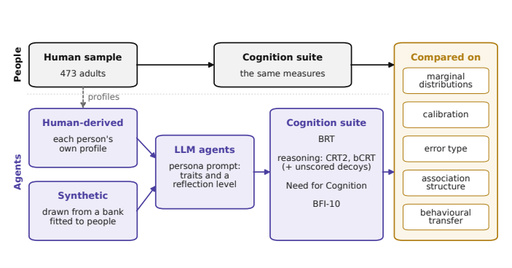
Figure 5 : How is each run evaluated? People and LLM agents answer the same cognition suite; the agents are conditioned on profiles taken from people, either each person’s own or drawn from a bank fitted to them, and the two sets of answers are compared on the five fidelity targets.
Original paper · CC BY 4.0 · Sion Weatherhead, Ben Newell, Aaron Belbasis, Flora Salim · Imperfectly Imperfect: Evaluating Graded Cognitive Diversity in LLM Persona Simulations · Original paper figure · Extracted the figure area from page 14 of the original PDF.Why self-report traits don't settle the question
LLM agents are increasingly used as synthetic participants because they produce language, keep persona descriptions and scale beyond human data collection. Plausible agents aren't enough, since a population also has to match demographic marginals and endorse personality-consistent self-descriptions. Cognitive reflection is a sharp stress test, because low-reflection behaviour isn't simply lower accuracy.
Humans produce intuitive-lure errors on CRT items, such as answering 27 for the dirt-in-a-hole question, and on reflection they realise the hole holds no dirt.
A model that answers every item correctly can fail the process it is meant to simulate, so removing human-like error can count as a fidelity failure. Prior persona studies show that prompted Big Five traits shift self-report answers and some linguistic markers. Those studies show steerability, but they don't establish whether a population keeps the joint structure of marginals, associations, error profiles and behaviour.
In people, Need for Cognition tends to go with conscientiousness and with slightly higher CRT scores, so the traits are correlated.
The authors frame the question as cognitive-diversity fidelity, which follows construct-oriented approaches to AI evaluation. Their target has five parts: marginal, calibration, association, error-type and transfer fidelity. Marginal fidelity compares agent distributions with human ones using Jensen–Shannon divergence, mean shifts and variance ratios.
The results split along that structure: Need for Cognition and Big Five distributions track people, while the two CRTs don't.
A cognition suite with a human reference
The cognition suite pairs CRT2, Need for Cognition and BFI-10 with two tests the authors built. The bCRT is a newly assembled bespoke CRT. The BRT scenarios measure reflection in behaviour at each assigned level. The companion study developed and tested both tests before any human answers to them were public. That timing makes people's bCRT distributions and coded BRT behaviours targets absent from the models' training data.
Agents are conditioned on synthetic or human-derived profiles of reflection, Need for Cognition and Big Five traits. Each agent answers the same suite that 473 adults completed. The human reference sample came from Prolific, with 341 adults in the UK and 132 in the US. Prompt steering is the only method tested, and each persona is told a target reflection level in its prompt.
Scoring checks five fidelity targets against the human reference. Marginal fidelity compares distributions with Jensen–Shannon divergence, mean shifts and variance ratios. Association fidelity compares simulated-minus-human Spearman correlation differences among cognitive and personality constructs. Error-type fidelity asks whether CRT responses keep the human mix of correct, intuitive-lure, other incorrect and missing answers.
LIWC diagnostics serve as supplementary language-based probes of BRT responses. The BRT scenarios are stylised probes, and their outcomes rely on LLM-assisted, rubric-based annotation.
Questionnaire traits are recovered, but performance tests are not
Questionnaire traits are where the simulated agents track people most closely. Across the seven runs, JS divergence for Need for Cognition sits at .10–.20, and the Big Five average at .11–.24. On the two CRTs, the same measure reaches .34–.74, so the performance tests show a different pattern. Calibration R2 for Need for Cognition runs from .74 to .93, so the agents follow their specified scores.
The Big Five calibration R2 spans .79–.96, the same split between questionnaires and CRTs.
Under numeric prompting, Claude Sonnet 4.6 shifts its NFC mean by only +0.01 points with either persona source. Every Claude Sonnet 4.6 agent scores 4 of 4 on both CRTs, whatever reflection level its persona was assigned. Scores rise by 1.53 points on CRT2 and 2.56 points on bCRT, on a four-item scale, so variance is zero. With no variation to calibrate, the R2 can't be estimated, so Figure 1 marks those panels n/e.
The other three runs vary and partly follow the assigned level, but their scores pile up at full marks. On bCRT, 49–82% of these agents score 4 of 4, compared to 8% of people. Claude Sonnet 5 keeps only 20% of its agents at 2 or 3 of 4 on CRT2, compared to 73% of people.
Its average BFI divergence is .14 under numeric prompts, against .17 and .18 under lexical prompts. The format advantage doesn't reach reflection, because every agent still scores full marks under both formats.
Lure errors depend on model and thinking
In people, errors on the bCRT are structured: 41.1% of answers are intuitive lures and 22.8% are other errors. Agents reproduce that structure only in part. The four Claude Sonnet 4.6 runs produce no lures at all, because every CRT2 and bCRT response is correct.
Claude Sonnet 5's pooled CRT2 lure rate is 33.3%, the same as people's familiarity-adjusted rate. On the bCRT it gives 25.5% lures, compared to 41.1% for people.
Figure 2 shows which runs produce lures and on which items, with the configuration runs alongside. The lure rates are the simulation runs' rates for CRT2 and bCRT, plotted against the human reference for each test.
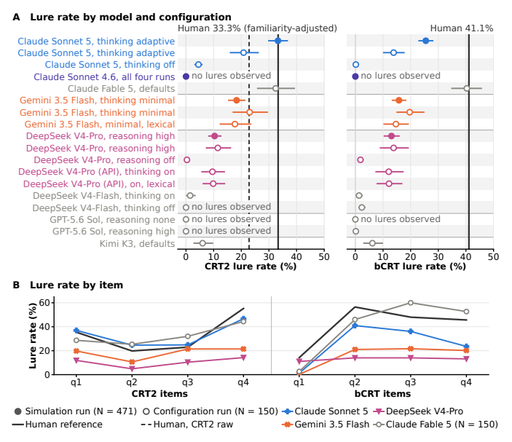
Figure 2 : Which runs produce intuitive-lure errors, and on which items? (A) Lure rate on CRT2 and bCRT with its 95% interval, for the simulation runs (N= 471 ) and for the configuration runs (Section 4.3). (B) Lure rate per item for people (CRT2 familiarity-adjusted) and the three runs that produce lures, with Claude Fable 5, the configuration run whose lure rates are closest to people’s. Models with configuration runs only are drawn in grey. Intervals are persona-clustered bootstrap intervals. Solid black lines are the human reference for each test (CRT2: familiarity-adjusted, people’s rate predicted for items not seen before; bCRT: as answered); the dashed line is people’s raw CRT2 rate.
Original paper · CC BY 4.0The configuration runs show that the lure pattern depends on the model and its thinking setting. Telling GPT-5.6 Sol its persona's reflection level didn't bring lures back with reasoning on or off.
Where lures appear, the two CRTs become almost interchangeable, although people correlate them only modestly. The authors read this as the told level being applied as a general CRT answering pattern, not as a reflection construct that interacts with each item.
Where the behavioural links break
Every run over-produces between 8 and 11 of the 15 coded BRT behaviours, each by at least 20 percentage points. The runs most often postponed the medication decision to check the claim, consulted authoritative sources and appealed to fairness or loyalty.
Of the five associations that people show reliably, Claude Sonnet 5 and Gemini 3.5 Flash reproduce three, and DeepSeek V4-Pro reproduces one. All three runs fail to carry over the link between reflection and asking friends or family about the medication. Transfer can't be tested in the Claude Sonnet 4.6 runs, because their bCRT scores don't vary.
Steering with the told reflection level can be estimated in every run, Claude Sonnet 4.6 included. Asking friends or family about the medication falls with the told level in five runs, whereas more reflective people ask more often. Worry about the medication is the unstable exception, because six runs voice it in 96 to 99% of responses.
The authors read the rise in regulator consultation as weighing against a fixed assistant default. They offer two readings of the over-production: a stereotype of reflective behaviour, or an assistant default that recommends authoritative sources. Prompt steering was the only method tested, so activation steering and fine-tuning remain untested.
What bounds the claim
Several things bound the claim, and the first is who sits in the human reference group. The 473 Prolific adults come from the UK and the US, so the human targets may not hold in other countries. A sample from another country would show whether those targets carry over. Only four models ran the full battery, while the configuration runs added reasoning items for further models and thinking regimes.
The BRT scenarios are stylised probes, not exhaustive samples of everyday reasoning. Its outcomes also rely on LLM-assisted, rubric-based annotation. The BRT pattern admits two readings: a stereotype of reflective behaviour, or an assistant default that recommends authoritative sources.
The authors tested only prompt steering, so activation steering, reinforcement learning and fine-tuning remain untested. Those methods stay as targets for higher-fidelity simulation of decision-making and reasoning. Prompt steering does create variation, so prompt designs that improve fidelity remain open to explore.
The task is therefore to temper those behaviours to the human rate rather than induce them. The central contrast stands: agent prompting can look trait-conditioned while lacking fine-grained cognitive and behavioural variation. Future work can address each of these limits.
Paper info
- Authors
- Sion Weatherhead, Ben Newell, Aaron Belbasis, Flora Salim
- Venue
- arXiv · Preprint
- First published
- 2026-11-7
- Added
- 2026-11-10
- Updated
- 2026-11-7
- Version
- v1
- arXiv
- 2611.10508
- Category
- cs.CL · cs.AI · cs.CY
- Original paper terms
- CC BY 4.0
- What we show
- Paper info, commentary and permitted figures from the original paper
AI commentary is a separate explanation from the original paper and may contain errors. The original paper and figures follow each source's terms of use and any rights noted separately.
Abstract
Large language model (LLM) agents are increasingly used as synthetic participants in social, behavioural, and decision-making research, yet it remains unclear whether they can express graded cognitive diversity as assigned when engaging in simulated behaviour. We introduce a cognition-suite evaluation that tests whether simulated populations reproduce human variation in reasoning, self-reported traits, their associations, and downstream behaviour. Agents conditioned on synthetic or human-derived profiles of cognitive reflection, Need for Cognition, and Big Five personality answer the same suite as a cohort of 473 adults: two newly assembled tests, a Cognitive Reflection Test (CRT) and a Behavioural Reflection Test (BRT) whose decision scenarios measure reflection in behaviour, alongside an established CRT and the two trait questionnaires. Across seven full-battery simulation runs of four models, agents recover Need for Cognition and Big Five trait distributions on self-report questionnaires, but fall short on simulating diversity of cognitive task performance and downstream behaviours. In the four Claude Sonnet 4.6 runs, every agent scores full marks on both CRTs, whatever reflection level its persona was assigned. In the other three runs agents make intuitive-lure errors (the tempting wrong answers CRT items invite), but 49 to 85% score full marks, against under 10% in the human sample. Claude Sonnet 5 comes closest to people's item-by-item pattern of lures; the other two runs give fewer lures and vary less between items. In the BRT scenarios, every run over-produces 8 to 11 of 15 coded behaviours by at least 20 percentage points, and people's links between reflection and behaviour carry over only in part. Useful synthetic populations must preserve not only trait descriptors but the structured variation in reasoning, error type, and behaviour those descriptors are meant to organise.
Quote from the paper
Sion Weatherhead, Ben Newell, Aaron Belbasis, Flora Salim (2026). Imperfectly Imperfect: Evaluating Graded Cognitive Diversity in LLM Persona Simulations. arXiv:2611.10508v1. https://arxiv.org/abs/2611.10508v1
BibTeX
@misc{weatherhead2026imperfectly,
  title = {{Imperfectly Imperfect: Evaluating Graded Cognitive Diversity in LLM Persona Simulations}},
  author = {Sion Weatherhead and Ben Newell and Aaron Belbasis and Flora Salim},
  year = {2026},
  eprint = {2611.10508},
  archivePrefix = {arXiv},
  url = {https://arxiv.org/abs/2611.10508v1}
}