Paper commentary
AI in the Clinical Documentation Loop: Effects of LLM-Induced Note Bloat and Diagnostic Overcall on Downstream LLMs
Summaries written by an LLM can degrade later LLM readers of the same record
- Problem Earlier note-bloat studies covered only human-written copy-forward text, so it was unknown whether LLM-authored notes in a medical record change what a later reader LLM writes. Records now feed back into models that generated parts of them.
- Method The authors plant AI-written summaries into real MIMIC-III records at matched lengths and positions. They then compare the hospital-course output of a reader LLM against copied human text and boilerplate.
- Results At dose 0.5, AI summary notes lowered judge-rated accuracy by 0.47 points compared with snippet-based copied text, and the effect grew with dose.
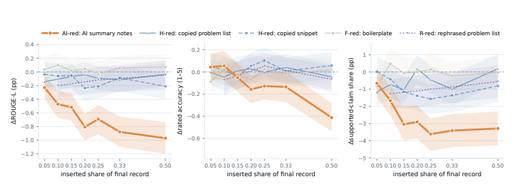
Figure 2 : Effect of note bloat on downstream clinical summarization (main reader, Gemma-4-26B-A4B).
Original paper · CC BY 4.0 · Jinghui Liu, Anthony Nguyen, Taylan Gurgenci · AI in the Clinical Documentation Loop: Effects of LLM-Induced Note Bloat and Diagnostic Overcall on Downstream LLMs · Original paper figure · Extracted the figure area from page 4 of the original PDF.Why AI-written notes matter to later readers
Text that an LLM wrote earlier in a record can become the input for the next model that reads it. AI scribes and automated summarization are already deployed at scale, so this loop is no longer hypothetical. Earlier work on note bloat studied human-written copy-forward text, so whether LLM authorship changes the effect stayed open. Notes accumulate over time, so a recursive context could amplify redundancies and errors.
The second risk is distortion, which differs from hallucination because a claim can keep some truth while losing its context. A distorted claim can also keep an error in hedged form, so it can look plausible rather than invented. A note that calls a recurrence unlikely, written only to guide other clinicians, can be read by an AI as a live differential.
The authors call this pattern diagnostic overcall and treat it as a case of distortion.
Longer context adds a second problem, since LLMs use information unevenly across long input windows. Material in the middle of the context is recovered least reliably. Models can also be distracted by irrelevant but topically related content in the context. Added length and added content therefore need to be separated when analyzing note bloat.
The paper asks whether LLM-authored content in a record changes what a downstream reader writes. Across seven reader models from four families, the authors report evidence of both bloat and distortion effects. Training-dynamics work on models trained on their own outputs is a related idea, but this setting concerns inference-time context.
The key idea and the two artifacts
The study isolates AI-written content by planting it into a real record and keeping everything else matched. The clinician-written Brief Hospital Course from the discharge summary serves as the reference for scoring.
The first artifact is note bloat, where LLM-generated summaries accumulate in the record and change its length and provenance over time. Bloat inserts redundant notes, and the study compares AI summaries against copied human text and boilerplate at the same inserted length and positions. A rephrased control separates AI authorship from content by rewriting copied problem-list notes in new words while keeping their content.
The bloat dose is the inserted fraction of the final record, running from 0.05 to 0.50.
The second artifact is distortion, which the study tests through diagnostic overcall. A diagnostic overcall is an unsupported differential that AI documents and that clinicians would otherwise omit. The generator first neutrally rephrases a selected passage, which gives the control record. It then adds the target diagnosis as an unresolved, hedged differential, so both records share the same AI-rewritten passage.
Because the two records differ only by the overcall, the design holds AI authorship fixed while testing the diagnosis.
How the bloat arms are built and matched
The bloat design writes x^{a,d}_i for a record whose inserted notes come from setting a at dose d. Dose d measures the inserted fraction of the final record, so at d = 0.5 half the record is inserted text. The authors used seven doses, ranging from 0.05 to 0.50, so the inserted share rises gradually across the arms. Four settings fill those slots: AI-red, two H-red variants, F-red, and the rephrased control R-red.
Qwen3.8-27B serves as G in the main setup, and Nemotron-3.5-Lightning-30B-A3B provides a second generator. Insertion positions stay identical across settings, so every arm fills the same slots in the same way. H-red and F-red are sized to match the length of AI-red at each position, so length stays constant across arms. The rephrased control runs only at doses 0.10, 0.25 and 0.50.
The bloat effect is a paired mean difference, so each admission contributes its own bloated-minus-original score. The estimator averages the score difference over all admissions in I, with a as the bloated record and b as the original. For the original record, x^{b,d}_i equals x_i, so both sides of each comparison come from the same admission.
Figure 2 plots this ΔROUGE-L for the main reader across the seven doses.
The study samples 300 admissions, one per patient, from MIMIC-III. At dose 0.5, AI-red lowered judge-rated accuracy by 0.47 points relative to snippet-based H-red. Against F-red, AI-red lowered judge-rated accuracy by 0.43 points at the same dose. This effect increased with dose, while equal-length H-red and F-red stayed close to the original-record output.
Against R-red, AI-red lowered ROUGE-L by 0.92 pp at dose 0.50.
How overcalls are injected and scored
Overcall rewrites a chosen narrative passage rather than adding a new note. For each admission, the generator G first neutrally rephrases a selected passage, which becomes the control record. It then adds the target diagnosis to that passage as an unresolved, hedged differential. Both records share the same AI-rewritten passage, so AI authorship stays fixed while only the overcall changes.
Target types come from ICD code co-occurrence with the primary diagnosis. Related targets frequently co-occur with the primary diagnosis, while unrelated targets show the opposite pattern. The evaluator labels each injected condition as confirmed, possible or absent in both summaries. A summary counts as mentioning the condition when its label is confirmed or possible.
A pair counts as propagated only when the distorted summary mentions the condition and the control does not.
At most 0.6% of pairs stated the condition as confirmed. Every main-reader rate stayed significantly above zero under Bonferroni-adjusted intervals. Related targets propagated more often than unrelated ones, but the gap wasn't statistically significant.
With overcalls written by the Nemotron-based generator, the main reader propagated less. Those edits were much shorter, and at matched lengths the two generators propagated at similar rates. Document-level evaluation didn't reflect the targeted failure, which shows the limits of existing metrics.
Bloat effect on the main reader
AI-authored summary notes lowered hospital-course quality for the main reader, Gemma-4-26B-A4B, compared with copied human text at the same inserted length and position. The authors inserted seven doses, from 0.05 to 0.50, where the dose is the inserted fraction of the final record. The gap between the AI arm and the copied and boilerplate arms grew as the dose rose.
At dose 0.5, AI-red lowered judge-rated accuracy by 0.47 points against snippet-based H-red, with a 95% interval of 0.34 to 0.59. Against F-red boilerplate, the accuracy drop at the same dose was 0.43 points, with an interval of 0.31 to 0.55. The authors call this effect modest, about half the run-to-run variation of a single summary, yet they find it consistent.
A rephrase control separated authorship from content, because the generator rewrote each copied note in its own words. R-red changed ROUGE-L by -0.07, -0.07 and 0.00 percentage points at doses 0.10, 0.25 and 0.50, with intervals that included zero. AI-red still lowered ROUGE-L by 0.28, 0.59 and 0.92 percentage points against R-red at those three doses, so the drop tracks the AI content rather than the wording.
Overcalls that reappear in summaries
Injected diagnostic overcalls came back in the main reader's summaries at measurable rates. The authors report these rates for every reader in the same table, so the spread shows how much reader choice matters.
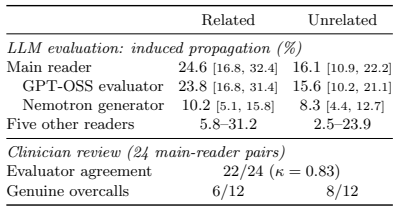
Table 1 : Diagnostic overcall propagation. Unless
Original paper · CC BY 4.0Most propagated overcalls stayed hedged, because the reader kept them as possible rather than confirming them. At most 0.6% of pairs stated the condition as confirmed. With Bonferroni-adjusted intervals, every main-reader rate was significantly greater than zero. Related targets propagated more often than unrelated ones, but the difference was not statistically significant.
Overcalls written by the Nemotron generator propagated less for the main reader. Those Nemotron edits were much shorter, so length could explain the gap.
Document-level quality did not register this failure, even though propagation was common. Similarity and judge scores can therefore miss an unsupported differential that reappears in a later summary. The authors see this as a limit of existing metrics for catching subtle changes in AI-generated documentation.
Clinician check of the evaluator
The propagation labels come from an LLM evaluator, so a clinician co-author checked them against 24 stratified summary pairs. The reviewer worked blind to target type, summary source, and the evaluator's labels. Agreement on induced propagation reached 22 of 24 pairs, or 91.7%, with a kappa of 0.83. The 95% confidence interval for that agreement runs from 74–98%.
The evaluator found all 10 propagations that the clinician identified, and it carried every one as possible.
Yet the clinician labelled just 14 of the 24 injections as genuine overcalls. A genuine overcall, in this sense, is an open differential the record can't back up. The authors read this gap as a limitation of their ICD-based targets. Even so, genuine overcalls still propagated, 7 of 14 times.
The targets rest on ICD codes and titles, which set the scope of what the evaluator could check. Those codes may not capture the clinical nuances that separate a genuine overcall from a reasonable differential. So the study can't claim that its targets always match what a clinician would document. Document-level scores missed this failure, which is why the propagation labels carry the finding.
Limits of the study: how far these results travel
MIMIC-III predates LLM documentation, so its records can't show how much AI content current health systems hold. The AI content in the study is synthetic, so the authors generated it rather than observing it in practice. Even so, the authors consider MIMIC-III the most realistic testbed available to them, and it offers an uncontaminated baseline.
The overcall targets depend on ICD codes and titles, which may miss the clinical nuance of genuine overcalls. The clinician judged only 14 of 24 injections to be genuine overcalls, which exposes this limitation of the ICD-based targets. Of those 14 genuine overcalls, 7 still propagated into the summaries. So the propagation rates rest on targets that are only partly genuine overcalls.
Seven reader models from four families were tested, with Gemma-4-26B-A4B as the main reader. Qwen3.8-27B served as the generator, and Nemotron-3.5-Lightning-30B-A3B served as an alternative generator for the main reader. All models ran locally through vLLM, so the results cover open-weight models only. Frontier models weren't tested, because they need a compliant pathway.
Paper info
- Authors
- Jinghui Liu, Anthony Nguyen, Taylan Gurgenci
- Venue
- arXiv · Preprint
- First published
- 2026-11-7
- Added
- 2026-11-10
- Updated
- 2026-11-7
- Version
- v1
- arXiv
- 2611.10601
- Category
- cs.CL · cs.AI
- Original paper terms
- CC BY 4.0
- What we show
- Paper info, commentary and permitted figures from the original paper
AI commentary is a separate explanation from the original paper and may contain errors. The original paper and figures follow each source's terms of use and any rights noted separately.
Abstract
Large language models (LLMs) are increasingly used to process medical records for healthcare tasks such as clinical documentation. Because these tools also generate documentation, the relationship is now bidirectional: models both read from and write to the record. Understanding how LLMs behave when reading records that already contain LLM-authored content is therefore critical for their safe deployment. In this study, we examine how LLM-authored content in the medical record affects downstream LLMs that read the same record. We consider two types of LLM-induced artifacts: bloat, in which LLM-generated summaries accumulate in the record and change the length and provenance of its content over time; and distortion, in which LLMs subtly alter clinical findings rather than fabricating facts outright. As a case of distortion, we study diagnostic overcall (documenting an unconfirmed differential diagnosis in the record) and test whether it propagates to the reader LLM's output. Across seven reader models from four families, we find evidence of both effects. First, LLM-generated summary notes modestly but consistently degraded downstream hospital-course generation compared with copy-forward and templated text of matched length. Second, injected overcalls reappeared in downstream outputs at rates that varied by reader model, without detectable changes in standard quality metrics. These findings show the need to monitor AI-generated content in medical records and to account for it when those records are later processed by AI.
Quote from the paper
Jinghui Liu, Anthony Nguyen, Taylan Gurgenci (2026). AI in the Clinical Documentation Loop: Effects of LLM-Induced Note Bloat and Diagnostic Overcall on Downstream LLMs. arXiv:2611.10601v1. https://arxiv.org/abs/2611.10601v1
BibTeX
@misc{liu2026clinical,
  title = {{AI in the Clinical Documentation Loop: Effects of LLM-Induced Note Bloat and Diagnostic Overcall on Downstream LLMs}},
  author = {Jinghui Liu and Anthony Nguyen and Taylan Gurgenci},
  year = {2026},
  eprint = {2611.10601},
  archivePrefix = {arXiv},
  url = {https://arxiv.org/abs/2611.10601v1}
}