Paper commentary
Do Verifier Judgments Survive Abstraction? Measuring Verification Transport for LLM Agent Evaluation
Verifier judgments often break when agent executions are abstracted
- Problem LLM verifiers are usually tested on one fixed view of an agent's trajectory. Deployed systems often hide steps behind macro actions, delegation, or compacted histories, so it was unclear whether correct judgments survive these changes.
- Method Verification Transport tests this by holding the same frozen execution fixed and changing only what the verifier sees. Each trajectory gets a native view, an abstracted view, and a restored view with the removed provenance added back.
- Results Across four benchmarks and seven verifier backbones, 31.0% of native-correct judgments failed under macro abstraction, and 30.9% under delegation. Compaction gave 20.3%.
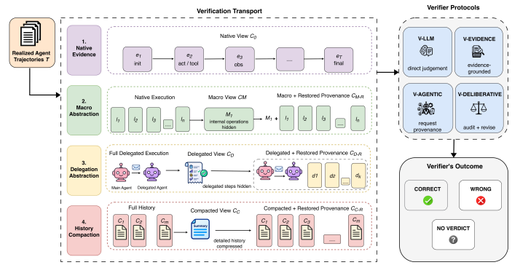
Figure 2 : Overview of the verification transport framework. The same underlying agent execution is evaluated under native and abstraction-induced observability conditions, followed by provenance restoration to test whether abstraction-induced verification failures can be recovered.
Original paper · CC BY 4.0 · Disha Sheshanarayana, Sai Linisha Reddy Goli · Do Verifier Judgments Survive Abstraction? Measuring Verification Transport for LLM Agent Evaluation · Original paper figure · Extracted the figure area from page 3 of the original PDF.Why a verdict on one view may not carry over
Trajectory-level verifiers now judge whether an agent's process was sound, not only whether its final answer was right. Their output feeds process feedback, reward modeling, and safety monitoring, so a verifier that misreads an execution sends a wrong signal onward. Most evaluations ask whether a verifier separates better executions from worse ones, and they assume each execution reaches the verifier in one fixed form.
That fixed-representation assumption is left largely implicit, so it is rarely tested directly.
Deployed systems often break that assumption, because low-level operations can be represented as macro actions. Execution can also run behind delegation boundaries, and long histories can be compacted before a verifier reads them. The underlying execution stays the same in these cases, while the provenance a verifier can observe changes. That leaves an open question: does a verifier keep its judgment when the same execution crosses such a boundary?
Verification Transport tests exactly this by holding the task, realized trajectory, outcome, and criterion fixed.
Transport failure applies only to judgments that are correct under the native view. A failure occurs when such a judgment becomes either an incorrect verdict or no usable verdict. The paper reports this failure rate at 31.0% under macro abstraction, 30.9% under delegation, and 20.3% under compaction. Native-view accuracy alone doesn't characterize verifier reliability once execution evidence crosses an abstraction boundary.
Because the failure rate counts only native-correct judgments, it measures how stable those judgments are rather than overall accuracy.
Holding the execution fixed and changing only the view
The framework keeps one realized trajectory, its outcome, its ground truth, and the verifier fixed, and changes only the evidence the verifier receives. Each trajectory gets a native view and an abstracted view, so any change in the judgment has to come from the view itself. The native condition C0 exposes the benchmark's original trajectory representation, while the abstracted condition Ca changes how execution evidence reaches the verifier.
A Verification Transport Failure happens when a native-correct judgment becomes a wrong verdict or no usable verdict. Abstention counts as lost verdict coverage, so the authors analyze wrong verdicts and missing verdicts separately.
Each abstracted condition gets a paired restoration condition, Ca-R, that brings back the provenance removed from the original trajectory. Restoration changes only what the verifier can see, and it doesn't correct the execution itself. The chain C0 to Ca to Ca-R tests two things: whether a native-correct judgment breaks under abstraction, and whether restoration repairs it.
The authors instantiate three boundaries, macro abstraction, delegation, and history compaction, with conditions CM, CD, and CC.
Macro abstraction hides low-level operations and their intermediate observations behind a higher-level macro action. In delegation, the verifier sees the delegation and its returned result, while the delegated execution stays hidden until CD-R restores it.
It measures how stable initially correct judgments are under abstraction, not overall verifier accuracy. Under this measure, transport failure reaches 31.0% under macro abstraction, 30.9% under delegation, and 20.3% under compaction.
Four ways a verifier can use the evidence
V-LLM is the direct baseline, giving one task-level verdict on the presented trajectory in a single pass. It has no evidence audit, no provenance request, and no reconsideration stage. V-EVIDENCE asks the verifier to name the visible evidence and check whether that evidence is sufficient before it judges. Because it cannot reach provenance that the current observation condition hides, V-EVIDENCE tests whether grounding alone helps transport robustness.
V-AGENTIC may request more execution provenance when the visible evidence isn't enough for a reliable judgment. That requested provenance comes from the same realized trajectory, not from a new execution. V-DELIBERATIVE starts from the frozen V-EVIDENCE verdict, which the authors call D1. A second pass, D2, audits the same visible evidence plus the frozen D1 response, then keeps or revises the verdict.
D2 gets no extra provenance, so this design separates the effect of deliberation from the effect of provenance acquisition.
Under macro abstraction, V-LLM gives 15.8% wrong verdicts and 0.7% no verdicts. Under the same abstraction, V-EVIDENCE gives 10.6% wrong verdicts but 24.0% no verdicts. V-DELIBERATIVE gives 9.4% wrong verdicts and 39.9% no verdicts, so its losses come mostly from abstention. Across the aggregate results, V-LLM has the lowest denominator-weighted VTFR, at 16.4% under macro abstraction.
V-AGENTIC reaches 25.0% under macro abstraction, while V-EVIDENCE reaches 34.5% and V-DELIBERATIVE reaches 49.3%. Since VTFR counts both wrong verdicts and lost verdict coverage, a lower rate doesn't by itself mean a more reliable verifier. VTFR is also conditioned on native-correct judgments, which can cover different instance subsets for each protocol.
The authors therefore compare protocols by both failure modes and their native-correct subsets, not by the aggregate rate alone.
Benchmarks, backbones and metrics
The study draws on four benchmarks: 250 trajectories from AgentProcessBench, 758 from ATBench, 441 PlanRewardBench pairs, and 754 from AgentDojo. These counts cover only the instances that met each benchmark's eligibility rules for building matched views, so they aren't the full benchmarks. On AgentProcessBench, each instance targets one designated message and its step-level label, not labels pooled across the whole trajectory.
On PlanRewardBench, the authors abstract both candidates when eligible, and the preference label and candidate ordering stay fixed. For history compaction, an earlier region becomes a compaction boundary marker, while recent evidence such as the final tool-call and tool-result pair stays visible.
Seven verifier backbones span several model families and scales, which lets the authors check whether transport behaviour generalizes. The set includes Gemini-3.7-Flash, Gemini-2.5-Flash, GPT-OSS-120B, GPT-OSS-20B, Gemma-4-31B, Gemma-4-26B-A4B, and Llama-4-Maverick. All abstraction and restoration views are built deterministically from frozen source trajectories before any verifier sees them.
C0 OBA measures native-view operational balanced accuracy, and for multi-stage protocols it uses the protocol's final task verdict. VTFR is the share of C0-correct judgments that turn incorrect or invalid after abstraction, so it tracks stability rather than overall accuracy. RRR measures the fraction of abstraction-induced failures that are recovered after restoration.
RDR measures how often restoration degrades judgments that stayed correct after abstraction. Pooled rates add numerators and denominators across cells, instead of averaging the cell percentages.
How often correct judgments break
Pooled across four benchmarks, seven models and four protocols, the VTFR is 31.0% under macro abstraction. Under delegation, the pooled VTFR is 30.9%, close to the macro figure. Under compaction, the pooled VTFR falls to 20.3%, so the boundary type changes how much a correct judgment loses. The rate counts both wrong verdicts and cases where the verifier returns no usable judgment.
Split by benchmark, macro abstraction gives aggregate VTFRs of 25.5 to 32.2%. Delegation gives aggregate VTFRs of 26.1 to 32.9% on the same four benchmarks. Compaction ranges from 16.2 to 24.7%, so the ordering of boundaries holds on every benchmark.
The seven verifier backbones, from Gemini-3.7-Flash to Llama-4-Maverick, show the same ordering. The size of the gap varies a lot by model, as Figure 3 shows. Figure 3 aggregates each backbone across the four verifier protocols, so it doesn't isolate protocol effects. The authors read this as representation sensitivity that is widespread but not uniform.
Under macro abstraction, V-LLM gives 15.8% wrong verdicts and 0.7% no verdicts, so the failure mix depends on the protocol.
Wrong verdicts versus missing verdicts
Under macro abstraction, the four protocols don't fail in the same way, and the aggregate rates hide that split. V-LLM has the lowest denominator-weighted VTFR at 16.4% under macro abstraction, while V-AGENTIC reaches 25.0%. V-EVIDENCE reaches 34.5% and V-DELIBERATIVE reaches 49.3% under the same condition. Those totals count wrong verdicts and missing verdicts together, so the protocol ranking can shift once they are split apart.
V-LLM gives 15.8% wrong verdicts and only 0.7% no verdicts under macro abstraction. V-EVIDENCE gives 10.6% wrong verdicts but 24.0% no verdicts under the same condition. V-DELIBERATIVE gives 9.4% wrong verdicts and 39.9% no verdicts, the largest share of withheld answers. Direct verification thus errs by giving a wrong answer, while evidence-grounded and deliberative protocols more often withhold a verdict.
The D2 audit in V-DELIBERATIVE gives a native-view C0 that can differ from the frozen V-EVIDENCE D1 judgment. In several model and benchmark settings, D2 substantially lowers native-view performance before any abstraction is applied. VTFR is conditioned on native-correct judgments, which can cover different instance subsets for each protocol.
The authors advise comparing protocols on both their failure modes and their native-correct subsets.
The authors conclude that a lower transport failure rate doesn't necessarily mean a more reliable verifier. A verifier that withholds verdicts can post lower wrong-verdict rates while still failing to deliver a usable judgment.
Restoring provenance recovers most transport failures
Restoration is the test that separates repairable verifier errors from stable ones, because each abstraction gets a paired restored view. In the same pooled view, restoration degrades only 5.2% of judgments that had already survived abstraction.
Recovery is strongest under macro abstraction at 87.9% and under delegation at 86.9%. Degradation stays close to that level, at 5.3% for macro abstraction and 5.4% for delegation, so repairs don't come at a large cost. Under compaction, recovery drops to 79.8%, while degradation is 4.9%. This lower compaction figure fits the paper's observation that recovery is lower when provenance is lossy or unavailable.
The authors read these recoveries as evidence that the failures track how accessible the execution evidence is. Restoration doesn't alter the execution, so a repaired verdict reflects what the verifier was able to see. Because the trajectory, outcome and criterion stay fixed, the verifier's behavior is the only thing that changes between views.
The discussion goes further and says that higher-fidelity restoration beats re-evaluation alone.
Most transport failures are therefore recoverable once the original provenance is returned to the verifier. The next section splits recovery by abstraction severity and by how faithfully the provenance is restored.
Severity and provenance fidelity ablations
The severity ablation hides nested subsets of approximately 25%, 50%, and 75% of the eligible evidence atoms in one execution block. Each step hides more evidence, while the source execution and the order of the remaining visible evidence stay the same. On AgentProcessBench, Gemini's VTFR rises from 24.3% at A25 to 31.4% at A75. GPT-OSS on the same benchmark rises from 21.5% to 29.6%.
On ATBench, VTFR climbs from 17.7% to 21.1% for Gemini and from 16.9% to 22.9% for GPT-OSS.
The A50 point isn't strictly monotonic in every setting, but the A25-to-A75 increase holds in all four model-benchmark pairs. So the authors read failure as growing with severity, not merely from the presence of an abstraction boundary. The fidelity ablation compares three ways of supplying evidence after an abstraction-induced failure. Requery repeats verification on the same abstracted evidence, while LossyR restores ordered action and tool identities without arguments, observations, or textual contents.
ExactR restores the exact frozen provenance tied to the abstraction boundary.
On AgentProcessBench, Gemini's RRR rises from 22.5% under Requery to 42.8% under LossyR and to 80.0% under ExactR. GPT-OSS on the same benchmark goes from 24.6% to 34.0% to 82.5%. On ATBench, the RRR values are 33.1%, 53.9%, and 81.9% for Gemini, and 30.2%, 47.2%, and 73.6% for GPT-OSS. So recovery follows provenance fidelity, not re-evaluation alone.
The ablations use Gemini-2.5-Flash and GPT-OSS-120B on two benchmarks, so they didn't test other backbones or benchmarks. The discussion frames this as higher-fidelity restoration beating re-evaluation.
Limits of the evidence
VTFR folds wrong verdicts and lost verdicts into one number, so an abstaining protocol can look stable on it. Under macro abstraction, V-LLM produces 15.8% wrong verdicts and 0.7% no verdicts. V-EVIDENCE produces 10.6% wrong verdicts but 24.0% no verdicts under the same condition. The authors conclude that a lower transport failure rate doesn't by itself mean greater verifier reliability.
VTFR is computed only on native-correct judgments, and each protocol can have a different set of such instances. Cross-protocol comparisons therefore need to examine both the failure modes and the native-correct subsets behind each rate. V-DELIBERATIVE reports its final D2 audit under every observation condition, so its native-view C0 can differ from the frozen V-EVIDENCE D1 judgment.
In several model and benchmark settings, the D2 audit substantially lowers native-view performance before any abstraction is applied.
The benchmark counts cover only instances that meet the eligibility requirements for matched abstraction and restoration construction. Those eligible sets contain 250 APB trajectories, 758 ATBench trajectories, 441 PRB comparisons and 754 AgentDojo trajectories. The two targeted ablations ran on Gemini-2.5-Flash and GPT-OSS-120B, using only AgentProcessBench and ATBench.
They didn't test the severity and fidelity ablations on the other five verifier backbones or on AgentDojo and PRB. The study also covers only three abstraction boundaries, so other observability changes remain outside these results.
Paper info
- Authors
- Disha Sheshanarayana, Sai Linisha Reddy Goli
- Venue
- arXiv · Preprint
- First published
- 2026-11-13
- Added
- 2026-11-16
- Updated
- 2026-11-13
- Version
- v1
- arXiv
- 2611.18471
- Category
- cs.CL · cs.AI
- Original paper terms
- CC BY 4.0
- What we show
- Paper info, commentary and permitted figures from the original paper
AI commentary is a separate explanation from the original paper and may contain errors. The original paper and figures follow each source's terms of use and any rights noted separately.
Abstract
LLM-based verifiers are increasingly used to evaluate agent executions, but their reliability is typically measured under a single representation of the trajectory. In deployed agent systems, the same execution may be exposed through composed tools, delegation boundaries, or compacted histories, changing what execution evidence is directly observable to the verifier. It therefore remains unclear whether correct verifier judgments persist across such abstraction boundaries. We introduce Verification Transport, a reliability test that measures judgment stability under abstraction-induced changes in execution observability. We construct matched native, abstracted, and restored views of the same frozen executions while holding the task, realized trajectory, outcome, ground truth, evaluation criterion, and verifier fixed. Across four agent-evaluation benchmarks, seven verifier backbones, four verification protocols, and three abstraction boundaries, we find substantial transport failure, reaching about 31% under macro abstraction and delegation. Verification protocols exhibit distinct failure modes: direct verification more often produces incorrect verdicts, whereas evidence-grounded and deliberative protocols tend to abstain under limited observability. This suggests that lower transport failure rates do not necessarily imply greater reliability. Restoring the corresponding execution provenance recovers 85.5% of transport failures, while recovery is lower when provenance is lossy or unavailable. These results show that native-view accuracy alone is insufficient to characterize verifier reliability when execution evidence crosses abstraction boundaries.
Figures from the paper
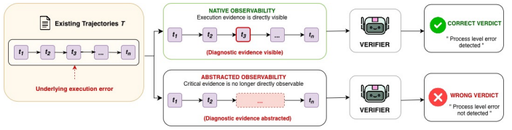
Figure 1 : The same underlying agent execution is evaluated under native and abstracted observability. A native-correct judgment that becomes incorrect or unusable under the abstracted view constitutes a Verification Transport failure.
Original paper · CC BY 4.0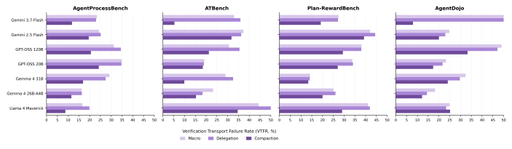
Figure 3 : Verification Transport Failure Rate (VTFR) across benchmarks and verifier backbones. Bars show denominator-weighted VTFR under macro abstraction, delegation, and history compaction, aggregated across the four verifier protocols. Lower VTFR indicates more robust Verification Transport.
Original paper · CC BY 4.0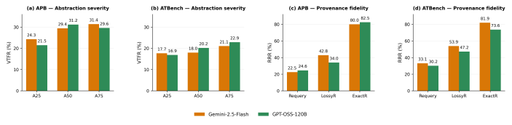
Figure 4 : Ablations for abstraction severity and provenance fidelity using Gemini-2.5-Flash and GPT-OSS-120B on AgentProcessBench and ATBench.
Original paper · CC BY 4.0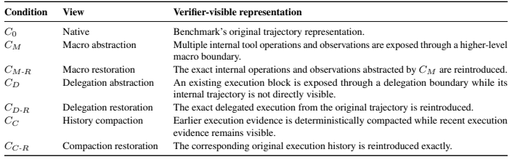
Table 3 : Summary of the native, abstraction, and restoration conditions used for Verification Transport. Restoration conditions reintroduce provenance from the same original execution.
Original paper · CC BY 4.0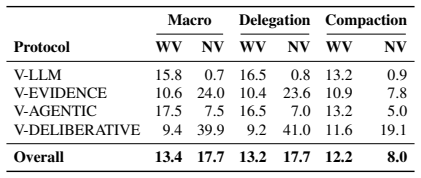
Table 4 : Decomposition of Verification Transport failures into Wrong Verdict (WV) and No Verdict (NV) outcomes. Values are denominator-weighted across benchmarks and verifier backbones. WV and NV sum to VTFR within each abstraction condition.
Original paper · CC BY 4.0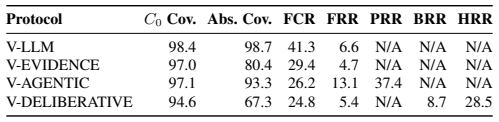
Table 5 : Diagnostic behavior of the four verifier protocols under abstraction. C0 Cov. denotes native- view Coverage and Abs. Cov. denotes Coverage pooled across macro, delegation, and compaction conditions. FCR and FRR are computed only on benchmarks with a meaningful positive–negative verdict space. All values are percentages and are denominator-weighted. N/A denotes a diagnostic that is not defined for the corresponding protocol.
Original paper · CC BY 4.0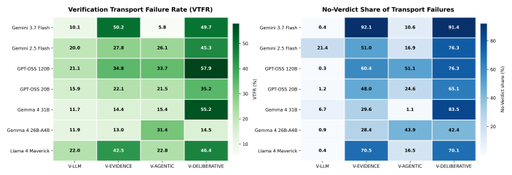
Figure 5 : Model–protocol patterns in Verification Transport failure. Left: denominator-weighted Verification Transport Failure Rate (VTFR), pooled across benchmarks and abstraction conditions. Right: the share of transport failures attributable to No Verdict outcomes. Each cell corresponds to one verifier backbone–protocol combination.
Original paper · CC BY 4.0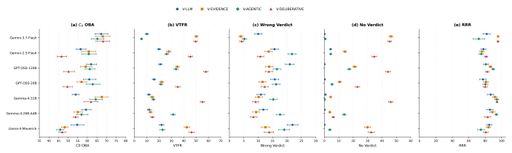
Figure 6 : Bootstrap 95% confidence intervals for verifier performance and Verification Transport outcomes. Panels report native-view Operational Balanced Accuracy (C0 OBA), Verification Trans- port Failure Rate (VTFR), Wrong Verdict, No Verdict, and Restoration Recovery Rate (RRR). Points denote denominator-weighted estimates and error bars show paired benchmark-stratified bootstrap 95% confidence intervals.
Original paper · CC BY 4.0Quote from the paper
Disha Sheshanarayana, Sai Linisha Reddy Goli (2026). Do Verifier Judgments Survive Abstraction? Measuring Verification Transport for LLM Agent Evaluation. arXiv:2611.18471v1. https://arxiv.org/abs/2611.18471v1
BibTeX
@misc{sheshanarayana2026verifier,
  title = {{Do Verifier Judgments Survive Abstraction? Measuring Verification Transport for LLM Agent Evaluation}},
  author = {Disha Sheshanarayana and Sai Linisha Reddy Goli},
  year = {2026},
  eprint = {2611.18471},
  archivePrefix = {arXiv},
  url = {https://arxiv.org/abs/2611.18471v1}
}