Paper commentary
Chain-of-Thought Reasoning Without Prompting
- Problem Greedy decoding returns a direct answer, which can hide reasoning that a pre-trained LLM already holds in its alternative top-k continuations.
- Method Branches on the top-k first tokens, continues each branch greedily, and ranks the resulting paths by the answer-confidence gap Δ over the answer tokens, without prompts or model tuning.
- Results Raised PaLM-2 Large GSM8K top-100 accuracy from 44.0% with greedy decoding to 72.0% when paths are ranked by answer confidence.
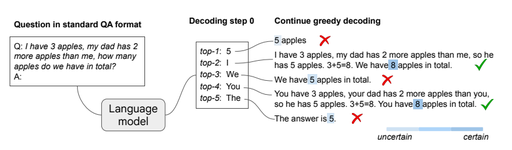
Figure 1 | Illustration of CoT-decoding. Pre-trained LLMs are capable of inherent reasoning without prompting by considering alternative top-𝑘 tokens, rather than solely relying on the top-1 greedy decoding path. Moreover, these models tend to display higher confidence in decoding the final answer (indicated by a darker shaded color) when a CoT reasoning path is present.
Original paper · CC BY 4.0 · Xuezhi Wang, Denny Zhou · Chain-of-Thought Reasoning Without Prompting · Original paper figure · Extracted the figure area from page 2 of the original PDF.Why greedy decoding can hide reasoning
Most direct question-answer evaluations of LLM reasoning follow the greedy path, which keeps only the most probable token at each step. Under that setup, models often skip intermediate steps and answer at once, which yields low reasoning accuracy in prior direct-answer studies. The authors' starting point is that this weakness may come from looking at one path only rather than from a missing capability.
The authors attribute the tendency to answer immediately to a skewed sense of problem difficulty, since pre-training data is dominated by simpler questions. The study therefore asks whether the reasoning is absent from the model or simply not expressed on the greedy path.
Branching on the first token
The input is the question placed in a Q and A format, since without that format a pre-trained model tends to continue the question instead of answering. The model itself is not changed: the only modification is the decoding search.
At the first decoding step the top-k tokens are taken, with k set to 10 by default, and each branch is continued with greedy decoding. Branching at the first step produces a more diverse set of paths than branching later, because later tokens are strongly conditioned on what was already generated.
Table 1 shows the effect for a GSM8K question and a year parity question on PaLM-2 Large: the greedy path answers directly, while some alternative first tokens lead to a worked solution. Figure 1 presents the same idea for a short apple-counting question, shading each path by how confident the model is in its final answer.
Scoring paths by answer confidence
For each path k, the score Δ is the average over the answer tokens of the gap between the top-1 and top-2 probabilities at each answer position. \[ \Delta_{k,\text{answer}} = \frac{1}{|\text{answer}|}\sum_{x_t\in\text{answer}} \bigl( p(x_t^{1}\mid x_{<t}) - p(x_t^{2}\mid x_{<t}) \bigr) \] Here x_t^1 and x_t^2 are the top two tokens at step t of path k, chosen by maximum post-softmax probability, and the sum runs only over tokens that belong to the answer.
A large gap means the model strongly prefers one token over its nearest rival at each answer position, so a high Δ reads as high confidence in the answer. The authors also tested the top-1 probability alone, which performed slightly worse, and they judged entropy unreliable because of the large vocabulary and vocabulary truncation.
Paths with a CoT component show a clearly higher Δ than paths without one in the examples in Table 1. In a manual check of the first 100 GSM8K questions, the highest-confidence path among the top-10 paths contained a CoT path in 88% of cases.
Rather than choosing one maximum path, the aggregation sums Δ over all paths that give the same answer a, and selects the answer with the largest total. The aggregation reduces sensitivity to small differences in logits, and the authors note that the majority answer over paths is unlikely to be the correct one.
Accuracy on PaLM-2 and Mistral-7B
On PaLM-2 Large, ranking the top-10 paths by answer confidence raised GSM8K top-100 accuracy from 44.0% with greedy decoding to 72.0%. On year parity, the same ranking raised accuracy from 57.0% to 95.0%, while ranking by the highest log-probability or by the highest length-normalized log-probability gave weaker gains on GSM8K.
On the pre-trained Mistral-7B, greedy decoding reached 9.9% on GSM8K and CoT-decoding with 10 paths reached 25.1%. The authors report that CoT-decoding was the only decoding strategy in this comparison that clearly improved reasoning, while some baselines were below greedy decoding.
For pre-trained Mistral-7B, CoT-decoding raised MultiArith from 14.3 to 45.7 and year parity from 35.0 to 66.0. For the instruction-tuned Mistral-7B, GSM8K rose from 31.2 to 38.2, MultiArith from 37.8 to 66.5 and year parity from 62.2 to 73.5. The authors attribute the remaining gap in the instruction-tuned model to cases where it still answers a question directly before any reasoning.
On PaLM-2 Large, self-consistency without a CoT prompt reached 40.6%, below CoT-decoding at 63.2%.
How many first-step branches, and why not sample
Across PaLM-2 scales, higher values of k generally improved accuracy, which suggests that correct CoT paths often exist but are ranked lower in decoding. For Mistral-7B pre-trained, the gain from larger k was highly consistent, while for the instruction-tuned model larger k brought little further improvement. The authors explain the smaller effect for instruction-tuned models by the CoT paths being moved to the first few branches during instruction tuning.
Sampling was tested as an alternative to branching, since sampling also produces several paths. The authors argue that sampling fails without prompts because the first token has little diversity when the model strongly prefers a direct answer, whereas CoT-decoding forces diversity at the first step.
Synthetic tasks and the role of prompt demonstrations
On Coin Flip with two rounds, PaLM-2 L reached 94.0 with CoT-decoding against 70.0 with greedy decoding. At three and four rounds the gap was much smaller, with CoT-decoding at 57.0 and 55.0 against greedy scores of 53.0 and 48.0.
On Web of lies and multi-step arithmetic, the authors found that correct CoT paths were generated when the solution needs at most one or two steps of knowledge manipulation. Beyond about three steps the model rarely produced correct paths, and the accuracy gain appeared only for larger k as complexity rose.
The authors read the Coin Flip and Web of lies failures as weak state tracking, and the arithmetic failures as left-to-right calculation that ignores operator precedence. Few-shot CoT prompts on these tasks mostly teach the model to copy a prescribed procedure, such as explicit state tracking, so their results reflect the prompt as well as the model.
Combining CoT-decoding with zero-shot CoT prompting
Zero-shot CoT prompting alone reached 17.5% on Mistral-7B and 75.1% on PaLM-2 L on GSM8K. Without a prompt, path aggregation gave 25.3% on Mistral-7B and 64.1% on PaLM-2 L, against 25.1% and 63.2% for the maximum-Δ path.
The compute column of Table 7 lists O(1) for greedy and zero-shot prompting, and O(k) for the decoding and self-consistency methods that use several paths.
Limitations
Exploring alternative decoding paths adds computational cost, since each branch is a separate decoding run. The study branches only at the first token, and branching at any token with a search for the best path was not tested.
The top-two-token margin may be less precise for open-ended answers, where one answer is not preferred over another in a simple way. For Mistral-7B year parity, the birth year was taken from the model's own answers because the small model could not reliably retrieve it, and celebrities without a retrievable year were dropped, under 2% on the instruction-tuned model.
Paper info
- Authors
- Xuezhi Wang, Denny Zhou
- Venue
- arXiv · Preprint
- First published
- 2024-2-15
- Added
- 2026-11-5
- Updated
- 2024-5-23
- Version
- v2
- arXiv
- 2402.10200
- Category
- cs.CL
- Original paper terms
- CC BY 4.0
- What we show
- Paper info, commentary and permitted figures from the original paper
AI commentary is a separate explanation from the original paper and may contain errors. The original paper and figures follow each source's terms of use and any rights noted separately.
Abstract
In enhancing the reasoning capabilities of large language models (LLMs), prior research primarily focuses on specific prompting techniques such as few-shot or zero-shot chain-of-thought (CoT) prompting. These methods, while effective, often involve manually intensive prompt engineering. Our study takes a novel approach by asking: Can LLMs reason effectively without prompting? Our findings reveal that, intriguingly, CoT reasoning paths can be elicited from pre-trained LLMs by simply altering the \textit{decoding} process. Rather than conventional greedy decoding, we investigate the top-$k$ alternative tokens, uncovering that CoT paths are frequently inherent in these sequences. This approach not only bypasses the confounders of prompting but also allows us to assess the LLMs' \textit{intrinsic} reasoning abilities. Moreover, we observe that the presence of a CoT in the decoding path correlates with a higher confidence in the model's decoded answer. This confidence metric effectively differentiates between CoT and non-CoT paths. Extensive empirical studies on various reasoning benchmarks show that the proposed CoT-decoding effectively elicits reasoning capabilities from language models, which were previously obscured by standard greedy decoding.
Quote from the paper
Xuezhi Wang, Denny Zhou (2024). Chain-of-Thought Reasoning Without Prompting. arXiv:2402.10200v2. https://arxiv.org/abs/2402.10200v2
BibTeX
@misc{wang2024chain,
  title = {{Chain-of-Thought Reasoning Without Prompting}},
  author = {Xuezhi Wang and Denny Zhou},
  year = {2024},
  eprint = {2402.10200},
  archivePrefix = {arXiv},
  url = {https://arxiv.org/abs/2402.10200v2}
}