Paper commentary
Decision-Oriented Dialogue for Human-AI Collaboration
Decision-oriented dialogue tests whether AI assistants help humans reach better joint decisions
- Problem Task-oriented dialogue systems are scored coarsely, such as whether the user's goal was met. That says nothing about how close the final joint decision came to the best option.
- Method The authors define decision-oriented dialogues, where an assistant and users combine their information to pick a joint decision. Each game is scored by how close the final decision comes to optimal, minus communication cost.
- Results GPT-3 assistants paired with humans reached lower rewards than human assistants, despite longer dialogues. Human pairs reached roughly 90% of maximum reward on Assignment and Planning.
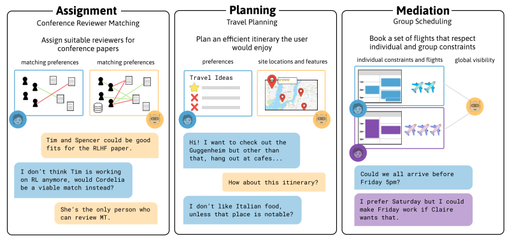
Figure 1 : Overview of the three collaborative dialogue tasks that we consider. In Assignment, two agents with symmetric access to information play the role of area co-chairs assigning reviewers to conference papers. In Planning, an assistant collaborates with a user to help them plan an itinerary. In Mediation, an assistant must chat with multiple separate users to help them resolve a group scheduling problem.
Original paper · CC BY 4.0 · Jessy Lin, Nicholas Tomlin, Jacob Andreas, Jason Eisner · Decision-Oriented Dialogue for Human-AI Collaboration · Original paper figure · Extracted the figure area from page 2 of the original PDF.Where assistants stall on joint decisions
Task-oriented dialogue systems are usually judged by coarse measures, such as whether the user's goal was met. Word overlap with human-human dialogues is another common score, and it says little about how close the final choice came to the best option. The authors target a harder case, where parties must reach one joint decision from a combinatorially large set of options.
Sharing that information lets both sides better assess different travel plans, so neither can simply pass everything along. Instead, each agent must work out what its partner already knows and what is likely to matter for the decision.
The reward in a decision-oriented dialogue gives a graded measure of communication success, based on how close the final decision is to optimal. The authors score each final decision with a reward normalized to [0, 1], so that games of different difficulty can be compared. Human pairs averaged 13 messages over 8 minutes, so the tasks demand real back-and-forth.
Human pairs reached roughly 90% of the maximum possible range-normalized reward on Assignment and Planning, and close to 100% on Mediation.
When GPT-3 played the assistant, the dialogues ran longer yet ended with lower rewards than human assistants achieved. Participants found the LM assistant frustrating, since it often got stuck making similar proposals repeatedly. The models also hallucinated flights that were not in their data, and that made it hard to collaborate reliably.
In self-play, where a model also plays the cooperative user, rewards fell further and dialogues grew longer.
Human partners may compensate for model failures, for example by sharing relevant information or keeping the dialogue on track. The Planning and Mediation results show that models can communicate about the task but struggle to find the final optimal proposal. The authors didn't test tool use on this optimization step in the paper, and they name it as future work.
Scoring a dialogue as a decision problem
The paper treats a dialogue as a search for one joint decision, where each message carries a cost. The world state is a weighted graph W, and a candidate decision is a subgraph W′ that meets the task constraints. The reward adds the vertex weights and the edge weights inside the chosen subgraph W′. Each weight is linear in a preference vector θ, computed from feature vectors ϕ.
The overall objective subtracts the total communication cost from that reward.
A message is worth sending only when it raises the decision reward by more than it costs. Each agent holds a partial, possibly noisy observation of the world state, which stays fixed during the dialogue. Agents must exchange messages because the world state and the preferences θ are only partly observed. Each agent's policy maps its observation and the dialogue history to the next message.
The authors cast this as a decentralized partially observable Markov decision process, where messages and formal decisions are actions.
Modeling the world as a graph lets the authors cover most discrete optimization problems. A more general version would use an unstructured world state, with agents discussing random variables. The reward could be any function of W′, but the authors focus on the linear objective. Messages are natural language except for three formal messages: a proposal, an acceptance, and a rejection.
If an agent proposes a decision and every other agent accepts it, the dialogue ends.
Task-oriented dialogue systems are usually scored with success rate, which says whether the user's goal was met. The reward in a DoD gives a graded measure of how close a final decision comes to optimal. Because the reward scores the decision itself, a dialogue can be judged by how far its final choice falls short of the best option.
Who knows what in each task, and how games are sampled
Assignment gives both agents the same kind of information about reviewer-paper fit. Each agent observes a subset of the affinity scores, and each cell reaches a given agent with probability 0.4. Each game samples a random 8 × 8 table of affinity scores, and either agent can propose a decision. Each agent's scores are scaled by a random positive constant, so the agents can only compare values in relative terms.
The shared reward is the value of the final matching, normalized by the best matching computed from posterior mean weights over both agents' observations.
In Planning, the assistant has a database of sites with their cost, location and amenities, while the user knows only a preference vector θ. Only the assistant can propose, and each proposal is a set of three sites. Each game gives the user ten nonzero preference elements, which the user sees only as binned natural-language strengths. The user sees the score of each proposal and decides whether to accept or reject it.
The reward is range-normalized against the best and worst three-site itineraries.
In Mediation, the assistant holds one-on-one chats with each of n users, and the games here use n = 2. The assistant sees both users' work calendars and flight sets, but it doesn't see their personal calendars or meeting importances. Each user sees their own personal and work calendars along with their flight set. The game ends when both users accept the same joint proposal, and the reward is that proposal's total weight, range-normalized.
Because the environment samples each game from its parameters, it can produce new instances or new themes. The rewards are normalized to [0, 1], so games of different difficulty can be compared. Agents prefix each message with a type tag, and a full proposal leaves the other agents only accept or reject. Human workers play the users, and the environment generates their preferences and tells the workers what they are, so the true preferences are known for scoring.
Human baseline and GPT-3 setup
Human pairs set the reference point for every model score in this section. The authors collected 409 human-human dialogues with 5253 messages in total. The authors recruited workers both directly and through Amazon Mechanical Turk. Pairs took a median of 8min 19sec, which shows that these tasks take real effort. Pairs reached roughly 90% of the maximum range-normalized reward on Assignment and Planning.
On Mediation, pairs came close to 100% of the maximum.
Real users would know their own preferences, but the workers played programmatically generated users. Because the workers were told those preferences, the authors knew the true user preferences when scoring decisions.
The LM agents are few-shot prompted text-davinci-003, an instruction-tuned GPT-3 model. Each task gets one or two of the collected human-human dialogues as examples. The models receive the same information and actions as human annotators, as formatted text rather than the graphical UI. When a model writes an invalid message, the game's error goes back into the prompt, so the model can revise its previous generation.
For Planning, the authors added [think] steps in a ReAct-style format to the example dialogues. They did this because the assistant must search based on the dialogue, and the user must judge scores before accepting. For Mediation, the agents take turns round-robin, and the assistant picks a user by generating 0 or 1. Figure 4 plots these human-human and human-LM dialogues against their lengths in words.
Human-LM, self-play and prompted self-play results
GPT-3 assistants reached lower normalized rewards than human assistants when paired with human users. The authors recruited 13 participants, who produced 77 dialogues with GPT-3 prompted for the assistant role. Human-LM dialogues ran longer than human-human dialogues, yet they scored lower. Participants found the LM assistant frustrating, because it often got stuck making similar proposals.
Participants were told to accept the best proposal they could get, so the dialogues could have run much longer. The authors judge current LMs to be far from useful assistants, despite how helpful they appear.
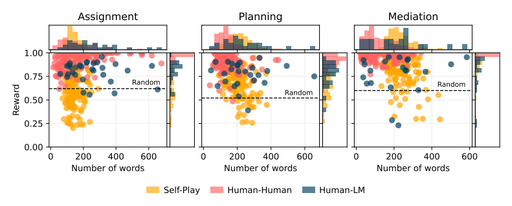
Figure 4 : Human-LM and self-play scores compared to human dialogues, plotted against dialogue lengths in words. LM assistants achieve lower scores than human assistants on average, and also tend to have longer dialogues. Models in self-play have even lower scores and longer dialogues since they must also play the role of a cooperative user. The histograms show the marginal distributions of the scores and dialogue lengths. The dashed line shows the average score of a random proposal.
Original paper · CC BY 4.0In self-play, a second model plays the cooperative user, which makes this setting harder than human-LM play. Self-play rewards fall below both human-human and human-LM pairs, and its dialogues are longer. The authors suggest that human partners compensate for model failures by sharing relevant information or keeping the dialogue on track.
Prompted self-play gives the model a human prefix of 50% or 75% of the dialogue, or everything except the final proposal. Models are told to propose once the word count passes the human dialogue length minus 25, which keeps lengths comparable. In Assignment, models fail in every prefix condition, because the final step needs a bipartite matching built from discussed values.
In Planning, models score higher with more human prefix, but a substantial gap to human-human scores remains. In Mediation, models beat the random baseline in every PSP condition, but extra human context doesn't improve them. The authors expect tool use on the optimization step to help most on Mediation.
Where the gap shows up in messages and failures
GPT-4 labeled each message with one or more types, such as share, query, affirm, explain, meta, revise, miscellany and proposal. The authors built these categories from standard dialogue act taxonomies and added meta for the idiosyncrasies of their domain. GPT-4 labels matched human labels on 88% of the 106 messages that the authors checked by hand.
Across six dialogues, the human labels differed on 13 messages, and the authors judged 7 of the GPT-generated labels reasonable. In Planning and Mediation, agents query for information or discuss the meta-game more often, to learn what the other agent can see. The authors saw no major differences in message types between human-human and human-LM dialogues.
LM assistants ask broad questions about other preferences or price, rather than questions aimed at decision-critical information. Their iterative proposals often fail to improve in score, so they build up longer dialogues that score lower than human assistants. In Planning, the model makes tool queries as prompted, but it doesn't reason over the outputs.
Hallucinated flights were a major source of frustration for users and made reliable collaboration difficult. In Mediation, the LM sometimes proposes after eliciting preferences from one player without consulting the other.
Figure 3 places a human-human Planning dialogue beside a GPT-3 self-play dialogue for comparison. Human pairs vary their initiative and coordination, moving from incremental partial proposals to backtracking, while self-play dialogues repeat themselves.
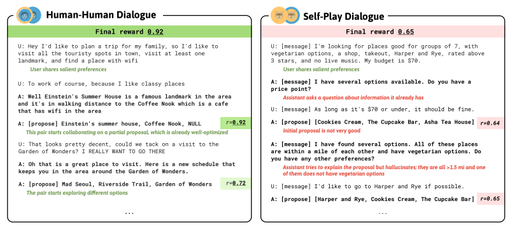
Figure 3 : For the Planning task, an annotated example of a human-human dialogue (left) and an annotated example of an LM self-play dialogue using GPT-3 (right). While humans generally exhibit diverse and flexible strategies and reach good solutions, self-play dialogues tend to be repetitive, and the assistant makes mediocre proposals and often hallucinates. We discuss further in §7.
Original paper · CC BY 4.0What the experiments leave untested
Human-LM evaluation used 13 participants and 77 dialogues with GPT-3, prompted with the assistant role. The only LM the authors tested was text-davinci-003, so other models' behavior remains unmeasured. Self-play and prompted self-play reuse the same GPT-3 setup, so they don't show how other models would behave. The authors note that more realistic designs were possible, such as sharing features instead of raw scores.
Assignment is a simplified version of the reviewer matching problem with two agents and a one-to-one matching. Each agent observes a random subset of an 8 × 8 affinity table, with each cell shown with probability pobserved = 0.4. The authors didn't test a version where agents discuss underlying features rather than full edge weights.
Mediation was run only with n = 2 users, so larger groups are untested. Prompted self-play fixes a target length near the human dialogue, so its scores reflect that control as well as the model. Prompted self-play uses only 50% and 75% prefixes, plus the final-proposal case. Tool use for the optimization step is left to future work.
Paper info
- Authors
- Jessy Lin, Nicholas Tomlin, Jacob Andreas, Jason Eisner
- Venue
- arXiv · Preprint
- First published
- 2023-5-31
- Added
- 2026-11-6
- Updated
- 2024-5-5
- Version
- v3
- arXiv
- 2305.20076
- Category
- cs.CL · cs.AI
- Original paper terms
- CC BY 4.0
- What we show
- Paper info, commentary and permitted figures from the original paper
AI commentary is a separate explanation from the original paper and may contain errors. The original paper and figures follow each source's terms of use and any rights noted separately.
Abstract
We describe a class of tasks called decision-oriented dialogues, in which AI assistants such as large language models (LMs) must collaborate with one or more humans via natural language to help them make complex decisions. We formalize three domains in which users face everyday decisions: (1) choosing an assignment of reviewers to conference papers, (2) planning a multi-step itinerary in a city, and (3) negotiating travel plans for a group of friends. In each of these settings, AI assistants and users have disparate abilities that they must combine to arrive at the best decision: assistants can access and process large amounts of information, while users have preferences and constraints external to the system. For each task, we build a dialogue environment where agents receive a reward based on the quality of the final decision they reach. We evaluate LMs in self-play and in collaboration with humans and find that they fall short compared to human assistants, achieving much lower rewards despite engaging in longer dialogues. We highlight a number of challenges models face in decision-oriented dialogues, ranging from goal-directed behavior to reasoning and optimization, and release our environments as a testbed for future work.
Quote from the paper
Jessy Lin, Nicholas Tomlin, Jacob Andreas, Jason Eisner (2023). Decision-Oriented Dialogue for Human-AI Collaboration. arXiv:2305.20076v3. https://arxiv.org/abs/2305.20076v3
BibTeX
@misc{lin2023decision,
  title = {{Decision-Oriented Dialogue for Human-AI Collaboration}},
  author = {Jessy Lin and Nicholas Tomlin and Jacob Andreas and Jason Eisner},
  year = {2023},
  eprint = {2305.20076},
  archivePrefix = {arXiv},
  url = {https://arxiv.org/abs/2305.20076v3}
}