Paper commentary
Preference learning made easy: Everything should be understood through win rate
Win rate should be the yardstick for judging preference learning methods
- Problem Preference learning methods have no shared foundation, so their objectives are hard to compare. Common evaluations like reward and ranking accuracy use offline data and ignore how often the model produces each pair.
- Method The authors show that win rate against an anchor is the only evaluation grounded in preference data alone. They then sort methods into win rate optimization (WRO) or non-WRO and check each against two properties.
- Results WRO objectives keep both properties, while DPO and SFT on preferred samples lose them. The authors also find that optimization success predicts performance better than the choices that shape the objective's solution.
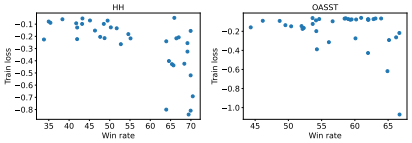
Figure 3 : Train loss vs. test win rate across all settings tested in Table 1.
Original paper · CC BY 4.0 · Lily H. Zhang, Rajesh Ranganath · Preference learning made easy: Everything should be understood through win rate · Original paper figure · Extracted the figure area from page 8 of the original PDF.Why preference objectives are hard to compare
Preference learning tries to align language models with human preferences, and the number of objectives built on that data keeps growing. The field has become fragmented, which makes it hard for practitioners and researchers to decide where to focus their efforts. Classification rests on principles such as maximum likelihood, but preference learning doesn't have a comparable unifying foundation.
The authors therefore ask which underlying principles should underpin preference learning, and they start from the sampling distribution of pairwise preference data. Their framework splits the space into win rate optimization (WRO) and non-WRO objectives, and it compares methods through two properties: win rate-correspondence and win rate-consistency.
RLHF, DPO and SFT on preferred samples each push a model toward a different target distribution. The authors take the first question to be which evaluation of a generative model the preference data itself justifies. Reward and ranking accuracy are common choices, but they are computed on offline data that may be unlikely under the model. Because of that, a metric can look sound while ignoring how often the model actually produces each pair.
Average reward is equivalent to a translated logit-Win Rate only under the Bradley-Terry assumption. The underlying preference environment doesn't have to satisfy that assumption, so the equivalence can fail in practice. The authors conclude that h-win rate with respect to some anchor distribution is the only evaluation grounded in preference data alone.
They then use that evaluation to compare preference learning algorithms by how each relates to optimizing win rate.
Win rate as the grounded evaluation
The evaluation question starts from the sampling distribution of pairwise preference data, which has an input, two candidate outputs and a label. The query distribution and the two generation competitors are user-specified, so the user chooses the inputs of interest and the candidates to compare. The preference classifier is the one piece that can't be directly specified, because the environment where preferences are collected defines it.
An evaluation therefore has to be built from what the data can actually show, not from a classifier the user picks.
The authors ask an evaluation function to satisfy two consistency conditions, preference-consistency and prevalence-consistency. Preference-consistency reduces the evaluation to an increasing function of the preference classifier when query, model and anchor are single deterministic values. The function h only needs the evaluation to rise when the preference probability rises, so it doesn't have to equal that probability.
Prevalence-consistency weights each preference by how often the query, the generator and the anchor produce it. If the generator condition fails, the evaluation weights preferences by a distribution the model doesn't follow when it generates.
Proposition 3.3 shows that the only evaluation meeting both conditions is a win rate against an anchor distribution. With h equal to the identity, the result is vanilla win rate, which is often estimated from samples of the preference classifier. Any other strictly increasing h gives an h-win rate, and it stretches some preference probability differences while contracting others.
Placing a non-identity function on the query or generator term breaks prevalence-consistency, so h is the only place it can sit. Reward and ranking accuracy, computed on offline data, don't respect model prevalences and correlate little with win rate. Average reward matches a translated logit win rate only under the Bradley-Terry assumption, which the preference environment need not satisfy.
Section 4 then characterizes the space of Win Rate Optimization objectives, and Section 5 analyzes non-WRO methods. Because the h-win rate is the only grounded evaluation, the paper treats it as the objective to optimize.
Win rate optimization and its two benefits
WRO objectives start from the h-win rate, so the direct objective is to maximize the h-win rate of a policy against an anchor. Choices of h and of anchor change the optimum in general, so many distinct WRO objectives exist. The RLHF setting, with h equal to logit and the Bradley-Terry assumption, is one such instance that estimates the classifier through a reward function.
Under the Bradley-Terry assumption, Proposition 4.1 says all such objectives with strictly increasing h share one optimal solution. That shared solution maximizes win rate over all possible anchor distributions.
The authors name two benefits that every WRO objective has, and both follow directly because the objective equals the h-win rate. Win rate-correspondence means that a higher objective value gives a higher h-win rate, which makes gradient steps useful. Win rate-consistency means that the optimum of the objective reaches the maximum h-win rate.
The authors say win rate-consistency ensures the loss has no fundamental limitation at its optimal solution.
Because p(ℓ = 1 | x, y0, y1) is typically estimated from data, the authors add a divergence penalty D(pθ, pref) with parameter β. With reverse KL regularization, the optimum is the target distribution p∗WRO-KL, which reweights the reference model pref. With the penalty, the two benefits hold only in modified form, relative to the divergence M(β) allowed by β.
Regularized win rate-correspondence allows an objective improvement to come from either higher h-win rate or lower divergence to the reference.
These WRO properties set the baseline that DPO is later measured against, since DPO's loss is not an h-win rate. The next section shows that DPO and SFT lose these properties, which is why the authors treat WRO as the reference point.
Why DPO and SFT fall short of win rate benefits
DPO minimizes a log loss over offline preference pairs, and the authors show that a lower DPO loss doesn't guarantee a higher win rate. The first cause is offline data, which breaks prevalence-consistency. A model change can improve the ranking of responses in the offline data while moving more mass to dispreferred responses the data never covers, so the loss improves but win rate drops.
Sampling from the initial model isn't enough, because prevalence-consistency of the generator doesn't hold throughout training.
Even with a fully online setting, win rate-correspondence still fails. The reason is that the likelihood of preference distribution in Equation (3) is not an h-win rate. Since prevalence-consistency holds in the online case, the authors note that preference-consistency must fail, because the argument inside the expectation is not a fixed function of the preference classifier.
Figure 1 plots win rate against online DPO loss for different policies, and any pair forming a positive-slope segment shows that win rate-correspondence doesn't hold.
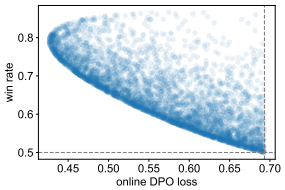
Figure 1 : Plot of win rate vs. DPO loss for differentpθ(y | x) for a given choice of anchor and preference classifier (see Appendix F.2 for details). Any pair of points that would form a line segment with a positive slope form a setting of θ, θ′ such that win rate correspondence does not hold. Grey lines denote the win rate and DPO loss at initialization. See Appendix F.2 for additional discussion and examples.
Original paper · CC BY 4.0DPO also fails regularized win rate-correspondence, so a lower loss can come without better win rate or lower divergence to the reference model. This explains the loss versus win rate misalignment reported in earlier work, and why checkpoints selected by win rate work better than by validation loss. The same failures extend to direct alignment algorithms in general, because offline data breaks prevalence-consistency and a non-classifier inner objective breaks preference-consistency.
DPO and other direct alignment algorithms share the regularized-WRO optimum, yet they still fail win rate-correspondence.
SFT on preferred samples fails win rate-correspondence, because its maximum likelihood loss isn't an h-win rate. Its target distribution tilts the initial model toward sequences with higher average preference probability over the anchor, but that tilt has limits. Theorem 5.1 gives the exact win rate of this target, which is 0.5 plus 2 times the expected variance of the average preference probability.
If every sequence is equally preferred, the model can't improve, so the gain grows with the spread of average preference across outputs. With support over more than two sequences, SFT on preferred samples can't reach the maximum win rate.
Both the filter threshold and the diversity in preference of the initial model set how much improvement is possible. Backtranslation in Li et al. (2023a) and quantile filtering in Brandfonbrener et al. (2021) fit this picture, because they widen the set of responses or filter more strictly. Filter-plus-SFT methods with stricter criteria can therefore gain further win rate, which makes diversity the lever for SFT.
Experiments: optimization outweighs design choices
The authors fine-tuned Pythia-2.8b on the dataset outputs and used those finetuned models as the initial models. They trained an oracle judge model per dataset to estimate the preference probability and relabeled the annotations with it. The learned reward model reached 82.8 accuracy on OASST and 81.36 on HH. The imperfect judge model reached 80.47 accuracy on OASST and 85.16 on HH.
WRO-KL objectives were optimized with PPO from the TRL library, using a single-sample Monte Carlo estimate of the expectation.
On OASST, SFT tracked its expected win rate, and DPO did so when it was more strongly regularized. RLHF fell well short of its expected win rate, and DPO with weaker regularization also underperformed. Swapping the learned reward model for the oracle classifier didn't help RLHF. The authors read this as another factor at play, since the oracle variant performed even worse.
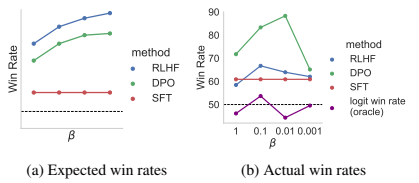
Figure 2 : Expected versus observed win rates of RLHF, DPO, and SFT over the original model for OASST. RLHF notably underperforms relative to expectations. Moreover, substituting the learned reward model for the oracle pref- erence classifier (logit win rate (oracle)) does not improve performance, suggesting other factors are more important.
Original paper · CC BY 4.0Table 1 varies h, β and the classifier estimate across HH and OASST. The highest HH value is 70.46, from logit h with the BT estimate at β = 0.001. No choice of h wins systematically across the settings, and the best target distributions don't always give the best win rates. The BT assumption helps classifier estimation on OASST, because OASST outputs are globally ranked, but not on HH.
Training loss correlates with test win rate more than the classifier estimate, h or β do, with a Spearman p-value of 8.27e-5. The p-values are 0.968 for the classifier estimate and 0.133 for β. The authors therefore take optimization success to matter more for performance than the objective's target.
Limitations and open directions
The experiments rest on one base model, Pythia-2.8b, so the variant comparisons don't show how the findings carry to other models. The authors fine-tuned Pythia-2.8b on the dataset outputs and used these finetuned models as the initial models. They ran the comparisons on two datasets, OpenAssistant (OASST) and Anthropic Helpfulness and Harmlessness (HH).
Each dataset got its own oracle judge model, which both relabeled the preferences and evaluated win rate after training.
The reward model reached 82.8 accuracy on OASST and 81.36 on HH, while the imperfect judge reached 80.47 and 85.16. The WRO-KL variants in Table 1 were compared across h, β, and the estimate of the preference classifier, but only in these two settings. The paper's conclusion that no WRO-KL choice of h dominates therefore holds only for these two datasets.
The authors did not test other preference datasets, other model sizes, or other base models.
The authors point to non-constant-sum WRO games as a direction, since aligning to preferences need not be constant-sum. They also name fully online direct alignment algorithms and contrastive post-training as ways to satisfy prevalence-consistency. Filter-plus-SFT methods that account for diversity and filter strength are another proposed direction.
The paper doesn't test any of these directions, so their benefits remain open. The authors also suggest variational inference and probabilistic inference tools for variance reduction, which they don't try.
Paper info
- Authors
- Lily H. Zhang, Rajesh Ranganath
- Venue
- arXiv · Preprint
- First published
- 2025-2-14
- Added
- 2026-10-31
- Updated
- 2025-7-26
- Version
- v2
- arXiv
- 2502.10505
- Category
- cs.LG · cs.CL · stat.ML
- Original paper terms
- CC BY 4.0
- What we show
- Paper info, commentary and permitted figures from the original paper
AI commentary is a separate explanation from the original paper and may contain errors. The original paper and figures follow each source's terms of use and any rights noted separately.
Abstract
Preference learning, or the task of aligning generative models to preference comparison data, has yet to reach the conceptual maturity of classification, density estimation, etc. To close this gap, this work presents a framework to understand preference learning starting from the sampling distribution of pairwise preference data. First, we prove that the only evaluation of a generative model that respects both preferences and prevalences in the data distribution is a form of win rate, justifying win rate as the focal point to understand preference learning. We then analyze preference learning methods as win rate optimization (WRO) or non-WRO. We present novel instances of WRO beyond existing examples (RLHF, NLHF) and identify two key theoretical benefits of all such methods. We prove that common non-WRO methods like DPO and SFT on preferred samples lack these properties and suggest ways to mitigate such theoretical limitations. We also show that WRO underperforms in practice due optimization difficulties and that optimization success predicts performance better than choices which affect the objective's solution. Our analysis highlights best practices for existing methods and provides recommendations for future research, guided by the principle that one should either align non-WRO methods more closely with WRO or improve the optimization of WRO objectives.
Quote from the paper
Lily H. Zhang, Rajesh Ranganath (2025). Preference learning made easy: Everything should be understood through win rate. arXiv:2502.10505v2. https://arxiv.org/abs/2502.10505v2
BibTeX
@misc{zhang2025preference,
  title = {{Preference learning made easy: Everything should be understood through win rate}},
  author = {Lily H. Zhang and Rajesh Ranganath},
  year = {2025},
  eprint = {2502.10505},
  archivePrefix = {arXiv},
  url = {https://arxiv.org/abs/2502.10505v2}
}