Paper commentary
The RSI Tax: When Recursive Self-Improvement Is Not Worth the Cost
Recursive self-improvement can cost more tokens than the gains it brings
- Problem Recursive self-improvement lets agents learn from past tasks, but each update is paid for before its value is known. Its token cost, the RSI Tax, is often ignored, so costly updates can exceed the value they add.
- Method The authors add SRN, a bounded-note baseline. Instead of searching over candidate updates, SRN revises one note of at most 2,048 tokens, and only after failed tasks.
- Results On the DeepSeek terminal stream, SRN gained 9.0 percentage points of accuracy over Static. Its total token cost was 15.7% higher on that stream, but it matched heavier methods at far lower update cost.
Why update cost gets its own line
Recursive self-improvement (RSI) lets an agent carry lessons from completed tasks into later ones while its model weights stay fixed. Methods differ in the components they update, since one group maintains evolving memories or skills and another modifies the harness used for execution. The catch is that each update is paid for before its value for later tasks becomes known.
The authors call the token cost of this self-improvement process the RSI Tax, and they count it even when the agent keeps its previous state. The two terms interact, because an update can shorten later executions or lengthen them by adding context or inducing longer trajectories.
The authors record each task's outcome before its feedback updates the agent, so every score is fixed before the state changes. Execution yields a trajectory and a binary verification outcome, and updates then draw on the completed-task history. Figure 1 shows this loop and how the RSI Tax splits into verification, exploration and writing costs.
Token costs spent re-executing completed tasks count toward the RSI Tax, and those re-runs don't replace the original outcomes.
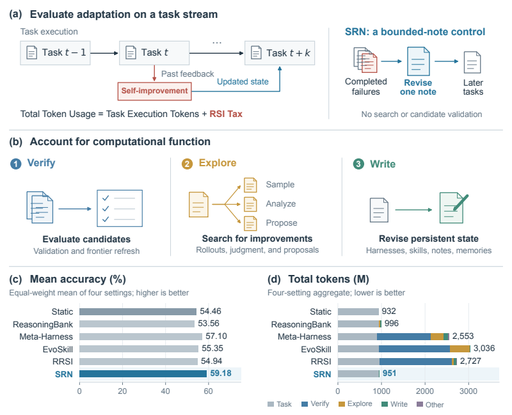
Figure 1 : Streaming evaluation and the RSI T ax. (a) Updates use completed-task feedback; SRN maintains a bounded note. (b) The RSI Tax is broken down into verification, exploration, and writing costs. (c) Accuracy averaged equally over the four settings. (d) Input-plus-output tokens summed over those settings, including task execution, the three RSI Tax components, and the Other residual. These sums describe token volume across the runs; within-setting comparisons are reported in Section 5.1.
Original paper · CC BY 4.0 · Yitong Zhang, Ang Li, Yisen Wang · The RSI Tax: When Recursive Self-Improvement Is Not Worth the Cost · Original paper figure · Extracted the figure area from page 2 of the original PDF.A bounded note as the baseline
SRN, the Simple Reflection with Notes baseline, keeps one bounded note of at most 2,048 tokens and revises it at each four-task update. At each update boundary, SRN uses scalar verifier outcomes to select the failed tasks in the permitted recent window. The update set F_t holds only tasks whose outcome is zero, so an empty set leaves the note as it is.
SRN therefore changes its note only when the recent window contains failure evidence. The note also stays in later task contexts, so the agent reads it during every subsequent execution.
A valid nonempty revision replaces the note directly, while an invalid response leaves the note unchanged. Oversized notes are truncated by the configured tokenizer, and every retry call counts toward the token total. It also tells the model not to infer hidden tests or reference solutions, and not to solve the next task.
SRN performs no extra task sampling, no candidate validation, and no retrieval search. They didn't isolate the effect of each design choice in SRN, so it serves as a low-cost comparison rather than an ablation.
Accuracy against end-to-end tokens
The authors compare six methods across two backbone models and two task streams, and each comparison shares the task order and starting agent. Averaged over the four settings with equal weight, SRN gains 4.7 percentage points of accuracy over Static. That gain comes with a 3.6% mean increase in total tokens over Static. Against Meta-Harness, EvoSkill and RRSI, its mean token reductions are 65.6%, 71.0% and 68.2%.
Those summaries weight each setting equally, and token changes are ratios formed within each setting before averaging.
ReasoningBank carries a smaller RSI Tax than the three heavier methods, but it doesn't reliably beat Static. On the DeepSeek terminal stream, Static uses the fewest tokens at 185.55M, while SRN uses 15.7% more. That extra spend buys SRN a 9.0 percentage point gain in observed accuracy. The picture flips on the GPT-6 Luna repository stream, where SRN uses 156.67M task-execution tokens against Static's 179.69M.
Its 0.40M update cost doesn't offset that difference, so its total is 12.6% lower than Static's and its accuracy is 2.9 points higher.
Omitting the RSI Tax can reverse the cost comparison, as the DeepSeek terminal stream shows. Meta-Harness uses fewer task-execution tokens than SRN there, at 184.13M versus 214.37M. Its 578.45M RSI Tax lifts its total to 762.57M, compared with 214.65M for SRN. Its observed accuracy is slightly lower, at 77.5% versus 78.7% for SRN. Judging by execution tokens alone would hide that gap.
The authors caution that these totals cover every state deployed during the stream, not a separate evaluation of the final checkpoint.
For SRN, the tax rate stays below 0.4% in every setting. Meta-Harness's tax rate reaches 314.16 on the DeepSeek terminal stream, far above SRN's 0.13. Across these comparisons, SRN keeps the update cost small while it matches the accuracy of the heavier methods.
Where the RSI Tax goes
The RSI Tax splits into verification, exploration, writing, and a residual labelled Other, and verification dominates for the heavier methods. Verification takes 74.83% of Meta-Harness's RSI Tax, 78.13% of EvoSkill's, and 93.58% of RRSI's. Verification performed during the original task execution stays in task cost, so only the update-time checks count toward the tax.
Writing covers creating or revising harness code, skills, notes, and memories, and SRN charges its joint note analysis and revision entirely to Write.
On the DeepSeek terminal stream, EvoSkill spent 497.45M tokens refreshing its old frontier, compared to 182.26M for the 89 arriving tasks. The authors attribute much of that refresh to the rolling support window in their implementation, whereas EvoSkill's original algorithm uses a fixed validation set. Among the RSI methods other than SRN, 23.7 to 63.6% of the RSI Tax is tied to states or artifacts that aren't used later.
For Meta-Harness, 52.78% of the tax attaches to state the stream never used, so about half its tax has no later use. Meta-Harness's unused-state tax splits into 564.85M verification, 217.60M exploration, and 69.22M writing tokens.
The same unused share can come from different operations, which the aggregate percentages alone don't reveal. The authors don't test whether removing the unused calls would change later updates or task outcomes.
What individual update traces show
The paper uses three diagnostic criteria, proposal-free search, decision-invariant evaluation and unretrieved memory, to inspect single update traces. These diagnostics don't form an additive partition of the RSI Tax, so they can't be summed with the category totals.
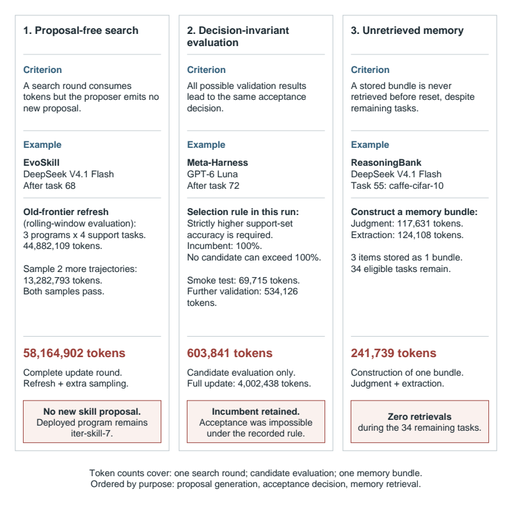
Figure 4 : Illustrative update traces. Left: a search round without a proposal. Middle: candidate evaluation whose result cannot change acceptance. Right: a stored memory bundle with no later retrieval. The first two examples depend on the online implementation choices described in Section 2.3.
Original paper · CC BY 4.0In the GPT-6 Luna Meta-Harness run after task 72, the incumbent already scored 100% on the support set. The Meta-Harness selector accepted only a strictly higher accuracy, so no candidate could change the deployment. Even so, candidate evaluation used 603,841 tokens, which is part of a 4,002,438-token update. The authors note that establishing the saturation may itself need incumbent evaluation.
The case tests their strict deployment rule, and the original Meta-Harness population search doesn't require it.
The EvoSkill round after task 68 shows a different kind of waste, with no new proposal produced. Three existing programs were re-scored on four support tasks for 44,882,109 tokens. Two extra trajectories then cost 13,282,793 more tokens, and both samples passed. Since no failure triggered the proposer, the round ended with the deployed program iter-skill-7 unchanged, at a cost of 58,164,902 tokens.
The authors say the repeated refresh comes from their rolling support window, while the original EvoSkill uses a fixed validation set.
The ReasoningBank case shows a third kind of cost, memory construction that is never retrieved. For task 55, caffe-cifar-10, judgment and extraction cost 117,631 and 124,108 tokens in the DeepSeek run. The resulting bundle of three items was never retrieved during the 34 remaining tasks, giving 241,739 construction tokens. Retrieval only records whether a bundle entered the task context, so it doesn't show that the memory was useless.
What these results can't settle
Other models, workloads, orderings and repeated runs haven't been tested, so the stability of these comparisons is open. The cost attribution is descriptive, so use in a later task doesn't establish an accuracy benefit. Non-use doesn't establish that the associated calls could be dropped without changing later updates or task outcomes.
Meta-Harness, ReasoningBank and the other methods show different splits of the RSI Tax, so the shares of unused cost don't reveal their composition. Meta-Harness puts 564.85M verification tokens, 217.60M exploration tokens and 69.22M writing tokens on candidates not used later. The authors' proposed policy, which would forecast update costs and choose which updates to run, wasn't built or tested.
Whether cutting verification or building fewer skills and memories keeps task performance needs controlled evaluation.
So the paper establishes a cost pattern on these streams, not a tested remedy for the RSI Tax.
Paper info
- Authors
- Yitong Zhang, Ang Li, Yisen Wang
- Venue
- arXiv · Preprint
- First published
- 2026-11-10
- Added
- 2026-11-11
- Updated
- 2026-11-10
- Version
- v1
- arXiv
- 2611.13524
- Category
- cs.LG
- Original paper terms
- CC BY 4.0
- What we show
- Paper info, commentary and permitted figures from the original paper
AI commentary is a separate explanation from the original paper and may contain errors. The original paper and figures follow each source's terms of use and any rights noted separately.
Abstract
Recursive self-improvement (RSI) seeks to improve an agent using its own task experience. Its practical value depends on whether performance gains justify the full cost of self-improvement and task execution. We evaluate this trade-off on continual task streams, scoring each task before its feedback is used for subsequent updates. We define the \emph{RSI Tax} as the token cost of the self-improvement process and include it alongside task-execution costs in end-to-end evaluation. Across six methods and two language models, a bounded-note baseline matches or exceeds the observed accuracy of Meta-Harness, EvoSkill, and RRSI, with mean total-token savings of 65.6-71.0\%. We decompose the RSI Tax into verification, exploration, and writing costs, and track subsequent use of the associated state or artifact. For these three RSI methods, verification accounts for 74.8--93.6% of the aggregate RSI Tax. A substantial share of the RSI Tax is also associated with states or artifacts that are not used later in the evaluated streams. These results expose a practical limitation of costly RSI procedures: improvements in the deployed agent need not justify the expense of the improvement process. They motivate RSI objectives that jointly optimize the RSI Tax and expected task-execution cost while ensuring continued growth in agent capabilities across the task stream.
Quote from the paper
Yitong Zhang, Ang Li, Yisen Wang (2026). The RSI Tax: When Recursive Self-Improvement Is Not Worth the Cost. arXiv:2611.13524v1. https://arxiv.org/abs/2611.13524v1
BibTeX
@misc{zhang2026when,
  title = {{The RSI Tax: When Recursive Self-Improvement Is Not Worth the Cost}},
  author = {Yitong Zhang and Ang Li and Yisen Wang},
  year = {2026},
  eprint = {2611.13524},
  archivePrefix = {arXiv},
  url = {https://arxiv.org/abs/2611.13524v1}
}