Paper commentary
RAHC: Rule-Augmented Hyper-Relational Knowledge Graph Completion for Materials Synthesis
RAHC uses retrieved rules to fill missing synthesis conditions in materials records
- Problem Hyper-relational knowledge graph models score missing synthesis conditions from learned patterns alone. They cannot name the documented rule or evidence that supports a candidate, and filling conditions one at a time ignores how they interact.
- Method RAHC retrieves rules whose conclusion is each candidate and uses them as evidence. Hard rules remove invalid candidates, and soft rules rank the rest, fused with the structural encoding through a gate.
- Results On MOF-SynHKG solvent completion, RAHC-Q reached 0.379 Semi-inductive MRR, compared to 0.330 for MAYPL.
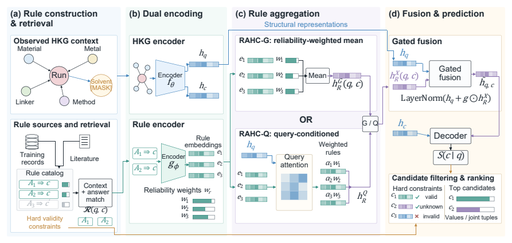
Figure 3 : The RAHC framework. (a) Training records and retrieved literature form a traceable rule catalog; retrieval matches observed context and candidate conclusions. (b) Separate encoders represent HKG structure and rule evidence. (c) RAHC-G aggregates by global reliability; RAHC-Q also learns query-conditioned relevance. (d) Gated fusion supports candidate-value and tuple ranking. Hard rules constrain candidate validity.
Original paper · CC BY 4.0 · Jiawei Sun, Sijia Xu, Zihan Chen, Zhengyi Yang · RAHC: Rule-Augmented Hyper-Relational Knowledge Graph Completion for Materials Synthesis · Original paper figure · Extracted the figure area from page 4 of the original PDF.Why missing conditions are hard to infer
Synthesis records are often incomplete, and a missing condition can't be read off the target material alone. The same material can be prepared through different routes, so the other conditions observed in the same experiment decide which candidate fits.
Hyper-relational models keep the conditions of an experiment attached to its primary fact, which gives them context. Their scores reflect learned compatibility, but they don't identify the documented regularity, evidence, or scope behind a candidate. Scoring each missing condition on its own ignores interactions among candidate values. Filling conditions one at a time is sensitive to the order in which they are filled.
The authors frame three challenges that a context-aware completion method has to meet. The first challenge, C1, is connecting experimental context with explicit evidence, which means checking whether a candidate's premises hold under the observed conditions. The third, C3, is evaluating dependencies among missing conditions, which requires distinguishing violated constraints from combinations with weaker empirical support.
Inductive structural methods such as NBFNet and NodePiece learn from subgraphs and paths, but they don't explain why a candidate is supported. Rules expose premises and conclusions, yet predictive coverage depends on rule groundings.
A rule catalog retrieved per candidate
RAHC makes rule evidence depend on each candidate by attaching to a candidate only the rules whose conclusion is that candidate. A rule that predicts another solvent can't support a candidate, even when its antecedent fits the run. Because each rule keeps its link to a candidate, the evidence can be traced back to the rule that supplied it.
Each rule carries antecedent conditions, a candidate conclusion, an applicability scope, supporting and counter-evidence, a source tag, and a global reliability weight. The catalog has two sources: training-mined dependencies and literature-derived statements. Data rules use up to three generalizable antecedents, and their statistics come from training records only.
Retrieval builds verifiable rules and doesn't generate candidate answers directly.
Retrieval first matches the target slot, the observed antecedents, and the material or reaction scope. Hard rules then remove only candidates marked invalid, and soft rules rank the surviving candidates. A candidate with no matching rule isn't discarded, so the structural branch still scores it unless a hard check rejects it.
Global reliability weights are fixed per rule, so RAHC-G and RAHC-Q both start from the same matched set. Data-rule reliability combines support, confidence, and lift with significance, stability, and counterexample rate. Literature-rule reliability uses independent sources, textual directness, scope consistency, and counterexamples. Reliability is normalized within each task, so the weights don't compare across tasks.
Two ways to weigh matched rules
RAHC-G and RAHC-Q start from the same matched rule set but weigh its members differently before fusion. The rule encoder first turns each rule into an embedding e_r, pooling role-value embeddings over the antecedents, the conclusion and the scope. Normalized evidence statistics and a source embedding join that pooled vector, and an MLP with LayerNorm produces e_r.
DOIs, paper IDs and run IDs stay out of the encoder, so the source embedding records source type rather than document identity. Structural and rule representations share a d-dimensional space, while the evidence-derived reliability w_r stays separate from the statistics vector v_r.
RAHC-G averages the matched rule embeddings, each scaled by its fixed reliability w_r through a projection W_V. The sum is divided by max(1, |R(q,c)|), so a candidate with no matched rules receives a zero rule vector. Retrieval depends on the pair (q,c), but the weights w_r don't change with the query. RAHC-Q instead lets the query representation h_q attend over the matched rules.
Its attention logit adds η log(w_r + ε) to the scaled query-rule dot product, so more reliable rules start with a higher weight. The softmax is normalized within R(q,c), and the attended rule vectors are scaled again by w_r before projection.
Both variants then pass their rule vector into the same candidate-specific gate, which keeps the structural query and rule evidence separate until fusion. The gate g_{q,c} is a sigmoid over the concatenation of h_q and the rule vector, so each candidate gets its own mixing weight. LayerNorm applied to h_q plus the gated rule vector gives the fused representation.
For joint completion, only rules whose conclusions cover at least two target slots of a tuple enter the joint evidence. The full tuple score adds the slot scores and a weighted joint term, so a tuple with no joint evidence gets no joint reward. Training updates the encoders, fusion, decoder and RAHC-Q attention, while the global reliabilities stay fixed.
Single-slot and cross-material results
On MOF-SynHKG solvent completion, RAHC-Q scored 0.379 Semi-inductive MRR, while MAYPL scored 0.330. The RAHC-Q solvent score sits above the MAYPL baseline by 14.8% under the Semi-inductive protocol. RAHC-G leads the SynMOF and FAIR-MOFs solvent columns, so the preferred aggregation changes with the data source. Explicit rule evidence lands near the structural leaders or above them, because AnyBURL and HyperPath are also strong on solvent.
For temperature on MOF-SynHKG, RAHC-Q reached 0.732 Semi-inductive MRR, while MAYPL reached 0.633. That result is a 15.6% gain over MAYPL, the largest single-slot improvement the authors report on that dataset. RAHC-Q leads most temperature and time columns, so the choice between global and query-conditioned weighting depends on the target.
On Solution Inorganic, RAHC-Q scored 0.342 Semi-inductive MRR and 0.306 Open-Answer MRR, against 0.1792 Semi-inductive MRR for HyperPath. That is 90.8% above HyperPath, the strongest baseline in that table on this task. Of 8,110 queries, 7,258 have answers in the 2,386-precursor vocabulary (89.49%), while 852 receive zero reciprocal rank.
Out-of-vocabulary answers count as failures under Open-Answer scoring, so that coverage bounds the OA numbers. On ZeoSyn, RAHC-G reached 0.465 Semi-inductive MRR, compared to 0.448 for AnyBURL.
Joint completion and the ablations
Joint completion is scored on the complete recorded tuple, so a partial slot match earns nothing. For TemperatureBin+TimeBin, RAHC-Q raises joint MRR from 0.4012 to 0.4331, an 8.0% gain over the same scorer with the joint term set to zero. For Solvent+ReactionMethod, RAHC-G moves from 0.3907 to 0.4197, a 7.4% gain. Independent uses the RAHC tuple scorer with the joint term set to zero, so these gains isolate what the joint rules add.
RAHC-G also exceeds both autoregressive orders and their bidirectional combination on all four comparisons in Table 12.
The exploratory three-slot task masks solvent, temperature bin and time bin together. It runs over 1,256 test queries and 73,760 candidate tuples, with the same protocol for every method. Joint-gold coverage is 0.95383, and a gold tuple outside the candidate space contributes zero. RAHC-Q reaches the highest Joint MRR of 0.15725 and Hits@10 of 0.42468 on this task.
RAHC-G leads Hits@1 at 0.13462 and Hits@3 at 0.27244.
The element-conditioned missing-precursor validation ablation separates hard constraints from soft rules. The full RAHC reaches a Semi-inductive MRR of 0.4613, versus 0.0491 when both rule components are removed. Removing only hard constraints leaves MRR at 0.4595, but removing soft rules drops it to 0.2585. So the ranking gain mostly comes from soft evidence, while hard constraints raise Hits@3 from 0.5124 to 0.5794.
Table 6 isolates the rule sources for MOF-SynHKG solvent completion on the SI validation split. Training plus literature rules reach 0.3752 MRR, compared to 0.3726 with training rules alone. Literature rules alone reach 0.3486 MRR, compared to 0.3381 without any rules. The extra gain from literature rules in this setting is small, so the paper treats it as a minor contribution.
Fully inductive transfer on ILPC'22 Small
On ILPC'22 Small, RAHC-G scored 0.08965 MRR, compared to 0.08659 for NodePieceGNN, a gain of 0.00306. Its 95% paired-bootstrap interval is [0.00169, 0.00448], which excludes zero.
The 119 training-graph relation rules cover 38.12% of validation prediction directions and 38.35% of test prediction directions. The rules are mined only from the training graph and instantiated through observed inference-graph paths. Global aggregation does better here, while the materials tables showed that the preferred weighting depends on the target.
Shuffling rule heads lowers RAHC-G validation MRR from 0.08394 to 0.08122, so the gain depends on rule content. Shuffling rule bodies gives 0.08123, and removing inference-path evidence also gives 0.08122. Without query conditioning, RAHC-Q drops from 0.08326 to 0.08165 on validation. They didn't report a test ablation of these validation variants.
Where the evidence is thinner than the headline numbers
The literature branch is the weakest link in the rule-source evidence, since its gain in the MOF solvent validation ablation is small. Literature rules alone reach 0.3486, compared to 0.3381 with no rules at all. The authors also call the additional gain from literature rules in this setting small. That ablation uses SI validation on 3,688 training-seen solvent candidates, so it is a validation result rather than a test result.
The three-slot evaluation is labelled exploratory, so its ranking shouldn't be read as a settled benchmark result. Its 1,256 test queries and 73,760 candidate tuples come from one shared protocol, and RAHC-Q leads only on Joint MRR and Hits@10 there. The rule catalog counts are descriptive, not a controlled comparison of rule quantity. A larger catalog doesn't mean each query gets more evidence, because a rule contributes only when its antecedent, scope and conclusion all match.
The reliability summaries don't by themselves establish retrieval coverage or the causal effect of the catalog on accuracy. Normalized reliabilities are relative within each task, so they shouldn't be compared across tasks or read as absolute probabilities.
Paper info
- Authors
- Jiawei Sun, Sijia Xu, Zihan Chen, Zhengyi Yang
- Venue
- arXiv · Preprint
- First published
- 2026-11-3
- Added
- 2026-11-5
- Updated
- 2026-11-3
- Version
- v1
- arXiv
- 2611.04809
- Category
- cs.AI
- Original paper terms
- CC BY 4.0
- What we show
- Paper info, commentary and permitted figures from the original paper
AI commentary is a separate explanation from the original paper and may contain errors. The original paper and figures follow each source's terms of use and any rights noted separately.
Abstract
Scientific discovery depends on reusing experimental knowledge, yet records scattered across papers and repositories are often incomplete. In materials synthesis, recovering missing conditions requires reasoning about the target material and the observed context of a specific experiment. Hyper-relational knowledge graphs (HKGs) represent this context through qualifiers, but existing completion methods leave domain knowledge and experimental regularities implicit. We propose RAHC, a rule-augmented HKG framework for single-slot and joint multi-slot synthesis-condition completion. RAHC builds a traceable rule catalog from training records and retrieved literature, retrieves rules for each query-candidate pair, and separately encodes graph structure and rule evidence. Hard rules constrain candidate validity, while soft rules guide ranking. RAHC-G aggregates rules using global reliability; RAHC-Q additionally learns query-specific relevance. Gated fusion combines structural and rule representations, while tuple-conclusion rules provide cross-condition evidence for joint completion. Experiments on five materials-synthesis datasets show improvements in single-slot and joint completion under Semi-inductive and Open-Answer Inductive settings, with Semi-inductive MRR gains of up to 15.6% over MAYPL. RAHC also improves performance on the entity-disjoint ILPC'22 Small benchmark, supporting transfer to fully inductive KG completion. These results support experimental condition selection, synthesis planning, and the reuse of scientific knowledge.
Figures from the paper
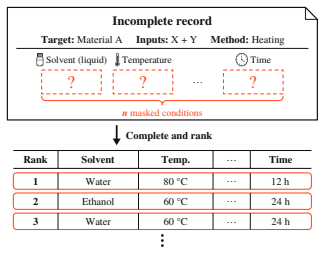
Figure 1 : Joint completion of𝑛 masked conditions. Candidate values and ranking are illustrative.
Original paper · CC BY 4.0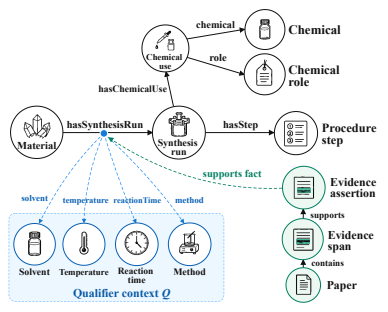
Figure 2 : Run-centric synthesis HKG. Qualifiers contextu- alize the material–run fact; chemical-use roles, procedure steps, and provenance retain experimental semantics.
Original paper · CC BY 4.0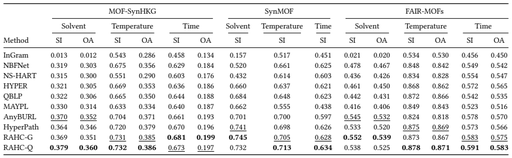
Table 1 : MOF solvent, temperature, and time completion (MRR). SI denotes Semi-inductive; OA denotes Open-Answer Inductive. Scores are rounded to three decimals; bold and underline mark the best and second-best displayed scores.
Original paper · CC BY 4.0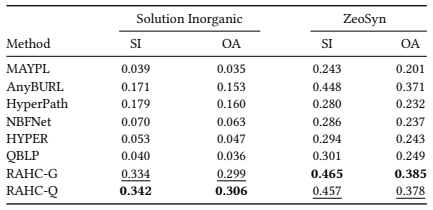
Table 2 : Cross-material completion after task-specific re- training (MRR). SI denotes Semi-inductive; OA denotes Open- Answer Inductive. Scores are rounded to three decimals; em- phasis follows unrounded rankings.
Original paper · CC BY 4.0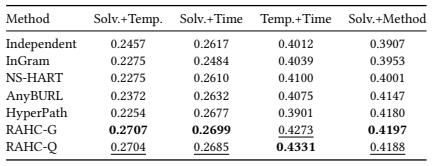
Table 3 : Joint two-slot completion (query-level joint MRR). Independent is RAHC with 𝜆𝐽 = 0. Solv., Temp., and Method denote solvent, temperature bin, and reaction method.
Original paper · CC BY 4.0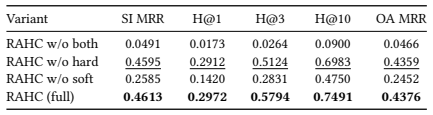
Table 5 : Hard- and soft-rule ablation on the element- conditioned missing-precursor validation task. H@𝑘 denotes SI Hits@𝑘. “w/o hard”, “w/o soft”, and “w/o both” remove hard constraints, soft rules, or both.
Original paper · CC BY 4.0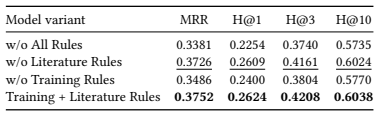
Table 6 : Rule-source ablation for MOF-SynHKG solvent com- pletion (SI validation; 3,688 training-seen solvent candidates). For unseen-MOF or unseen-run queries, candidate-specific evidence comes from training-derived rules, literature- derived rules, or both; H@𝑘denotes Hits@𝑘.
Original paper · CC BY 4.0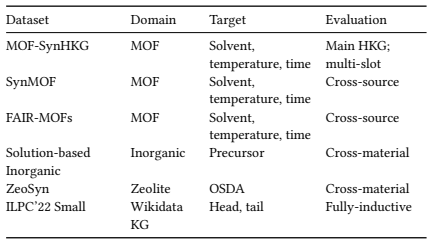
Table 7 : Datasets and tasks. ILPC’22 uses an entity-disjoint inference graph.
Original paper · CC BY 4.0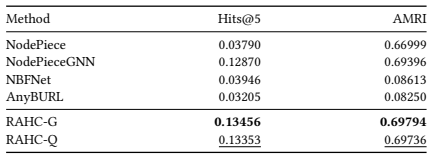
Table 8 : Additional ILPC’22 Small metrics under the protocol of Table 4. AMRI is the adjusted mean rank index.
Original paper · CC BY 4.0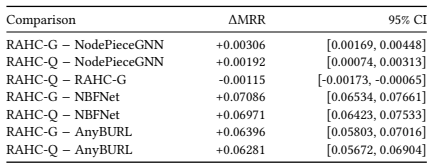
Table 9 : Paired-bootstrap MRR differences on ILPC’22 Small; intervals are 95% confidence intervals over test triples.
Original paper · CC BY 4.0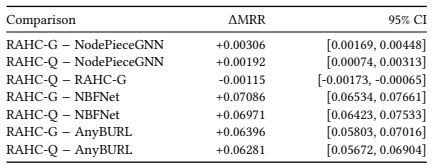
Table 10 : Validation ablation of ILPC’22 Small relation-rule components (MRR).
Original paper · CC BY 4.0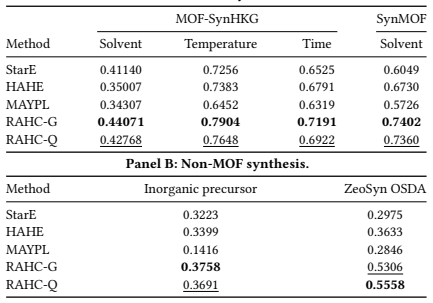
Table 11 : Transductive MRR across tasks.
Original paper · CC BY 4.0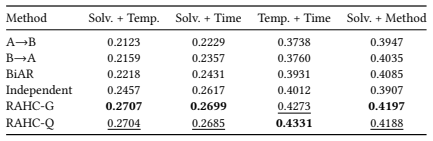
Table 12 : Post-hoc bidirectional autoregressive comparison for joint completion (query-level joint MRR). Independent is RAHC with𝜆𝐽 = 0. Solv., Temp., and Method denote solvent, temperature bin, and reaction method.
Original paper · CC BY 4.0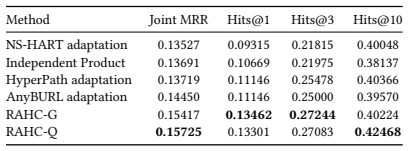
Table 13 : Exploratory three-slot completion on the test set. Joint MRR and Hits@𝑘 are query-level metrics over all 1,256 queries; OOV gold tuples contribute zero. All methods use the same exact filtered-ranking protocol.
Original paper · CC BY 4.0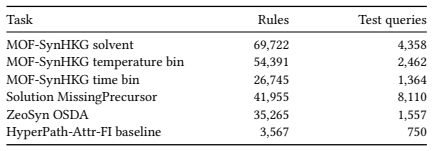
Table 15 : Task-specific mined rule catalogs and evaluation query counts.
Original paper · CC BY 4.0Quote from the paper
Jiawei Sun, Sijia Xu, Zihan Chen, Zhengyi Yang (2026). RAHC: Rule-Augmented Hyper-Relational Knowledge Graph Completion for Materials Synthesis. arXiv:2611.04809v1. https://arxiv.org/abs/2611.04809v1
BibTeX
@misc{sun2026rahc,
  title = {{RAHC: Rule-Augmented Hyper-Relational Knowledge Graph Completion for Materials Synthesis}},
  author = {Jiawei Sun and Sijia Xu and Zihan Chen and Zhengyi Yang},
  year = {2026},
  eprint = {2611.04809},
  archivePrefix = {arXiv},
  url = {https://arxiv.org/abs/2611.04809v1}
}