Paper commentary
For You, Not for Everyone: Bystander-Aware Delivery of Critical Feedback in Robot Tutoring
Robot tutors can adapt feedback delivery when bystanders are present
- Problem Robot tutors speak critical feedback aloud, so bystanders nearby can overhear it. Earlier privacy work focused on data collection and storage, not on what a robot says when others are present.
- Method The authors' robot tutor scans for a bystander and turns its body and display away once it finds one. It then gives a spoken attention cue and shows the same feedback silently on its display.
- Results Participants rated the adaptive robot higher in perceived privacy awareness, 5.84 compared to 3.36 for the invariant robot. Evidence for reduced embarrassment was inconclusive.
Why spoken feedback reaches bystanders
A robot tutor's critical feedback is aimed at one learner, yet a robot that speaks aloud can be overheard by anyone nearby. Privacy work in HRI has mostly asked how robots collect, process and store information. Far less attention has gone to the privacy risks that come from what a robot says when other people are present. Robot-assisted language learning already takes place in shared classrooms, where feedback from a robot may be heard by other people.
A learner in that position may worry less about the criticism itself than about others becoming aware of it. Users of shared smart speakers want control over what visitors can see or hear, which shows how strongly access matters. That proposal makes the delivery of feedback itself the thing to examine, rather than only data handling.
Existing work on robot privacy also shows that evaluations of robots can change with how information is handled. Tang et al. found that participants rated a robot higher in perceived privacy awareness and social awareness when a privacy controller governed its disclosures. That finding concerns sensing, so it motivates studying physical behavior in privacy-relevant situations rather than answering the delivery question.
The key idea and its expected effects
The key idea is to keep the feedback words fixed and change only how they reach the learner when a bystander is present. Both conditions deliver the same two scripted messages about pronunciation and handwriting, so the wording never varies. In the context-invariant condition, the robot stays forward-facing and speaks each message aloud, even with a bystander nearby.
In the context-adaptive condition, the robot scans for the bystander, turns its body and display away, and gives a spoken attention cue. The authors expected this shift in delivery to convey consideration for the learner's privacy, because the criticism itself stays unchanged.
The study tests three predictions about how observers judge the tutor and how the learner feels. H2 predicts higher perceived social competence, because responding to the nearby audience acknowledges the social setting of the interaction. H3 predicts lower experienced embarrassment, because reducing potential social exposure may lessen how exposed learners feel.
Embarrassment is a separate question, since the criticism stays the same under both behaviors. Salem and Sumi found that robot evaluations differed across neutral, empathic, and ridiculing responses. They didn't find a statistically significant difference in experienced embarrassment in that study. Tang et al. reported that a privacy controller raised perceived privacy awareness and social awareness in a video study.
How the adaptive robot works, step by step
The robot tutor is built on an Ohbot 2.2 head with a customized 3D-printed torso and a front-facing smartphone display. A motorized turntable rotates the body and display, and a camera mounted above the eyes moves with the head. A Python program on macOS 26.4.1 runs the lesson, using the Ohbot library for movement, OpenCV for camera frames and MediaPipe for face and pose processing.
Once the experimenter starts a sequence, the program runs it without further human control. The system doesn't use microphone input and doesn't assess actual performance.
Detection starts with registration, where the system takes 50 paired face and pose samples of the participant. The system separates the participant from another person using landmark-derived representations, cosine similarity and spatial checks. During a scan, the robot tutor sweeps its head approximately ±45° with 2-s holds. A bystander is confirmed only once three consecutive evaluated frames show a detection.
The scan halts once the round that found someone finishes, after two empty rounds, or at a 2-s camera timeout. Frames are processed locally, and the registration profile is cleared after the task.
TinyTuya sends learned rotation commands through a NOUS L5 infrared transmitter. A stop command ends a rotation after 1 s, and a turn in the opposite direction returns the robot to its previous position. Participants sit approximately 0.5 m from the robot tutor, while the bystander sits approximately 2 m from the participant. The bystander is occupied with an unrelated writing task and doesn't initiate conversation, establish eye contact or react to the feedback.
The bystander enters only after the robot introduces the next part of the lesson. Figure 2 contrasts the two behaviors with the bystander present, and Figure 3 shows the adaptive sequence from the participant's viewpoint.
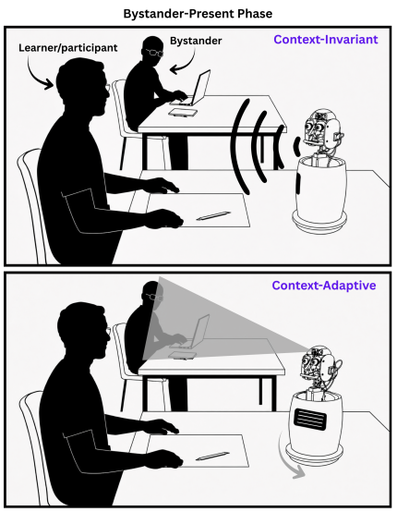
Figure 2 : Robot behaviors with a bystander present. With context-invariant behavior (top), the robot tutor speaks the critical feedback aloud. With context-adaptive behavior (bot- tom), the robot tutor scans for the bystander before giving critical feedback, turns its body and display away after de- tecting the bystander, gives an attention cue, and presents the critical feedback message silently on its display.
Original paper · CC BY 4.0 · Atikkhan Faridkhan Nilgar, Manuel Dietrich, Kristof Van Laerhoven · For You, Not for Everyone: Bystander-Aware Delivery of Critical Feedback in Robot Tutoring · Original paper figure · Extracted the figure area from page 4 of the original PDF.Privacy awareness and social competence ratings
The adaptive group rated the robot's perceived privacy awareness at 5.84, compared to 3.36 for the invariant group. Each group had 20 participants, and the groups were formed by alternating enrollment order rather than randomization. The difference was statistically significant with a Holm-adjusted p below .001 from a two-sided Mann–Whitney test, and the rank-biserial correlation was .75.
Participants judged the adaptive robot as keeping feedback more private, which supports H1.
A possible objection is that the one new item, written for feedback delivery, drove the result. Without that item, the adaptive mean was 5.83 compared to 3.45 for the invariant group. The gap stayed statistically significant at U = 49.50 with an unadjusted p below .001. That check was post hoc, so it supports the result rather than confirming it.
Social competence moved in the same direction, from 3.53 for the invariant group to 4.85 for the adaptive group. The Holm-adjusted p was .019 and r_rb was .48, a smaller effect than for privacy, which supports H2. Participants' explanations included one who called the robot socially aware and said it doesn't want to embarrass the participant.
This is still a rating of the robot, and it doesn't show how the bystander judged the robot.
The authors ran a sensitivity analysis that put the minimum detectable effect at d = 1.11 (|r_rb| = .57). That analysis used 80% power and a per-test alpha of .05/3, so the study could detect large differences. They didn't test smaller effects on these scales, so those remain untested.
Did participants notice the robot reacting to the bystander?
Every adaptive participant reported that the robot looked around, while 6 of 20 invariant participants said the same. That gap had a Holm-adjusted p below .001 and a Cramér's V of .73, from two-sided Fisher's exact tests. The scan was therefore visible to every adaptive participant, so the manipulation reached the people it was meant for.
On whether the robot had noticed the bystander, 12 adaptive participants answered yes, versus 1 invariant participant. Six adaptive participants were uncertain and two said no, while the invariant counts were 4 uncertain and 15 no. The authors report this detection gap with a Holm-adjusted p below .001 and a V of .59. CI-P10 doubted that the robot had recognized the person who was there.
Fifteen of 20 adaptive participants and 9 of 20 invariant participants reported a change in behavior during feedback. That gap was inconclusive, with Holm p = .105 and Cramér's V = .31. Invariant participants pointed to feedback content, tone, pacing and timing, such as CI-P8 describing a more sarcastic robot. The authors suggest these reports may reflect the critical feedback itself, which arrived only in the bystander-present phase.
CA-P5 first called the turning unexplained and later suggested the robot might be looking for other people. These accounts illustrate individual interpretations and don't establish how common each one was within a group. The spoken attention cue pointed learners to the display without explaining that the robot was responding to the bystander.
Why the embarrassment result stays open
H3 predicted that adaptive delivery would lower experienced embarrassment, and the data don't settle that prediction. Adaptive participants averaged 2.75 on the embarrassment scale, compared to 3.85 for invariant participants. The comparison gave a Holm-adjusted p of .130 and r_rb = −.28, with a 95% CI of [−.61, .08]. That interval includes both lower and higher embarrassment in the adaptive group, so H3 is not supported.
The embarrassment items asked about the whole situation the participant had just experienced, not about each message.
The adaptation changed who could access the feedback, but the criticism itself stayed the same. Adaptive participants gave two different explanations for their feelings about the situation. One participant said there was no embarrassment because only they could see the feedback. Another felt awkward because a second person could notice a poor performance.
Across both conditions, participants tied discomfort to the remarks themselves, such as one who found the feedback rude.
The bystander familiarity results add more uncertainty to the embarrassment picture. Participants who knew the bystander reported higher embarrassment on average than those who didn't, in both conditions. Exploratory analyses didn't establish an association between familiarity and any primary outcome.
Reading the adaptation as consideration
Accounts link looking around to keeping feedback private, and describe the displayed text as visible only to the learner. The adaptation could be read as marking a boundary between what the learner receives and what others can access. The authors stress that this concerns perceived access, since they didn't measure how much the bystander could hear or read.
Accounts about social competence follow the same line: one participant described the feedback as directed at the learner, and another called the robot socially aware. The authors suggest participants may have read the changed delivery as consideration for the learner's situation.
The attention cue pointed learners to the display without saying the robot was responding to the bystander. Some participants inferred detection anyway, while others doubted the robot had recognized anyone. A future study could add an on-display explanation and test whether it adds clarity beyond what the behavior already shows.
What the results leave untested
The 40 participants came from one university community, which narrows how far the findings reach. Assignment was nonrandom, with alternating enrollment that started in the context-invariant condition, so causal inference stays limited. Seven invariant and eight adaptive participants already knew the bystander. This left the familiar and unfamiliar subgroups unequal, at 15 and 25 participants.
Bystander familiarity was uncontrolled, and relationship closeness wasn't assessed.
The feedback was scripted and unrelated to actual performance. Only one stationary bystander was tested, played by the same confederate in every session. Bystander access to the feedback wasn't measured, so the privacy result reflects perceived access rather than actual access. The study evaluated only one context-adaptive design, so other adaptive behaviors remain untested.
Embarrassment was measured for the overall situation, not for individual feedback messages. Learning outcomes weren't examined, so the study can't speak to whether the adaptation helped learning. Detection logs weren't retained, so the scan's behavior in each session can't be checked afterward. The quotations illustrate individual experiences but don't show how common those interpretations were within each group.
Future studies could test whether a learner-facing explanation adds clarity to the behavior participants already infer.
Paper info
- Authors
- Atikkhan Faridkhan Nilgar, Manuel Dietrich, Kristof Van Laerhoven
- Venue
- arXiv · Preprint
- First published
- 2026-11-3
- Added
- 2026-11-5
- Updated
- 2026-11-3
- Version
- v1
- arXiv
- 2611.05001
- Category
- cs.HC · cs.RO
- Original paper terms
- CC BY 4.0
- What we show
- Paper info, commentary and permitted figures from the original paper
AI commentary is a separate explanation from the original paper and may contain errors. The original paper and figures follow each source's terms of use and any rights noted separately.
Abstract
Robots in shared settings may expose information intended for an individual user to nearby bystanders. Robot tutoring makes this concern particularly salient: critical feedback is directed at an individual learner, yet bystanders may overhear or see it. To address this, we compared context-invariant and context-adaptive robot behaviors in a between-subjects study with 40 participants. Following an initial phase without a bystander, a bystander entered the setting. Participants then received two scripted critical feedback messages concerning their pronunciation and handwriting, independent of their actual performance. With the context-invariant behavior, the robot tutor delivered both messages aloud. With the context-adaptive behavior, the robot tutor scanned for the bystander, turned its body and display away after detecting them, gave a spoken attention cue, and presented the same feedback messages silently on its display. Participants rated the robot tutor higher in perceived privacy awareness and perceived social competence in the context-adaptive condition than in the context-invariant condition, while evidence for reduced experienced embarrassment was inconclusive. These findings inform the design and evaluation of robots that respond to bystander presence by adapting how they communicate potentially sensitive information.
Quote from the paper
Atikkhan Faridkhan Nilgar, Manuel Dietrich, Kristof Van Laerhoven (2026). For You, Not for Everyone: Bystander-Aware Delivery of Critical Feedback in Robot Tutoring. arXiv:2611.05001v1. https://arxiv.org/abs/2611.05001v1
BibTeX
@misc{nilgar2026everyone,
  title = {{For You, Not for Everyone: Bystander-Aware Delivery of Critical Feedback in Robot Tutoring}},
  author = {Atikkhan Faridkhan Nilgar and Manuel Dietrich and Kristof Van Laerhoven},
  year = {2026},
  eprint = {2611.05001},
  archivePrefix = {arXiv},
  url = {https://arxiv.org/abs/2611.05001v1}
}