Paper commentary
Right Reason, Wrong Advice: Evaluating Recourse in LLM Explanations of Denied Requests
Explanations of denied requests can cite true reasons that still leave people denied
- Problem Language models write the explanations people get when rule systems deny them. A true reason can still leave the person denied after they fix it, when several rules deny independently.
- Method The authors score each explanation by whether changing its cited features, with the request's goal fixed, flips the decision.
- Results The GPT-6 Luna judge, asked whether acting on the explanation would work, reached AUROC 0.97.
Why a true reason can still fail
Rule systems now decide many requests, and an LLM often writes the explanation the person reads. Data-protection law and the algorithmic recourse literature both push for explanations that say what could change the outcome. The usual checks, though, ask whether an explanation is faithful to the process or whether a reader can predict the decision.
An explanation can pass both checks and still leave the person with nothing to act on.
The authors' running example is a family applying for public housing, with net assets above the limit and a suitable home it owns. Under HUD's rules, each of those two facts bars admission on its own. Gemma-4-12B names only the asset rule, citing 24 CFR 5.618(a)(1)(i), and the explanation is true. If the family brings its assets under the $100,000 limit and reapplies, it is denied again under F3.
The explanation therefore names a true reason that gives the applicant no working change.
The oracle finds that the two reasons share no feature, so neither one alone gives recourse. Figure 2 places the oracle beside an extractor that reads the features an explanation cites. With independent reasons, the failure can be predicted from the policy alone, before any model writes an explanation.
Faithfulness, simulatability and causal recall all reward this explanation, and a judge asked about correctness has no reason to object. Across 20 LLMs, the correctness checks come close to chance at spotting this failure.
Checking recourse exactly from the decision function
The check holds the requester's goal fixed and asks whether changing the features an explanation cites can flip the decision. Goal features, such as a Pell grant request or a pod creation, stay put, because changing one would mean asking for something else. Definition 1 marks an explanation as recourse-valid when some assignment to the features outside Δ leads to ALLOW.
Here Δ is the set of cited features the requester may change, so the kept features stay at the request's values. The check credits an explanation whenever some assignment flips the decision, even if the explanation doesn't say which change to make.
Proposition 1 says that, when the goal alone doesn't force the denial, the verdict is 1 exactly when Δ meets every goal-fixed reason. A goal-fixed reason is a subset-minimal set of non-goal features that, together with the goal, is sufficient for the denial. For a single reason, recourse holds only if that reason shares a feature with every other goal-fixed reason.
Fixing the goal can create this gap, since the privileged-containers case has one reason with the goal free and none with it fixed.
An exact oracle computes the minimal sufficient sets from each rule system, and these sets are the reasons for a denial. An extractor reads each explanation and lists the features it presents as reasons. Correctness checks ask whether that list contains a reason, while recourse validity asks whether the list hits all of them. Causal recall can score an explanation 1 while its recourse validity is 0, because one complete reason is enough for that score.
Actionable recourse validity replaces the goal with the goal plus immutable features, so it covers fewer denials than the goal-fixed version.
Seven ported rule systems and the oracle gap
The authors port seven rule systems into executable gates over categorical features. Cedar and Gatekeeper come from public example policies and templates, and the eligibility ports cover SNAP, HUD public housing and Title IV student aid. Each port keeps its source's combination semantics and records every omitted provision in the port file.
For each port, they draw 30 multi-reason denials and 30 single-reason controls, which gives 420 episodes.
Table 1 gives the oracle-level gap for each port, computed exactly over every context. Cedar github-model is the negative control, with a share of 0.00, because its reasons share a role-membership feature. Corollary 1 predicts this result, since every single reason succeeds when all members of the reason set share a feature.
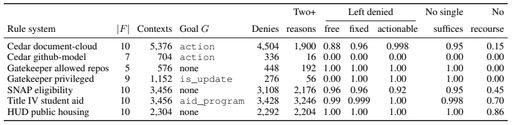
Table 1 : Rule systems and the oracle-level gap, exact over every context. Cedar and the eligibility rules use deny-overrides, Gatekeeper violation-any on 3-container pods.Two+ reasons: denials with two or more goal-fixed reasons.Left denied: share of (denial, reason) pairs in which citing that one correct reason leaves the request denied, over denials with two or more reasons (free) or two or more goal-fixed reasons (fixed; actionable also fixes the immutable features).No single suffices: share of those denials in which no reason cited alone gives goal-fixed recourse.No recourse: share that the goal and immutable features alone deny. Shares are under the uniform context measure, not population rates.
Original paper · CC BY 4.0The eligibility rule sets show the gap because each disqualifying condition denies a request on its own. Of the 3,108 SNAP denials, 2,176 have two or more reasons, and Title IV has 3,246 of its 3,428 denials. With immutable features held fixed, 0.45 to 0.86 of these multi-reason denials admit no actionable recourse at all. These shares use a uniform measure over contexts, so they aren't population rates.
Do correctness checks catch the failure?
On multi-reason denials, the same fidelity signal drops to 0.49 [0.48, 0.51] across all 20 models. Within a single model, fidelity ranges from 0.42 to 0.64. Causal recall and causal precision both reach 0.48 on those same multi-reason denials.
The blind spot doesn't depend on how often models fail. On the 4,072 thinking-on explanations, 93% are recourse-valid, and fidelity still separates at 0.49 [0.46, 0.52]. Causal recall stays at 0.48 there, while coverage still reaches 0.75. Of the 17,859 explanations with causal recall 1, 37% leave the requester denied. That share rises to 79% for Gemma-3-12B.
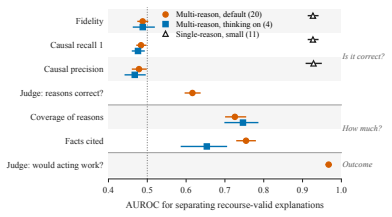
Figure 3 : How well each per-explanation signal sep- arates recourse-valid explanations from the rest (AU- ROC, 95% interval from resampling episodes; dotted line: chance). Circles: 20,375 default explanations of multi-reason denials from all 20 models; squares: 4,072 thinking-on explanations; triangles: single-reason con- trols, small open models. Judges are GPT-6 Luna on a sample (§5.3). Within-model and within-episode values are in Table 8.
Original paper · CC BY 4.0 · Arunkumar V · Right Reason, Wrong Advice: Evaluating Recourse in LLM Explanations of Denied Requests · Original paper figure · Extracted the figure area from page 5 of the original PDF.Coverage of the reason structure separates recourse-valid explanations better than correctness does. Covering two or more goal-fixed reasons gives recourse-validity of 0.75. Within an episode, coverage reaches AUROC 0.83 and the number of facts cited reaches 0.87. In a logistic model, fidelity's coefficient is −0.46 with a 95% CI of [−2.55, 1.63] once coverage and facts cited are known.
A random citation of as many facts as the episode holds gives less recourse than every model does. A stronger null draws facts only from those that belong to some reason, and all 11 small open models fall below it. Llama-3.1-8B falls furthest below that null, by 0.26, while the frontier models sit at it.
Can an LLM judge stand in for the oracle
The authors gave three LLM judges each case, the requester's fixed goal and one explanation. In a single prompt, each judge gave 1 to 5 ratings for whether the reasons are true, whether changing the named facts would get the request allowed, and overall quality. On the correctness question, the judges put 84% to 89% of explanations at 4 or 5.
That rating separated recourse-valid explanations at AUROC 0.56 to 0.62, and only 0.51 to 0.55 within a model.
Asked whether acting on the explanation would work, GPT-6 Luna reached AUROC 0.97 [0.96, 0.98]. Gemma-4-31B reached 0.92 [0.90, 0.94], while Qwen3.8-27B reached only 0.67. The judges' mean ratings ranked the models almost as the oracle does, with Spearman 0.99 and 0.98. Table 2 pairs each judge's outcome AUROC with its quality AUROC, and GPT-6 Luna scored 0.95 on quality, a difference of 0.02.
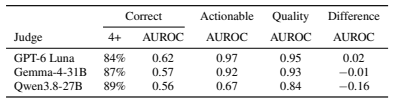
Table 2 : LLM judges on default explanations of multi- reason denials, 20 per model and system, 2,800 per judge over 20 models.4+: share rated 4 or 5 on correct. AUROC: how well each 1 to 5 rating separates recourse- valid explanations from the rest;Difference: actionable minus quality AUROC, paired.
Original paper · CC BY 4.0Asked one question per call on 700 explanations already rated, GPT-6 Luna scored 0.97 [0.95, 0.98] on the outcome question. Its quality AUROC fell to 0.89 [0.86, 0.91], down from 0.94, so part of the quality rating's strength came from the earlier question. Leaving out each judge's own explanations moved no AUROC by more than 0.005.
The correctness question fails for all three judges, while the outcome question separates them. The authors used the exact oracle to decide which judge is strong enough to be trusted with the outcome question.
Which models give recourse, and does reasoning help
Recourse validity follows model capability across the 15 models that have a published Epoch Capabilities Index, with a Spearman correlation of 0.88 [0.64, 0.96]. Across the 10 open models alone the correlation drops to 0.71 [0.06, 0.92], and among the seven small open models it doesn't separate them (0.54, p = 0.23). The frontier models give recourse in 0.92 to 0.99 of multi-reason denials, while the open models of 27B to 32B reach 0.44 to 0.97.
Models of 8B to 21B give recourse in 0.23 to 0.70, so capability explains the ranking only at the coarse level.
Reasoning explains much of that band, and the authors turned thinking on for four models. With thinking on, a 3,000-token budget that no answer reaches lifts Qwen3-14B, Qwen3-32B, Qwen3.8-27B and gpt-oss-20b from between 0.40 and 0.77 to between 0.89 and 0.99. The weakest frontier model sits at 0.92 for comparison.
Recourse falls as the number of goal-fixed reasons grows, and it falls in every group, reasoning models included. Six of the nine reasoning runs fall below 0.8 at four or more reasons, so reasoning doesn't remove the failure. Rerun at high effort, Sonnet gives recourse in 0.93 [0.86, 0.98] and GPT-6 Luna in 0.88, while Haiku reaches 0.78.
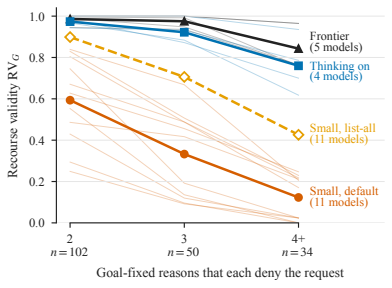
Figure 4 : R VG by the number of goal-fixed reasons on the multi-reason denials (n episodes per bucket). It falls in every group, reasoning models included. Bold: mean over a group’s models; faint: one line per model. Thinking on: Qwen3-14B, Qwen3-32B, Qwen3.8-27B, and gpt-oss-20b at high effort. Per-bucket values are in Table 7.
Original paper · CC BY 4.0On the eligibility systems, actionable recourse is much lower for the small open models, at 0.26 of Title IV and 0.36 of HUD denials. The frontier models reach 0.96 and 0.98 on those same systems, so holding immutable features fixed separates the groups sharply. Gemma-4-31B depends on the policy text, falling from 0.97 to 0.58 without it, and on HUD from 1.00 to 0.15.
Which prompt changes close the gap
Asking the model to say what would need to change did not help the recourse rate.
Asking for every rule raised recourse validity for each open model whose default was below 0.90. That covers 14 models, with gains from 0.14 for Gemma-4-12B to 0.61 for Gemma-3-12B. The frontier models moved by at most 0.05. The fix closed 35% of the default's gap for Phi-4-14B and 79% for Gemma-3-12B. List-all lifted every small open model to between 0.55 and 0.91.
Thinking on and list-all stack, since Qwen3-14B and gpt-oss-20b reached recourse in 0.97 to 0.98 of multi-reason denials. On four or more reasons, the same two models reached 0.84 to 0.90, up from 0.62 to 0.79 with thinking alone. The price is length, because list-all explanations cite 4.6 facts on average against 3.3 by default. Causal precision fell for ten of the 11 small open models under list-all.
Asking instead for an explanation addressed to the person helped nine of the 11 small open models. Those nine gained 0.14 on average, yet ten small open models still gave less recourse than list-all, by 0.16 on average. Most of the gain came from length, since lifting the 2 to 4 sentence cap added 0.10 to 0.25. Giving the model its reasons directly gave the three models an average of 0.95.
That sits 0.08 to 0.29 above the minimum change, where the extractor misses a named feature in 2% to 8% of explanations.
Does the advice work as written
The authors ran the concrete changes each explanation proposes through the decision function, to see whether advice works as written. Changes to goal features are discarded before the check runs. The test covers three ladder models, Qwen3-14B, Gemma-3-12B and Llama-3.1-8B, under the counterfactual and minimum-change prompts and the requester prompt.
Under the counterfactual prompt, 0.81 to 0.86 of explanations propose a usable change. Applying those changes allows the request in only 0.17 to 0.21 of cases, while recourse validity on the same explanations is 0.25 to 0.34. Advice from explanations that fail RV works in at most 0.02 of cases, but advice from passing ones works in 0.59 to 0.64.
With the minimum change, advice works in 0.30 to 0.69 of explanations, against RV of 0.58 to 0.90. Advice from explanations that fail RV still works in up to 0.24 of cases. The 83 working cases each alter a feature that the advice names but the reason list omits. The reason extractor leaves those features out, since RV scores only the reasons an explanation gives.
That is set against RV of 0.37 to 0.95, and no model reaches four fifths of what RV credits.
RV stays an optimistic construct because it credits changes the explanation never mentions. The pass that reads proposed changes has not been checked by hand.
Limitations of the recourse measurements
The extraction step sits between every model's explanation and every number reported, so the measurements inherit its errors. Qwen3-14B also extracts its own explanations, and a second extractor, Gemma-3-12B, agrees with the first at α of 0.83 to 0.90. One author labelled 200 explanations, and agreement with the extractor reached α = 0.83 with micro-F1 0.91.
Recourse validity credits any assignment to the cited features, including ones the explanation never suggests. Because of that, it can overstate how often acting on an explanation succeeds. The authors' gains for a mitigation therefore overstate gains in working advice.
Each port folds its source's predicates into a few categorical features, and SNAP is modelled for a one-person household. Open models ran 4-bit with thinking off, while the public capability index scores provider-hosted weights.
Paper info
- Authors
- Arunkumar V
- Venue
- arXiv · Preprint
- First published
- 2026-11-16
- Added
- 2026-11-18
- Updated
- 2026-11-16
- Version
- v1
- arXiv
- 2611.21545
- Category
- cs.AI · cs.CL · cs.CY
- Original paper terms
- CC BY 4.0
- What we show
- Paper info, commentary and permitted figures from the original paper
AI commentary is a separate explanation from the original paper and may contain errors. The original paper and figures follow each source's terms of use and any rights noted separately.
Abstract
Language models increasingly write the explanations people receive when a rule system denies their request. If several rules deny the request independently, an explanation can name a true reason and still leave the person denied after they fix it. We call the missing property recourse validity: changing what the explanation cites, without changing what was asked for, can flip the decision. We compute it exactly, and a hitting-set argument predicts from the policy alone when a correct reason fails. In six of seven rule systems ported from access control and US benefit eligibility, a single correct reason almost never gives recourse when several reasons apply. Across 20 LLMs, checks of whether the cited reasons are correct, computed or asked of an LLM judge, are close to chance at spotting this failure, as the argument predicts. A strong judge asked whether acting on the explanation would work does spot it. Stronger and reasoning models do better but still fail on many denials with four or more independent reasons. Asking for every rule helps every open model with room to improve. Explanations of eligibility decisions should be built from the decision function and judged by whether acting on them works.
Quote from the paper
Arunkumar V (2026). Right Reason, Wrong Advice: Evaluating Recourse in LLM Explanations of Denied Requests. arXiv:2611.21545v1. https://arxiv.org/abs/2611.21545v1
BibTeX
@misc{v2026right,
  title = {{Right Reason, Wrong Advice: Evaluating Recourse in LLM Explanations of Denied Requests}},
  author = {Arunkumar V},
  year = {2026},
  eprint = {2611.21545},
  archivePrefix = {arXiv},
  url = {https://arxiv.org/abs/2611.21545v1}
}