Paper commentary
UniLatent: Cross-Embodiment Transfer via Latent Observation Alignment
UniLatent aligns a source encoder to a frozen target encoder for robot transfer
- Problem Robot demonstrations usually work only on the robot that collected them, because a new arm or gripper changes what the camera sees. Earlier fixes edited source images to look like the target robot, but policies then overfit to translation artifacts.
- Method UniLatent trains a source visual encoder to match a frozen target encoder on paired simulated renders of both robots at matched poses. Instead of translating images, the policy trains on encoded source demonstrations and runs directly on target observations.
- Results Across three simulation tasks and two target arms, UniLatent reaches up to 93% zero-shot success. Its mean target success is 76.0%, compared to 44.5% for the strongest pixel-translation baseline, RoVi-Aug*.
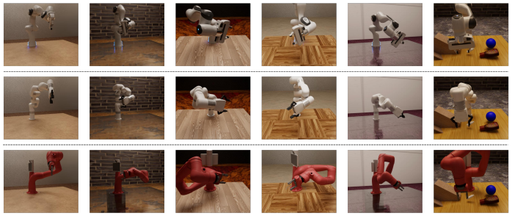
Figure 3 : Paired image generation.Examples of simulation-rendered paired observations for three robots (top to bottom): Franka, xArm, and Sawyer. For each sampled end-effector pose, we render the robots under randomized backgrounds, lighting, and scene variations while preserving action-level correspondence between paired frames.
Original paper · CC BY 4.0 · Yufei Ding, Yi Du, Weiduo Yuan, Hao Jiang, Dylan Goetting, Lawrence Yunliang Chen, Daniel Seita, Yue Wang · UniLatent: Cross-Embodiment Transfer via Latent Observation Alignment · Original paper figure · Extracted the figure area from page 4 of the original PDF.Why embodiment shift breaks visual policies
Robot datasets are costly to collect and concentrate on a few popular arms and grippers, so many platforms have little data. Recollecting the same task for every new robot doesn't scale, which makes reuse of source-robot demonstrations attractive. The obstacle is visual: changing the arm or gripper alters self-occlusion, contact geometry and object visibility, and a vision policy then degrades.
Prior work tries to fix this by editing source frames with masking, inpainting or diffusion so they resemble the target robot. Policies may then overfit to translation artifacts rather than real target views, which limits how well they generalize.
Align features instead of pixels
UniLatent changes the comparison space: it aligns observation features rather than translating target images into pixels. Matched poses on the two robots therefore receive the same representation, so the target encoder defines what the policy sees.
The method's central move is to replace image synthesis with explicit correspondence built from paired renderings. Rendering both robots at matched TCP poses turns alignment into supervised feature regression onto a frozen pretrained target encoder. The source encoder ES is initialized from DINOv2-base, and the target encoder ET stays frozen and defines the deployment representation.
For each paired rendering, only ES is trained to match the target features under the alignment loss. At deployment, target observations are encoded directly by the frozen ET, so no test-time image synthesis happens.
Pixel-space editing methods such as Mirage, RoVi-Aug, and Shadow change the RGB images that the policy consumes. Wang et al. also align a latent space to a frozen anchor domain, but they rely on unpaired adversarial and cycle-consistency objectives. UniLatent instead relies on paired renders, which gives the regression target a direct per-pose correspondence.
How paired renders train the encoder
Pose sampling starts from end-effector poses inside the reachable workspace, and inverse kinematics then solves for both robots' joints at each pose. Poses are matched at the tool-center point, defined as the midpoint between the parallel-jaw fingertips. A pose is kept only when inverse kinematics succeeds for both embodiments, so every retained pair is reachable by both robots.
The generic set contains about 100k pairs, and the optional task-specific set adds about 10k.
Both encoders start from DINOv2-base, but only the source encoder E S is updated during alignment. The loss is the squared distance between the source and target features of each pair, written as L_align in Equation 1. The loss is applied to the encoder tokens the policy uses, including global and patch-level features. Freezing the target encoder keeps the latent space tied to the representation used at deployment, so the target side doesn't drift.
The policy is a conditional flow-matching head trained on encoded source demonstrations, with history k = 3 and action horizon H = 8. At deployment, target frames pass through the same frozen target encoder before reaching the policy, so UniLatent synthesizes no image. Alignment consumes only robot models, inverse kinematics and rendering, so it needs no target demonstrations.
Source demonstrations need not be collected for alignment, which keeps the alignment step separate from data collection.
Simulated zero-shot results: alignment versus direct transfer and pixel translation
The authors train every policy on 300 Franka demonstrations per task and test zero-shot on xArm7 and Sawyer across three tasks. Each setting runs 100 closed-loop rollouts, and the Franka column serves as the in-domain reference. Direct policy transfer reaches only 0 to 5% target success, while the same kind of Franka-trained policy reaches 80 to 97% in-domain.
That gap shows that sharing a Cartesian TCP action interface doesn't remove the visual embodiment gap.
The DINOv2 without alignment baseline uses one frozen DINOv2 encoder for both robots and the same latent policy. It helps some xArm settings, but it reaches at most 16% on Sawyer. So a generic pretrained feature space isn't enough, and the authors conclude that explicit alignment is necessary.
RoVi-Aug* is the strongest pixel baseline, and it reuses the same paired renderings and aligned source encoder. It decodes aligned source features back to RGB with the pretrained Representation Autoencoder decoder. Averaged over six target task–robot settings, mean target success rises from 44.5% for RoVi-Aug* to 76.0% for UniLatent. The largest gain appears on Stack Cup into Bowl, where xArm moves from 15% to 65% and Sawyer from 5% to 51%.
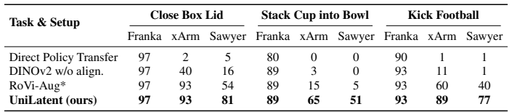
Table 1 : Zero-shot transfer results in simulation.Policies are trained on Franka demonstrations and evalu- ated on Franka (in-domain) and zero-shot on xArm and Sawyer. We compare direct policy transfer, a shared frozen DINOv2 encoder without alignment, RoVi-Aug* (our adaptation of RoVi-Aug), and the full UniLatent pipeline. Entries report success rates (%) over 100 rollouts.
Original paper · CC BY 4.0The authors attribute part of the gap to a train–test mismatch in the pixel pipeline. RoVi-Aug* trains on decoded images but runs on real target images, while UniLatent trains and runs on features from the same frozen target encoder.
Real-world xArm to Franka transfer with 10 demonstrations
The real-world setup transfers from an xArm source robot to a Franka target robot on Close Drawer, Close Box Lid and Wipe Table. The xArm source data comes from 150 teleoperated demonstrations for Close Drawer and 61 for each of the other two tasks, collected at 10 Hz. Because controllers and calibration differ between the physical robots, each task gets 10 Franka demonstrations for fine-tuning.
The encoder is aligned only in simulation with about 100k generic paired renderings, and one task-agnostic encoder serves all three real tasks.
The authors compare four settings, all evaluated on Franka except the xArm reference. Source-only is trained and evaluated on xArm as an in-domain upper reference. Target-only trains from scratch on the 10 Franka demonstrations, while RoVi-Aug pretrain plus few-shot follows the original RoVi-Aug pipeline. The RoVi-Aug pipeline segments xArm frames with Grounded-SAM2 and replaces the xArm with a Franka using a ControlNet-conditioned diffusion model trained on rendered pairs.
Cross-emb pretrain plus few-shot pretrains the latent policy on aligned xArm observations and then fine-tunes it on the same Franka data.
UniLatent completes 27 of 30 rollouts, compared to 23 of 30 for RoVi-Aug pretraining and 11 of 30 for target-only training. RoVi-Aug pretraining beats target-only training on all three tasks, so source data helps once it is bridged to the target domain. Against RoVi-Aug, UniLatent moves Close Drawer from 9/10 to 10/10 and Wipe Table from 5/10 to 8/10.
Close Box Lid stays tied at 9/10 for both methods.
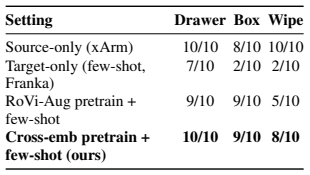
Table 2 : Few-shot real-world transfer. Source-onlyis an in-domain xArm reference. Rows 2–4 are evaluated on Franka and use the sameM T = 10Franka demonstrations.Cross- emb pretrain + few-shot (ours)is UniLatent.
Original paper · CC BY 4.0These results suggest that a single encoder aligned on generic simulated pairs gives a useful starting point at the 10-demonstration budget. The authors didn't test larger demonstration budgets in this real-world comparison. The evidence covers only one physical setup, so robustness to clutter and lighting remains untested.
Multi-source and background tests
Multi-source transfer tests whether UniLatent can pool demonstrations from two different source robots into one policy. Franka and Sawyer source encoders are each aligned to the same frozen xArm target encoder. One policy trains on their combined demonstrations, so both sources feed a shared target-anchored latent space. Using 100 demonstrations from each source alone reaches only 63–64% for either set.
The background test keeps the Close Box Lid task and asks whether scene randomization on the source side carries over to the target policy. When source backgrounds are randomized across five held-out simulated scenes, the policy gets 88.6 on Franka, 85.6 on xArm and 80.0 on Sawyer. The authors averaged these numbers over five held-out simulated scenes.
This is a single simulated task, so the result doesn't show the same robustness on other scenes. The paper also doesn't test real-world clutter, lighting, or distractors.
Policy head and pose sampling
The generative head matters less than the encoder, but it still changes results in this setting. Flow matching and a DDPM policy share the same aligned encoders and UNet, and differ only in the generative formulation. The DDPM variant denoises action chunks over T_diff = 100 steps, one network forward pass per step. The flow-matching policy integrates the learned ODE for 10 solver steps with a second-order Midpoint method.
Flow matching averages 87.7% across three simulation tasks and two robots, compared to 77.0% for DDPM. On Stack Cup into Bowl for xArm, flow matching reaches 65 while DDPM reaches 49. Flow matching also needs 20 network forward passes at inference, instead of the 100 used by DDPM.
Pose sampling for the paired renderings is the second factor the authors tested in this section. The manipulation-relevant sampler mixes broad workspace sampling with empirical demonstration poses. The baseline draws feasible TCP poses broadly, without biasing them toward tabletop manipulation configurations.
On Sawyer, the same sampler substantially narrows the transfer gap, though it does not close it. The authors conclude that paired rendering works best when pairs cover configurations likely to occur during manipulation. So the pose coverage of the alignment pairs shapes what the encoder learns.
Background randomization is the last test the authors ran on Close Box Lid, in simulation. The matched-background setting draws training and evaluation scenes from the same background distribution. The randomized-background setting changes the scene distribution between source demonstrations and deployment.
Limitations
Dexterous hands, humanoids and mobile manipulators would need extra retargeting and contact modeling. Application to external source datasets such as Open X-Embodiment has not been shown. The target robot must also reach the source task in a comparable workspace.
The background-shift evaluation covers one simulated task, and the real experiments use one physical setup. Robustness to real clutter, lighting, distractors and broader object variation is not established.
Paper info
- Authors
- Yufei Ding, Yi Du, Weiduo Yuan, Hao Jiang, Dylan Goetting, Lawrence Yunliang Chen, Daniel Seita, Yue Wang
- Venue
- arXiv · Preprint
- First published
- 2026-11-6
- Added
- 2026-11-10
- Updated
- 2026-11-6
- Version
- v1
- arXiv
- 2611.10061
- Category
- cs.RO · cs.CV
- Original paper terms
- CC BY 4.0
- What we show
- Paper info, commentary and permitted figures from the original paper
AI commentary is a separate explanation from the original paper and may contain errors. The original paper and figures follow each source's terms of use and any rights noted separately.
Abstract
Robot datasets are costly to collect and are usually tied to a specific embodiment, making it difficult to reuse demonstrations across robots with different geometry, appearance, and kinematics. We introduce UniLatent, a cross-embodiment transfer framework that reduces the embodiment-induced observation gap in a shared latent space. UniLatent renders paired source-target robot observations in simulation and aligns a source visual encoder to a frozen target encoder. A policy trained on encoded source demonstrations can then run directly on target observations, with no pixel-level image translation. Across three simulation tasks and two target robot arms, UniLatent reaches up to 93% zero-shot success, exceeding the strongest pixel-translation baseline by over 30 points on average. In real-world xArm-to-Franka transfer, fine-tuning with only 10 target demonstrations per task yields 27/30 successful rollouts. Code, videos and data are available at https://selina2023.github.io/unilatent/.
Quote from the paper
Yufei Ding, Yi Du, Weiduo Yuan, Hao Jiang, Dylan Goetting, Lawrence Yunliang Chen, Daniel Seita, Yue Wang (2026). UniLatent: Cross-Embodiment Transfer via Latent Observation Alignment. arXiv:2611.10061v1. https://arxiv.org/abs/2611.10061v1
BibTeX
@misc{ding2026unilatent,
  title = {{UniLatent: Cross-Embodiment Transfer via Latent Observation Alignment}},
  author = {Yufei Ding and Yi Du and Weiduo Yuan and Hao Jiang and Dylan Goetting and Lawrence Yunliang Chen and Daniel Seita and Yue Wang},
  year = {2026},
  eprint = {2611.10061},
  archivePrefix = {arXiv},
  url = {https://arxiv.org/abs/2611.10061v1}
}