Paper commentary
Accelerating Offloading-Based MoE Inference by Interleaving Concurrent Requests
Bevy lets concurrent requests run ahead so MoE offloading beats prefetching
- Problem Prefetching for offloaded MoE models loses precision once an expert cache sits in GPU memory. Its fetches then waste link bandwidth and GPU memory on experts no request needs.
- Method Bevy lets requests whose experts are cached run ahead to later layers. This reveals the experts they need next, so Bevy fetches only those instead of predicting them.
- Results Bevy reaches up to 3.46× the decode throughput of llama.cpp across two local platforms. It also reaches up to 1.55× that of the fastest prefetching baseline.
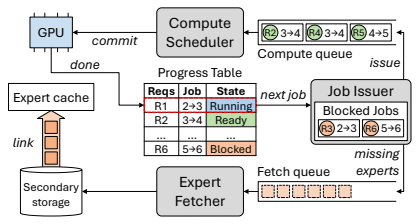
Figure 6 . System overview of Bevy.
Original paper · CC BY 4.0 · Hongseung Yu, In Gim, Kyunghan Lee, Lin Zhong · Accelerating Offloading-Based MoE Inference by Interleaving Concurrent Requests · Original paper figure · Extracted the figure area from page 5 of the original PDF.Where batching stalls and prefetching falls short
Local deployments increasingly serve several requests at once, because personal agents split one task into four to eight subtasks. An MoE model still needs all of its experts, yet a personal device often can't hold them all in GPU memory. An expert cache keeps a subset in GPU memory, and the missing experts are fetched over a link such as PCIe.
Under conventional batching, each layer's gate selects experts, the absent ones are fetched, and only then does the MoE compute. The GPU therefore waits on the link at every layer, and the link sits idle while the GPU computes. A prefetcher tries to hide that wait by predicting which experts later layers will need. It then fetches those predicted experts while the current layer computes.
Prefetching is the obvious fix, but the authors find its benefit questionable once an expert cache is present. The cache already holds many of the experts a later layer will need. It also tends to keep the experts that are easier to predict, so the prefetcher is left with harder candidates. Needed experts are less common among the remaining candidates, so much of the prefetched bandwidth goes to experts no request needs.
The authors test this with a trace-driven cache simulator on Qwen3.6-35B-A3B decode traces from eight concurrent ShareGPT requests. Randomizing the cache reproduces part of the precision decline, while the actual cache shows an extra drop. The authors read this as a sign that the cache keeps experts the prefetchers can predict well.
The authors' key insight is that proper request scheduling beats prefetching. Concurrent requests can use idle link bandwidth to fetch experts already known to be needed, without any prediction. A request whose experts are present can proceed to later layers, which reveals its needs earlier. This avoids the barrier of batching, where every request waits for the whole batch's experts.
Why a larger cache lowers prefetch precision
The simulation ran ProMoE, Mixtral-Offloading and FineMoE on Qwen3.6-35B-A3B decode traces from eight concurrent ShareGPT requests, all sharing the same LFU cache. Precision is the share of selected nonresident experts that the target layer needs, measured at a fixed 80% coverage of nonresident demand. Precision falls as the cache grows for all three prefetchers.
A cache holding 30% of all experts already contains 54.1% of the experts the target layer needs on average, so the nonresident candidates hold a smaller share of needed experts.
To check whether this smaller share alone explains the decline, the authors built a randomized cache. The randomized cache reproduces part of the decline, which is region (1) in Figure 2. The actual cache falls further, in region (2), and the authors read this as the cache holding experts that prefetchers predict accurately. The remaining candidates are therefore harder to predict, so the cache content itself lowers precision.
Prefetching keeps the link busy, yet much of what it fetches isn't needed by the target layer. This is the gap that runahead inference addresses, because it fetches only experts a request has already revealed as needed.
Runahead inference lets ready requests move ahead
A request whose experts are already cached can run ahead to later layers while other requests wait for their fetches. Bevy calls this execution method runahead inference, and it reveals the experts a request needs next without predicting expert selections. The fetches it queues cover experts the request has actually selected, so the link carries demand rather than guesses.
Consider three requests, R1, R2 and R3, that reach layer l together. R1 then runs the attention and gate of layer l+1, because their weights stay in GPU memory. R2 runs once its fetches finish, followed by R3, and R1 resumes once its layer l+1 fetches are done. By the time R3 finishes, R1's fetches are complete, so the GPU moves on to R1 right away.
Compute time is the total time the GPU is busy during a step, and fetch time is the total time the link is busy fetching that step's missing experts. Running each request separately repeats reads of shared weights, so compute time rises as grouping gets finer. In the paper's setting, six requests as one batch take 56.5 ms per step, while running them one at a time takes 126.8 ms.
Static grouping reduces that compute time, but it restricts when requests can run ahead and so overlaps less with fetching.
Bevy's Job Issuer checks each job's experts and sends the job to the compute queue only when all are cached. Otherwise the job blocks, and its missing experts go into the fetch queue for the Expert Fetcher. Bevy also gives priority to the lowest layer, so lagging requests catch up and create batching opportunities.
Why a fixed grouping can't fit every step
Running requests separately repeats reads of shared weights, so compute time grows as the requests split apart. Two groups of three requests reduce the compute time to 74.6 ms, and three groups of two requests reduce it to 90.1 ms. Both values fall below the mean fetch time, so grouping does cut compute time. A fixed group, however, restricts when requests can run ahead, because grouping R2 and R3 forces R2 to wait for R3's experts.
The number of expert misses changes from step to step, so the fetch time changes as well. Over 256 steps, the fetch time ranges from 55.7 to 160.1 ms. Compute time also grows as each request's context gets longer, so the two times shift in different directions. A grouping can be faster than the fetch time in one step and slower in another.
The authors argue that no grouping fixed in advance suits every step, which motivates grouping at runtime for each layer.
Ordering creates a second problem, because the order of computation and fetches decides how much of each can overlap. Serving the request with the fewest remaining misses first lets its computation start sooner and overlap with other fetches. Always favouring requests with fewer misses, however, leaves requests that missed more early behind.
Such a straggler finishes its remaining fetches and computation alone, so the scheduling order must weigh both current overlap and the progress of all requests.
Bevy answers both problems with a design that groups requests at each layer, rather than fixing groups for the whole step.
How Bevy's modules and queues connect
Bevy has three modules, the Compute Scheduler, the Job Issuer, and the Expert Fetcher. Each request is cut into jobs, where job l runs the MoE of layer l and then the attention and gate of layer l+1. The Progress Table records each request's current job and state, so Bevy can schedule requests independently. At the start of a step, every request first runs the attention and gate of the first layer together.
The Job Issuer checks whether all experts a job needs are already in the expert cache. If they are, it sends the job to the compute queue, but if not, it blocks the job. A blocked job's missing experts go into the fetch queue, where the Expert Fetcher pulls them from secondary storage. Once all of those experts arrive, the Job Issuer issues the blocked job to the compute queue.
Algorithm 1 gives the Scheduler and the Fetcher different selection rules. The Scheduler picks the lowest layer among ready jobs and batches all ready jobs at that layer. The Fetcher picks the blocked job at the lowest layer first, then the one with the fewest remaining missing experts.
Two jobs that need the same expert share one pending fetch instead of issuing duplicate reads. A resident expert is pinned at lookup, and each cache entry's reference count tracks every job that needs it.
Layerwise grouping and cache pinning
Bevy batches all ready jobs at the layer its Scheduler selects, and that group lasts only for that layer. With few misses, R2, R3, and R4 are all ready, so the Scheduler batches them and runs them together. The grouping therefore adapts across layers within a step, and Bevy doesn't need profiling to do it.
The Scheduler could hold R2 back until R3 becomes ready, which would enlarge the batch. But waiting also delays R2's next gate computation and the fetches that computation would trigger. Lowest-layer-first priority helps lagging requests catch up, and that creates more batching chances.
Jobs request experts independently, so one expert can be needed by two jobs at different times. Bevy tracks each expert's pending fetch, and a second job shares the fetch that is already queued or in flight. At lookup, Bevy pins a resident expert, and a new fetch reserves and pins a cache entry before it starts. Each entry's reference count covers every job that needs it, and only zero-reference entries can be evicted.
Bevy enables runahead only when the cache has enough entries for every concurrent request's selected experts, which prevents deadlock. For 16 requests selecting eight experts each, 128 entries suffice, which is 1.25% of all experts for Qwen3.6-35B-A3B.
Platforms, models and baselines
Bevy runs on two unified-memory platforms, an Apple Mac mini with the M6 chip and a Jetson AGX Thor Developer Kit. The Mac mini has 24 GB of unified memory and a 512 GB SSD, while the Thor has 128 GB of unified memory and a Samsung 9100 PRO 2 TB SSD over PCIe 5.0×4. Bevy is built on llama.cpp with Metal and CUDA support, so the same engine serves both devices.
The two MoE models, Qwen3.6-35B-A3B and Gemma4-26B-A4B, are both quantized to Q4_0. Chat requests come from ShareGPT, and Agentic Coding requests come from SWE-agent trajectories.
The baselines run in the same engine as Bevy, so the comparison isolates the scheduling and caching choices. llama.cpp uses its built-in GPU expert cache with LRU eviction and doesn't prefetch. SpecMD evicts with its Least-Stale policy and applies the next layer's gate to the current gate input to predict experts. SpecMD prefetches each token's top-k experts with an overfetch factor of 1.5, which is 12 experts per token.
FineMoE prefetches the experts predicted from the most similar of the recorded expert maps and evicts by usage frequency times predicted probability. FineMoE runs its open-source code as is, with 4096 expert maps and a prefetch distance of 3 layers. FineMoE and SpecMD use at most two of the eight reader threads for prefetching, so prefetches delay on-demand fetches as little as possible.
Each run decodes 512 steps, and the first 256 steps are excluded because they warm up the expert cache. Decode throughput in tokens per second is the main metric, and steps with observed SSD-read slowdowns are excluded from all systems. On Thor, the CPU and GPU clocks are fixed at their maximum with jetson clocks. On M6, the GPU clock drops whenever the GPU idles, so the baselines run a dummy kernel during idle time.
Figure 8 then compares throughput as concurrency grows from 2 to 16 with 30% of experts cached.
Throughput across concurrency and cache size
Across the five concurrency levels, both workloads, both models and both devices, Bevy leads in all 40 configurations. At four or more concurrent requests, the speedup over the fastest baseline stays between 1.15 and 1.38× on both devices. The gap is smallest at two requests, down to 1.01× for Gemma4-26B-A4B on Thor, because only one other request can run ahead.
Even without prefetching, Bevy beats every baseline at every concurrency level tested.
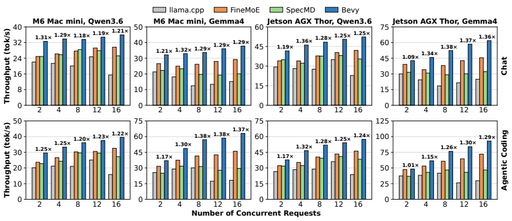
Figure 8 . Throughput as the number of concurrent requests grows. The numbers above the bars give Bevy’s speedup over the fastest baseline. Even without prefetching, Bevy achieves the highest throughput in every configuration.
Original paper · CC BY 4.0The prefetching baselines beat llama.cpp in almost all configurations, and the faster of them reaches 1.13 to 2.52× over llama.cpp. FineMoE's speedup over llama.cpp is 1.43 to 2.06× at 20 to 30% of the experts. That speedup falls to 1.08 to 1.18× at 70%, because prefetch precision drops as the cache grows.
The prefetching baselines lose their edge as the cache grows, so they approach llama.cpp. Bevy is bound by the link, so a larger cache shortens its link time and raises its throughput. At 50 to 60% of the experts, Bevy's speedup over the fastest baseline reaches 1.40 to 1.55× on M6 with both models. On Thor with Qwen3.6-35B-A3B, the same range of speedup appears at 50 to 60% of the experts.
Bevy's step time exceeds its link busy time by only 4 to 9 ms on Thor at these cache sizes.
Where the speedup comes from
To see where Bevy's gain comes from, the authors replaced the eviction policy of each baseline with LFU, the policy Bevy uses. In llama.cpp with LFU, the link and the GPU were never busy at the same time, and the GPU idled for 60% of each step. FineMoE and SpecMD overlapped fetching with computation for 36–40% of the step, yet the GPU still waited for the link for 57–59% of it.
Bevy's GPU busy time was 1.6–1.7× that of the baselines, but Bevy overlapped 86% of that busy time with fetching, which shortens the step.
The prefetching baselines also fetch many experts that no request needs. FineMoE and SpecMD fetched 1.4–1.5× as many experts per step as llama.cpp with LFU. Of the experts they prefetched, 51–64% went unused, which matches the simulation in §2.4 under the same LFU policy. Bevy fetched 235 experts per step, almost the same as llama.cpp with LFU, so it doesn't add wasted fetches.
Grouping and ordering ablations
Bevy's opportunistic layerwise grouping was compared with five static groupings for six concurrent requests. The static groupings were 3:3, 2:2:2, 2:2:1:1, 2:1:1:1:1, and 1:1:1:1:1:1, and the fastest one depended on the number of missing experts. That step time was 0.9–4.3 ms below the fastest static grouping at each point.
The ordering ablation replaced the lowest-layer-first compute order with FIFO, which picks the layer of the oldest ready job. Changing the compute order made the step 12.3% longer, because FIFO forms smaller groups and repeats reads of shared weights. Under FIFO, the share of single-job groups rose from 56% to 67%, while groups with three or more jobs fell from 23% to 12%.
Changing only the fetch order made the step 1.7% longer, and changing both orders made it 13.6% longer. In all three cases GPU idle time didn't increase, so the extra step time came from additional computation rather than waiting.
Adding prefetching on top of Bevy
Bevy fetches experts only on demand, so the authors tested whether a predictor could still add value on top of it. They applied the prediction method of Mixtral-Offloading to Bevy and called the combined system Bevy + Prefetch. The runs used Qwen3.6-35B-A3B with Agentic Coding requests, a 30% expert cache on M6, and two to 16 concurrent requests.
Adding the predictor didn't raise throughput, and Bevy + Prefetch was 4.2% and 5.4% lower than Bevy with two and four requests. From eight requests on, Bevy + Prefetch rarely prefetches, so its throughput matches Bevy's. The Figure 13(b) breakdown splits each step's prefetches into needed and wasted experts.
So the prefetch saves little time, even when the prediction turns out to be correct. The second reason is waste, since 46% and 39% of the prefetched experts in the Bevy + Prefetch runs go unused. These wasted fetches delay the missing experts that the step does need, because both share the same link. Past eight requests, missing experts occupy the link for almost the whole step, which leaves no idle time for prefetching.
The authors conclude that adding Mixtral-Offloading's prediction doesn't improve Bevy's throughput.
Limitations: what the experiments cover and what stays open
The authors ran their experiments on two unified-memory platforms, an Apple Mac mini with the M6 chip and an NVIDIA Jetson AGX Thor. They evaluated Qwen3.6-35B-A3B and Gemma4-26B-A4B, both quantized to Q4 0. Their two workloads, Chat and Agentic Coding, drew requests from ShareGPT and SWE-agent trajectories. The motivating precision study used a trace-driven cache simulator on Qwen3.6-35B-A3B with eight concurrent ShareGPT requests.
Bevy doesn't use CPU computation, so the authors leave extending it to CPU computation for future work. The paper says Bevy also applies to discrete GPUs by offloading experts to CPU memory instead of SSD. They didn't test that discrete-GPU setup, so its behaviour remains unreported. Existing CPU-GPU hybrid systems can't run on unified-memory devices, which is why the authors target such platforms.
The cache-size sweep used eight concurrent Chat requests, so other workloads at that cache size aren't shown. The ablation of static groupings used six concurrent requests on the setting of Figure 4. The Bevy + Prefetch test covered only Qwen3.6-35B-A3B with Agentic Coding requests on M6. They didn't test prefetchers other than the Mixtral-Offloading prediction on top of Bevy.
Paper info
- Authors
- Hongseung Yu, In Gim, Kyunghan Lee, Lin Zhong
- Venue
- arXiv · Preprint
- First published
- 2026-11-3
- Added
- 2026-11-5
- Updated
- 2026-11-3
- Version
- v1
- arXiv
- 2611.04794
- Category
- cs.DC · cs.LG
- Original paper terms
- CC BY 4.0
- What we show
- Paper info, commentary and permitted figures from the original paper
AI commentary is a separate explanation from the original paper and may contain errors. The original paper and figures follow each source's terms of use and any rights noted separately.
Abstract
Expert offloading enables large mixture-of-experts (MoE) language models to run locally, but conventional batching stalls the GPU while missing experts are fetched. A popular remedy, known as prefetching, is to predict what experts will be needed soon and fetch them using idle link bandwidth. Imprecise prediction, however, wastes bandwidth and GPU memory on fetching unnecessary experts. Our key finding is that prefetching can be harmful when there is an expert cache in GPU memory. This is because as the cache includes more necessary experts, expert prediction becomes less precise. Our key insight is that proper request scheduling beats prefetching. Building on this insight, we present Bevy, an MoE inference system based on runahead inference for concurrent requests. A request whose experts are available can run ahead to later layers while other requests wait for fetches, revealing the experts it needs next. Bevy can then fetch the missing experts so identified while computing ready requests, overlapping computation and fetching without predicting expert selections. Running requests separately, however, repeats reads of shared weights in GPU memory and increases compute time. To limit this cost, Bevy's self-balancing scheduler batches ready requests at each layer and prioritizes lagging requests, adapting their grouping as expert availability changes. Across two local platforms, Bevy delivers up to 3.46$\times$ the decode throughput of llama.cpp and up to 1.55$\times$ that of the fastest prefetching baseline.
Quote from the paper
Hongseung Yu, In Gim, Kyunghan Lee, Lin Zhong (2026). Accelerating Offloading-Based MoE Inference by Interleaving Concurrent Requests. arXiv:2611.04794v1. https://arxiv.org/abs/2611.04794v1
BibTeX
@misc{yu2026accelerating,
  title = {{Accelerating Offloading-Based MoE Inference by Interleaving Concurrent Requests}},
  author = {Hongseung Yu and In Gim and Kyunghan Lee and Lin Zhong},
  year = {2026},
  eprint = {2611.04794},
  archivePrefix = {arXiv},
  url = {https://arxiv.org/abs/2611.04794v1}
}