Paper commentary
Learning Agile Soccer Skills for a Bipedal Robot with Deep Reinforcement Learning
- Problem Full-body control of a low-cost humanoid for fast, multi-agent soccer is hard to script by hand, and a policy learned in simulation often fails on hardware.
- Method Deep RL trains a 20-joint OP3 agent in two stages: separate get-up and soccer skills, then distillation into one agent trained with self-play, with domain randomization and perturbations added for transfer.
- Results On the real OP3, the learned policy walked 181% faster, turned 302% faster and needed 63% less time to get up than the scripted controllers, and scored in 29 of 50 real set-piece episodes versus 35 of 50 in simulation.
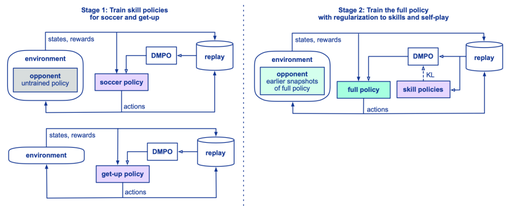
Figure 2 | Agent training setup.We trained agents in two stages. In the first stage (left), we train a separate soccer skill and get-up skill (Stage 1: Skill Training). In the second stage (right), we distill these two skills into a single agent that can both get up from the ground and play soccer (Stage 2: Distillation and Self-Play). The second stage also incorporates self-play: the opponent is uniformly randomly sampled from saved policy snapshots from earlier in training. We found that this two-stage approach leads to qualitatively better behavior and improved sim-to-real transfer, compared to training an agent from scratch for the full 1v1 soccer task.
Original paper · CC BY 4.0 · Extracted the figure area from page 3 of the original PDF.Why humanoid soccer control is hard
Learned control has advanced most on quadrupeds, where deep RL has produced locomotion, fall recovery and basic soccer skills such as dribbling and shooting. Bipeds and humanoids have received much less attention, because they bring stability and safety problems, more degrees of freedom and fewer suitable robots. Earlier learned humanoid work mostly targeted single skills such as walking or stair climbing, and the strongest humanoid controllers rely on model-based predictive control, which narrows what they can do.
This study instead learns full-body control for a longer task, a simplified one-versus-one soccer game played by Robotis OP3 robots. The policy is trained in a simulated pitch that is 5m long by 4m wide, then run on a matching real pitch, using proprioceptive and motion capture observations. Transfer is zero-shot, so the policy uses no real-robot training data, and the authors list reliance on sim-to-real transfer alone as a limitation.
Two stages: skills first, then one agent
The first stage trains two skill policies in simulation, a soccer skill that scores against an untrained opponent and a get-up skill that brings the robot back to standing. Figure 2 summarizes the two stages. Training end-to-end without these skills led to one of two degenerate outcomes, either rolling on the ground or standing upright without learning to score.
The second stage distills both skills into a single agent, which then trains against an opponent drawn from its own earlier snapshots. The opponent is sampled uniformly from saved snapshots, and only the earliest quarter of the snapshots enters the pool, which the authors found made training more stable. Because mixing opponents makes the critic's inputs partly ambiguous, the critic is also conditioned on an integer identity of the opponent.
How the skill regularization is switched
Policy distillation adds a regularization term that pulls the agent's policy towards the output of a skill policy. The two skills are useful in disjoint sets of states: the soccer skill when the robot is upright, the get-up skill otherwise, so each state is regularized to only one of them. In the policy improvement step, the Q-value term is replaced by a weighted combination of the expected Q-value and a KL term toward the relevant skill, with weight \(\lambda_s\) for upright states \(\mathcal{U}\) and \(\lambda_g\) otherwise.
The weights are adapted instead of fixed, so regularization is removed once the predicted Q-values exceed the thresholds \(Q_s\) and \(Q_g\). The weight \(\lambda_s\) is updated by stochastic gradient descent on a cost equal to \(\lambda_s\) times the difference between the expected Q-value and \(Q_s\), passed through a softplus and clipped to the interval from 0 to 1.
This lets the agent move beyond simply scheduling the two skills and refine the skills themselves.
Measures that carry the policy to hardware
The agent acts at 40Hz and outputs 20 joint position set points, which are clipped to a manually chosen range and then smoothed by an exponential action filter \(u_t = 0.8u_{t-1} + 0.2a_t\) before reaching the PID controllers. System identification fitted the actuator model with a sinusoidal drive of a loaded motor, giving final values of 1.084 Nm/(rad/s) for damping, 4.1 Nm for maximum torque and 21.1 N/rad for proportional gain.
The authors kept position control because it hides model mismatch behind fast feedback, and direct current control produced a gap too large for zero-shot transfer to work.
Domain randomization re-samples a small set of parameters at the start of each episode: floor friction from 0.5 to 1.0, joint angular offsets of ±2.9 degrees, IMU orientation up to 2 degrees and position up to 5mm, an external mass up to 0.5kg on the torso, and observation delays of 10 to 50ms. Random impulses of 5 to 15Nm lasting 0.05 to 0.15s hit a random point on the torso every 1 to 3s.
Agents trained without randomization and perturbations fell every one or two steps on hardware and could not score.
Two shaping terms target hardware damage: a penalty on time-integrated torque peaks above 5Nm at the knees, which had broken gears, and a reward for staying within 11.5 degrees of upright, which curbs a forward lean that caused falls.
Hardware results against scripted controllers
In the get-up-and-shoot set piece, the robot scored in 29 of 50 real episodes (58%) and in 35 of 50 simulated episodes (70%). The robot got up and kicked the ball in every real episode, and the mean time to first touch was 4.7s on hardware and 4.6s in simulation.
In Table 1 the real-robot walking speed is 0.57m/s for the learned policy and 0.20m/s for the scripted baseline, and the get-up time is 0.93s against 2.52s. The baseline walking and turning controllers were tuned by grid search over step length, step angle and step time on a real robot, while the kick and get-up controllers have no tunable parameters.
Without a run-up, the learned kick reached 2.02m/s on the real robot against 2.07m/s for the scripted kick, while with a run-up it averaged 2.77m/s and reached a maximum of 3.4m/s across episodes. The gap between simulation and hardware is small for each behavior: walking was 13% faster on the real robot, turning 11% slower, get-up 28% slower and kicking 5% slower.
The authors read this as no extreme sim-to-real gap in any behavior, though the gap to the scripted baseline is much larger.
The forward running speed of 0.57m/s and turning speed of 2.85rad/s on the real OP3 are higher than the 0.45m/s and 2.01rad/s reported for simulated OP3 parametric controllers in prior work. The authors note that those results are not precisely comparable because of methodological differences.
Set pieces that probe context sensitivity
In the interception set piece the opponent starts with the ball and stays still, and over 10 trials the agent first moved onto the line between the ball and its own goal before turning to approach. Some RoboCup teams implement this defensive tactic by hand, whereas here the policy found it through the task reward alone. In 10 control trials with the opponent away from the ball, the agent approached the ball directly.
In the opponent-obstacle set piece the opponent stands between the ball and the agent, and the agent walked around the opponent in all 10 trials and scored in 9 of them. In 14 control trials with the opponent to one side, the agent approached directly and scored in 13 of the 14.
The authors compare the short steps with human defensive play and say the reason for them is unclear in this environment.
In the turn-and-kick set piece the agent turned, walked around the ball, turned again and kicked in roughly 10 footsteps, with one shorter penultimate step.
What the critic values
The critic is probed by fixing a synthetic state and varying one input at a time, such as the ball velocity, the opponent position or the agent position. High predicted value appears for ball velocities directed toward the goal and for velocities that keep the ball within the agent's control.
What breaks without skill regularization
The authors attribute this to an exploration problem that is too hard when the agent must learn to get up and play soccer at the same time. The authors describe the two-stage approach as qualitatively better in behavior and in sim-to-real transfer than training from scratch on the full 1v1 task.
Limitations
The robots degraded over time, mainly from loose hip joints and miscalibrated encoders, so maintenance routines were needed regularly. The servos were not modeled in simulation, and battery charge strongly affected behavior, limiting operation to 5 to 10 minutes per charge in practice.
The pipeline relies on domain-specific knowledge for reward design, for hand-designed key poses in the get-up skill and for choosing the correct skill in each state during distillation. Self-play sometimes learned unstably, and the authors suggest that a population-based scheme might help, which was not tried here.
Paper info
- Authors
- Tuomas Haarnoja, Ben Moran, Guy Lever, Sandy H. Huang, Dhruva Tirumala, Jan Humplik, Markus Wulfmeier, Saran Tunyasuvunakool, Noah Y. Siegel, Roland Hafner, Michael Bloesch, Kristian Hartikainen, Arunkumar Byravan, Leonard Hasenclever, Yuval Tassa, Fereshteh Sadeghi, Nathan Batchelor, Federico Casarini, Stefano Saliceti, Charles Game, Neil Sreendra, Kushal Patel, Marlon Gwira, Andrea Huber, Nicole Hurley, Francesco Nori, Raia Hadsell, Nicolas Heess
- Venue
- arXiv · Preprint
- First published
- 2023-4-26
- Added
- 2026-11-6
- Updated
- 2024-4-11
- Version
- v2
- arXiv
- 2304.13653
- DOI
- 10.1126/scirobotics.adi8022
- Category
- cs.RO · cs.AI · cs.LG
- Original paper terms
- CC BY 4.0
- What we show
- Paper info, commentary and permitted figures from the original paper
AI commentary is a separate explanation from the original paper and may contain errors. The original paper and figures follow each source's terms of use and any rights noted separately.
Abstract
We investigate whether Deep Reinforcement Learning (Deep RL) is able to synthesize sophisticated and safe movement skills for a low-cost, miniature humanoid robot that can be composed into complex behavioral strategies in dynamic environments. We used Deep RL to train a humanoid robot with 20 actuated joints to play a simplified one-versus-one (1v1) soccer game. The resulting agent exhibits robust and dynamic movement skills such as rapid fall recovery, walking, turning, kicking and more; and it transitions between them in a smooth, stable, and efficient manner. The agent's locomotion and tactical behavior adapts to specific game contexts in a way that would be impractical to manually design. The agent also developed a basic strategic understanding of the game, and learned, for instance, to anticipate ball movements and to block opponent shots. Our agent was trained in simulation and transferred to real robots zero-shot. We found that a combination of sufficiently high-frequency control, targeted dynamics randomization, and perturbations during training in simulation enabled good-quality transfer. Although the robots are inherently fragile, basic regularization of the behavior during training led the robots to learn safe and effective movements while still performing in a dynamic and agile way -- well beyond what is intuitively expected from the robot. Indeed, in experiments, they walked 181% faster, turned 302% faster, took 63% less time to get up, and kicked a ball 34% faster than a scripted baseline, while efficiently combining the skills to achieve the longer term objectives.
Quote from the paper
Tuomas Haarnoja, Ben Moran, Guy Lever, Sandy H. Huang, Dhruva Tirumala, Jan Humplik, Markus Wulfmeier, Saran Tunyasuvunakool, Noah Y. Siegel, Roland Hafner, Michael Bloesch, Kristian Hartikainen, Arunkumar Byravan, Leonard Hasenclever, Yuval Tassa, Fereshteh Sadeghi, Nathan Batchelor, Federico Casarini, Stefano Saliceti, Charles Game et al. (2023). Learning Agile Soccer Skills for a Bipedal Robot with Deep Reinforcement Learning. arXiv:2304.13653v2. https://doi.org/10.1126/scirobotics.adi8022
BibTeX
@article{haarnoja2023learning,
  title = {{Learning Agile Soccer Skills for a Bipedal Robot with Deep Reinforcement Learning}},
  author = {Tuomas Haarnoja and Ben Moran and Guy Lever and Sandy H. Huang and Dhruva Tirumala and Jan Humplik and Markus Wulfmeier and Saran Tunyasuvunakool and Noah Y. Siegel and Roland Hafner and Michael Bloesch and Kristian Hartikainen and Arunkumar Byravan and Leonard Hasenclever and Yuval Tassa and Fereshteh Sadeghi and Nathan Batchelor and Federico Casarini and Stefano Saliceti and Charles Game and Neil Sreendra and Kushal Patel and Marlon Gwira and Andrea Huber and Nicole Hurley and Francesco Nori and Raia Hadsell and Nicolas Heess},
  year = {2023},
  eprint = {2304.13653},
  archivePrefix = {arXiv},
  doi = {10.1126/scirobotics.adi8022},
  url = {https://arxiv.org/abs/2304.13653v2}
}