논문 해설
Learning Agile Soccer Skills for a Bipedal Robot with Deep Reinforcement Learning
심층 강화학습을 이용한 이족 보행 로봇의 민첩한 축구 기술 학습
- 연구 문제 저비용 소형 휴머노이드가 동적인 1v1 축구에서 민첩한 전신 기술을 학습으로 얻을 수 있는지 검증합니다.
- 연구 방법 골 득점 스킬과 일어서기 스킬을 따로 학습한 뒤 정책 증류와 자기 대전으로 하나의 에이전트에 결합하고, 시뮬레이션 무작위화를 거쳐 실제 OP3에 배포합니다.
- 주요 결과 실제 로봇 세트피스 득점 성공률은 58%이며 시뮬레이션은 70%입니다. 학습 정책은 스크립트 기준선보다 보행과 회전이 빠르고 일어서기 시간이 짧았습니다.
저비용 휴머노이드의 민첩한 협응 문제
이 논문은 저비용 소형 휴머노이드 로봇이 동적인 1대1 축구에서 넘어짐 복구, 걷기, 회전, 차기 같은 기술을 스스로 익힐 수 있는지를 다룹니다. 기존 학습 기반 연구는 사족보행 로봇에서 많이 이루어졌고, 휴머노이드에서는 걷기나 계단 오르기처럼 분리된 기술을 주로 다루었습니다. 저자들은 이를 장기 과제를 포함한 전신 제어로 확장하려고 합니다. 특히 로봇이 쉽게 손상되는 점과 시뮬레이션과 실제 환경의 차이가 함께 문제가 됩니다. 이 연구의 범위는 OP3 로봇의 단순화된 1v1 축구 과제입니다.
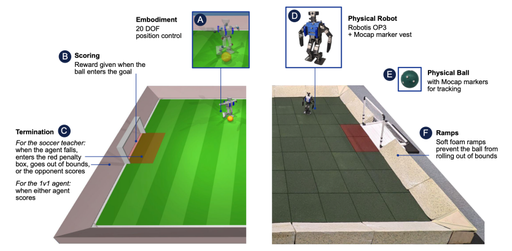
Figure 1 | The robot soccer environment.We created matching simulated (left) and real (right) soccer environments. The pitch is 5m long by 4m wide. The real environment was also equipped with a motion capture (mocap) system for tracking the two robots and the ball.
원문 · CC BY 4.0 · Tuomas Haarnoja, Ben Moran, Guy Lever, Sandy H. Huang, Dhruva Tirumala, Jan Humplik, Markus Wulfmeier, Saran Tunyasuvunakool, Noah Y. Siegel, Roland Hafner, Michael Bloesch, Kristian Hartikainen, Arunkumar Byravan, Leonard Hasenclever, Yuval Tassa, Fereshteh Sadeghi, Nathan Batchelor, Federico Casarini, Stefano Saliceti, Charles Game, Neil Sreendra, Kushal Patel, Marlon Gwira, Andrea Huber, Nicole Hurley, Francesco Nori, Raia Hadsell, Nicolas Heess · Learning Agile Soccer Skills for a Bipedal Robot with Deep Reinforcement Learning · 원문 그림 인용 · 원본 PDF 2쪽에서 그림 영역을 추출했습니다.두 단계 학습 파이프라인
학습은 두 단계로 진행됩니다. 1단계에서는 골을 넣는 축구 스킬과 바닥에서 일어서는 스킬을 각각 따로 학습합니다. 2단계에서는 정책 증류로 두 스킬을 하나의 1v1 에이전트에 결합하고, 이전 정책 스냅샷을 상대로 자기 대전을 수행합니다. 증류는 스킬 정책과의 KL 정규화 항으로 구현되며, 일어서기 상태와 그 밖의 상태에서 각각 다른 스킬을 따르도록 λ 가중치를 조정합니다. 저자들은 바로 전체 과제를 학습하면 나쁜 국소 최적해에 빠진다고 보고합니다. 알고리즘은 분포형 크리틱을 쓰는 MPO 계열인 DMPO입니다.
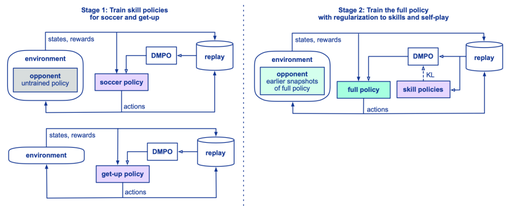
Figure 2 | Agent training setup.We trained agents in two stages. In the first stage (left), we train a separate soccer skill and get-up skill (Stage 1: Skill Training). In the second stage (right), we distill these two skills into a single agent that can both get up from the ground and play soccer (Stage 2: Distillation and Self-Play). The second stage also incorporates self-play: the opponent is uniformly randomly sampled from saved policy snapshots from earlier in training. We found that this two-stage approach leads to qualitatively better behavior and improved sim-to-real transfer, compared to training an agent from scratch for the full 1v1 soccer task.
원문 · CC BY 4.0 · Tuomas Haarnoja, Ben Moran, Guy Lever, Sandy H. Huang, Dhruva Tirumala, Jan Humplik, Markus Wulfmeier, Saran Tunyasuvunakool, Noah Y. Siegel, Roland Hafner, Michael Bloesch, Kristian Hartikainen, Arunkumar Byravan, Leonard Hasenclever, Yuval Tassa, Fereshteh Sadeghi, Nathan Batchelor, Federico Casarini, Stefano Saliceti, Charles Game, Neil Sreendra, Kushal Patel, Marlon Gwira, Andrea Huber, Nicole Hurley, Francesco Nori, Raia Hadsell, Nicolas Heess · Learning Agile Soccer Skills for a Bipedal Robot with Deep Reinforcement Learning · 원문 그림 인용 · 원본 PDF 3쪽에서 그림 영역을 추출했습니다.시뮬레이션 대 실제 전이와 강건화
정책은 시뮬레이션에서 학습한 뒤 실제 로봇에 제로샷으로 배포됩니다. 도메인 무작위화로 바닥 마찰, 관절 각도 오프셋, IMU 자세, 외부 질량, 관측 지연을 에피소드마다 바꾸고, 몸통에 임펄스 교란을 가합니다. 행동은 40Hz로 출력되며 지수 행동 필터를 거친 뒤 PID 제어기로 관절을 구동합니다. 저자들은 무작위화와 교란이 없는 에이전트는 실제 로봇에서 거의 넘어지고 득점하지 못했다고 보고합니다.
세트피스와 기준선 비교
득점 세트피스에서 시뮬레이션은 50회 중 35회 득점(70%), 실제 로봇은 50회 중 29회 득점(58%)으로 보고됩니다. 실제 환경에서도 매번 일어나 공을 찼으며, 전이로 인한 성능 저하는 있었지만 대부분 득점했습니다. 스크립트 기준선과의 비교에서 학습 정책은 보행 속도가 더 빠르고 회전 속도가 더 높으며 일어서기 시간이 짧았습니다. 킥 속도는 달리기 접근이 있을 때 더 높게 보고되었습니다. 이 결과는 OP3의 특정 실험 설정에서 얻은 것입니다.
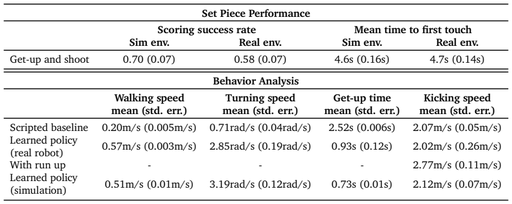
Table 1 | Performance in the get-up-and-shoot set piece and at specific behaviors. Performance in simulation and on the real robot are compared, and the learned behavior is compared to the scripted baseline at the four behaviors. Values in braces are standard errors. The learned policy’s mean kicking power was roughly equivalent to the scripted behavior from a standing pose, but with an additional run up approach to the ball the learned policy achieved a more powerful kick.
원문 · CC BY 4.0 · Tuomas Haarnoja, Ben Moran, Guy Lever, Sandy H. Huang, Dhruva Tirumala, Jan Humplik, Markus Wulfmeier, Saran Tunyasuvunakool, Noah Y. Siegel, Roland Hafner, Michael Bloesch, Kristian Hartikainen, Arunkumar Byravan, Leonard Hasenclever, Yuval Tassa, Fereshteh Sadeghi, Nathan Batchelor, Federico Casarini, Stefano Saliceti, Charles Game, Neil Sreendra, Kushal Patel, Marlon Gwira, Andrea Huber, Nicole Hurley, Francesco Nori, Raia Hadsell, Nicolas Heess · Learning Agile Soccer Skills for a Bipedal Robot with Deep Reinforcement Learning · 원문 그림 인용 · 원본 PDF 5쪽에서 그림 영역을 추출했습니다.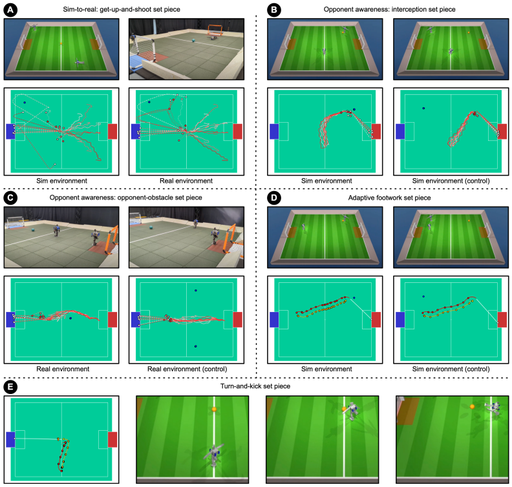
Figure 5 | Behavior analysis. A-C: Set pieces.Top rows: Example initializations for the set piece tasks in sim and on the real robot. Second rows: Overlayed plots of the 10 trajectories collected from the set piece experiments showing the robot trajectory before kicking (solid lines), after kicking (dotted lines), the ball trajectory (dashed lines), final ball position (white circle), final robot position (red-pink circles) and opponent position (blue circle). Each red-pink shade corresponds to one of the 10 trajectories.D: Adaptive footwork set piece.Right foot trajectory (orange), left foot trajectory (red), ball trajectory (white), point of the kick (yellow), and footsteps highlighted with dots.E: Turn-and-kick set piece.Right 3: a sequence of frames from the set piece. Left: a plot of the footsteps from the corresponding trajectory. The agent turned, walked approximately 2m, turned, kicked, and finally balanced using 10 footsteps. Please refer to Behavior Analysis for a discussion of these results.
원문 · CC BY 4.0 · Tuomas Haarnoja, Ben Moran, Guy Lever, Sandy H. Huang, Dhruva Tirumala, Jan Humplik, Markus Wulfmeier, Saran Tunyasuvunakool, Noah Y. Siegel, Roland Hafner, Michael Bloesch, Kristian Hartikainen, Arunkumar Byravan, Leonard Hasenclever, Yuval Tassa, Fereshteh Sadeghi, Nathan Batchelor, Federico Casarini, Stefano Saliceti, Charles Game, Neil Sreendra, Kushal Patel, Marlon Gwira, Andrea Huber, Nicole Hurley, Francesco Nori, Raia Hadsell, Nicolas Heess · Learning Agile Soccer Skills for a Bipedal Robot with Deep Reinforcement Learning · 원문 그림 인용 · 원본 PDF 8쪽에서 그림 영역을 추출했습니다.절제 실험과 학습 전략의 효과
희소 보상만 사용한 변형은 공을 굴려 차는 국소 최적해에 머물렀고 일어서기와 걷기를 충분히 배우지 못했습니다. 저자들은 일어서기 스킬을 먼저 학습하고 결합하는 방식이 이 탐색 문제를 줄인다고 해석합니다. 자기 대전 대신 고정된 상대만 쓴 변형은 자기 대전 방식보다 평가 성능이 약간 낮았고, 모든 스냅샷을 쓴 변형은 학습이 덜 안정적이었습니다. 이 절제 결과는 각 구성요소를 유지했을 때의 효용을 보여 주며, 모든 요소가 항상 기여한다는 결론은 아닙니다.
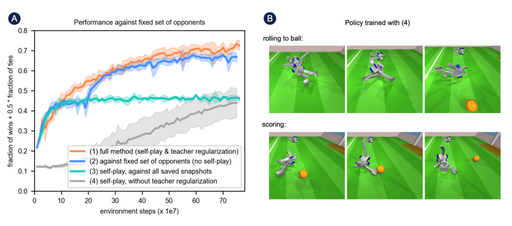
Figure 7 | Comparison against ablations. A:The plot compares our full method (1) against ablations: at regular intervals across training, each policy was evaluated against a fixed set of six opponents, playing 100 matches against each. The first player to score in the episode wins the match; if neither player scores within 50 seconds, then it is a tie. The y-axis corresponds to the fraction of wins (with a draw counting as 1/2 of a win), averaged across the six opponents. We ran five seeds per method, and the error bars show 95% confidence intervals. Our full method (1) includes both self-play and regularization to pre-trained skills. In (2), instead of self-play, agents are trained against the same fixed set of six opponents as in the evaluation. Interestingly, agents trained with self-play in (1) performed better when evaluated against this fixed set of opponents, despite not playing directly against them during training. In (3), self-play consists of training against all saved snapshots, rather than the first quarter. This led to less stable learning and converged to worse performance. In (4), agents are trained without regularization to skills and without reward shaping.B: Two sequences of frames taken from an agent trained with (4). These agents did not learn to get up from the ground; instead, they learned to score by rolling to the ball and knocking it into the goal.
원문 · CC BY 4.0 · Tuomas Haarnoja, Ben Moran, Guy Lever, Sandy H. Huang, Dhruva Tirumala, Jan Humplik, Markus Wulfmeier, Saran Tunyasuvunakool, Noah Y. Siegel, Roland Hafner, Michael Bloesch, Kristian Hartikainen, Arunkumar Byravan, Leonard Hasenclever, Yuval Tassa, Fereshteh Sadeghi, Nathan Batchelor, Federico Casarini, Stefano Saliceti, Charles Game, Neil Sreendra, Kushal Patel, Marlon Gwira, Andrea Huber, Nicole Hurley, Francesco Nori, Raia Hadsell, Nicolas Heess · Learning Agile Soccer Skills for a Bipedal Robot with Deep Reinforcement Learning · 원문 그림 인용 · 원본 PDF 19쪽에서 그림 영역을 추출했습니다.한계와 남은 과제
저자들은 모션 캡처 기반 공 추적이 마커 감지 문제와 벽에 의한 가림 때문에 어렵다고 보고합니다. 제어 주기 25ms는 실제로 종종 시간 안에 행동을 만들지 못해 성능에 영향을 주었다고 밝힙니다. 시뮬레이션은 서보 모터를 이상적 액추에이터로 근사했으며, 배터리 상태에 따라 행동이 민감하여 한 번 충전에 운용 시간이 5~10분 정도였다고 보고합니다. 원시 시각 입력 기반 연구는 예비 결과로 제시되었습니다.
논문 정보
- 저자
- Tuomas Haarnoja, Ben Moran, Guy Lever, Sandy H. Huang, Dhruva Tirumala, Jan Humplik, Markus Wulfmeier, Saran Tunyasuvunakool, Noah Y. Siegel, Roland Hafner, Michael Bloesch, Kristian Hartikainen, Arunkumar Byravan, Leonard Hasenclever, Yuval Tassa, Fereshteh Sadeghi, Nathan Batchelor, Federico Casarini, Stefano Saliceti, Charles Game, Neil Sreendra, Kushal Patel, Marlon Gwira, Andrea Huber, Nicole Hurley, Francesco Nori, Raia Hadsell, Nicolas Heess
- 학회·저널
- arXiv · 프리프린트
- 최초 공개일
- 2023년 4월 26일
- 등록일
- 2026년 11월 6일
- 수정일
- 2024년 4월 11일
- 버전
- v2
- arXiv
- 2304.13653
- DOI
- 10.1126/scirobotics.adi8022
- 분류
- cs.RO · cs.AI · cs.LG
- 원문 이용 조건
- CC BY 4.0
- 제공 범위
- 논문 정보, 해설, 허용된 원문 그림
AI 해설은 논문 원문과 별개의 설명이며 오류가 있을 수 있습니다. 원문과 그림은 각 출처의 이용 조건과 따로 표시된 권리를 따릅니다.
초록
We investigate whether Deep Reinforcement Learning (Deep RL) is able to synthesize sophisticated and safe movement skills for a low-cost, miniature humanoid robot that can be composed into complex behavioral strategies in dynamic environments. We used Deep RL to train a humanoid robot with 20 actuated joints to play a simplified one-versus-one (1v1) soccer game. The resulting agent exhibits robust and dynamic movement skills such as rapid fall recovery, walking, turning, kicking and more; and it transitions between them in a smooth, stable, and efficient manner. The agent's locomotion and tactical behavior adapts to specific game contexts in a way that would be impractical to manually design. The agent also developed a basic strategic understanding of the game, and learned, for instance, to anticipate ball movements and to block opponent shots. Our agent was trained in simulation and transferred to real robots zero-shot. We found that a combination of sufficiently high-frequency control, targeted dynamics randomization, and perturbations during training in simulation enabled good-quality transfer. Although the robots are inherently fragile, basic regularization of the behavior during training led the robots to learn safe and effective movements while still performing in a dynamic and agile way -- well beyond what is intuitively expected from the robot. Indeed, in experiments, they walked 181% faster, turned 302% faster, took 63% less time to get up, and kicked a ball 34% faster than a scripted baseline, while efficiently combining the skills to achieve the longer term objectives.
원문 인용
Tuomas Haarnoja, Ben Moran, Guy Lever, Sandy H. Huang, Dhruva Tirumala, Jan Humplik, Markus Wulfmeier, Saran Tunyasuvunakool, Noah Y. Siegel, Roland Hafner, Michael Bloesch, Kristian Hartikainen, Arunkumar Byravan, Leonard Hasenclever, Yuval Tassa, Fereshteh Sadeghi, Nathan Batchelor, Federico Casarini, Stefano Saliceti, Charles Game et al. (2023). Learning Agile Soccer Skills for a Bipedal Robot with Deep Reinforcement Learning. arXiv:2304.13653v2. https://doi.org/10.1126/scirobotics.adi8022
BibTeX
@article{haarnoja2023learning,
  title = {{Learning Agile Soccer Skills for a Bipedal Robot with Deep Reinforcement Learning}},
  author = {Tuomas Haarnoja and Ben Moran and Guy Lever and Sandy H. Huang and Dhruva Tirumala and Jan Humplik and Markus Wulfmeier and Saran Tunyasuvunakool and Noah Y. Siegel and Roland Hafner and Michael Bloesch and Kristian Hartikainen and Arunkumar Byravan and Leonard Hasenclever and Yuval Tassa and Fereshteh Sadeghi and Nathan Batchelor and Federico Casarini and Stefano Saliceti and Charles Game and Neil Sreendra and Kushal Patel and Marlon Gwira and Andrea Huber and Nicole Hurley and Francesco Nori and Raia Hadsell and Nicolas Heess},
  year = {2023},
  eprint = {2304.13653},
  archivePrefix = {arXiv},
  doi = {10.1126/scirobotics.adi8022},
  url = {https://arxiv.org/abs/2304.13653v2}
}